Workplace policy has changed fast, then settled into an uneasy split. In March 2026, 22.6% of employed people in the United States teleworked or worked at home for pay, according to the U.S. Bureau of Labor Statistics, a share that has barely moved in a year. Meanwhile, employers keep tightening attendance rules. That gap shows why a simple return is not enough.
RTO, short for return to office, is shorthand for a policy that sets how many days staff must be on site. Amazon, Microsoft, Instagram, Airbus, and Paramount Skydance show how trust, commute costs, productivity data, and employee needs shape results.
The best policy connects time together with clear goals, real collaboration, and measurable outcomes. You will learn how to assess return office mandates without harming engagement or losing top talent.
Key Takeaways
- Attendance alone does not prove productivity.
- Employee expectations should guide workplace decisions.
- Commute costs affect morale and retention.
- Clear goals make flexible work easier to manage.
- Trust and collaboration outperform rigid mandates.
Return-to-Office Mandates Explained in 7 Minutes (Video)
Prefer to watch? In just 7 minutes, this video shows you what the data says about office mandates, what forcing people back really costs, and how to build a hybrid policy your best people won’t quit over.
Why Companies Are Pushing Return-to-Office Mandates
Leaders view shared time as a way to strengthen culture, speed decisions, and support innovation. KPMG’s 2024 CEO Outlook, based on 1,300 chief executives, found 83% expected full-time attendance within three years, up from 64% a year earlier. That reflects executive belief, not proof that every role needs the same structure.
The 2026 Wave of Tighter Rules
The push did not stop with Amazon’s five-day rule in January 2025. Instagram, the photo and video app owned by Meta, told U.S. staff with assigned desks to come in five days a week from 2 February 2026, while office-assigned Facebook and WhatsApp employees stayed on three days. Microsoft began requiring three days on site for staff living within 50 miles of an office, starting in the Seattle region on 23 February 2026. Home Depot moved corporate teams to five days in April 2026, and PNC Financial followed in early May.
The market has not converged on full attendance. Flex Index tracks the stated work-location policies of roughly 9,000 U.S. companies, together with Boston Consulting Group. In the third quarter of 2025 it found that 33% required full-time office work. Among Fortune 100 firms, 71% still offered some form of flexibility.
Executive Concerns About Culture and Collaboration
Amazon’s Andy Jassy says teams connect better and solve trade-offs faster in person. Disney’s Bob Iger links physical connection to creativity and mentoring. EY’s Carmine Di Sibio warned that culture was “drying up” with less attendance. The concern is not imaginary. Gartner surveyed 18,000 workers worldwide and published the results in October 2025. Highly engaged employees fell from 33.2% in the third quarter of 2022 to 25.5% in the second quarter of 2025. The open question is whether desk time is the cure, or whether the answer lies in giving employees a real voice in decisions.
Space, Management Habits, and Industry Needs
Cost also shapes policy, and it cuts both ways. Bloomberg reported in June 2025 that HSBC’s return-to-office push could add roughly $200 million a year in real estate costs, working against the bank’s own savings plan. Smart mandates match tasks and teams rather than copy a competitor’s press release.
Why Employees Resist Rigid Office Mandates
Employees do not reject collaboration. They question whether a fixed location improves their work. For many, the issue is the cost of getting there and the loss of control over the day.
Commutes, Caregiving Costs, and Lost Flexibility
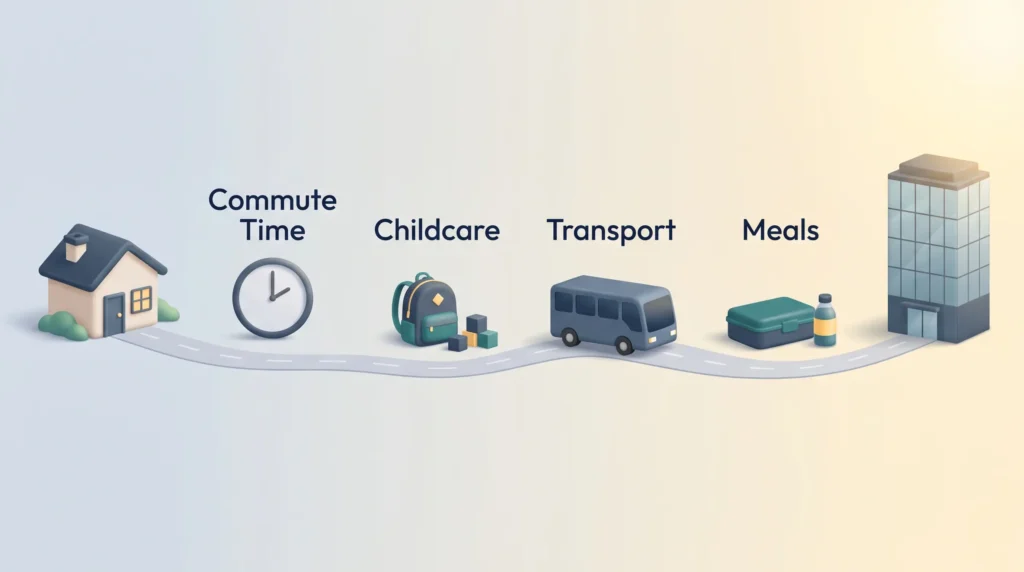
Pew Research’s 2024 study found that longer commutes, childcare, transport, and meal costs drive resistance. These pressures cut personal time and weaken work-life balance, and parents and caregivers lose the most flexibility. A flexible PTO policy does not offset ten extra hours a week in traffic.
Remote work also brought benefits for mental health and autonomy, and it widened access to stable employment for people with disabilities. Where pressure is already high, employers get further with resilience training and practical help to manage workplace stress than with another attendance rule.
Trust, Autonomy, and Modern Work Expectations
When Yahoo CEO Marissa Mayer ordered a broad return in 2013, the argument was that togetherness supported interaction and experience. Many employees now see that as an older model of workplace culture, because they have since delivered results without constant supervision.
Commuting five days a week to join online meetings can feel like a “Zoom cage.” That is the common complaint: you travel to a desk, then spend the day on video with colleagues in other buildings. Clear norms help more than proximity does, which is why teams that set instant messaging boundaries tend to feel calmer wherever they sit.
What Employee Data Reveals About Remote and Hybrid Work
Reliable numbers beat workplace assumptions. A Blind survey of Amazon employees in September 2024, reported by CNBC and Fortune, found 73% were considering leaving after the five-day mandate. Yet the national picture barely moved. Gallup’s May 2026 figures for remote-capable jobs show 52% hybrid, 26% exclusively remote, and 22% fully on site, unchanged from its previous reading.
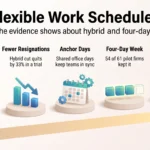
The best causal evidence comes from a randomized trial, meaning teams were assigned to schedules at random rather than choosing for themselves. That rules out the objection that flexible teams simply attract better people. Nicholas Bloom and colleagues studied 1,612 Trip.com employees in Shanghai and published the results in Nature in June 2024. Two remote days a week cut resignations among non-managers by 33%, with no measurable effect on productivity or promotions.
Gartner surveys of knowledge workers in 2023 pointed the same way. Intent to stay was 16% lower among high performers at employers with strict RTO requirements. That is double the 8% drop seen among average employees. Women and millennials were also less likely to stay. Productivity, retention, engagement, and benefits should guide hybrid decisions.
- Compare employee survey results with output and retention.
- Track productivity by goals, not presence.
- Check whether hybrid work improves access to talent.
Executive conviction runs ahead of that evidence. Modern employee experience platforms make listening easier than it was in 2020. They also help you catch proximity bias, the habit of rewarding the people a manager sees most often.
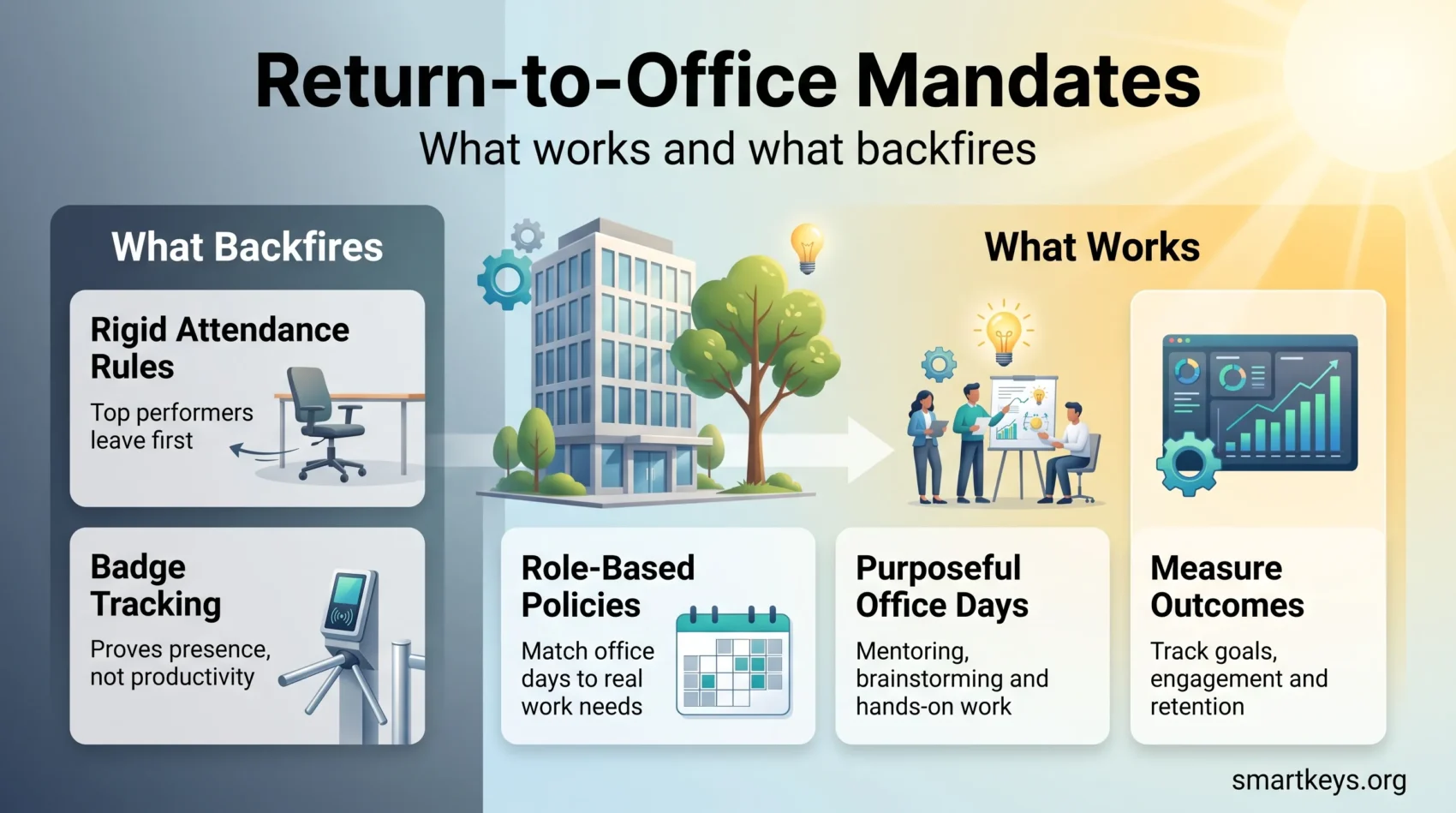
What Backfires When You Force Employees Back to the Office
A rigid attendance shift can settle a visibility concern while creating larger business risks. When a policy pushes people to resign, the cost reaches far beyond an empty desk.
Turnover, Disengagement, and the Loss of Top Talent
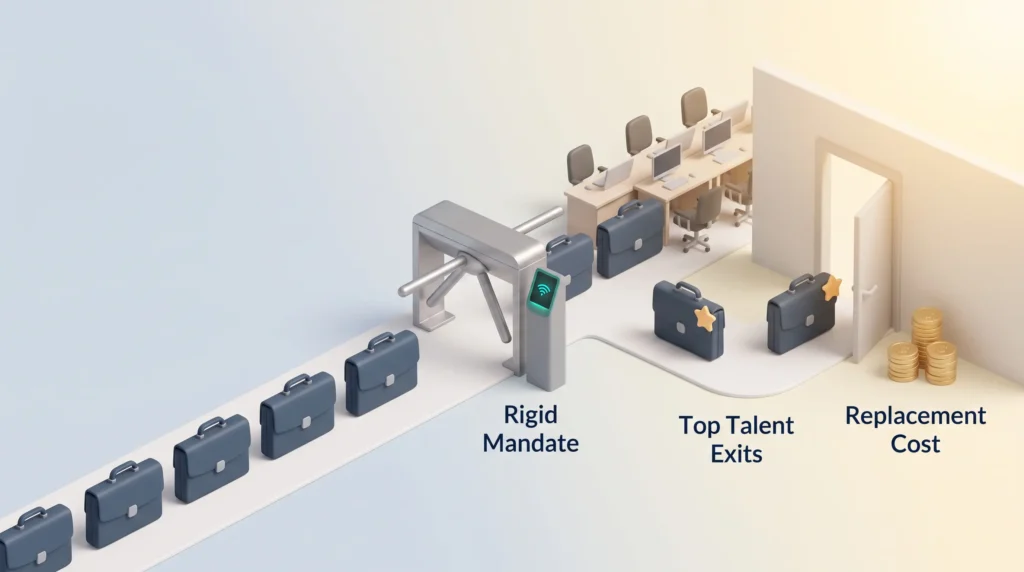
Gallup estimates that replacing one employee costs between one-half and two times their annual salary. For someone earning $100,000, that is $50,000 to $200,000 before you count lost knowledge. Paramount Skydance shows how quickly expenses grow. About 600 employees accepted voluntary buyouts rather than comply with its five-day mandate, and company filings reported in November 2025 placed the cost near $185 million.
That case deserves an honest caveat, because it is cited constantly as proof that mandates backfire. Paramount was already planning to cut roughly 10% of its workforce after the Skydance merger, targeting $2 billion in savings, and about 1,000 layoffs followed in October 2025 with a similar number expected after. Some commentators read the five-day rule as a way to thin headcount voluntarily before involuntary cuts began. The number still matters, but for a subtler reason than the headline suggests: voluntary buyouts are self-selecting. The people confident enough to take a package and walk are rarely the ones an employer would have chosen to lose.
PNC employees also reported long commutes and disruption after a five-days-per-week schedule began in May 2026. That pressure weakens trust and pushes top talent toward employers with more choice. It also shrinks the pool you can rehire from, one reason corporate alumni networks have become a serious talent channel.
What the Airbus Reversal Teaches About Rollout Risk
Airbus planned to raise its white-collar requirement to four days on site from September 2026, cutting home working from two days a week to one. Staff in Spain struck on and off from July 2026, with roughly 40% of the company’s 14,000 Spanish employees taking part, and protests spread to France and Britain.
By 21 August 2026, Airbus had stepped back. Managers may now let teams keep the existing two remote days, and the company said it would make the transition more gradually. Two lessons follow. Where employees are organized, a mandate is a negotiation rather than an announcement. And a policy withdrawn under pressure costs more credibility than the flexibility it tried to remove.
Why Attendance Tracking Can Create a Culture of Compliance
Samsung introduced a tracking tool for some U.S. semiconductor employees to address “coffee badging,” the practice of badging in, showing your face, and leaving soon afterwards. Badge scans confirm presence, but they cannot prove productivity or meaningful collaboration. Strong companies measure outcomes, not compliance. Before expanding return office mandates, ask whether the workload is the real problem. Teams drowning in tool overload or chronic digital fatigue will not be fixed by a badge reader.
- Review turnover and engagement after each policy change.
- Protect culture by giving employees a clear reason to gather.
How to Build a Fair Return-to-Office Policy
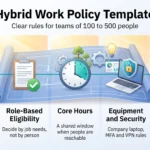
A fair attendance plan starts with the job, not a blanket rule. Match each role to client contact, equipment, security, and collaboration needs. That pairs naturally with skills-first hiring, which judges people by what they can do rather than where they sit. If you are drafting the document itself, our hybrid work policy template covers the clauses most rollouts forget.
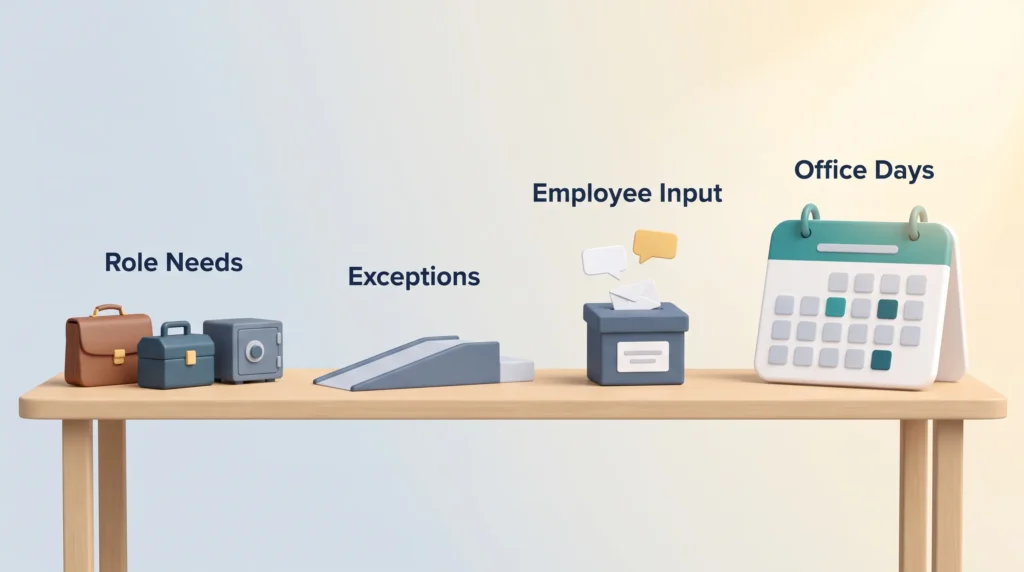
Evaluate Requirements by Role Instead of Applying One Rule to Everyone
Microsoft used a 50-mile boundary and set a three-day minimum from February 2026, while exempting roles such as account management, consulting, and field marketing. Teams and managers could choose which days fit their work. EY took another path, asking U.S. tax employees from July 2026 to spend 12 days each month at an office or client site, roughly three days a week on average. Both connect presence to business needs instead of identical schedules.
Set Clear Principles for Flexibility, Accessibility, and Exceptions
Explain who qualifies for adjustments, including caregivers and employees with disabilities, and weigh commute distance, workplace safety, and essential back-office duties. Since the same questions recur hundreds of times during a rollout, an HR chatbot can carry the routine load. Publishing the reasoning behind exceptions follows the logic of pay transparency: people accept rules they can see the basis for.
Gather Employee Input Before Changing Your Office Policy
Survey employees before adopting new RTO mandates. EA gave workers at least 12 weeks’ notice before its three-day hybrid change. Minnesota’s 2025 rule drew union criticism over limited consultation. Listening first can protect trust, culture, and retention. An honest one-on-one check-in often surfaces the real blockers, such as a school run or a two-hour commute, faster than any survey.
How to Make In-Person Work Worth the Commute
Shared days should create value a video call cannot match. Reserve them for mentoring, brainstorming, hard trade-offs, and hands-on work, so presence never becomes a compliance test.
Use Office Days for Collaboration, Mentoring, and Team Connection
Woolworths Australia offers a model for a gradual return office plan. Across its Support Office of roughly 10,000 people, attendance rose in steps during 2025: one day a week from June, two from August, and three from October. Each step gave staff time to rearrange childcare and travel.
Starbucks moved its support-center teams from three to four days a week in October 2025, naming Monday to Thursday as the shared days. For teams spread across countries, real-time translation tools now remove a barrier that used to make shared days feel exclusive.
Coordinate Shared Team Days Without Creating a Zoom Cage
Plan gatherings around active work, not status meetings. Instagram encouraged teams to build prototypes rather than lean on slide decks, and planned to cancel recurring meetings every six months unless they stayed necessary. Protecting uninterrupted time matters just as much, which is the insight behind the maker versus manager schedule. When each visit has a clear purpose, flexibility and collaboration work together.
How to Manage and Measure Hybrid Work Successfully
Good measurement starts with the results your organization needs, not where people sit. A useful framework connects output, quality, deadlines, and cost per employee, then tracks engagement and retention over time.

Focus on Outcomes, Productivity, Engagement, and Retention
Research by Jose Maria Barrero, Nicholas Bloom, and Steven Davis found people put about 40% of the time they save by not commuting back into their jobs. That challenges the idea that remote work means less effort. Compare results by role, project, and team instead of using five days as a proxy for commitment. Where the work itself has changed, AI-driven organizational design is a more useful lever than a seating chart.
- Track productivity through completed goals and quality scores.
- Measure engagement, retention, and unplanned absences.
- Compare client satisfaction and cost per employee.
- Test whether office mandates improve teamwork or only compliance.
Use Visibility Tools Without Losing Trust
Use scheduling tools for planning, but keep flexibility and sound management at the center of the policy. Feedback beats surveillance: AI performance coaching gives people something they can act on, and a company-wide unplug day shows that recovery time is real.
Conclusion
Smart workplace decisions start with evidence, not desk counts. Ignoring employee expectations is expensive. Amazon saw 73% of surveyed staff consider leaving. Paramount Skydance booked $185 million in buyouts, some of it arguably intended. Strikes pushed Airbus to pause its four-day plan. The Trip.com trial points the other way: two remote days cut resignations by a third without denting output.
Before you ask employees back, review each role’s needs, accessibility, and results. Invite feedback, then explain the policy and its exceptions. Meaningful office time should earn the commute. Track engagement and retention, not badge counts.
The best path beyond rigid RTO mandates blends purposeful gatherings, flexible structure, and accountability, so hybrid work strengthens culture and keeps the people you cannot afford to lose.
Listen to the Podcast Episode
Found this useful?
Make SmartKeys a preferred source on Google, and our articles will surface more often in your Top Stories, AI Overviews, and AI Mode.
Add as Preferred Source