Pay transparency means telling people how pay is decided at your company, and what a job actually pays. That can be a salary range in a job advert, a pay band published on the intranet, or a written rule for how a promotion changes someone’s salary.
For years this was optional. In 2026 it mostly is not. Three more US states switch on posting rules this year, and every EU country must have a pay transparency law on its books by 7 June 2026. If you hire in more than one place, the strictest rule in your footprint is effectively your policy.
Key Takeaways
- Eleven states and Washington DC already require a pay range in job postings. Virginia, Maine and Connecticut join them in 2026.
- The EU Pay Transparency Directive must be law in every member state by 7 June 2026, with the first gender pay gap reports due in June 2027.
- Research from Canada and the UK shows transparency narrows the gender pay gap, though the UK effect came from slower pay growth for men.
- Publishing ranges before auditing your existing pay is the fastest way to lose trust.
- Structured pay bands let you disclose the rules without publishing anyone’s individual salary.
What pay transparency actually covers
Compensation is more than salary, so list every part of it: base pay, bonus, commission, equity, and the increase attached to a promotion. Naming each element matters, because most disputes are about the parts nobody wrote down. An employee who knows the bonus is based on team revenue, paid in March and capped at 15% of salary has nothing to argue about. One who only hears “there’s a bonus” fills the gap with rumour.
Pay bands explained
A pay band is a minimum and maximum salary attached to a job level rather than to a person. A mid-level analyst band might run from $72,000 to $94,000, and every analyst at that level sits somewhere inside it depending on experience and performance.
Bands force you to define what separates one level from the next. That definition is what employees want: not a number, but the route to the next number.
Structured ranges versus full disclosure
Structured ranges mean you publish the band and the rules that place someone inside it. Almost every law asks for this and nothing more.
Full disclosure means individual salaries are visible, as at Buffer or in much of the public sector. That is a cultural decision, not a compliance one, and it is very hard to reverse.
Publish the range and the criteria, not each person’s exact number.
A written pay philosophy, kept with your other documented procedures, gives managers one reference to quote instead of improvising.
What the evidence says openness changes
It narrows the gender pay gap, but not always the way you expect
Canadian provinces began publishing public sector salaries above a threshold, including university faculty. Economists Michael Baker, Yosh Halberstam, Kory Kroft, Alexandre Mas and Derek Messacar found this cut the gender pay gap among affected faculty by roughly 20% to 40% (NBER Working Paper 25834).
The UK result carries a warning. Since 2018, British employers with 250 or more staff have had to publish gender pay gap figures. Blundell, Duchini, Simion and Turrell found this closed about 19% of the gap, but mainly by slowing pay growth for men rather than raising women’s pay (American Economic Journal: Economic Policy, 2025).
Plan for that. If your budget does not move, transparency can close a gap by holding people back instead of catching people up. Decide in advance which you are willing to fund.
It lifts wages slightly, including for people who stay
Colorado was the first US state to require ranges in job adverts, from January 2021. David Arnold, Simon Quach and Bledi Taska compared it with other states around that date and found pay roughly 1.3% higher, with the gain reaching existing employees and not just new hires. They found no drop in employment and no sign of employers posting absurdly wide ranges to dodge the rule.
One percent is not dramatic, but it is a real cost. Put it in the business case.
It shortens hiring and steadies pay talks
Indeed’s Hiring Lab found 57.8% of US job postings on its site carried pay information by September 2024, up from 52.2% a year earlier. When the number is in the advert, candidates who would have walked away at offer stage never enter the process.
Internally, a manager with a published band and written criteria can explain a decision instead of defending it. That underpins continuous performance management, and works best where people can question a decision without fear, what researchers call psychological safety.
What goes wrong, and how to plan for it
People find out they are underpaid. That is an existing problem becoming visible. Audit first, fix what you find, then publish.
Undocumented past decisions become evidence. If two people at the same level are paid very differently for reasons nobody recorded, that gap is now on record.
Competitors read your adverts. Refresh market data more often once you post, and decide which roles you will pay above market to protect.
Managers are asked questions they cannot answer. The most common failure, and the most avoidable. Brief them first.
Some people leave. Targeted adjustments help, and so does a visible internal route upward, which is what an internal talent marketplace is for. Pay is only one part of the offer, as our pieces on benefits and retention cover.
US pay transparency laws in 2026
Most states require a range in the job advert itself. A few require it only on request or after an interview.
States requiring a range in job postings
- Colorado (all employers, January 2021), which also requires benefits information and internal notice of promotion opportunities.
- California (15+ employees) and Washington (15+), both January 2023.
- New York (4+ employees, September 2023).
- Hawaii (50+ employees, January 2024).
- District of Columbia (all employers, June 2024) and Maryland (all employers, October 2024).
- Illinois (15+) and Minnesota (30+), both January 2025.
- New Jersey (10+, June 2025), Vermont (5+, July 2025) and Massachusetts (25+, October 2025).
States requiring disclosure on request
Nevada (October 2021) requires a range for candidates who have been interviewed. Rhode Island (January 2023) requires it on request or before an offer.
What is new in 2026 and 2027
- Virginia, 1 July 2026: all employers must state the wage, salary or range in every public and internal posting. Salary history questions are banned, and employees get a private right of action with penalties up to $1,000 for a first violation, $5,000 after that.
- Maine, 29 July 2026: employers with 10 or more staff must list a range in postings, give the range for a current role on request, and keep pay history records for three years after someone leaves.
- Connecticut, 1 October 2026: all employers must put the wage or range plus a description of benefits in internal and external postings. Those with 100 or more staff also need a pay code guide in multiple languages.
- Delaware, 26 September 2027: employers with 26 or more staff must disclose the range and benefits before compensation is discussed.
City rules sit on top: Cleveland has required range disclosure and banned salary history questions for employers with 15 or more local staff since October 2025, and New York City, Jersey City, Cincinnati and Toledo have their own versions.
For a multi-state employer, build one posting template that satisfies the strictest rule you are exposed to. A dozen variants is how mistakes happen. Distributed teams usually fold this into their hybrid work policy, since both turn on where an employee actually is.
The EU Pay Transparency Directive: the 2026 deadline
Every member state must have the directive in national law by 7 June 2026, a date the European Commission has confirmed is not moving. National rules differ in detail, but the core duties are consistent.
Before you hire: candidates must be told the starting salary or range before the interview, and you may not ask about or rely on their pay history. That ends the practice of anchoring an offer to what someone earned previously, one of the ways gaps follow people between jobs. It sits alongside the duties that already apply to AI hiring tools under the EU AI Act.
During employment: employees may ask for the average pay level, broken down by sex, for colleagues doing equal work or work of equal value. You cannot stop staff discussing their own pay.
Reporting: employers with 150 or more staff report gender pay gap figures for the first time in June 2027, covering 2026 data, then annually. Those with 100 to 249 staff also report in June 2027, but only every three years. Below 100 employees there is no reporting duty.
The 5% rule: if a report shows a gender pay gap above 5% in any category of worker that you cannot explain by objective, gender-neutral factors, you must run a joint pay assessment with employee representatives and share the result with staff.
Burden of proof: in a pay discrimination claim, the employer now has to show discrimination did not happen. Your documentation is your defence. Penalties are set nationally and vary widely.
If you employ people in several countries, this ties into pay parity across locations and your payroll setup: you need consistent job categories before the numbers mean anything.
How to roll it out
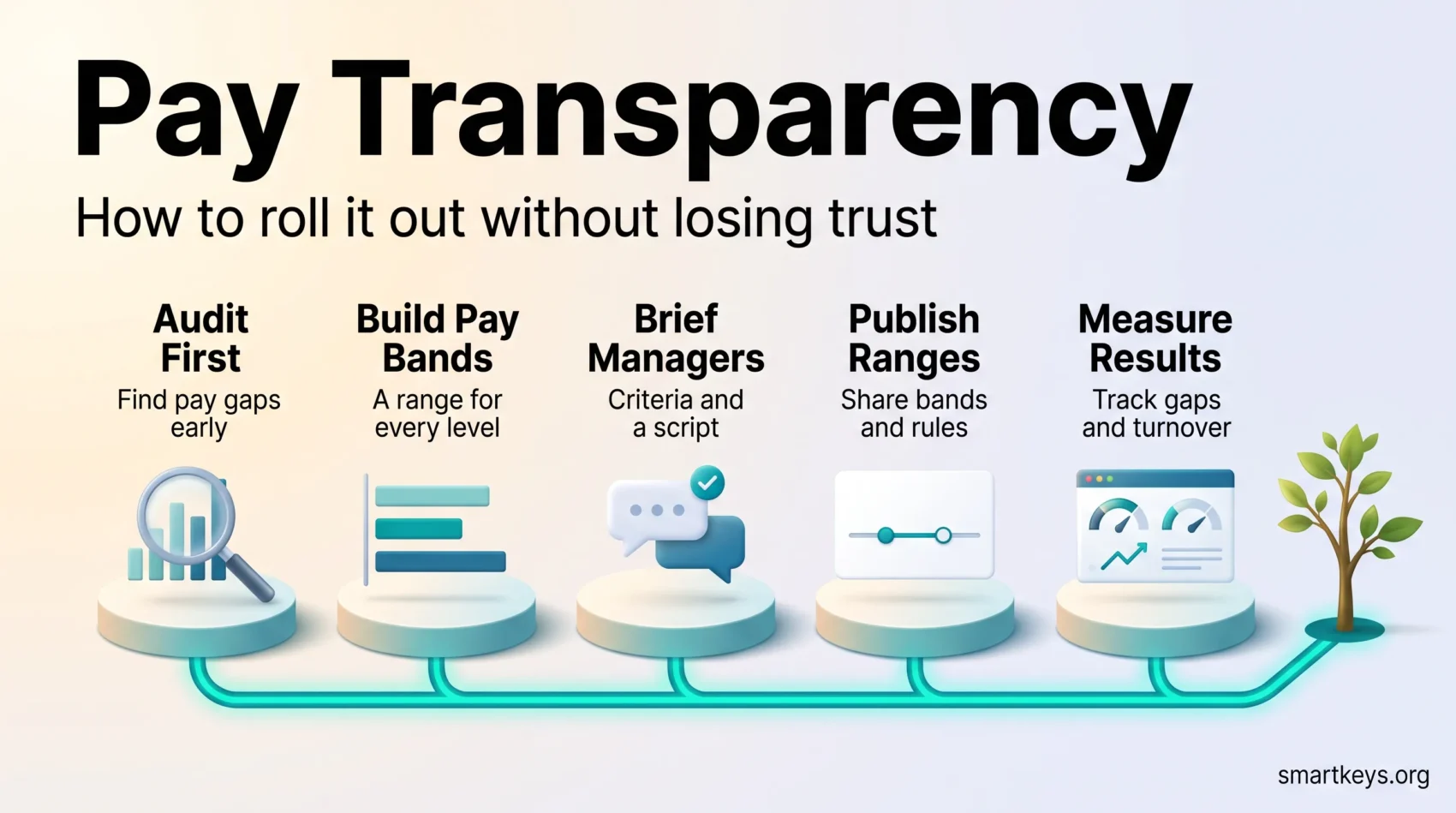
1. Audit before you publish
Map your job architecture: what levels exist, which roles sit at each one, and how people were placed there. Then look for outliers whose pay does not match their level or peers, and for patterns by gender or other group. Expect to find something, and decide what you fix and over how many cycles.
2. Build the bands
Set ranges using market benchmark data and internal comparisons. Write down the method, including which market you benchmark against and how often you refresh it. A band you cannot explain is worse than none.
3. Brief leaders first
Managers hear about this before employees do, with the criteria, a short script and a named person to escalate to. A manager caught off guard does more damage than a delayed launch.
4. Publish, then keep it current
Decide where the information lives: posting templates, intranet, manager toolkits. Set a review date for the bands and hold it. Stale ranges are a compliance risk.
5. Measure what changed
Track pay gaps by level and group, offer acceptance, time to hire, voluntary turnover and what your engagement survey says about fairness. Your workforce analytics tools already hold most of it.
Conclusion
Pay transparency is now a legal requirement in most of the markets US and EU employers hire in, and the June 2026 deadline widens that further.
The companies that handle it well do the unglamorous part first: fix the job architecture, audit actual pay, brief managers, then publish. The ones that struggle publish a range and discover their own inconsistencies in public. Start with the audit, because it decides how every conversation afterwards goes.
For the wider context, see our pieces on transparency culture, current HR trends, performance-based pay, employee engagement, AI hiring bias and the four-day workweek.
This article is general information, not legal advice. Rules differ by state and country and change often, so check current requirements for each place you hire.
Found this useful?
Make SmartKeys a preferred source on Google, and our articles will surface more often in your Top Stories, AI Overviews, and AI Mode.
Add as Preferred Source