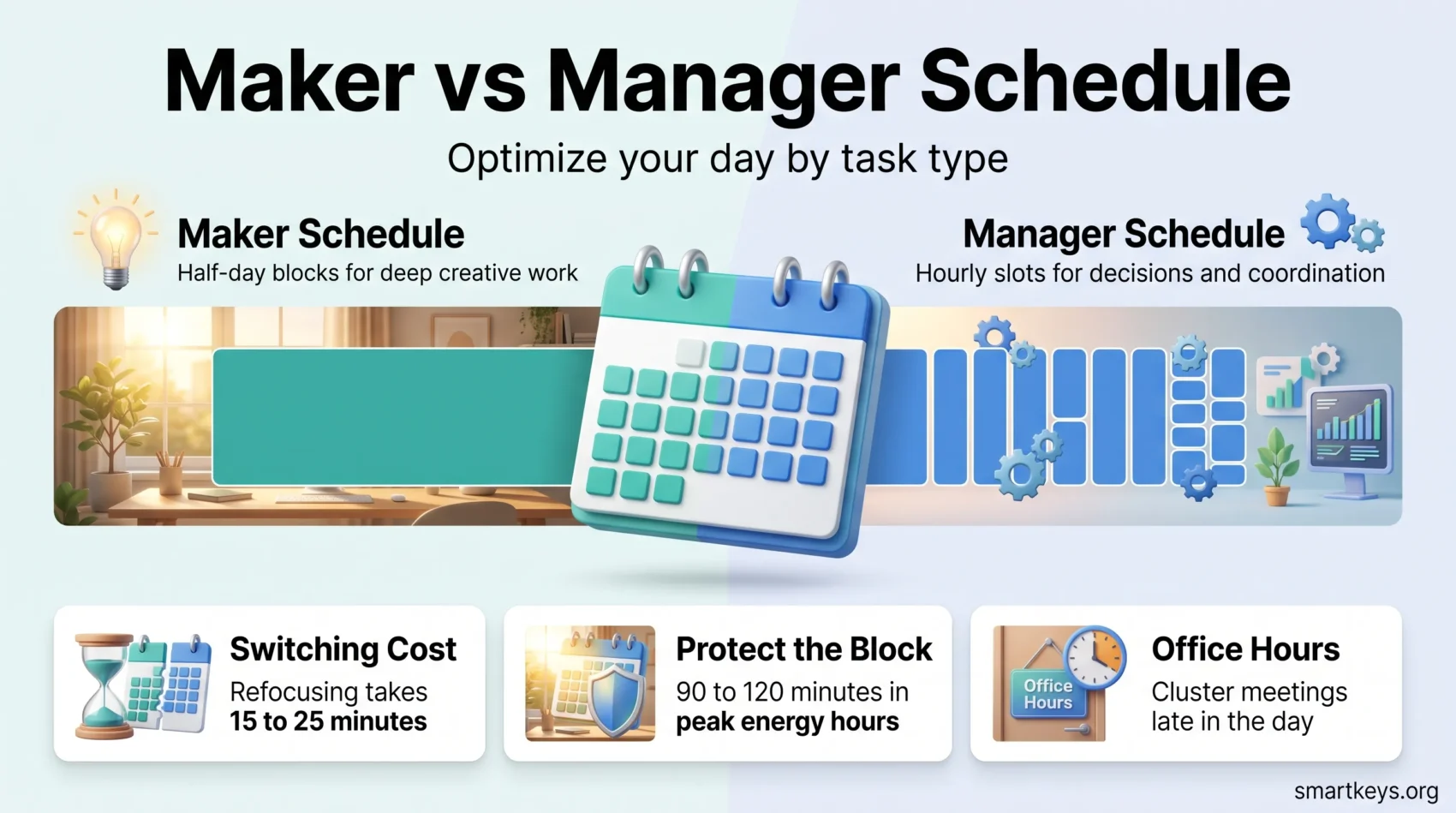
Your calendar quietly decides what you are capable of producing today. Fill it with half-hour slots and you will ship coordination. Protect one long stretch and you can ship the work itself.
Paul Graham named this split back in 2009: the manager’s schedule cuts the day into hourly boxes, while the maker’s schedule runs in half-day units. Nearly two decades later, the tension has only sharpened.
Microsoft’s Work Trend Index puts the average knowledge worker at roughly 15.4 hours of meetings per week against 12.1 hours of uninterrupted focus. Hubstaff’s 2026 benchmark report, drawn from more than 140,000 workers, found most people manage only two to three hours of genuine focus per day.
No to-do list fixes that ratio. You fix it by deciding each morning which schedule you are on, then defending that decision out loud.
Key Takeaways
- Long blocks produce creation, short slots produce coordination. Pick one mode per day rather than blending both.
- Meeting volume has climbed roughly 252% since early 2020, and about half of all meetings land in the two peak focus windows.
- A badly placed meeting costs far more than its 30 minutes, because refocusing alone takes 15 to 25 minutes.
- Research reported in Harvard Business Review links a 40% cut in meetings to a 71% jump in productivity.
- AI tools add coordination overhead: heavy AI users show around 27 fewer minutes of daily focus time.
- The average focused session now lasts roughly 13 minutes, and only about 27% of working hours arrive in stretches of two hours or more.
- Measure the schedule like any other system: focus hours, decision speed and interruption count tell you whether the guardrails hold.
- Guardrails only work when they are visible. Publish your mode so colleagues can plan around it.
Maker vs manager schedule: what is the real difference?
Some people carve the day into long, uninterrupted stretches. Others fill it with back-to-back appointments. Which one fits you depends entirely on what you must produce that day.
How Paul Graham defined the two approaches
Paul Graham framed this as two incompatible calendars. One divides the day by the hour so you can gather facts and decide quickly. The other protects half-days or more so you can build something without interruption.
The friction is structural, not personal. A manager booking a 2 p.m. call sees one hour disappear. The maker on the other end often loses the entire afternoon.
Murakami’s writing blocks vs Vaynerchuk’s rapid-fire slots
Haruki Murakami wrote for five to six hours starting at 4 a.m., then exercised and read. Those long blocks let him sustain creative output for decades.
Gary Vaynerchuk stacks calls, content and meetings into dense slots. That tempo works when your job is moving people and unblocking decisions.
Isaac Asimov sits at a third point on the same axis. He wrote every day for decades, holidays and hospital stays included, and the output compounded precisely because the rhythm never broke. The lesson is not his wake-up time but the consistency: a modest block you keep every day beats an ambitious one you defend twice a month.
Neither rhythm is superior. They simply produce different things, which is why calendar management is a strategic decision rather than an admin task.
Why meetings fuel managers but drain makers
For people who guide teams, a meeting is progress. Andrew Grove called meetings the medium of managerial work. For people who craft code, copy or design, a single meeting can fracture attention for hours.
Three quick diagnostics:
- You are on a manager schedule when your hours are sliced and decisions are your main output.
- You are on a maker schedule when long, protected time is how you produce anything of value.
- You are in trouble when both are true on the same day and neither is scheduled deliberately.
What schedule choice costs you in 2026
The numbers behind this argument have moved sharply since Graham wrote his essay, and all of them point the same direction.
The interruption baseline has collapsed
Microsoft’s telemetry shows the average Microsoft 365 user is interrupted roughly every two minutes during core hours, adding up to about 275 pings a day from meetings, email and chat. Around 68% of workers say they lack enough uninterrupted focus time.
Meeting volume has risen roughly 252% since February 2020, and the average knowledge worker now sits in about 21.7 meetings a week. Meanwhile 57% of workday activity goes to communicating, and only 43% to actually creating in documents, sheets and decks.
The fragments themselves are getting shorter. ActivTrak’s 2026 State of the Workplace report puts the average focused session at about 13 minutes, roughly 9% shorter than in 2023. Clockwise’s analysis of millions of calendar blocks found that only around 27% of working hours now arrive in uninterrupted stretches of two hours or more, and Atlassian’s State of Teams 2026 counts more than 60 context switches in a single workday. Work arrangement matters too: Worklytics benchmarks show hybrid teams spend about 31% of their hours in deep focus, against roughly 45% for fully in-office and 41% for fully remote teams.
Worst of all, roughly half of meetings are booked into the 9 to 11 a.m. and 1 to 3 p.m. windows, which is exactly when most people can think hardest. Setting instant messaging boundaries removes part of that noise, but the calendar problem needs its own fix.
Context switching and attention residue
You lose time every time you switch context. Research on attention residue shows part of your mind stays on the previous task, and returning to full depth typically takes 15 to 25 minutes.
That is why a single meeting can flatten an afternoon. You stop early to prepare, you idle afterwards, and the remaining fragments are too short for anything complex. The same mechanism explains why multitasking hurts output and why deliberate task switching technique matters more than raw discipline.
The four-hour rule and the AI twist
Ray Ozzie refused to touch product work without at least four straight hours. When developers work in short slots, defects rise and rework compounds.
There is a newer wrinkle. ActivTrak data shows heavy AI users log longer workdays, more collaboration time and about 27 fewer minutes of focus time than non-users. The tools remove some drudgery but add prompting, reviewing and coordination on top. AI does not hand you deep work; it only pays off when the blocks already exist.
“Protect the block first. Then let the tools make the block more productive.”
Designing a maker schedule that protects deep work
Start the day by defending one long stretch. Morning energy favours sustained attention, which makes complex problem solving measurably easier.
Long blocks, morning focus and batching
Front-load your hardest work. Use a multi-hour block in the morning when focus is highest, and treat it as a fixed appointment rather than a nice-to-have. Building the habit into a productive morning routine removes the daily negotiation with yourself.
Most effective blocks in 2026 share four traits: 90 to 120 minutes long, placed in peak energy hours, fully notification-free, and aimed at one defined output rather than a vague project name. That duration is no accident, since it maps onto your natural ultradian rhythm of roughly 90-minute focus cycles.
Batch similar work so context stays loaded. Group deep tasks into contiguous blocks and push lighter activity to late afternoon. Task batching and structured time blocking do most of the heavy lifting here.
Guardrails that hold up under pressure
Set visible Do Not Disturb windows and publish them. Vague intentions collapse the moment someone senior sends an invite.
- Block focus time on the shared calendar and mark it busy, not free.
- Move necessary meetings to after lunch and keep them strictly timeboxed.
- Batch team updates into one weekly written summary instead of a drip of pings.
- Tighten your notification settings so the block is quiet in practice, not just on paper.
Track which tasks genuinely need long focus. Many people discover only two or three hours a week truly require it, which makes those hours far easier to defend. If you want the full method behind protected blocks, our guide to deep work covers the mechanics.
Operating on a manager schedule without wasting the day
If most of your work happens in calls, you need rules that make each session count. Treat meetings as your core deliverable rather than calendar clutter.
Meetings as the medium of managerial work
“A meeting is nothing less than the medium through which managerial work is performed.”
Make every session purposeful. Define the decision or the information goal before you send the invite, and circulate a pre-read the day before so nobody arrives cold.
- Cluster meetings back-to-back so the gaps elsewhere stay large enough to be useful.
- Keep the attendee list lean: decision-makers and essential contributors only.
- Use time-boxes and a parking lot so discussion keeps moving and follow-ups get captured.
- Run recurring check-ins from a consistent one-on-one template instead of improvising.
- Capture owners and due dates immediately, or the conversation was decoration.
About 60% of meetings are now ad hoc rather than scheduled, and one in ten is booked at the last minute. A quarterly meeting audit is the fastest way to find out how much of your week is genuinely necessary.
Bridging both worlds: when you are maker and manager
When you wear both hats, partition the day so neither role erodes the other. You can hold deep flow and still answer quick questions, provided the transitions are planned.
Office hours and end-of-day clustering
Paul Graham used office hours late in the day to collect meeting requests without breaking his morning. Try a 45-minute window at day’s end for quick touchpoints and approvals.
Signal availability clearly through calendar titles and status messages so colleagues know when to drop in and when to wait.
Short decision slots for triage
Not every coordination need deserves half an hour. Elon Musk is frequently cited for running leadership work in five-minute bursts, and the principle scales down to any team: time-box decisions to five or fifteen minutes, stack them together, and refuse to let triage bleed into the next build block.
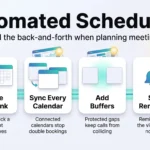
Letting colleagues book those slots themselves through automated scheduling removes the email volley that usually precedes a ten-minute answer.
Seasonal batching
Adam Grant staggers heavy teaching seasons against quiet research months. The same logic scales down: dedicate one month to stakeholder work and the next to concentrated creation, especially when managing multiple projects at once.
Two workdays in one
Some leaders run a split day: long blocks for creative work, then a compact window for admin and calls. The split only survives if comms stay silent during the first half.
- Separate the modes: maker blocks in the morning, managerial windows kept tight and late.
- Fill the gaps: keep a running list of small tasks for the 15-minute fragments so your big blocks stay intact.
- Rebalance weekly: a Friday weekly review shows whether last week’s ratio matched your priorities.
“Partition your calendar so creation and coordination each get the time they need.”
Team practices that respect both modes
A healthy organization sets norms so focused builders and meeting-driven leads can both function. The evidence for doing so is unusually strong.
Cut the volume, not just the length
Research reported in Harvard Business Review found that organizations cutting meetings by around 40% saw productivity rise by 71%, with satisfaction improving alongside it. Roughly a third of companies now enforce meeting-free blocks, and Wednesday has emerged as the most common no-meeting day.
Keep ceremonies tight. Honour time-boxes, share agendas early, and make pre-reads standard so planning sessions do not drift open-ended. A structured meeting reduction plan beats ad hoc calendar purges that quietly reverse within a quarter.
Change the default slot length too. Clockwise’s calendar data shows the average scheduled meeting runs roughly 30% longer than the host actually needs, because 30 and 60 minutes are what the booking form offers. Moving defaults to 25 and 50 minutes is the cheapest available intervention, and it works for the same reason Parkinson’s Law does: the work resizes itself to the container you give it.
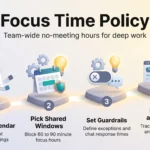
- Publish a team-wide focus time policy so makers get quiet hours and managers know when booking is fair game.
- Default to post-lunch meetings so the morning peak stays intact.
- When calendars collide, prioritize the builders’ blocks. They lose more per interruption.
Async first, real-time second
DeMarco and Lister found top performers consistently report more privacy and fewer needless interruptions. Async-first teams now block explicit communication windows, typically two or three short slots a day, and treat everything outside them as protected.
That norm is what makes asynchronous work viable. Without it, a blocked calendar still loses to the expectation of an instant Slack reply.
“Fewer needless interruptions lead to fewer defects and faster, higher-quality work.”
How to tell whether your schedule is actually working
A calendar can look disciplined and still produce nothing. Judge the system by output, plus three numbers you can collect inside a single week.
Three metrics worth tracking
- Focus hours: weekly time spent in blocks of 90 minutes or more. If that number never moves, your guardrails are decorative.
- Decision velocity: how long a typical decision sits between raised and resolved. Rising numbers usually mean your manager mode is too thin, not too fat.
- Interruption count: a plain tally of unplanned breaks during protected blocks. One week of counting is normally enough to identify the two or three sources doing most of the damage.
Review them on a weekly scorecard rather than daily, and let the trend pick your next change. It is the same logic as judging output instead of hours, which our guide to working smarter rather than longer covers in detail.
Run it as a two-week experiment
Do not reorganize your whole quarter. Pick one change — a single protected morning block, meetings only after lunch, or two fixed email windows instead of a permanently open inbox — and run it for two weeks. Short trials are easy to justify to a sceptical manager and easy to drop if the numbers disagree.
Keep a triage rule ready
Blocks fail at the moment something genuinely urgent lands. Decide in advance what qualifies: a customer-facing outage, a colleague who is blocked, a decision due today. Everything else gets logged and answered in your next coordination window.
Publish that rule. When colleagues can judge the threshold themselves, a polite deferral such as “not now, grab a slot in my afternoon window” stops reading as a rejection and starts working as a norm.
Conclusion
Decide each morning whether your best hours go to building or coordinating, then protect that choice in public.
The data is unambiguous: meetings now outweigh focus time for the average knowledge worker, half of them land in peak cognitive windows, and AI tools are adding coordination rather than removing it. Drifting through that environment guarantees a fragmented week.
Protect maker blocks from the single meeting that derails an afternoon. Signal availability through office hours, calendar labels and short written updates. Leaders should shield long chunks for their builders and keep every remaining meeting purposeful.
Apply this next week: reserve one 90-minute morning block, move meetings to after lunch, batch similar tasks, and manage the day around energy rather than hours. One week is enough to feel the difference, and two weeks of tracking focus hours and interruptions is enough to prove it to anyone who asks.
Found this useful?
Make SmartKeys a preferred source on Google, and our articles will surface more often in your Top Stories, AI Overviews, and AI Mode.
Add as Preferred Source