A corporate alumni network is a managed community of former employees that a company stays in touch with on purpose, instead of losing contact the day someone hands back the laptop. Think of the business version of a university alumni association: a member directory, a newsletter, a handful of events a year, and a job board that former staff can actually use.
That sounds like a nice-to-have until you look at where new hires come from. ADP payroll data shows that returning former employees made up 35% of new hires in March 2025, up from 31% a year earlier, and have averaged about 31% of hires since 2018. Roughly one in three people starting a job has worked for that employer before.
This guide explains what an alumni network does for hiring, referrals and revenue, what the largest corporate programs actually run, and how to build a small version that pays for itself before you buy any software.
Key Takeaways
- Former employees are now a mainstream hiring channel, not a fallback.
- Alumni also deliver referrals, client introductions and honest market intelligence.
- Track boomerang hires, referrals and influenced deals, or the program will lose its budget.
- Start with a newsletter, a directory and quarterly events before buying a platform.
- Get consent and data handling right at launch, not after the first complaint.
Why Corporate Alumni Networks Matter More in 2026
People change employers more often than they used to, and they increasingly come back. Boomerang hiring, the practice of rehiring someone who previously left, is no longer unusual: the ADP figures above put it at roughly a third of all new hires.
Two things make that useful to you. A returning employee already understands your systems, your customers and your internal shorthand, so they reach full productivity faster than an outside hire. And you already have performance evidence on them, which no interview process can fully replace.
The upside is not limited to rehiring. Writing in June 2024, the World Economic Forum cited data from the alumni software provider EnterpriseAlumni showing that rehired alumni had a 44% higher retention rate after three years than other new hires. The same piece reported that 83% of alumni would do business with a former employer and 79% would refer business to one. The WEF also disclosed its own number: former employees made up 8.4% of its global intake over four years.
There is a defensive argument too. Return-to-office rules, restructuring and AI-driven role changes all push people out of companies they did not want to leave. If you keep the relationship warm, some of them come back. If you cut contact at the exit interview, they become somebody else’s hire. This sits alongside the rest of your talent retention strategy, and it matters more when return-to-office mandates are reshaping who stays.
The Business Case: Four Returns You Can Measure
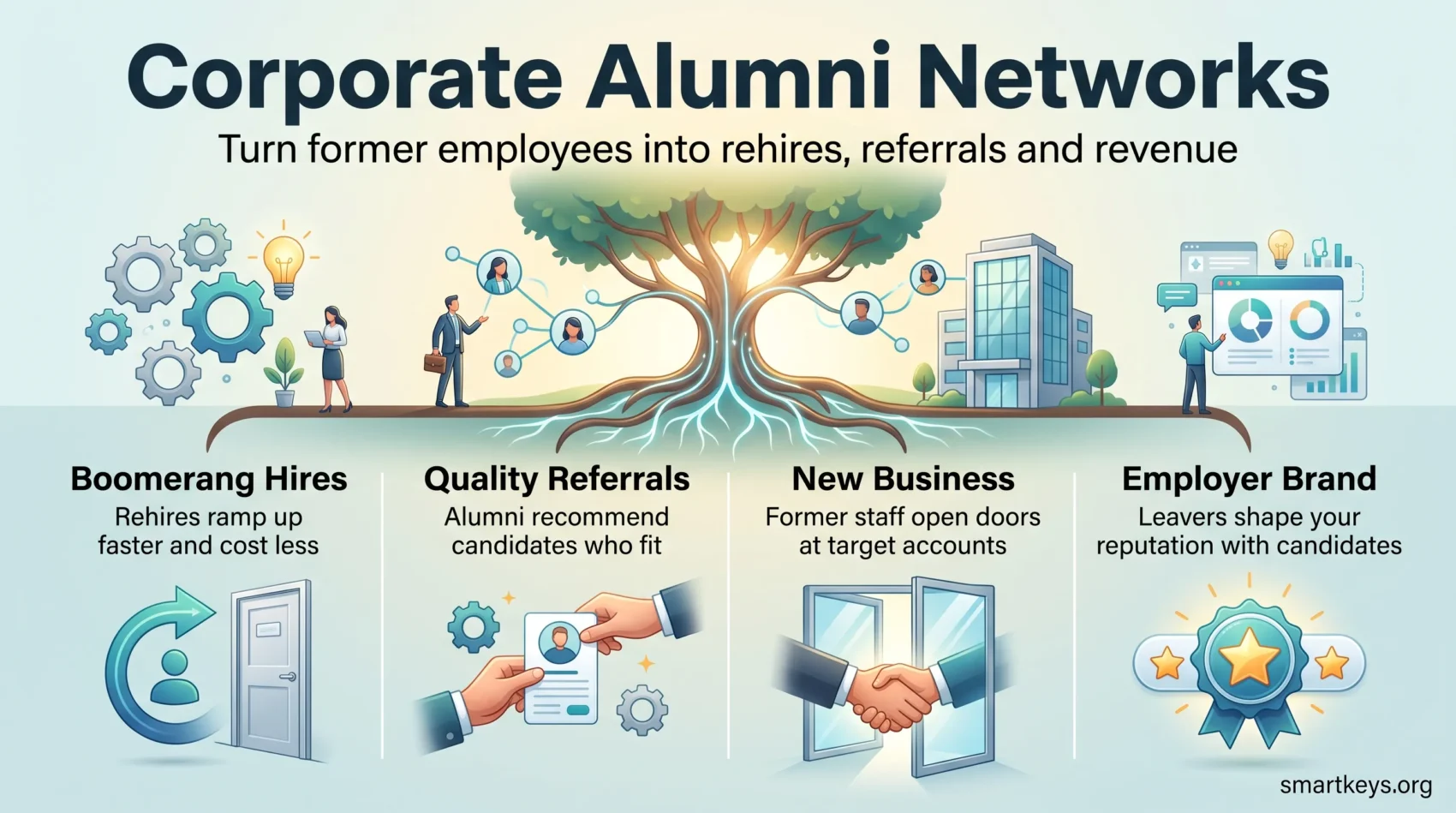
An alumni program earns its budget in four places. Each one has a metric attached, which is what separates a strategic program from a mailing list.
Rehiring former employees cuts cost and ramp time
Boomerang hires skip most of the discovery work. They know the products, the processes and often the customers. That shortens onboarding and lowers the risk of a bad fit, because both sides have already worked together.
EY, which runs one of the largest programs of its kind, says around 15% of its external hires each year come from its alumni community. Trent Henry, EY Global Vice Chair of Talent, put that figure on the record, and EY states the network has over one million members.
Track this as boomerang hires per quarter, time-to-fill for alumni-sourced roles, and how long those hires stay. Pair it with your onboarding program so returners get a short refresher rather than the full new-starter course.
Referrals arrive pre-qualified
Former employees know what good looks like in your organisation, so their candidate recommendations tend to be better targeted than a cold applicant pool. They also refer people they would be comfortable working with again, which is a quality filter you cannot buy.
Make the ask easy. A referral form inside the alumni portal, a monthly “roles we are struggling to fill” email, and a clear rehire policy will produce more than any incentive scheme bolted on later. If you already run AI-assisted hiring tools, route alumni referrals into the same pipeline so they are tracked, not lost in a manager’s inbox.
Business development through people who already trust you
Alumni move to customers, suppliers, competitors and regulators. Many end up in buying roles. That is why the WEF figures on doing business with and referring business to a former employer matter: the goodwill is real and it converts.
The practical version is unglamorous. Give sales a view of which alumni now work at target accounts, agree who makes the approach, and keep it in your CRM so it is a pipeline source rather than a favour. Measure sourced and influenced pipeline, win rate and deal cycle length.
Employer brand that other people vouch for
Former employees write reviews, answer questions from candidates and talk about you in their own networks. The WEF piece noted that alumni can account for close to half of an organisation’s Glassdoor score, which means your leavers shape your hiring reputation whether you engage them or not.
A well-run alumni community gives those people something positive to say and somewhere to say it. It works best when it sits alongside an active employee advocacy program.
Four Pillars of an Alumni Program That Works
Most programs fail for the same reasons: no owner, no purpose, and nothing in it for the member. These four pillars fix that.
A purpose tied to a business goal
Write one sentence that states what the program is for and what it will be judged on. “Fill 10% of senior openings with alumni within two years” is a purpose. “Stay connected” is not. A goal leaders recognise is what unlocks budget and cross-team help.
Member value worth someone’s evening
People join for themselves, not for you. Offer things they cannot get elsewhere: an honest jobs feed, industry briefings from your experts, access to internal learning material, and introductions. Borrowing from peer learning platforms and upskilling content costs little and gives members a reason to open the email.
Community rituals, not a broadcast list
Regular, predictable touchpoints beat occasional big gestures. A quarterly virtual meetup, a member spotlight, a mentoring match, a local drinks evening. Techniques from community-led growth apply directly, and structured mentorship matching gives members a concrete reason to talk to each other.
Owners, tooling and legal cover
Name one accountable owner, usually in talent acquisition or employer brand, and a small cross-functional group covering HR, marketing, sales and legal. Agree what data you keep, on what basis, and how members opt out. Employee data rules are tightening, so read up on workplace data privacy before you import a single contact list.
What the Largest Corporate Alumni Programs Actually Run
The biggest programs are useful as a menu, not a template. You are unlikely to match their budgets, but the components are all copyable at a smaller scale. The figures below are as reported by the alumni platform provider PeoplePath and the companies themselves.
McKinsey: a searchable directory plus a heavy events calendar
McKinsey runs an Alumni Center for more than 37,000 former consultants, with over 100 knowledge-sharing and social events a year and a searchable member directory. Alumni have founded more than 80 unicorn companies, and names such as Sundar Pichai and Sheryl Sandberg show the reach of the network.
The lesson is not the scale. It is that a directory plus a reliable events rhythm does most of the work.
Deloitte and EY: scale behind a simple promise
Deloitte launched its program in 2000 and reports over 300,000 members. Its “colleague for life” framing is doing real work: it tells leavers exactly what the relationship is. Programming includes webcasts and an alumni stories podcast.
EY uses the same trick with “Once EY, always EY” across more than a million members, and backs it with the hiring figure quoted earlier. A short, memorable promise makes the program easy to explain internally and easy to accept externally.
Microsoft and Goldman Sachs: perks, mentoring and a job marketplace
Microsoft’s AlumConnect serves 290,000+ members across 54 countries and combines clubs, mentoring, events, product discounts and a startup founders track. The network marked its 30th anniversary in 2025.
Goldman Sachs takes a narrower approach with an alumni job marketplace, where members both post roles and apply for them. That turns the community into a two-sided hiring market, which is the single highest-value feature for most programs. It complements rather than replaces an internal talent marketplace.
Xoogler: the independent, member-run model
Xoogler is the community for current and former Google employees, founded by Christopher Fong in 2015 and now stating 30,000+ members. Google supports it but does not own it.
That model is worth considering if your leavers are entrepreneurial. A member-run community needs far less central staffing, and the independence makes participation feel voluntary rather than corporate. The trade-off is that you control neither the messaging nor the data.
Starbucks and A&O Shearman: purpose and relaunch moments
Starbucks keeps more than 45,000 members under the promise “Once a Partner, Always a Partner,” and channels engagement into community grants: former partners have helped direct $255,000 to 233 nonprofits across 39 states.
A&O Shearman used its 2024 merger as the moment to relaunch a network of around 26,000 current and former colleagues, with mentoring circles, hybrid events and a single LinkedIn group. Mergers, anniversaries and rebrands are the easiest moments to restart a dormant program, because there is a reason to write to people.
Accenture, Marks & Spencer and Bird & Bird: Employer Brand in Action
Three smaller examples show how the same idea adapts to different industries.
Accenture connects more than 400,000 former employees across 80+ countries to open roles through structured rehire programs and a mix of global and local events. At that scale, segmentation is the whole game: nobody wants a global newsletter about a job in another hemisphere.
Marks & Spencer leans on tangible perks and seasonal rehiring drives, which suits a workforce with high turnover and predictable peak seasons. Bird & Bird, a law firm, runs an events-first strategy built on small, high-quality gatherings that generate referrals in a market where reputation travels by word of mouth.
The pattern across all three: pick the one lever that fits your workforce. Perks for high-volume retail, events for professional services, jobs for everyone. For practical steps and trends that link alumni engagement to revenue and hiring, see rehire programs and events.
How to Build an Alumni Community From the Ground Up
You can launch a credible version in a quarter with no new software.
Step 1: Decide who it is for and what they get
Segment former employees by role, seniority, location and how they left. A senior leaver who now runs a department elsewhere needs something different from a graduate who stayed 14 months.
Then write down both sides of the deal. Members get job alerts, briefings and introductions. You get referrals, rehire candidates and feedback. Saying the second half out loud keeps the program honest.
Step 2: Design the engagement mix
Start with four things: a member directory, a monthly email, a quarterly virtual event and a jobs feed. Add mentoring and local meetups once you see who turns up. Resist the urge to launch a full content calendar you cannot sustain past month three.
If your alumni are spread across time zones, borrow the habits that make asynchronous work function: record sessions, write summaries, and never make live attendance the only way to participate. The same applies to cross-border teams.
Step 3: Activate the teams that benefit
Talent acquisition wants candidates. Sales wants introductions. Marketing wants advocates. Learning wants case studies. Give each of them one thing they can ask the network for, and one thing they owe it in return, such as content or speakers.
Recruit a handful of alumni ambassadors to host sessions and welcome new members. Volunteers scale a program that a single coordinator never could. Treat the launch as a change project: the advice in our guide to change management applies, because you are asking several teams to add a habit.
Choosing a Platform: The Features That Actually Get Used
Software is the last step, not the first. Once you have a few thousand members and a real events calendar, a dedicated platform saves admin time. Before that, a mailing list, a spreadsheet and a LinkedIn group will do.

Job boards, groups, chat and mobile access
Prioritise the features that create weekly activity: a job board, topic or regional groups, direct messaging and simple event booking. Mobile access is not optional, because most members will check in between other commitments.
Segment the feed so people see roles and discussions relevant to their function and location. Give ambassadors moderation rights so the workload does not land on one person.
Analytics that connect to hiring and sales
Ask every vendor how the platform reports sign-ups, active members, job views, applications and event attendance, and whether it integrates with your applicant tracking system and CRM. Without that link you can report activity but not outcomes, which is how programs lose funding.
Consent controls matter here too. Members should be able to see what you hold, change their preferences and leave without emailing someone. If you already use workforce analytics tools, check whether alumni data can sit alongside them or must be kept separate for legal reasons.
Metrics That Prove the Value
Report three groups of numbers, and set a target for each before you launch.
Talent metrics: boomerang hires, alumni referrals, time-to-fill for alumni-sourced roles, and retention of alumni hires at 12 and 36 months. The EnterpriseAlumni retention finding cited by the WEF gives you a benchmark to test against your own data.
Business metrics: pipeline sourced or influenced by alumni contacts, win rate on those deals, and cycle length compared with cold outreach.
Engagement metrics: active members, event attendance and repeat attendance, email open rates and job-board applications. These tell you whether the program is healthy long before the talent and revenue numbers move.
Segment all three by cohort. You will usually find that one group, often mid-level leavers from the last three years, produces most of the referrals. That is where to spend your effort. Pair the dashboards with a short annual survey, in the same spirit as employee NPS, so you know why the numbers are moving.
Five Mistakes That Kill Alumni Programs
- Launching without an owner. A program run “by everyone” gets attention for one quarter and then stops.
- Making it all about you. If every email is a job ad or a company update, open rates collapse within months.
- Importing contacts without consent. This is both a legal risk and the fastest way to lose the goodwill you are trying to use.
- Buying software first. A platform with 200 inactive members is an expensive spreadsheet.
- Ignoring how people leave. A hostile exit process undoes years of alumni programming. Good offboarding and a clear rehire policy are part of the network, not separate from it.
Conclusion
Alumni networks work because they use a relationship you already paid for. The people in them know your business, trust your brand within reason, and will recommend you to candidates and buyers if you give them a reason to.
Start small. A directory, a monthly email, a jobs feed and a quarterly event will tell you within two quarters whether there is enough interest to justify a platform. Set a target for boomerang hires and referrals, report against it, and keep the promise short enough that leavers remember it.
The companies with the strongest programs did not start large. They started with a clear purpose, gave members something worth having, and kept going for years. That is a strategy any organisation can copy, whatever the headcount. It fits naturally alongside a healthy company culture and the wider shifts covered in our overview of HR trends.
Found this useful?
Make SmartKeys a preferred source on Google, and our articles will surface more often in your Top Stories, AI Overviews, and AI Mode.
Add as Preferred Source