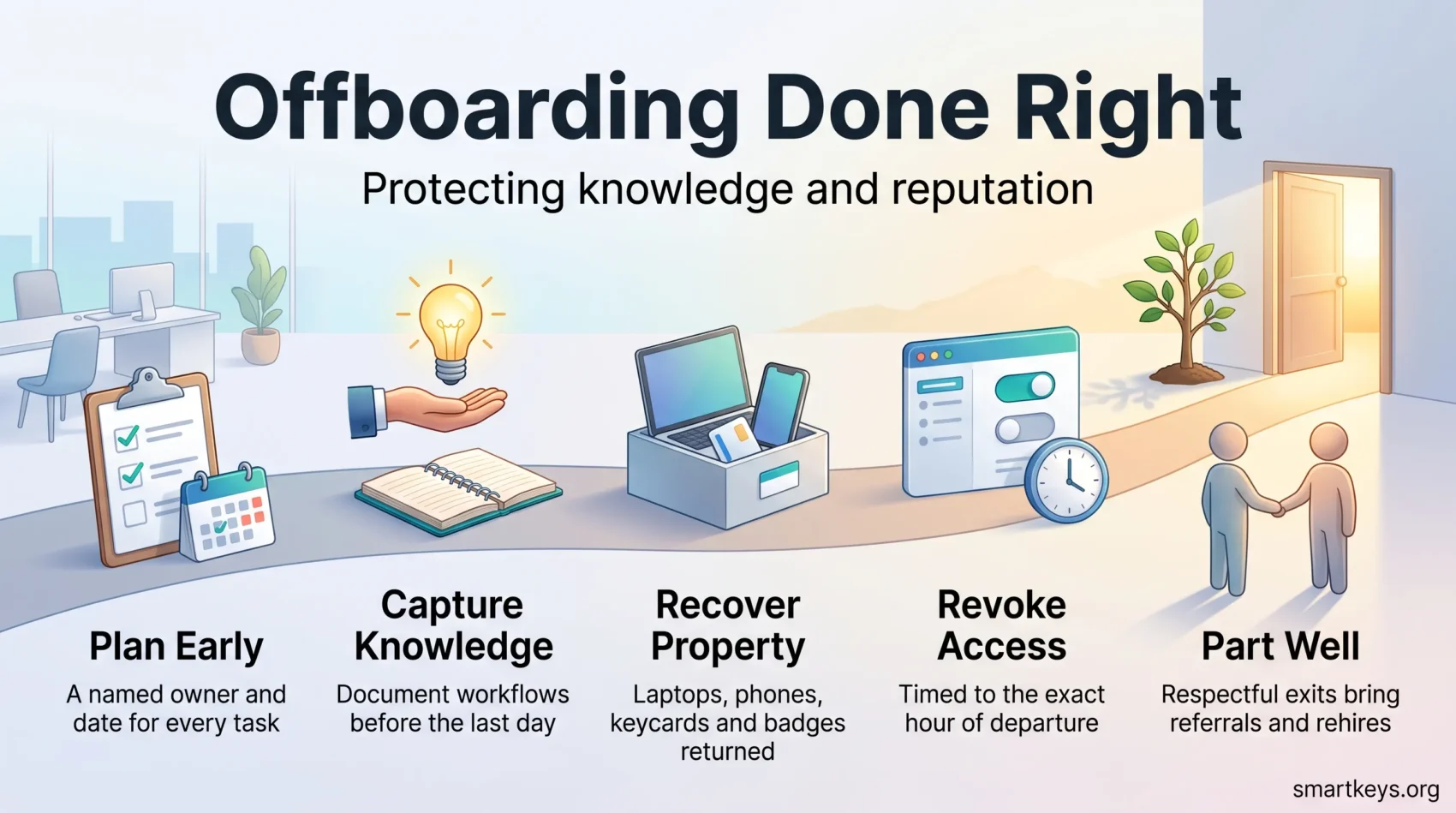
Every job ends at some point. Offboarding is the structured final stage of that employment relationship, and it covers every kind of exit: resignations, retirements, layoffs, terminations and the end of a fixed term contract. Each departure deserves the same care, because each one moves knowledge, data and goodwill out of your company.
Departures are not rare events. According to the U.S. Bureau of Labor Statistics, the June 2026 Job Openings and Labor Turnover Survey counted 5.4 million total separations in a single month, a rate of 3.4 percent of employment. Of those, 3.2 million were voluntary quits and 1.8 million were layoffs and discharges. Exits are routine, so the process should be too.
The cost of handling them badly is concrete. Verizon’s 2026 Data Breach Investigations Report found that 62 percent of breaches involved the human element, meaning a person made an error, misused access or was tricked into granting it. IBM’s 2026 Cost of a Data Breach Report puts the global average cost of a breach at 4.99 million dollars, up 12 percent on the previous year. A forgotten login is a small gap with a large price tag.
This guide covers a practical offboarding process: what to plan, what to document, what to switch off and when, and how to part ways without damaging your data or your reputation.
Key Takeaways
- Offboarding is the final stage of employment and covers every type of exit.
- A written process reduces security, compliance and continuity risk.
- Knowledge transfer has to start before the last day, not on it.
- Access revocation should be timed to the exact hour of departure.
- Respectful exits pay off later through referrals and rehires.
What the Offboarding Process Actually Covers
Offboarding is the planned process of disengaging a team member. It sits at the end of the employee lifecycle, the sequence running from recruitment and onboarding through development and retention to the exit itself.
Onboarding and offboarding mirror each other. Onboarding grants access, assigns equipment and builds context. Offboarding captures that context, then removes the access and recovers the equipment. The order matters: capture first, remove second.
The scope is wider than most managers expect. A complete process touches HR, payroll, IT, legal, the departing person’s manager and the colleagues who inherit the work. Leave one of them out and something predictable breaks: an unpaid expense claim, a live software licence, a client who learns about the change from a bounced email. Doing it consistently also supports the wider human resource management trends shaping 2026.
Why Offboarding Protects Knowledge and Reputation
The most valuable thing a departing colleague takes with them is undocumented knowledge: which client dislikes phone calls, why a workflow has an odd extra step, where the master spreadsheet lives. None of that is in a job description.
Capturing it early lowers disruption for everyone who stays. The successor starts with context instead of guesswork, rather than reverse engineering a colleague’s habits under deadline pressure. It is knowledge management for distributed teams applied to one person on a deadline.
Reputation is the second payoff, and it is measurable in hiring. ADP Research, drawing on its own payroll data, found that boomerang hires, meaning people rehired by a former employer, made up 35 percent of new hires in March 2025, up from 31 percent a year earlier and averaging around 31 percent since 2018. People who leave well are a live candidate pool. People who leave badly tell others why. Formalising that pool is the idea behind corporate alumni networks, and it starts with how the last two weeks feel.
Preparing a Structured Offboarding Plan
Start the moment the decision is made, not in the week of departure. Two weeks works for most roles. Senior, client facing or specialist roles usually need four to eight, because the handover is the bottleneck, not the paperwork.
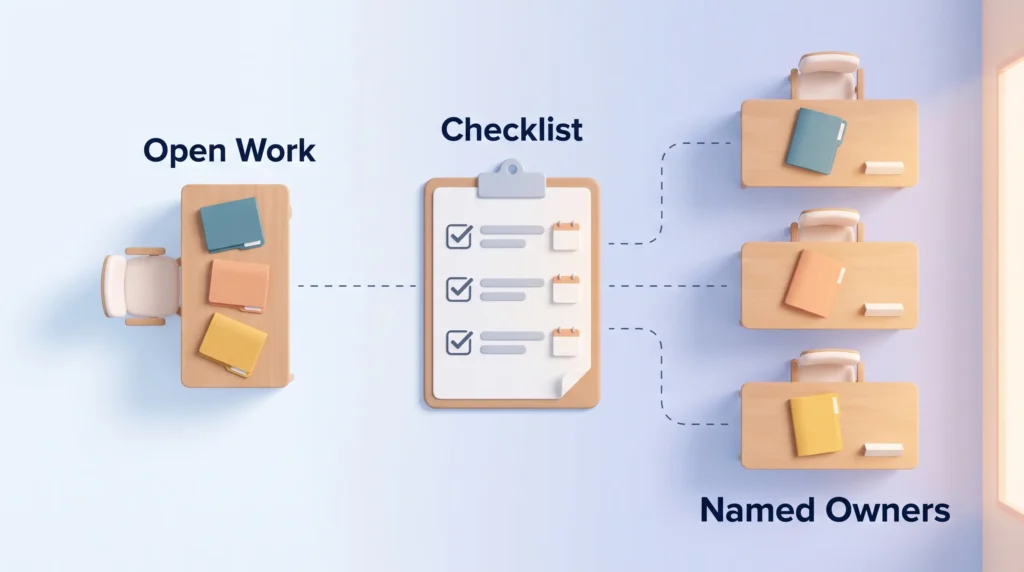
Write the plan as a checklist with a named owner for every line. It should cover:
- HR and payroll tasks, including final pay and benefits
- IT access revocation and account handover
- Knowledge transfer documentation and handover sessions
- Recovery of laptops, phones, keycards and badges
- Exit interview scheduling
- An internal and external communication plan
Give each item a date, not a vague deadline. That is the difference between a checklist and a wish list. If you already run workforce contingency planning, this is the same document at the scale of one person.
Decide who inherits the work before the last day. Splitting tasks across three colleagues without naming an owner for each is how projects quietly stall. A cross training strategy helps, because a second person already knows the basics, and an internal talent marketplace can surface a successor before you advertise externally.
Exit Interviews That Produce Usable Feedback
An exit interview is a structured conversation about why someone is leaving and what they would change. Its value depends on whether anyone acts on the answers.
Getting people into the room is the first hurdle. In a Capterra survey of 287 HR staff conducted in November 2022, 86 percent said at least one departing employee failed to attend their exit interview, and 70 percent said several had. Booking it early, while the person is still engaged, beats squeezing it into the final afternoon.
Four practices raise the quality of the answers:
- Use a neutral interviewer rather than the person’s direct manager.
- Give advance notice and share the questions.
- Ask about specific moments, not general satisfaction.
- Write structured notes so answers can be compared over time.
One interview is an anecdote. Twenty tagged by theme are evidence. Read them alongside ongoing signals such as employee net promoter scores and workforce analytics tools and you can tell a real pattern from one bad quarter. That is what turns offboarding into a talent retention input.
Knowledge Transfer and Company Property
Knowledge transfer works best as documentation plus a live session. Ask the departing person to write down recurring tasks, the status of every open project, key contacts and any system they are the sole user of. Then book time for them to walk a successor through the workflows that are hardest to explain in writing.
Company property needs the same rigour. In the same Capterra survey, 71 percent of respondents said at least one departing employee failed to return company equipment, at an average reported loss of 1,963 dollars per incident. Remote and hybrid staff were more likely to keep hardware, because nobody hands anything back at a desk.
Fix that with an asset inventory per person, a prepaid return label issued before the last day and a booked collection date covering laptops, phones, monitors, keycards, badges and hardware security keys.
IT and Digital Offboarding Essentials
Deprovisioning, meaning the removal of a user’s accounts and permissions, is the step where delay costs the most. A 2022 Beyond Identity survey of 1,121 workers and business leaders found that 83 percent of respondents said they had kept accessing accounts at a former employer after leaving, and 24 percent admitted deliberately holding on to a password. Self reported figures have obvious limits, but the direction is clear enough to act on.
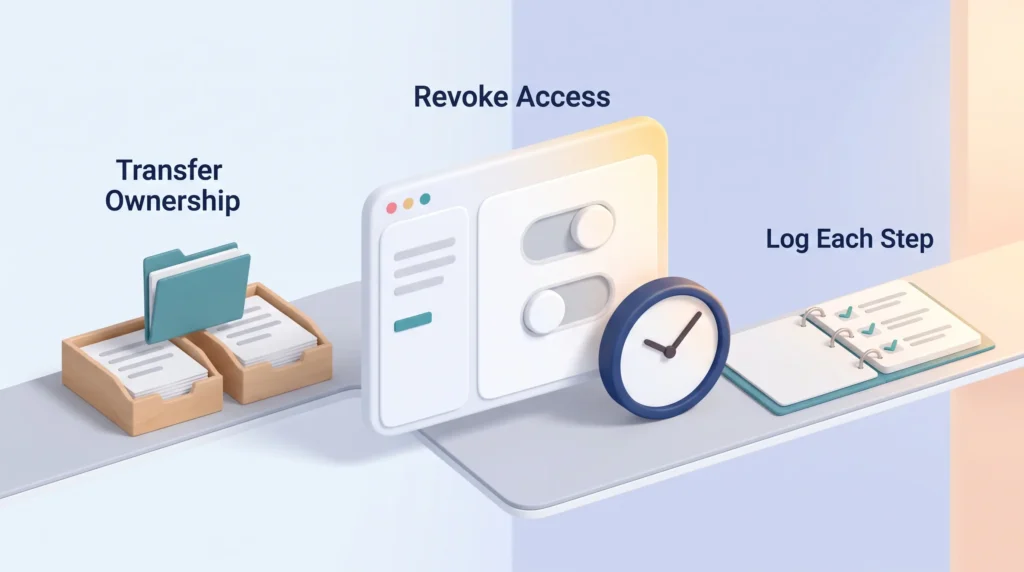
Build an IT checklist covering email, single sign on, cloud storage, the CRM, code repositories, VPN, payroll and every third party tool bought on a team card. That last group is the one that gets missed, which is why a shadow IT inventory pays for itself here.
Time deactivation to the departure hour, not the end of the month. Transfer file ownership to a named colleague first, then revoke, and record each completed step as evidence. For remote staff, book a short session with IT to confirm company software and data are off personal devices, following the same principles as cybersecurity for remote work.
Legal and Compliance Considerations
Documentation is what protects you if an exit is later disputed. Keep final pay and tax records, benefits notices, signed confidentiality and intellectual property agreements, restrictive covenants where they are enforceable, and any outstanding expense claims.
Final pay rules vary more than most employers expect. The federal Fair Labor Standards Act sets no deadline, so state law governs. California and Colorado require immediate payment on termination, Utah allows 24 hours, and many states simply require the next scheduled payday. There is no federal requirement to pay out unused vacation either, so state law and your own rules decide, which is worth checking before you write a flexible paid time off policy.
Employee data has its own rules. Retention periods, deletion requests and access logs still apply after someone leaves, as covered in data privacy at work. For international staff, notice periods and severance follow local law, which is where global payroll solutions or an employer of record, a provider that legally employs staff on your behalf, does the heavy lifting.
Keeping the Culture Intact During Transitions
Colleagues notice how you treat people on their way out and draw conclusions about how they would be treated. Tell the team promptly, explain who picks up what, and say it in one clear message rather than letting it leak. That is transparency culture when it is hardest to practise.
Acknowledge the contribution. A short farewell, a thank you from a manager, a note in a team channel: none of it is expensive, all of it is remembered. It also reduces the anxiety that fuels burnout among the people who remain, because the workload question gets answered instead of ignored.
Then keep the relationship alive. Former colleagues refer candidates, recommend suppliers and sometimes come back. Not every exit is abrupt either: phased retirement programmes turn one leaving date into a gradual handover.
Building Offboarding Into Your HR Strategy
Treat offboarding as a lifecycle stage with an owner, a service level and a metric, not a favour HR does at short notice. Feed exit themes into continuous performance management and your employee engagement programme, so the same complaint does not appear in four consecutive interviews. Trust built during employment, as described in work on digital trust in remote teams, is what makes people candid on the way out.

Automate the repeatable parts. HR platforms can trigger checklists, route approvals, schedule the exit interview and generate the final pay summary. Keep the judgement calls human, let the software chase the tasks.
Finally, measure it. Completion rate, days to full deprovisioning, equipment recovery rate and exit interview attendance tell you whether the process works. If your hiring side is already measured that closely, holding the exit to the same standard closes the loop.
Conclusion
A structured offboarding process protects three things: the knowledge your team needs, the systems an ex colleague can no longer reach, and the reputation that decides whether good people apply, refer or return.
Start early, name an owner for every task, capture the knowledge before the access disappears and recover the hardware. Then use what people tell you on the way out to fix what pushed them out.
Found this useful?
Make SmartKeys a preferred source on Google, and our articles will surface more often in your Top Stories, AI Overviews, and AI Mode.
Add as Preferred SourceFAQ
What is the purpose of the offboarding process?
Offboarding closes the employment relationship in a controlled way. It captures the knowledge a departing colleague holds, transfers their open work to a named successor, recovers company equipment, removes their system access and completes the legal and payroll paperwork. Done consistently, it protects business continuity and data security while leaving the person with a fair impression of the company, which matters later for referrals and rehires.
How can exit interviews benefit my organisation?
Exit interviews surface the reasons people leave while the answers are still specific. Their value comes from aggregation: one conversation is an anecdote, twenty tagged by theme show a pattern in a team, a manager or a policy. Use a neutral interviewer, share the questions in advance and take structured notes. Then compare the themes against engagement survey results before you change anything.
What should be included in an offboarding checklist?
A workable checklist covers six areas: HR and payroll tasks including final pay and benefits, IT access revocation and account handover, knowledge transfer documentation and handover sessions, recovery of laptops, phones and badges, the exit interview, and an internal and external communication plan. Give every line a named owner and a date. Without those two fields, a checklist records intentions rather than driving them.
When should IT revoke a departing employee’s access?
Time revocation to the exact hour employment ends, after file ownership and shared documents have been transferred to a named colleague. Work from a written list that includes email, single sign on, cloud storage, the CRM, code repositories, VPN, payroll and every third party tool bought outside IT. Log each completed step. For remote staff, confirm in a short session that company data has been removed from personal devices.
Why does company property matter during offboarding?
Unreturned hardware is both a cost and a security gap, because a laptop or phone usually still holds company data. In a Capterra survey of 287 HR staff conducted in November 2022, 71 percent said at least one departing employee had failed to return equipment, at an average reported loss of 1,963 dollars. Keep an asset inventory per person, send a prepaid return label before the last day and book a collection date.
What legal points should I check during offboarding?
Check final pay timing first. The federal Fair Labor Standards Act sets no deadline, so state law decides: California and Colorado require immediate payment on termination, while many states allow the next scheduled payday. There is no federal requirement to pay out unused vacation either. Also confirm benefits notices, confidentiality and intellectual property agreements, data retention rules and, for international staff, local notice and severance law.