
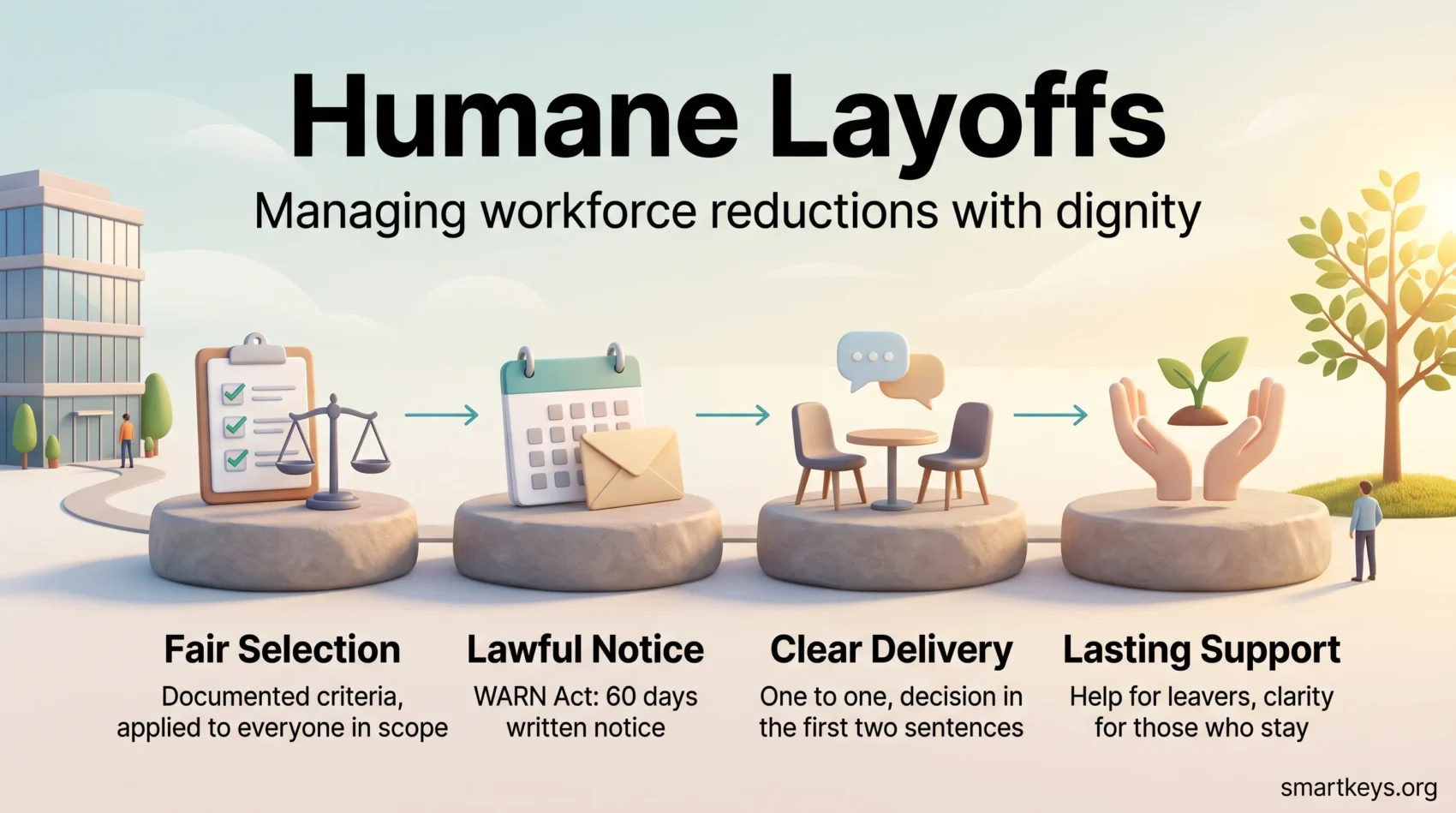
A layoff is a job cut caused by the employer’s situation, not by the employee’s performance. You cannot make one painless. You can make it fair, lawful and clear. Four things decide that: how you choose, what notice you give, how you deliver the news, and what you do afterwards for both sides.
Key Takeaways
- A layoff cannot be painless, but it can be fair, lawful and clear.
- US job cuts announced through September 2026 fell 39 percent year on year.
- AI is the most frequently cited reason for layoffs so far in 2026.
- Poorly handled cuts erode commitment among the people who stay.
- Write the plan and selection criteria before naming anyone.
- Check whether the list falls disproportionately on a protected group.
- The WARN Act requires 60 days of notice from employers with 100 or more staff.
- Federal law does not require severance, so set your formula early.
- Deliver the news one to one and state the decision right away.
- Tell remaining staff exactly what changed and rebalance their workload.
Where Layoffs Stand in 2026
Layoff activity has cooled. US employers announced 573,195 job cuts in the first nine months of 2026, down 39 percent year on year. Artificial intelligence is the leading stated reason so far this year, at 120,136 cuts or about a fifth of the total, although it ranked only fifth in September (Challenger, Gray and Christmas, October 2026). Official data agrees: layoffs and discharges ran at 1.6 million in August 2026, a rate of 1.0 percent (Bureau of Labor Statistics JOLTS survey, September 29, 2026).
The reason matters. Cuts framed as AI restructuring rarely reverse the way a cyclical dip does. Job automation research shows which skills stay in demand, and entry-level roles feel the shift first.
Recognizing the Human Impact of Layoffs
Academic reviews of downsizing find no reliable financial payoff and consistent harm to the people who remain. Datta and colleagues (Journal of Management, 2010) describe lower commitment, higher job insecurity and survivor syndrome, the guilt and anxiety remaining employees feel after colleagues are let go. They conclude that execution decides the outcome.
Global employee engagement has fallen to 20 percent, its lowest since 2020, and manager engagement to 22 percent (Gallup, State of the Global Workplace 2026). A badly handled layoff lands on that fragile base, which is why engagement trends, burnout prevention and psychological safety belong in the same conversation as headcount.
Building a Fair Layoff Process
Write the plan before you name a single person: why the reduction is needed, how many roles go, the selection criteria, who approves the list and the dates. Select by role and business need first, then by documented criteria such as the skills the remaining work requires. Apply them to everyone in scope and record the reasoning.
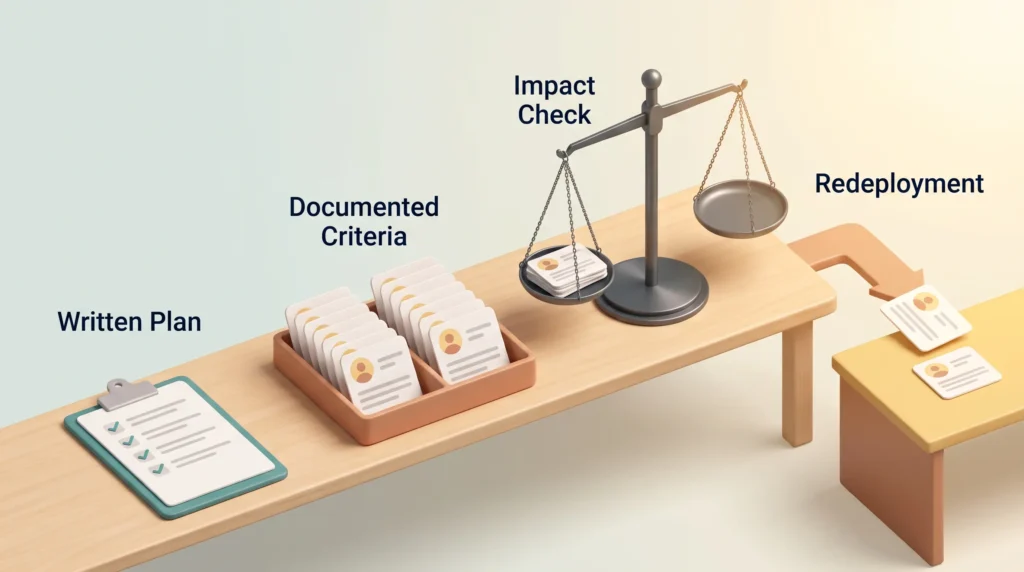
Then run an impact check. Does the list fall disproportionately on a protected group, meaning a category the law shields from discrimination, such as workers aged 40 and over? DEI technology tools can surface that pattern, but the judgement stays with your legal and HR advisers.
Check the alternatives honestly too. Redeployment through an internal talent marketplace, lateral moves along a career lattice or a written mobility policy can keep people you would otherwise pay to replace. Cutting a management layer? The great flattening shows what that costs.
The Legal Groundwork: Notice, Pay and Severance
In the US, the main federal rule is the WARN Act (Worker Adjustment and Retraining Notification Act). It covers employers with 100 or more employees and requires 60 calendar days of written notice before a plant closing or a mass layoff. A plant closing means 50 or more job losses at one site within 30 days. A mass layoff means 500 job losses, or 50 to 499 that make up at least a third of the site’s workforce. Notice goes to affected employees, the state dislocated worker unit and the chief elected local official (20 CFR Part 639).
State rules can be stricter. New York’s version applies from 50 full-time employees, requires 90 days and can trigger at 25 job losses. Remote staff are not exempt: under the outstationed employee rule they count at the site that assigns their work, so a distributed team can cross a threshold nobody expected.
Severance is separate. The Fair Labor Standards Act does not require it, so set your formula before the list exists. Some states do: New Jersey requires severance for layoffs covered by its own notice law.
Delivering the News With Care
A manager the person already knows should deliver the message, one to one, in person or on a live video call. Open with the decision in the first two sentences. People stop absorbing detail once they understand what is happening, so use the rest for facts they can act on: last day, final pay, benefits end date, severance, equipment return.
Expect anger, tears or silence, and let the pause sit. Give the reason honestly, at the level of the business decision, never the individual’s worth. “The company is closing the regional sales team” is a business reason. “We had to make tough choices about people” is not.
Give every manager the same script and the same written answers, a basic rule of change management. Inconsistency is what people remember.
Supporting Leavers and the People Who Stay
For those leaving, practical help beats sentiment: outplacement support (paid coaching and job search help from a specialist firm), an honest reference, instructions for collecting belongings and a named contact for pay questions. A structured offboarding process handles access, equipment and knowledge without humiliation. A corporate alumni network then turns former colleagues into referrals and, sometimes, boomerang rehires.
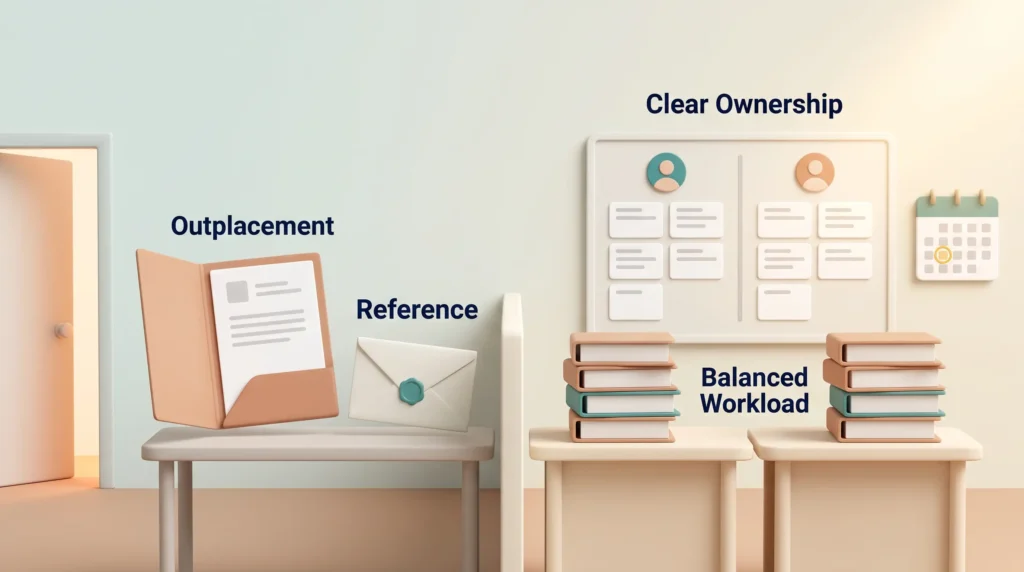
For those who stay, name what changed: which work stops, who picks up what, and when the next update comes. Regular one on one meetings are where the real questions surface. Letting people redesign the remaining work, the idea behind participatory management, gives back some control.
Watch workload as well as mood. Wellbeing support means little if three jobs now sit on two people. Both the 2026 HR picture and the case for retaining top performers point the same way: trust returns through visible decisions, not messaging.
Conclusion
Humane layoffs come down to four things: a documented reason, criteria you would explain in public, lawful notice, and support that lasts past the final day. None of that removes the pain. Together they decide whether you keep your credibility.
Found this useful?
Make SmartKeys a preferred source on Google, and our articles will surface more often in your Top Stories, AI Overviews, and AI Mode.
Add as Preferred Source