
Caffeine timing means deciding when you drink coffee, tea or an energy drink, not just how much. The same 100 milligrams can leave you sharp at 10 a.m. and wide awake at midnight, so the clock matters as much as the cup. Roughly 85 percent of adults in the United States drink at least one caffeinated beverage a day (Mitchell and colleagues, Food and Chemical Toxicology, 2014). Small changes here touch a lot of working days.
One warning first. Caffeine is a drug, and personal limits vary. If you are pregnant or nursing, take medication, or live with a heart condition, an anxiety disorder or high blood pressure, ask a doctor about your own limit.
Key Takeaways
- Caffeine blocks the brain signal that makes you sleepy. It does not create energy.
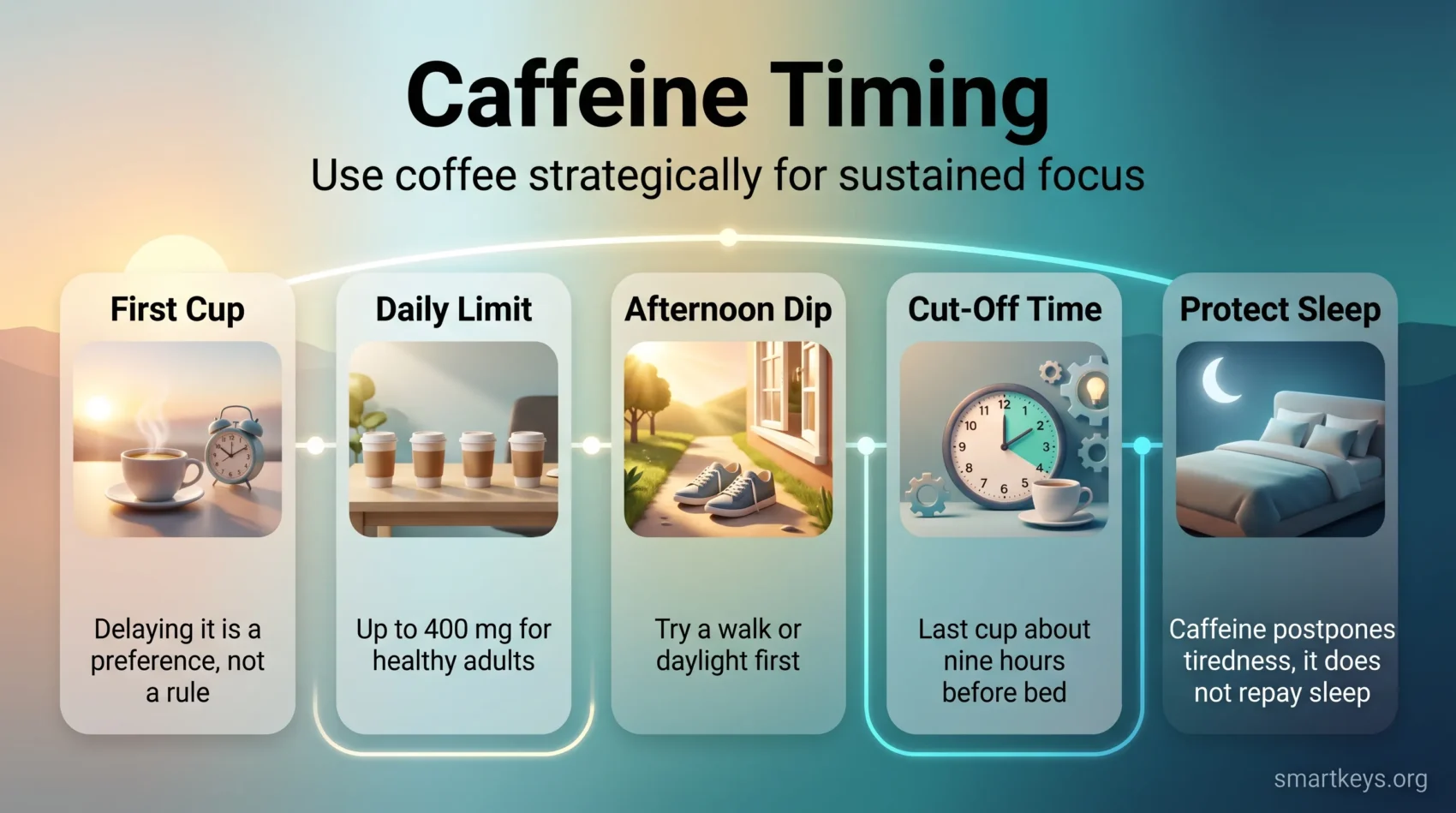
- The FDA calls up to 400 milligrams a day safe for healthy adults, roughly four home brewed cups.
- No study has found an ideal delay after waking. A late first cup is a preference, not a rule.
- Sleep is the real constraint: a standard cup needs around nine hours before bed.
What Caffeine Timing Actually Means
Most caffeine advice is about dose. Timing is about placement: which hours of your day get caffeine, and which stay clear.
Caffeine takes a while to arrive and much longer to leave. Peak blood levels turn up between 15 and 120 minutes after you drink. The leaving is the slow part, which is why a 4 p.m. cup can still be measurable at bedtime. Placement is also the cheapest lever you have. It fits the broader habit of managing your energy rather than only your time.
How Caffeine Works in Your Body
Adenosine is a molecule that builds up in your brain while you are awake. The longer you have been up, the more accumulates, and the sleepier you feel. That is why a 3 p.m. meeting feels heavier than the same meeting at 9 a.m.
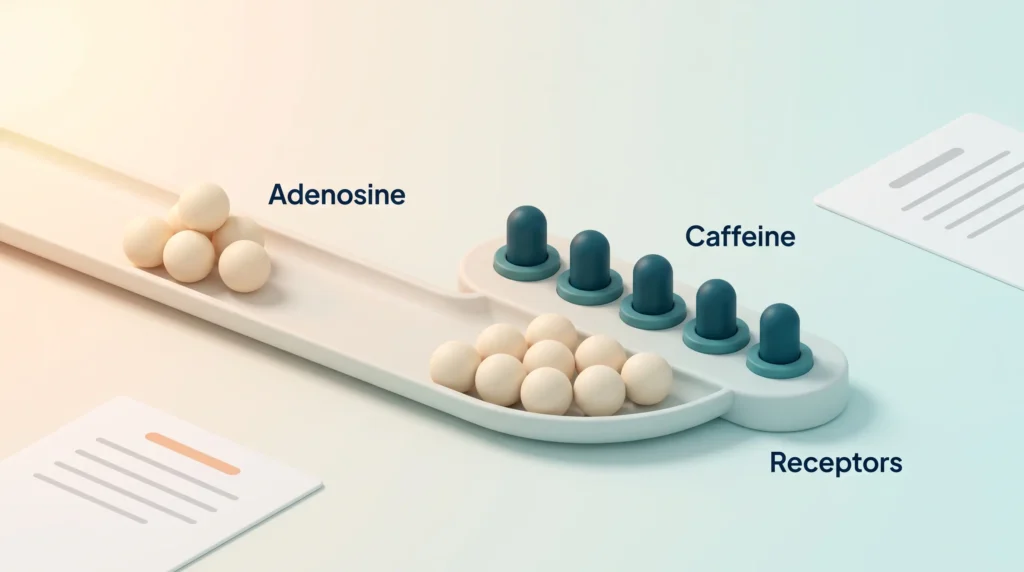
Caffeine fits the same receptors as adenosine and blocks them. The sleep pressure is still there; you simply stop feeling it. So caffeine postpones tiredness, it does not repay sleep. When it clears, the pressure is waiting. If you are short on sleep, fixing the sleep itself does far more than a stronger coffee.
How fast caffeine clears varies enormously. The half life usually quoted is about five hours, meaning half the dose is still in you five hours later. Individual values run from under two hours to more than nine, shifted by genetics, pregnancy, smoking, liver health and some medications. Two colleagues can drink the same espresso at 3 p.m., and only one will be staring at the ceiling at midnight.
Should You Delay Your First Coffee?
You have probably seen the advice to wait 90 minutes after waking. The reasoning: cortisol, a hormone linked to alertness, surges when you wake and peaks roughly 30 to 45 minutes later, so caffeine on top of it is wasted. The cortisol curve is real. The conclusion drawn from it is not.
No trial has compared alertness after an immediate coffee with alertness after a delayed one and shown the delay wins. Michael Grandner, a sleep researcher at the University of Arizona, has said there are no studies on optimal timing. He calls it a matter of personal preference. He waits 30 to 60 minutes himself, while noting there is no harm in caffeine first thing.
So treat the delay as an experiment, not a protocol. Two groups tend to gain: people who feel jittery after an early cup, and people who eat breakfast late. Otherwise, building the cup into a stable morning routine helps more than shifting it by 40 minutes.
Finding a Dose That Works for You
The FDA states that up to 400 milligrams of caffeine a day is not generally associated with negative effects in healthy adults. For reference, a home brewed 8 ounce coffee holds around 95 milligrams, an espresso shot around 65, black tea around 45, and an energy drink 80 to 160. Brewing strength varies, so read labels.
The daily total counts against that limit, not the pattern. Start low: begin with the smallest amount that clears the fog, then add from there.
Two safety notes. The FDA warns about pure and highly concentrated caffeine powders, where a teaspoon can hold a dangerous dose, so stay with measured products. And if you get palpitations, chest discomfort, severe anxiety or persistent insomnia, cut back and talk to a doctor. Food matters too. A cup on an empty stomach hits faster and harder, one more reason what you eat during the workday shows up in how you feel.
Caffeine Before Exercise
Exercise is the one area where the evidence is unusually clear. The International Society of Sports Nutrition position stand (2021) concludes that caffeine consistently improves exercise performance at 3 to 6 milligrams per kilogram of body mass. Most studies give it about 60 minutes beforehand. For an 80 kilogram person that is 240 to 480 milligrams, so the top of the range alone approaches the 400 milligram daily reference. If you also drink coffee at work, stay near the bottom.
More is not better: the same position stand notes that doses around 9 milligrams per kilogram bring a high rate of side effects without extra benefit. Test a pre-workout dose on an ordinary training day, and watch the clock. A strong pre-workout in the early evening is a common cause of a wrecked night. If you train late, the training itself still pays off; the caffeine is the part worth reconsidering.
Protect Your Sleep First
If you change one thing, make it your afternoon cut-off.
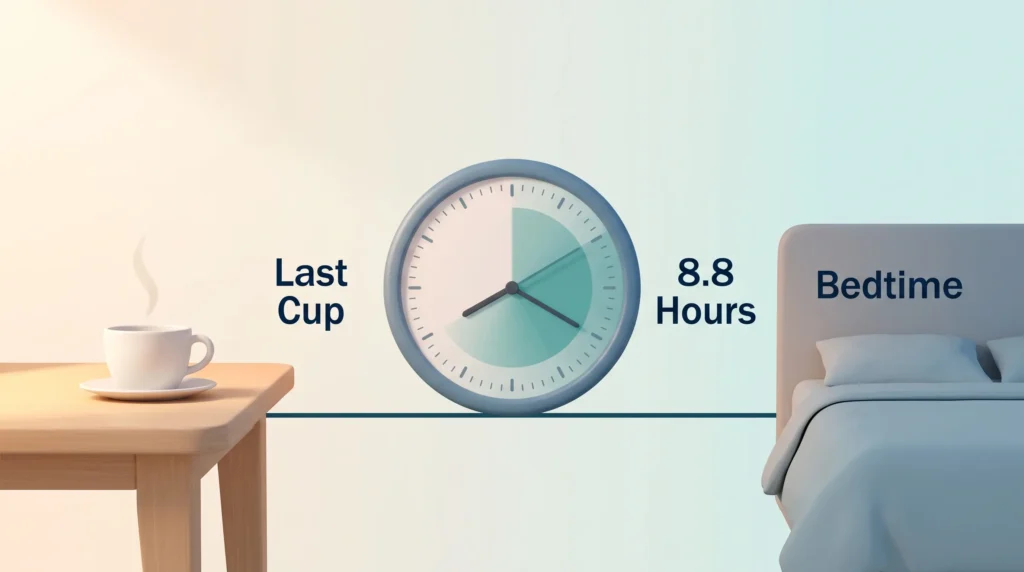
A controlled trial by Drake and colleagues (Journal of Clinical Sleep Medicine, 2013) gave people 400 milligrams of caffeine at bedtime, three hours before bed, and six hours before bed. Even the six hour dose measurably disrupted sleep, and participants often did not notice. A 2023 systematic review and meta-analysis by Gardiner and colleagues in Sleep Medicine Reviews put numbers on the cut-off. Caffeine cut total sleep time by roughly 45 minutes and sleep efficiency by about 7 percent. The authors suggest a standard 107 milligram cup at least 8.8 hours before bed, and a typical 217.5 milligram pre-workout at least 13.2 hours before bed. With an 11 p.m. bedtime, that means coffee before about 2 p.m. They call these figures a starting point: slow metabolisers need a wider gap.
The trap is circular. Lost sleep produces the tiredness that sells you tomorrow’s extra cup, which costs you more sleep. A steady evening routine is a practical place to break the loop.
Caffeine and the Afternoon Dip
The mid-afternoon slump is normal, and lunch is only part of the reason. Caffeine papers over it, but a short walk, daylight or a change of task work without borrowing from your night. Our guide to afternoon slump cures covers the alternatives, and walking meetings get movement into a low hour. Part of the heaviness is not tiredness at all. It is decision fatigue, the drop in judgement that follows a day of choices, and caffeine does little for it.
If you do reach for caffeine here, do it deliberately: when the tiredness arrives, and inside your cut-off. Better still, design around the dip. Matching demanding work to your sharper hours, an idea explored in working with your body’s 90 minute cycles and in the maker versus manager schedule, cuts down how often you need a rescue at all.
When Caffeine Works Against You
Anxiety is the clearest warning sign. Caffeine triggers adrenaline release, which raises heart rate and can feel identical to nervousness. If you are already tense, another cup usually leaves you more agitated, not more focused. Breathing techniques and the basics of managing stress at work are better tools for that. Blood pressure is the second concern: caffeine can cause a short term rise lasting about three hours. For most healthy people that is fine; if yours is already high, ask your doctor.
Tolerance is the quiet one. Drink the same amount daily and the lift fades while the sleep cost stays, so more coffee is rarely the answer. A few lower days usually restore the effect. Caffeine also cannot fix a depleted week: tiredness that survives a full night of sleep points to workload, not dosing, which makes burnout prevention the relevant subject.
A Two Week Self-Test
Rather than copying someone else’s schedule, run an experiment. In week one, change nothing. Write down every caffeinated drink, the time, and a rough milligram estimate from the label. Each evening, rate your morning, midday and afternoon alertness from one to five, and each morning rate the night you just had.
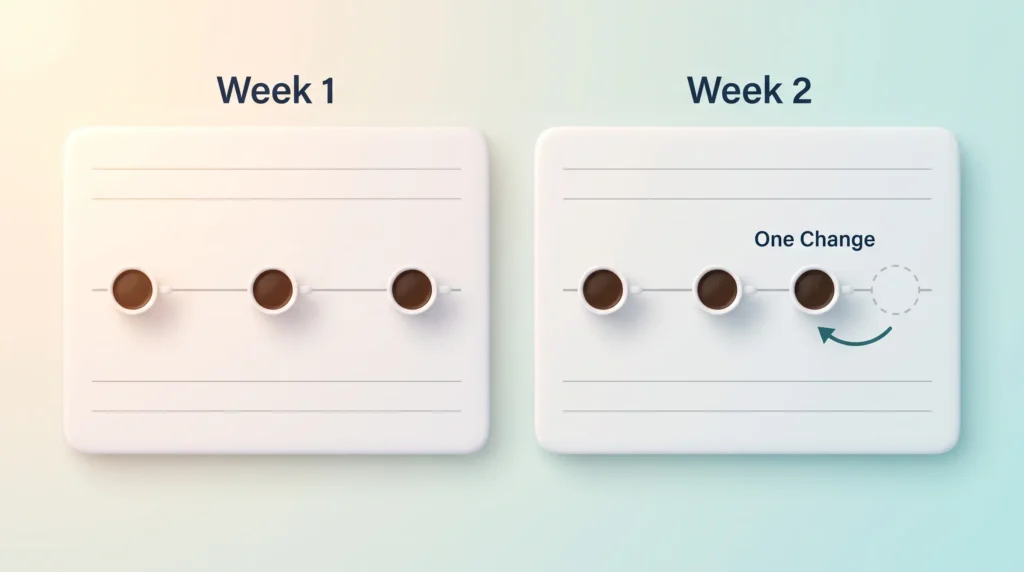
In week two, change exactly one variable: move your last cup two hours earlier, delay your first, or cut your total by a quarter. One change only, otherwise you will not know what did the work. Then compare. You want the smallest daily total that keeps alertness where you need it without pulling your sleep ratings down. A note on your phone is enough, and the method is the same one behind any personal productivity metric. A time audit shows where your energy actually goes.
Conclusion
There is no universal best time for coffee, only a best pattern for you, and two weeks is enough to find it. Three things are worth acting on today. Count your real daily total in milligrams rather than cups. Set a cut-off based on your bedtime and hold it for a fortnight. Use caffeine when tiredness actually arrives, not out of habit.
Everything else, including the delayed first cup, is a preference you can test and discard. Caffeine sharpens hours you already have, but it is a poor substitute for sleep you did not get. It works best alongside solid focus habits, a realistic daily routine and some patience for building your attention span.
Found this useful?
Make SmartKeys a preferred source on Google, and our articles will surface more often in your Top Stories, AI Overviews, and AI Mode.
Add as Preferred Source