A daily routine is simply a fixed order for the parts of your day that repeat anyway. You still decide what to work on. You stop re-deciding when to get up, when to eat, and when to start the hard task.
That matters because every small decision costs a little attention. Spend it on whether to work out this morning, and you have less left for the report due at noon. Researchers call that decision fatigue: the drop in decision quality that comes after making many choices in a row.
This guide gives you a template you can copy and adapt. You will see how habits actually form, what a realistic morning and evening sequence looks like, a sample timeline from wake-up to bed, and what to do when travel or a busy season breaks the pattern.
Key Takeaways
- A routine saves attention by turning repeated choices into defaults.
- Morning and evening anchors give the day a clear start and a clear end.
- New habits take months, not weeks, so add one or two at a time.
- Copy the structure of a template, not its exact clock times.
- A visible checklist beats willpower on busy days.
Why Structuring Your Day Works
Structure removes questions you would otherwise answer from scratch every morning. If Tuesday at 9 a.m. is always your writing block, you do not negotiate with yourself about it. You just open the document.
There is research behind the intuition, though it comes from an unexpected place. In 2017, a team led by Keith Brazendale published the structured days hypothesis in the International Journal of Behavioral Nutrition and Physical Activity. Comparing school days with summer holidays, they found children moved less, watched more screens, and slept less regularly on unstructured days. It is observational evidence about children, not proof about your calendar, but the pattern is suggestive: when the day has no shape, the easy option usually wins.
For knowledge work, the practical payoff is protected attention. A routine reserves a slot for the work that needs uninterrupted thought, which is what makes deep work possible on an ordinary Wednesday rather than only on a quiet Friday.
- Fewer on-the-spot choices: you save attention for work that deserves it.
- A clear sequence: you move through the day on purpose instead of reacting to whatever arrives.
- A defined end: a fixed shutdown time protects the evening and your sleep.
Habits, Routines and Rituals: What the Words Mean
The three terms get used interchangeably, but the difference changes how you build each one.
A habit is a single automatic action triggered by a cue, like starting the kettle the moment you walk into the kitchen. You barely notice doing it.
A routine is a sequence of actions you repeat in the same order. It needs a little attention at first and becomes steady with repetition.
A ritual is the same sequence with meaning attached. Writing tomorrow’s top task is a routine. Writing it, then closing the laptop and saying the workday is over, is a ritual: the meaning is what makes it feel like an ending.
Upgrading a routine into a ritual costs almost nothing. Pick one sequence you already run and add a small marker to it. Before you open email, take three slow breaths and name the one thing that would make the day count. The action barely changes. Its purpose does.
How Habits Actually Form
Most habits run on a loop: a cue triggers an action, and a reward makes the loop worth repeating. Waking up is the cue, making coffee is the action, and the first warm sip is the reward. After enough repetitions, the sequence runs without a decision.
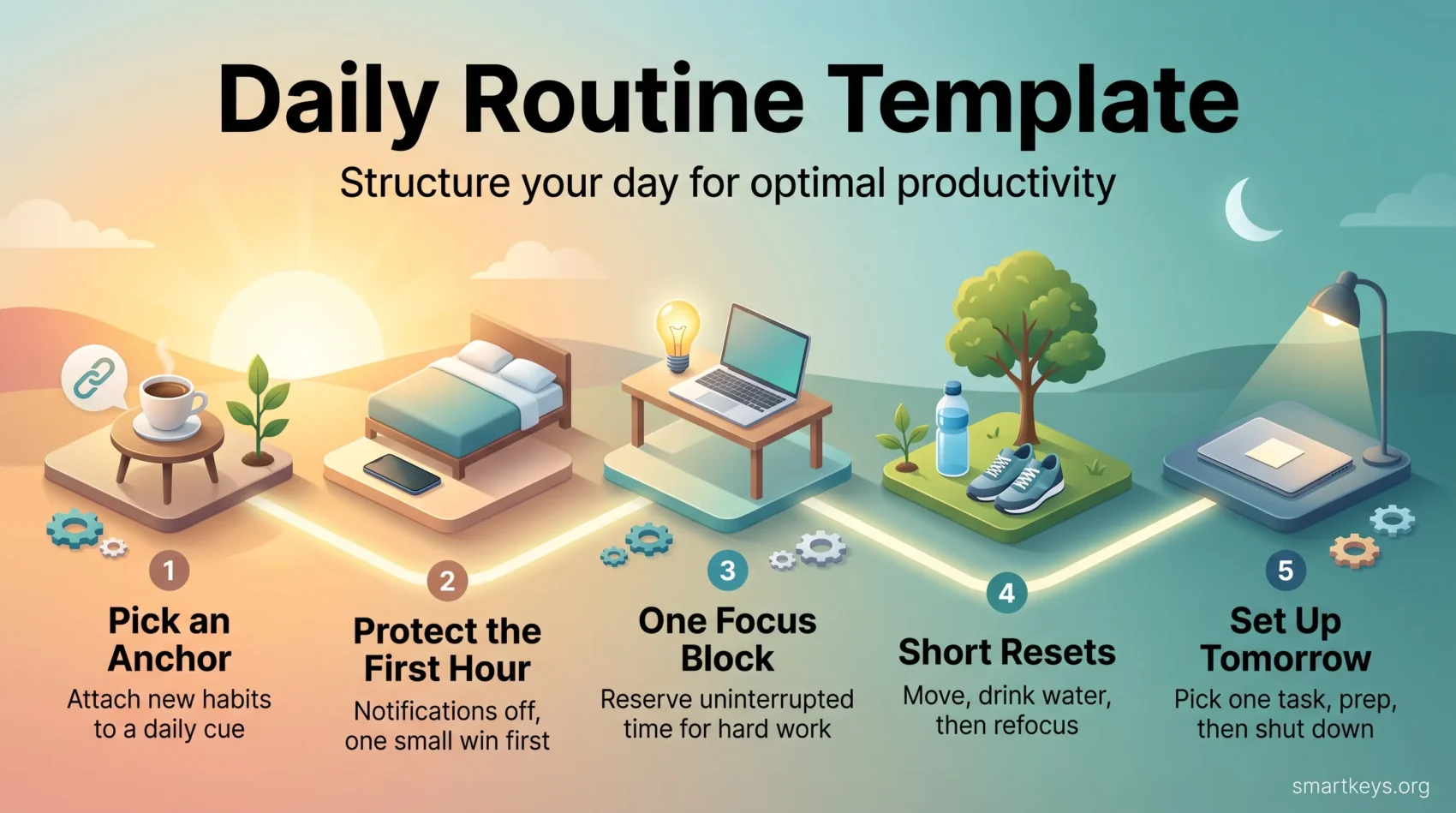
You can use that loop deliberately. Attach the behaviour you want to a cue that already happens reliably. If you make coffee every morning without fail, the four minutes while it brews is a slot you can hand to a single task: writing your top priority on a card.
How long it really takes
The popular figure is 66 days, which comes from a 2010 study by Phillippa Lally and colleagues at University College London. The average was 66 days, but individual participants ranged from 18 to 254 days.
A 2024 systematic review and meta-analysis in the journal Healthcare pooled 20 studies covering 2,601 people and found a median of 59 to 66 days, with a range from 4 to 335 days. Two findings are useful for planning. Habits people chose themselves formed more strongly than habits assigned to them. And simple, clearly cued behaviours, such as flossing, formed faster than complex ones like a full exercise programme.
The practical reading: plan in months, choose your own habits, and start with the simplest version of each. A habit tracker helps here, because it makes a long formation period visible instead of leaving you guessing whether anything is working.
Missing a day is not a relapse
Lally’s data showed that a single missed day did not measurably damage habit formation. What breaks momentum is abandoning the attempt after the miss. Decide in advance what your minimum version looks like: a 10-minute walk instead of a 45-minute run, two sentences instead of a full journal entry.
Build Your Daily Routine in Four Steps
Start with one change and make it stick before adding a second. A full routine designed in one sitting almost never survives its first difficult week.
1. Pick the anchor
Choose an event that already happens every day at roughly the same time: waking, the first coffee, the school run, logging off. That anchor is where the new action attaches.
2. Make the action embarrassingly small
The first version should take under five minutes. Not a workout, but putting your shoes on and stepping outside. Small versions survive bad days, and bad days are what decide whether a routine lasts.
3. Remove the friction
Set out the gear the night before. Put the book on the pillow. Leave the document open. Every obstacle you remove in the evening is a decision you do not make while half awake.
4. Give it a time and a place
Vague intentions fail quietly. Put the block in your calendar with a start time, and use time blocking so the slot is visible to you and to anyone who books your day. If colleagues fill your calendar, a shared focus time policy protects the same hours for the whole team.
Review once a week. Keep what held, drop what did not, and add something new only when the current steps feel close to effortless.
Morning Routine: Protect the First Hour
The first hour sets the terms for the rest of the day. Open your inbox first and you spend the morning on other people’s priorities. Keep messages closed for an hour and you get one block of attention that nobody else has claimed.
Start by silencing notifications overnight so the phone does not hand you a task before you are out of bed.
One win, then one primer
Make the bed. Admiral William H. McRaven made the case for this in his 2014 commencement address at the University of Texas at Austin: one completed task, however small, gives you something finished before the day starts asking things of you.
Then pick a single mindset primer and stick to it. Two minutes of meditation, a short journal entry, or writing the one task that must get done. One is enough. Three is a routine you will abandon by Thursday.
Move, drink, eat
A short walk or a few minutes of exercise raises alertness more reliably than a second coffee. Drink a glass of water before the coffee, since you wake mildly dehydrated after a night without fluids.
Eat something with protein rather than sugar alone, so your energy does not spike and collapse before your first meeting. Our guide to nutrition and productivity covers what that looks like in practice.
If you want more options to test, our roundup of morning routines lists ten you can borrow from.
Evening Routine: Set Up Tomorrow
A good evening routine does two jobs: it removes friction from tomorrow morning and it tells your body the day is over.
Choose tomorrow’s one task tonight
Before you close the laptop, pick the single task that would make tomorrow worthwhile. “Eat the frog” is the usual name for it: do the hardest or most important task first, before the day fills up. Write it down where you will see it, and keep the rest of the list short. Our guides to prioritization and to-do lists go deeper on choosing well.
Wind down the screens and the room
Put screens away 30 to 60 minutes before bed and dim the lights. Sleep hygiene, meaning the habits and conditions that make good sleep more likely, does most of its work in that last hour. Keep the bedroom cool: the Sleep Foundation recommends 65 to 68 degrees Fahrenheit, roughly 18 to 20 degrees Celsius.
A few slow breathing exercises or light stretching gives your body a signal it can read. If you struggle to fall asleep at all, our guide to sleep and productivity covers the underlying habits.
Prep, then stop
Set out clothes, fill the water bottle, load the coffee machine. Each takes seconds now and saves a decision at 6 a.m. Then stop working. A fixed shutdown is what turns the evening into recovery instead of a slower version of the workday. For a full sequence you can copy, see our evening routine guide.
Rituals That Keep Energy Steady During the Day
Two or three small resets spread across the day do more for afternoon focus than one long break. Pick a handful and attach them to cues you cannot miss, like the end of a meeting or finishing lunch.
Stand up and walk for a few minutes after a long call. Refill your water when you get up. These movement breaks are short enough that they cost you nothing and frequent enough that they keep you from stiffening into your chair.
Keep a notebook within reach and write one line each afternoon: what went well, or what is still unresolved. It takes under a minute and stops small worries from circling while you work.
Treat these as recovery, not as extra items on the list. For the wider picture of matching work to your natural energy peaks, see our guide to energy management.
A Daily Schedule You Can Copy
Here is one worked example. Treat the sequence as the template and the clock times as placeholders.
Sample workday
- 6:30 wake, water, make the bed
- 6:45 short walk or 15 minutes of exercise
- 7:15 shower, breakfast with protein
- 8:00 write down the one task that matters today
- 8:15 first focus block, notifications off
- 10:00 break, water, stand up and move
- 10:15 second focus block or meetings
- 12:30 lunch away from the desk, short walk
- 13:30 admin, email, calls
- 15:00 movement break, one line in the notebook
- 15:15 final work block
- 17:30 shutdown: choose tomorrow’s top task, close the laptop
- 21:30 screens off, tidy, prep for morning
- 22:30 bed
Adjusting it to your life
Keep the anchors and move the clock. If you cannot start before 9 a.m., shift every block later by the same amount. If school drop-off owns your mornings, put the focus block after it rather than pretending you will get up at 5.
Two things are worth keeping whatever your hours: one protected focus block, and a fixed end to the workday. Then match the blocks to your goals, so the protected hour goes to work that actually moves something forward.
Tools and Templates That Keep You on Track
The point of a tool here is to make the next step visible, not to add another system to maintain.
A printed checklist for your morning and evening steps is often enough. You tick items instead of remembering them, which is what you want on the days you are tired.
Beyond that, three things help. A habit tracker shows streaks and gaps at a glance. Calendar blocks give your focus time a defended place. Alarms cue the things you forget under pressure, like drinking water or shutting down at 17:30.
Keep one master list and move only today’s tasks into your plan. Copying everything across every morning is how a system quietly turns into digital overload.
Busy Seasons, Travel and Life Changes
When the schedule breaks, shrink the routine instead of dropping it. Name two anchors you will keep no matter what. For most people that is a fixed wake time and a fixed shutdown, because those two protect sleep and stop work from spreading into the night.
On travel days, define the minimum version now: a 10-minute walk and two minutes of stretching count as done. Booking a workout with someone else also helps, because a commitment to another person survives a tired evening better than a commitment to yourself.
After a disruption, restart with one habit rather than all of them. Rebuilding the whole sequence at once is the most common way people end up abandoning it. If the busy season has already left you running on empty, our guide to burnout prevention is the better starting point.
Conclusion
A daily routine is not a stricter version of your calendar. It is a way of spending fewer decisions on the parts of the day that repeat, so more attention is left for the work that matters.
Start with one anchor and one small action attached to it. Give it weeks rather than days. Keep a fixed end to the workday, protect one focus block, and write tomorrow’s top task before you close the laptop.
When it breaks, and it will, restart at the next opportunity with the smallest version that still counts.
Found this useful?
Make SmartKeys a preferred source on Google, and our articles will surface more often in your Top Stories, AI Overviews, and AI Mode.
Add as Preferred Source