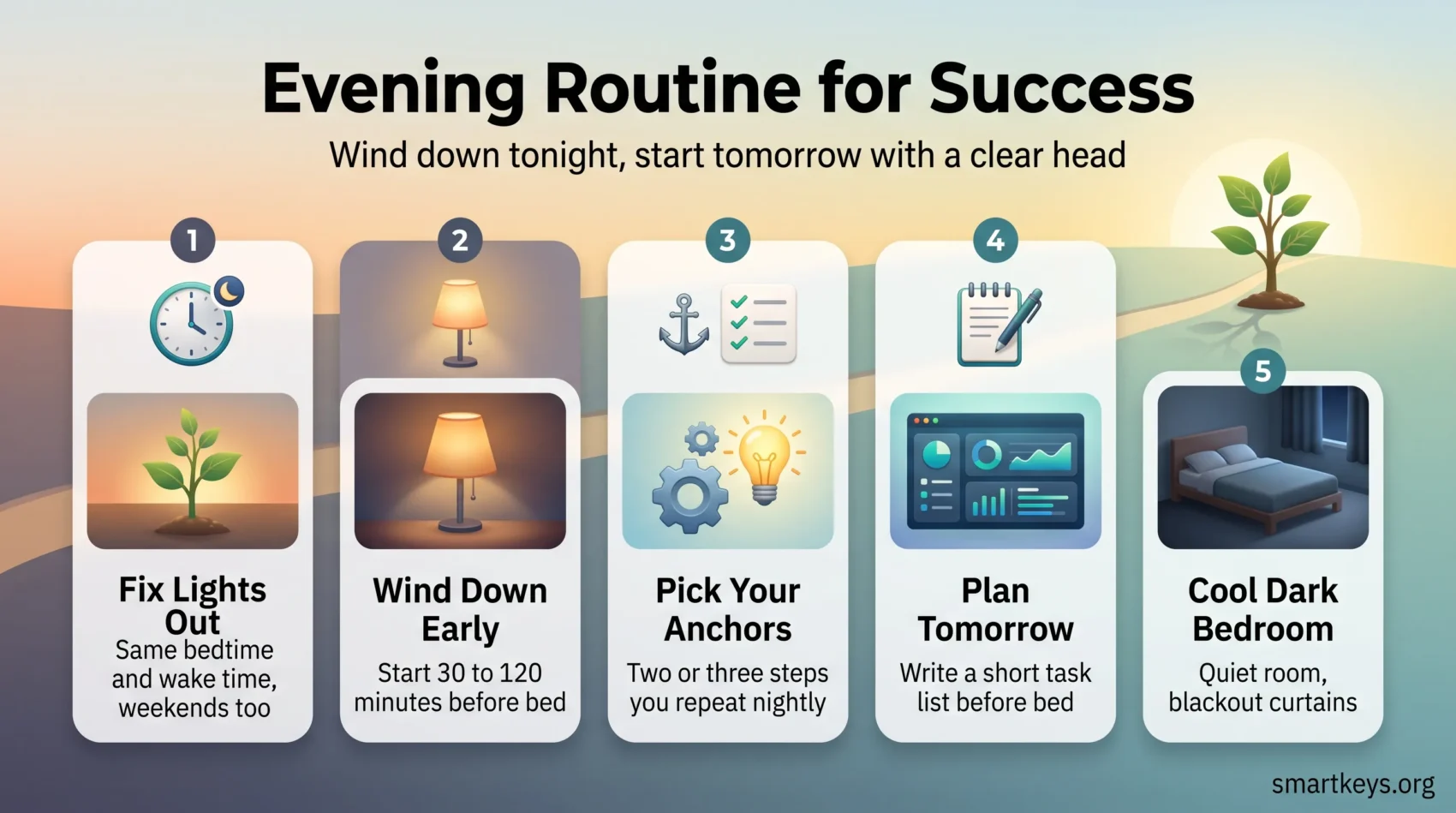
An evening routine is a short, repeatable sequence you run before bed so that the next morning starts without friction. It is not a wellness project. It is two or three small actions in a fixed order: put the phone away, tidy one surface, write down tomorrow’s first task, dim the lights.
The individual steps matter less than the repetition. When the same sequence happens at roughly the same time each night, your brain learns what it means, and winding down stops being a decision you have to make while you are already tired.
This guide shows how to build a routine that survives a normal week. You get a timing window that fits your schedule, a short list of anchors, a menu for low energy nights, and an honest look at what the sleep research actually supports.
Key Takeaways
- Fix your lights out time first. Regular timing does more for sleep than any single evening habit.
- Choose two or three anchors you can repeat on a bad night instead of a ten step ritual.
- What you do on a screen at night matters more than the blue light it emits.
- Write tomorrow’s tasks down before bed. In a controlled study, that measurably shortened the time it took to fall asleep.
- Treat a missed night as data, not failure. Partial consistency still works.
Why Your Evening Shapes Tomorrow’s Productivity
Your body starts preparing for sleep well before you get into bed. Core temperature falls, melatonin rises, alertness drops. A routine works because it gives that process a consistent cue, so sleepiness arrives when you want it to rather than an hour later.
Regular timing beats any single habit
The strongest lever is not a herbal tea or a stretch. It is going to bed and getting up at similar times, weekends included. When your timing is steady, mornings need less willpower. When it swings by two or three hours, no amount of chamomile makes up the difference.
What a calmer evening actually buys you
Here is the concrete version. You finish work at seven, scroll news until midnight, sleep badly, then spend the first ninety minutes of the next day rereading emails you are too foggy to answer. Change one thing, a fixed 10:30 p.m. lights out with the phone in another room, and the same morning starts with a clear head and one decided priority.
That is the real return: fewer wasted morning hours. Pair it with a short plan for the first hour of the day, which our guide to morning routines covers in detail.
Set Your Intention: Rest, Prep, or Connection
An evening can serve one of three purposes, and trying to serve all three is why most routines collapse.

Pick one purpose per night
Rest means low stimulus only: a bath, a novel, an early lights out. Prep means two small wins that clear tomorrow, such as laying out clothes and writing your first task. Connection means an undistracted half hour with a partner, a friend, or your children.
Decide what tonight actually needs. During a heavy work week, prep usually wins. After a draining stretch, rest does.
Aim for an outcome, not a perfect plan
Frame the goal as something you can notice: “wake up clear” or “stop replaying work meetings at 11 p.m.” An outcome like that tells you which steps to keep and which to drop.
If you want one decided priority waiting for you in the morning, the Ivy Lee method is the shortest version: write down the next day’s six tasks in priority order, then stop.
Design Your Timing: When to Start and How Long
Set lights out before you set anything else
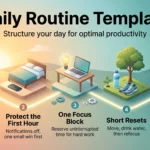
Choose a realistic lights out time and a wake up time, and hold both within about an hour on weekends. Everything else in this guide is built backwards from that pair. If you pick a bedtime you never actually keep, the rest of the routine has nothing to attach to.
Start winding down 30 to 120 minutes before bed
Pick the window that matches your life. Thirty minutes covers a basic set of anchors. Sixty leaves room for a bath or a chapter. Two hours suits people who need a long runway before they stop thinking about work.
Set an alarm for the start of the window, not just for bedtime. A phone reminder at 8:40 p.m. costs nothing and removes the decision at the moment you are least able to make it.
- Split the window into three blocks: unplug, hygiene, relax.
- Keep a short version for late nights and a longer one for calm nights, both ending at the same lights out.
- Note your real start time for a week and move the alarm if it never fits.
If your evenings keep collapsing because the workday never quite ends, the problem is upstream of your bedtime. Protecting structured downtime and drawing a clearer line at the end of the working day will do more than any wind down sequence.
Match the Routine to the Energy You Actually Have
Your 10 p.m. self is not your 10 a.m. self. Plans written by the morning version tend to fail at night, because they assume energy you no longer have.
Sort your habits into easy and draining
Spend a week noting which evening tasks feel effortless and which you keep avoiding. Folding laundry might be soothing for you and unbearable for someone else. Build the routine on the easy ones only, and leave the draining tasks in daylight.
Keep two modes
- Structured: two anchors plus one relaxing choice, for calm nights.
- Flexible: one gentle win, for nights when you have nothing left.
- A visible cue: a three line checklist by your phone charger, so there is nothing to decide.
“Small anchors beat big intentions when your energy is low.”
Adjust the plan as work, family, or health change. A routine that only works during quiet months is not a routine.
Your Evening Routine: Anchors and a Menu
A clear set of nightly anchors moves you from busy to calm without rethinking each step. Use three to five non-negotiables as the spine, then keep a short menu you pick one item from.
Anchors versus menu items
Anchors are what you do on almost every night: a phone curfew, ten minutes of hygiene, dimming the lights. They work as a signal precisely because they are boring and repeatable.
Menu items are the variable part: a short meditation, a chapter of fiction, five minutes of stretching, a cup of herbal tea. Pick one. Picking three turns your evening into another to-do list.
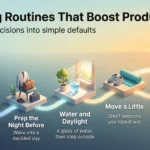
Attach the first anchor to something you already do without thinking. Habit stacking works better here than willpower, because an existing habit does the reminding for you.
A sample sequence
- Put the phone on Downtime and switch it to grayscale so news and social apps stop pulling.
- Spend about ten minutes on hygiene and skincare.
- Dim to warm light and change into what you sleep in.
- Write tomorrow’s tasks in two minutes. A quick brain dump is enough.
- Choose one menu item: read, stretch, or breathe.
- Lights out at your set time.
Run the sequence for a week, then keep the steps that made falling asleep easier and cut the rest. The same trimming logic that keeps to-do lists useful applies to evening rituals: the short version is the one you keep.
Screens at Night: What Actually Matters
The blue light story is smaller than it sounds. A 2024 review in Sleep Medicine Reviews, led by sleep researcher Michael Gradisar, pooled eleven studies and found that evening screen use delayed sleep onset by roughly ten minutes on average. Even a bright phone screen sits near 80 lux, well below the level of light needed to shift the body clock.
So the filter on your display is not the main issue. What keeps you awake is what the screen does to your attention: an argument in a comment thread, a work email that starts a new plan in your head, one more episode at 11:45 p.m. Arousal, not wavelength.
Cut the pull, not just the light
Phone settings still help, because they make the decision for you at the moment you are least likely to make it well.
- Downtime or Focus modes that lock social and news apps during your wind down window.
- Grayscale, which strips most of the visual reward out of scrolling.
- App limits, so the willpower is spent once, when you set them, rather than every night.
- Website blockers on the laptop, if that is where your evening actually disappears.
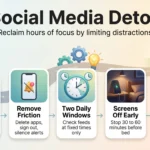
If your evenings regularly vanish into feeds, a short social media detox resets the habit faster than nightly resistance does.
Swap in something that ends by itself
Feeds are built not to finish. A paper book, one podcast episode, or a stretch sequence all stop on their own. That built in ending is what gets you into bed, not virtue.
Make the Bedroom Work For You
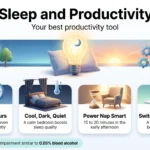
Cool, dark, and quiet is a signal your body reads reliably.

Temperature, darkness, and devices
The Sleep Foundation puts the useful range at 65 to 68 degrees Fahrenheit, roughly 18 to 20 degrees Celsius, because your body has to shed heat in order to fall asleep. Blackout curtains handle street lighting and early summer sunrises. Charge devices in another room so that notification buzzes and standby LEDs cannot reach you.
Warm light late, bright light early
Use a low wattage bedside lamp or a dimmable bulb with a warm tone in the last hour. Bright overhead light late at night works directly against the signal you are trying to send. The same principle applies in reverse at your desk, where brighter, cooler light supports alertness. Our guide to workspace lighting covers the daytime side.
Sound: masking, not magic
White or pink noise mainly hides sudden sounds such as traffic or a neighbour’s door, which is genuinely useful if you live somewhere loud. There is research behind pink noise specifically: a 2017 study in Frontiers in Human Neuroscience found that pink noise timed to brain waves deepened slow wave sleep in older adults. That was laboratory equipment used on a small group, not a bedside app, so treat a noise machine as a way to mask disturbances rather than as a way to upgrade your sleep.
Ways to Wind Down That Hold Up
Breathing and muscle relaxation
Slow breathing with a longer exhale than inhale settles the nervous system within a few minutes. Inhale for about four seconds, exhale for about six. Progressive muscle relaxation is the other dependable option: tense one muscle group for a few seconds, release it, then work upward from feet to face. Our overview of breathing techniques has the variations worth trying.
Gentle movement
Five minutes of slow stretching for hips, back, and neck releases the tightness a desk day leaves behind. Keep it slow enough that it calms you rather than waking you up. If you sit for most of the day, short movement breaks while you work make the evening version far easier.
Meditation, music, and waking at 3 a.m.
A short guided meditation gives circling thoughts somewhere to go. Music helps some people and distracts others, so test it instead of assuming.
If you wake in the middle of the night, start with slow breathing rather than your phone. It is the fastest route back to sleep and it does not restart the whole wind down.
Read and Write: Two Minutes That Save an Hour
Why the bedtime to-do list works
This is the best evidenced habit in the routine. In a 2018 study in the Journal of Experimental Psychology: General, 57 adults spent five minutes writing before bed in a sleep laboratory. Those who wrote a to-do list for the days ahead fell asleep faster than those who wrote about tasks they had already completed. Getting the task onto paper appears to stop your mind from rehearsing it.
Keep the list short and specific. “Draft the client email first thing” parks the task. “Sort out the client situation” does not, because your brain still has to plan it.
Fiction beats analysis at 11 p.m.
Dense nonfiction invites you to argue and plan, which is the opposite of winding down. Fiction slows thought. Read outside the bed in warm light and get in only once your eyes feel heavy, so the bed stays associated with sleep rather than with lying awake.
If you prefer writing to reading, three prompts are enough: What went well today? What is tomorrow’s first move? What can wait? A regular journaling habit does the same job as the list, with a little more room for what is bothering you.
Food, Tea, and a Warm Bath
The bath is the strongest lever here
A 2019 meta-analysis in Sleep Medicine Reviews, by researchers at the University of Texas at Austin, found that a warm bath or shower at 104 to 109 degrees Fahrenheit, taken one to two hours before bed, shortened the time to fall asleep by about ten minutes on average. The mechanism is the cool down afterwards: warming your skin pushes heat out of the body, and the temperature drop that follows reads as a sleep signal.
What to eat, and what to skip
Heavy meals, alcohol, and nicotine close to bedtime all fragment sleep. Alcohol is the sneakiest of the three, because it buys a fast start at the cost of the second half of the night.
Kiwifruit and tart cherry juice come up repeatedly in sleep research, but the trials so far are small pilot studies rather than large ones. Treat them as low risk experiments worth a week, not proven remedies. The wider link between what you eat and how well you function is covered in our guide to nutrition and productivity.
Herbal tea works mostly as a ritual, which is not nothing: a warm cup at the same time each night is a perfectly good anchor. Finish it 30 to 60 minutes before bed so you are not awake at 3 a.m. for the bathroom.
Make It Stick
One tiny step, repeated, builds more momentum than a full overhaul.

Start with one habit, not seven
Add a single action and let it run for two weeks before adding another. Tie it to something already automatic, such as 30 seconds of breathing straight after you brush your teeth. That is the logic behind micro habits: the step is small enough that a bad day cannot break it.
Track lightly
A simple habit tracker or a row of checkmarks is enough. Look at it once a week for five minutes and ask which anchor actually helped. Drop whatever does not earn its place.
Missed nights are normal. Two in a row is a signal to shorten the routine, not to abandon it. If your evenings keep collapsing because work runs late, the fix belongs in the workday: chronic overrun is one of the clearest early warnings of burnout, and no bedtime ritual repairs it.
Three versions, not one
Write a busy weeknight version, a weekend version, and a travel version. The anchors stay the same and only the menu changes. On the road that might be earplugs, one breathing exercise, and a phone curfew. The routine that survives a hotel room is the one you will still have in six months.
The evening is one half of a loop. It works best when it connects to a stable daily routine and hands off cleanly to your morning routine on the other side of the night.
Conclusion
An evening routine is not a list of virtuous habits. It is a fixed lights out time, two or three anchors you can manage on a bad night, and a short menu for everything else.
Start with the timing, since that is where the evidence is strongest. Add the two minute task list, because it is cheap and it works. Then adjust the bedroom, the light, and the screens until the last hour of your day stops fighting the first hour of the next one.
Found this useful?
Make SmartKeys a preferred source on Google, and our articles will surface more often in your Top Stories, AI Overviews, and AI Mode.
Add as Preferred Source