Habit stacking is a simple planning trick: you attach a new habit to something you already do every day without thinking about it. The finished routine becomes the cue for the new behaviour. Pour your morning coffee, then write down the three tasks that matter today. Close the laptop at the end of the day, then set out tomorrow’s clothes.
The appeal is that you stop relying on memory and motivation. You already make coffee. Adding one small step to a routine you never skip is far easier than building a new routine from nothing.
This guide explains how habit stacking works, what the research actually supports, how to build your first stack, and where the method quietly falls apart.
Key Takeaways
- Habit stacking links a new habit to an existing routine, so the old habit becomes the trigger for the new one.
- The strongest evidence sits behind the format itself: a specific “after X, I will Y” plan beats a vague intention.
- Habits take much longer than the famous 21 days. A 2024 review put the median at roughly 59 to 66 days.
- Start with one or two stacks, and keep each new habit small enough to finish in about two minutes.
- Morning anchors and habits you picked yourself tend to stick better than evening ones assigned to you.
- Small habits compound and build the base for achieving larger goals over time.
Introduction to Habit Stacking
Most advice about new habits starts in the wrong place. It tells you what to do, but not when. “Read more” and “stretch every day” are wishes, not plans, and they compete with everything else in your day for attention.
Habit stacking fixes the timing problem. You pick a moment that already happens reliably, then attach the new behaviour to it. The old habit does the remembering for you.
Behaviour scientist BJ Fogg built this into his Tiny Habits method, where an existing routine acts as the anchor for a small new behaviour. James Clear popularised the same idea in Atomic Habits under the name habit stacking. Both use one sentence: “After I [current habit], I will [new habit].”

The method is not magic. It will not make you want to do something you hate. What it does is remove the two most common failure points: forgetting, and deciding in the moment whether you feel like it. It works best as one tool inside a wider approach to staying disciplined and consistent day to day.
What is Habit Stacking?
Habit stacking means linking a new behaviour to an established one, so that finishing the first prompts the second. In plain terms, you borrow a cue you already have instead of inventing a new one.
The formula is deliberately rigid: after I [current habit], I will [new habit].
Rigid is the point. “I’ll meditate more” gives your brain nothing to latch onto. “After I pour my morning coffee, I will sit down and breathe for two minutes” names the moment, the place and the action.
Note what habit stacking is not. It is no productivity system and it prioritises nothing. It gets a specific behaviour to happen at a specific time, no more. Deciding which behaviours deserve that slot still needs clear goals or a daily routine you have thought through.
Why Habit Stacking Works
Every habit needs a cue. Left to chance, cues are unreliable: you meant to stretch, but the phone rang. An existing routine is a cue that already fires every single day, which is why anchoring to one raises the odds so much.
There is solid research behind this format. Psychologists call it an implementation intention, an if-then plan that names exactly when and where you will act. A meta-analysis by Peter Gollwitzer and Paschal Sheeran covering 94 independent studies found such plans had a medium-to-large effect on reaching goals (d = 0.65) compared with intentions alone. Habit stacking is an implementation intention with a routine as the trigger instead of a clock time.
There is a second, smaller benefit. You stop spending attention on the decision. Once “after coffee, plan the day” is settled, the choice is made in advance and the moment passes without an argument. That matters most later in the day, when decisions have piled up and willpower is thinner. It is the same reasoning behind time blocking: decide once, then follow the plan.
One honest caveat. There are no controlled trials of habit stacking as a branded technique. The support comes from the underlying research on cues and if-then plans, which is well established. Claims that habit stacking produces a specific percentage gain in output are marketing, not evidence.
How to Habit Stack Effectively
Start with one stack. Not five.
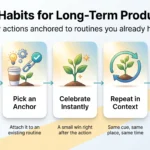
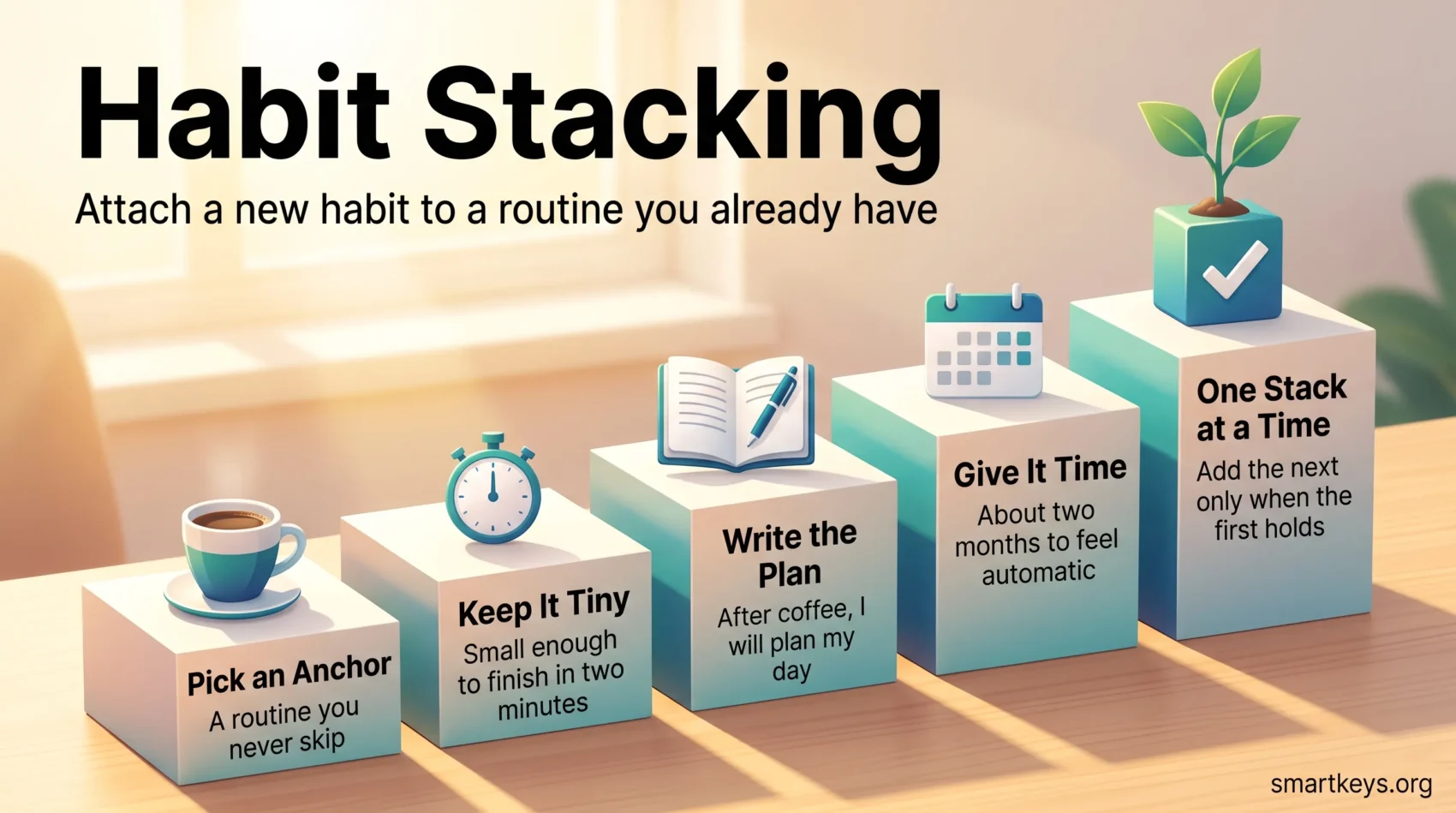
Pick an anchor you never skip. Making coffee, brushing your teeth, sitting down at your desk, closing your laptop. If you skip it twice a week, it is not an anchor.
Make the new habit small. Small enough that you cannot reasonably talk yourself out of it: two pages, five squats, one sentence in a journal. The two-minute rule is a useful test. You can always do more once you have started, and starting was the hard part.
Write the sentence down. Literally: “After I [X], I will [Y].” Vague plans fail quietly.
Prepare the physical setting. If the new habit is stretching after your morning coffee, the mat belongs in the kitchen, not the spare room.
Give it weeks, not days. This is where most guides mislead. The famous 21-day figure comes from the 1960 book Psycho-Cybernetics by plastic surgeon Maxwell Maltz, who noticed that patients took about three weeks to adjust to a changed appearance. It was never a study of habit formation.
The real numbers are less tidy. A systematic review published in the journal Healthcare in December 2024, covering 20 studies and 2,601 participants, found a median of roughly 59 to 66 days before a health behaviour felt automatic. Individual times ranged from 4 to 335 days. Expect a couple of months, and expect your own timing to differ from the average.
Defining Your Goals for Habit Stacking
Before you pick a habit, decide what you are actually trying to change. “Be more productive” is too broad to act on.
Ask a narrower question: what specifically goes wrong in your week? Perhaps you finish days without touching your most important project. Perhaps you sit for eight hours straight. Perhaps your inbox eats the first hour every morning. Each of those points at a different habit.
That same 2024 review found habits people chose for themselves produced stronger automaticity than habits assigned to them. So choose a habit you actually want, not the one you think you should want.
Then keep the scope honest. A stack is a small daily action, not a project. Reading five pages after breakfast is a stack. “Write a book” is not. If your target is large, split it into micro-goals first, then find the daily action that moves one of them.
Sir Dave Brailsford, who led British Cycling, called this the “aggregation of marginal gains”: many small improvements adding up to a result no single change could produce. That is a fair description of what a working habit stack does over a year.
Identifying Your Jumping-Off Habits
Your jumping-off habits are the things you already do on autopilot. Spend a day noticing them. Most people find between ten and twenty: the alarm, the shower, the first coffee, the commute, opening email, lunch, the end-of-day shutdown, brushing teeth.
Write them out in order. The list itself is useful, because it shows where the gaps in your day are.
Then match each new habit to an anchor that fits it in mood and location:
- After I pour my morning coffee, I will write down the three tasks that matter today.
- After I shut down my computer at the end of the workday, I will turn off Slack and email notifications on my phone.
- After I finish lunch, I will walk outside for ten minutes.
- Before I check social media, I will set a five-minute timer.
Fit matters more than people expect. Stacking demanding, focused work directly onto a noisy social routine rarely holds, because the two states are too far apart. Anchors that end in calm suit reflective habits; anchors that end in movement suit physical ones.
Timing matters too. The 2024 review found morning practice produced stronger habits than evening practice, particularly for exercise. If a habit keeps failing at 9pm, try moving it rather than trying harder. A settled evening routine is still worth having, but it is the harder slot to build in.

Simple Habit Stacking Examples
The examples that survive are the boring ones. Here are stacks people actually keep.
Morning. After I fill the kettle, I will take my vitamins. After I sit down at my desk, I will write my single most important task on a sticky note. If you are building a wider morning routine, add one link at a time rather than designing the whole chain at once. A consistent morning routine is built the same way, one anchor after another.
Work. After I finish a meeting, I will spend two minutes writing the follow-up action before opening anything else. After my first coffee break, I will start one Pomodoro session on the task I have been avoiding.
Movement. After I hang up from a phone call, I will stand and stretch. After I brush my teeth in the evening, I will lay out my running clothes. Short movement breaks stack particularly well, because the anchors are frequent and the action takes seconds.
Evening. After I load the dishwasher, I will read for ten minutes. After dinner, I will ask each person at the table one question about their day.
You can also pair a habit you resist with something you enjoy, a trick known as temptation bundling: the podcast you like only plays while you fold the laundry.
Creating a Habit Stacking System
Once one stack holds, a system is just the paperwork that keeps the rest from collapsing into each other.
Write your anchors in one column and your new habits in the next. Seeing them side by side exposes the collisions. Three habits all hanging off “after breakfast” is three habits competing for the same two minutes.
Keep the list short. One or two active stacks is a reasonable load. Add the next one only when the current stack happens without you thinking about it.
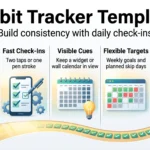
Track it simply. A paper habit tracker, a row of boxes in a notebook or a basic app all work. The purpose is feedback, not data: a visible chain of days tells you at a glance whether the stack is real or aspirational. Elaborate tracking becomes its own procrastination, so if you catch yourself designing a dashboard instead of doing the habit, simplify.
Finally, plan for the days it breaks. Travel, illness and busy weeks interrupt any chain. Missing once is noise. Missing four days in a row usually means the anchor is wrong or the habit is too big.
Tips for Successful Habit Stacking
Effective habit stacking is mostly a matter of keeping the first version smaller than feels necessary, then protecting it.
- Shrink it until it feels trivial. If a habit fails twice, halve it rather than pushing harder.
- Be specific about the trigger. “In the morning” is not a cue. “After I pour my coffee” is.
- Prepare the environment the night before. The mat, the book and the notebook should already be where the habit happens.
- Use accountability if you need it. Telling someone, or checking in with an accountability partner, raises the cost of quietly dropping the habit.
- Expect an off week. Restarting after a break is normal maintenance, not failure, and treating it that way is most of what people mean by self-discipline.

How to Measure Productivity Increases
It is tempting to skip measurement, but without it you cannot tell a habit that is working from one that is merely comfortable. Two things are worth tracking, and they answer different questions.
Did the habit happen? This is the simple one: a tick per day. After a few weeks the pattern is obvious, and you will usually be able to name the days it fails and why.
Did it change anything? This is harder and more useful. Pick one outcome the habit is supposed to move, then watch that. If the stack is “after coffee, plan the day”, the outcome might be how often you finish your most important task. If it is a stretching habit, it might be how your back feels by Friday.
Give it four to six weeks before judging. Softer signals count too: less friction starting work, fewer forgotten follow-ups, a calmer end to the day. Those are real effects even though they resist a spreadsheet. Setting a short daily intention in the morning gives you something concrete to compare the evening against.
Common Mistakes in Habit Stacking
Adding too many at once. The most common failure. Five new habits on Monday is five chances to feel like you failed by Thursday. One at a time.
Starting too big. “After work, I will go to the gym for an hour” is a plan, not a habit stack. “After I get home, I will put on my running shoes” is a stack, and it is the part that actually decides whether the run happens. Micro-habits work because they are too small to argue with.
Choosing an unstable anchor. If your anchor is “after my morning meeting” and the meeting moves twice a week, the habit moves with it.
Mismatching the mental states. Trying to go straight from a stressful call into deep work ignores how long it takes to settle. Give the transition its own small step.
Treating one missed day as the end. This is what turns a wobble into procrastination. Miss once, restart the next day, and the chain barely notices.
Stacking a habit you do not want. No cue survives sustained resistance. If you dread the habit every single day, the problem is the habit, not the trigger.
Conclusion
By attaching a new behaviour to a routine you already have, habit stacking solves the two problems that kill most new habits: remembering to start, and deciding whether you feel like it.
Keep the expectations realistic. Expect roughly two months before a stack feels automatic, expect your own timing to differ from any average, and expect to adjust the anchor once or twice before it holds. Start with one stack, keep it small, and write the sentence down.
The effect is cumulative rather than dramatic. One habit added to your morning coffee will not transform a week. Added to eighteen months of mornings, alongside regular movement and a routine you can actually keep, it changes what a normal day looks like.
Found this useful?
Make SmartKeys a preferred source on Google, and our articles will surface more often in your Top Stories, AI Overviews, and AI Mode.
Add as Preferred Source