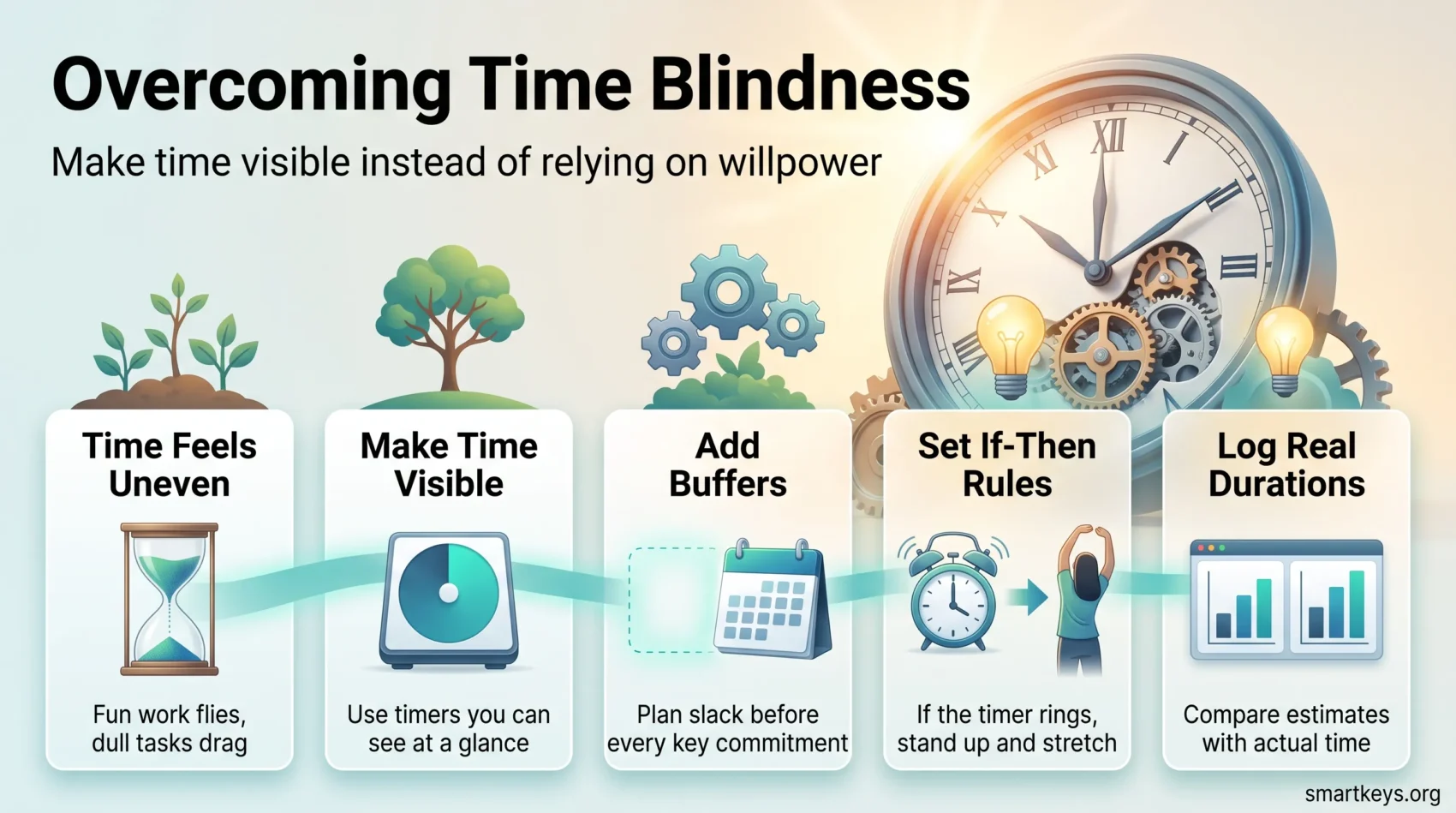
Losing track of time is not a discipline problem. The phrase time blindness describes one specific difficulty: you cannot feel how fast time is passing, so you misjudge how long a task will take and how much of your day is left.
The pattern is familiar even if the label is not. An hour with something you enjoy disappears. Twenty minutes of paperwork feels like a whole afternoon. The reason sits in how your brain hands out attention, not in how much you care about the work.
This guide explains what is actually happening, how to spot the pattern in your own week, and which fixes hold up in practice. You will not need to rebuild your entire system. Almost everything that works here is small: a visible timer, a buffer before a deadline, one rule that tells you when to stop.
Key Takeaways
- Time blindness is a difficulty judging elapsed time. It is a description, not a diagnosis.
- Enjoyable work speeds time up. Low-interest work stretches it out.
- Research links measurable timing errors to ADHD across every kind of timing task tested.
- External cues beat willpower: timers, alarms, buffers and written plans.
- Logging what tasks really take is the fastest way to fix bad estimates.
What Time Blindness Is, and What It Is Not
Time blindness is not a medical diagnosis and appears in no diagnostic manual. It is a plain-language label for a gap between how much time has passed and how much time you think has passed. You finish a task and are genuinely surprised by the clock.
That gap is measurable. A systematic review and meta-analysis by Marx and colleagues, published in the Journal of the American Academy of Child and Adolescent Psychiatry in 2021, pooled 55 studies of timing ability in ADHD. (A meta-analysis combines the results of many separate studies to see whether an effect holds up overall.) People with ADHD were worse at every kind of timing task the researchers looked at. Telling two short signals apart showed a medium-sized deficit across 25 studies and 1,633 participants. Reproducing a duration they had just experienced showed a medium-sized increase in error across 26 studies and 2,364 participants.
In short: this is a real, repeatedly measured pattern, not a character flaw. It also is not limited to ADHD, and having it does not mean you have ADHD.
Why enjoyable work makes hours disappear
Your brain runs attention in two rough modes. Automatic attention is what engaging work pulls out of you. You are not forcing yourself; the task holds you. In that state you can drop into hyperfocus, a stretch of intense absorption where the outside world stops registering. Hyperfocus is why a coding session, a design file or an interesting rabbit hole can eat four hours that felt like one.
The pull is strongest for anything with fast feedback: games, messages, social feeds, editing. You are not choosing to lose the afternoon. The feedback loop is simply doing what it was built to do.
Why “have to” tasks drag
Directed attention is the effortful kind. It is what you spend on expense reports, insurance forms and anything with no immediate reward. Directed attention tires quickly, and while you are spending it, time feels slow. A twenty-minute form genuinely feels longer than a twenty-minute conversation.
Two practical consequences follow. You avoid the dull task because it feels bigger than it is. And once you start it, you underestimate how much of it remains. Reducing digital fatigue helps here, because tired attention distorts time estimates even further.
Signs You Might Be Losing Track of Time
Individually these look like ordinary bad days. The signal is the repetition.
- You are late often, even for things you care about and left early for.
- You miss deadlines you had every intention of meeting.
- You start tasks and leave them at eighty percent.
- Your estimates are wrong in a consistent direction, usually too optimistic.
- You need other people to prompt you before you switch tasks.
- You pack a day with more than any day could hold, then scramble.
That last point has a name beyond ADHD. The planning fallacy is the well-documented tendency of almost everyone to underestimate how long their own projects will take, even when they remember the last one running over. Time blindness makes an already common bias considerably worse.
Unfinished work adds a second cost. Open loops, the tasks you started and never closed, keep claiming attention in the background, which leaves less of it for the thing in front of you.
How Executive Function Shapes Your Sense of Time
Behind planning, starting and finishing sits a set of mental control skills called executive function: holding information in mind, resisting impulses, sequencing steps and monitoring your own progress. Timing depends on all of them.

The prefrontal cortex as your brain’s conductor
The prefrontal cortex, the region behind your forehead, coordinates those skills. Developmental behavioural paediatrician Dr. Geeta Grover uses an orchestra image to explain it in UCI Health’s patient material.
“Imagine your brain is like a big orchestra. This prefrontal part of your brain is the conductor of the orchestra.”
A conductor does not play anything. It decides what starts, what stops and what comes next. When that coordination runs differently, the individual abilities can be perfectly intact while the timing of the whole performance slips. Grover is direct about what this means for blame: “It is not willful. Time blindness is part and parcel of the executive function skills deficits.”
Conditions that change how you experience time
ADHD has the strongest evidence base, but it is not the only route to the same experience. Autism, depression, anxiety and poor sleep all change attention, motivation or energy, and all three of those feed into your sense of duration. Chronic stress does the same thing.
This matters for how you choose fixes. If your timing slips mainly when you are exhausted, fixing sleep will do more than another app. If it slips all the time regardless of sleep, external structure is the better bet.
What It Actually Costs at Work and at Home
Small slips compound into expensive ones. A missed internal deadline becomes a rush fee. A pattern of lateness becomes a line in a performance review. At home, a missed handoff becomes an argument that looks disproportionate to the ten minutes that caused it.
The reputational damage is usually worse than the practical damage, because colleagues read chronic lateness as indifference. That reading is wrong, but it is the default one. Saying plainly that you are bad at estimating time and here is the system you use to compensate tends to land far better than another apology.
Quick Self-Check
Answer these honestly. Write the answers down rather than thinking them through, because the written version is harder to soften.
- When you guess how long a routine task takes, how far off are you, and in which direction?
- Which specific activities reliably swallow more time than you intended?
- How many external prompts do you need in a normal day to switch tasks on time?
- Does your sense of time shift predictably with stress, boredom or tiredness?
- Is this occasional, or has it been the pattern for years?
If most answers point the same way, pick one behaviour to change this week and one thing to measure. A structured walk-through of that exercise is in our guide to taking control of your day with time audits. If the pattern is long-standing and it is damaging your work, studies or relationships, it is worth raising with a clinician.
Plan Your Day So That Time Is Visible
The goal of planning here is not a tidier calendar. It is making elapsed time visible to a brain that does not track it on its own.
Build buffers before anything that matters
Add slack before every fixed commitment. A practical default is 30-60 minutes before anything you genuinely cannot be late for, and 15 minutes between meetings. This is the core idea behind time buffering: the buffer is not wasted time, it is the cost of not arriving unprepared.
Front-load whatever you can the night before. Bag packed, documents printed, clothes out. Morning friction is where buffers usually get eaten.
Chunk work and block it with honest estimates
Break large work into pieces with a visible finish line, then put those pieces on the calendar with a start and a stop. Time blocking works well for this, because a block on a calendar is an external cue and your internal sense of duration is not.
Three rules make the blocks hold:
- Sequence by energy. Put the hardest chunk where you are freshest, not where the calendar happens to be empty.
- Set two alarms per transition. One to wrap up, one to actually move. A single alarm gets absorbed.
- Write the estimate down before you start. You cannot correct an estimate you never recorded.
Watch the opposite failure too. Parkinson’s Law says work expands to fill the time available, so blocks that are too generous create their own drift.
Tools That Make Time Visible
The useful tools all do the same job: they move timekeeping out of your head and into the room.
Timers you can see, not just hear
A countdown you can glance at beats a number you have to read. Visual timers show a shrinking coloured disc, so remaining time registers without you doing any mental arithmetic. Sand timers in 5, 15 and 30 minute sizes do the same job with no battery and no screen.
Pair one visual timer with one audible alarm. The visual one keeps you oriented while you work. The audible one interrupts you when you have stopped looking.
Structured work intervals
If open-ended work reliably runs long, a fixed interval gives you a built-in stopping point. The Pomodoro Technique is the best known version: a set work period, a short break, repeat. The break is not the point. The forced check-in is.
Checklists, boards and reminders
Keep the day’s top three items somewhere you cannot avoid looking, with a visible “doing” and “done” split. Crossing something off gives you a concrete marker of progress, which is exactly what an unreliable internal clock fails to supply.
For fixed dates, stop relying on memory entirely. Automated reminders with a lead time you set once will outperform any amount of intending to remember. It helps to capture every task in one trusted place first, so the reminders fire on a list that is actually complete.
Routines and Environment Tweaks
Every decision you do not have to make is attention you keep for the work.
Same shape most days
A repeatable structure removes dozens of small choices. A daily routine template does not need to be rigid to help; it only needs a fixed start, a fixed review point and a fixed end. Keep a launchpad by the door with keys, wallet and laptop so leaving the house is one action rather than five.
Group similar work together. Every switch between different kinds of task costs you orientation time you will not notice losing. Single-tasking through one batch is faster than alternating, even when alternating feels more responsive.
Cut the inputs that pull you under
Set a no-scrolling rule for the 30-60 minutes before any departure or meeting. That window is where most lateness is created.
Beyond that window, remove the pull rather than resisting it. Website blockers handle the sites you cannot leave alone, and managing work notifications stops your attention being reset every few minutes. Protecting longer stretches this way is also the entry point to deep work.
Short resets
One minute of slow, deliberate breathing before a demanding task re-anchors your attention to the present. Simple breathing techniques take no equipment and no preparation, which is why they survive busy weeks when longer practices do not.
If-Then Rules for Getting Out of Hyperfocus
The hard part of hyperfocus is not noticing that you should stop. It is that noticing arrives too late to matter. An if-then rule, known in the research literature as an implementation intention, solves this by deciding the response in advance so the moment itself requires no judgement.
The format is always the same: if [specific cue], then [specific small action].
- If the 25-minute timer rings, then stand up, stretch and say out loud what comes next.
- If it is 9:30 pm, then close the laptop and set out tomorrow’s clothes.
- If I notice I have drifted, then do one small step of the real task rather than restarting the plan.
- If a task starts pulling me in, then put a written note in view with my exit time on it.
Keep the rules concrete and add one per week. A rule that names a vague cue (“if I have been working a while”) will not fire. A rule that names a specific one (“if the timer rings”) will. Review them weekly and drop whatever is not being used.
Time Blindness and ADHD: What Is Different
The mechanics are the same; the intensity is not. In ADHD the pull toward engaging work is stronger, so hyperfocus arrives faster and holds longer. Directed attention also runs out sooner, so dull tasks stall earlier. The result is a wider gap between the two states and a less reliable sense of duration in both.
What tends to work is more external structure rather than more effort:
- Two cues, not one. A visual timer plus an audible alarm, because a single signal is easy to absorb and ignore.
- Body interrupts. Stand, walk or refill a glass at fixed checkpoints. Physical movement breaks absorption more reliably than a decision to stop.
- Start rituals. A fixed two-minute opening sequence lowers the barrier to beginning dull work, which is usually the harder half.
A broader set of systems built around this is collected in our guide to ADHD-friendly productivity.
When to Seek Professional Support
Self-help strategies have a ceiling. If the pattern is costing you jobs, grades or relationships despite months of consistent effort, that is the point to bring in a professional rather than trying harder.
A clinician can do three things you cannot do alone. They can assess whether an underlying condition is driving the pattern. They can teach structured behavioural and cognitive methods for planning and follow-through. And where a diagnosis such as ADHD applies, they can discuss whether medication fits your situation, including the trade-offs.
Coaching sits alongside this rather than replacing it. A coach helps turn strategies into routines that survive a real week, which is often where self-directed attempts break down. At work or school, structured deadlines, written checkpoints and extra time are reasonable adjustments to ask for, and asking is not an admission of incompetence.
Track Progress So You Know It Is Working
You fix a broken estimate by measuring the real thing. For two weeks, write down four numbers for a handful of tasks a day: what it was, what you estimated, what it actually took, and the difference.
Two weeks of that gives you something more useful than any app: your personal error rate. Most people find it is consistent. If admin work reliably takes 1.6 times your estimate, you now have a multiplier to apply rather than a vague sense that you are bad at this.
Then adjust the plan rather than the intention. Add your average overrun as standing buffer on similar tasks. Review the log weekly and look for which days hold together and which fall apart, and what was different about them.
Worth doing the structured version once. Our guide to conducting a time audit walks through the full method, and mastering time audits covers how to turn the results into a schedule you can actually keep.
Conclusion
Time blindness is a pattern you can work around, not a verdict on how much you care.
It comes from how attention and executive function operate, and the research on timing in ADHD shows the effect is measurable rather than imagined. That is good news, because measurable problems respond to external fixes.
Pick two things this week. One that makes time visible, such as a timer you can see from your chair. One that absorbs error, such as a 30-minute buffer before anything important. Log what your tasks actually take, and treat every overrun as data rather than as evidence against yourself.
If the pattern is affecting your work, your studies or the people around you, bring in a professional. Everything else on this page works better on top of that, not instead of it.
Found this useful?
Make SmartKeys a preferred source on Google, and our articles will surface more often in your Top Stories, AI Overviews, and AI Mode.
Add as Preferred SourceFAQ
What is time blindness?
Time blindness is a persistent difficulty judging how much time has passed and how much time a task will need. It is not about caring less or trying less. Your internal sense of duration simply does not match the clock, so you finish work and are surprised by how late it is. It shows up as chronic lateness, missed deadlines, and estimates that are wrong in the same direction every time. Interesting work makes hours vanish, while low-interest work feels much longer than it is. The term is descriptive rather than clinical, and it is used most often in connection with ADHD.
Is time blindness an official diagnosis?
No. Time blindness does not appear in any diagnostic manual and no clinician can diagnose you with it. It is a plain-language label for a symptom that shows up across several conditions, most commonly ADHD, and also in autism, depression, anxiety and periods of poor sleep or high stress. The underlying difficulty is well documented even though the label is informal. What this means practically is that you cannot be assessed for time blindness on its own. A clinician would instead look at whether an underlying condition explains the pattern, and treat or support that.
What are the most common signs?
Look for repetition rather than single incidents. The usual signs are chronic lateness even for things you care about, missed deadlines you fully intended to meet, and tasks abandoned near the end. Estimates that are consistently too optimistic are another strong indicator, as is needing other people to prompt you before you switch activities. Many people also overpack the day, fitting in more than any day could hold, and then run the whole week in a scramble. One bad month is a bad month. A pattern that has held for years, across different jobs and different systems, is worth taking seriously.
Which conditions affect how you experience time?
ADHD has by far the strongest evidence base. A 2021 systematic review and meta-analysis by Marx and colleagues in the Journal of the American Academy of Child and Adolescent Psychiatry pooled 55 studies and found deficits across every timing task examined, including a medium-sized effect for reproducing a duration across 26 studies and 2,364 participants. Autism, depression and anxiety can produce similar difficulties by changing attention, motivation or energy. Poor sleep and sustained stress do the same thing temporarily in almost anyone. Having the experience does not mean you have any of these conditions, but a long-standing pattern is worth discussing with a clinician.
How should I plan my day if I keep losing track of time?
Plan for the brain you have rather than the one you wish you had. Put buffers before every fixed commitment, roughly 30 to 60 minutes before anything you cannot be late for and 15 minutes between meetings. Break large work into chunks with a visible finish line, and give each chunk a start and a stop on the calendar so the boundary exists outside your head. Sequence the hardest work where your energy is highest. Set two alarms for every transition, one to wrap up and one to move, because a single alarm is easy to absorb and ignore. Write down your estimate before starting so you can correct it later.
Which tools actually help you notice time passing?
The useful ones move timekeeping out of your head and into the room. A visual timer that shows a shrinking coloured disc lets you read remaining time at a glance, with no mental arithmetic. Sand timers in 5, 15 and 30 minute sizes do the same job without a screen. Pair one visual timer with one audible alarm, since the visual cue keeps you oriented while you work and the sound interrupts you once you have stopped looking. Add a checklist or board showing the day’s top three items and a clear split between doing and done. For fixed dates, use calendar reminders with a lead time rather than memory.
How do I break out of hyperfocus once it has started?
Decide the exit before you start, because in the moment you will not notice that you should stop. Use an if-then rule, known in research as an implementation intention: if the timer rings, then stand up and say out loud what comes next. The cue has to be specific. A vague trigger such as “if I have been working a while” never fires, while “if the 25-minute timer rings” does. Physical movement breaks absorption more reliably than a decision to stop, so build standing, walking or refilling a glass into the rule. Two cues work better than one: a visual countdown plus a sound you cannot tune out.
When is it worth getting professional help?
When the pattern is costing you jobs, grades or relationships despite months of consistent effort with self-help strategies. That is a ceiling, not a failure of willpower. A clinician can assess whether an underlying condition such as ADHD is driving the pattern, teach structured behavioural and cognitive methods for planning and follow-through, and where a diagnosis applies, discuss whether medication fits your situation and what the trade-offs are. Coaching works alongside this by turning strategies into routines that survive a real week. At work or school, structured deadlines, written checkpoints and extra time are reasonable adjustments to request.