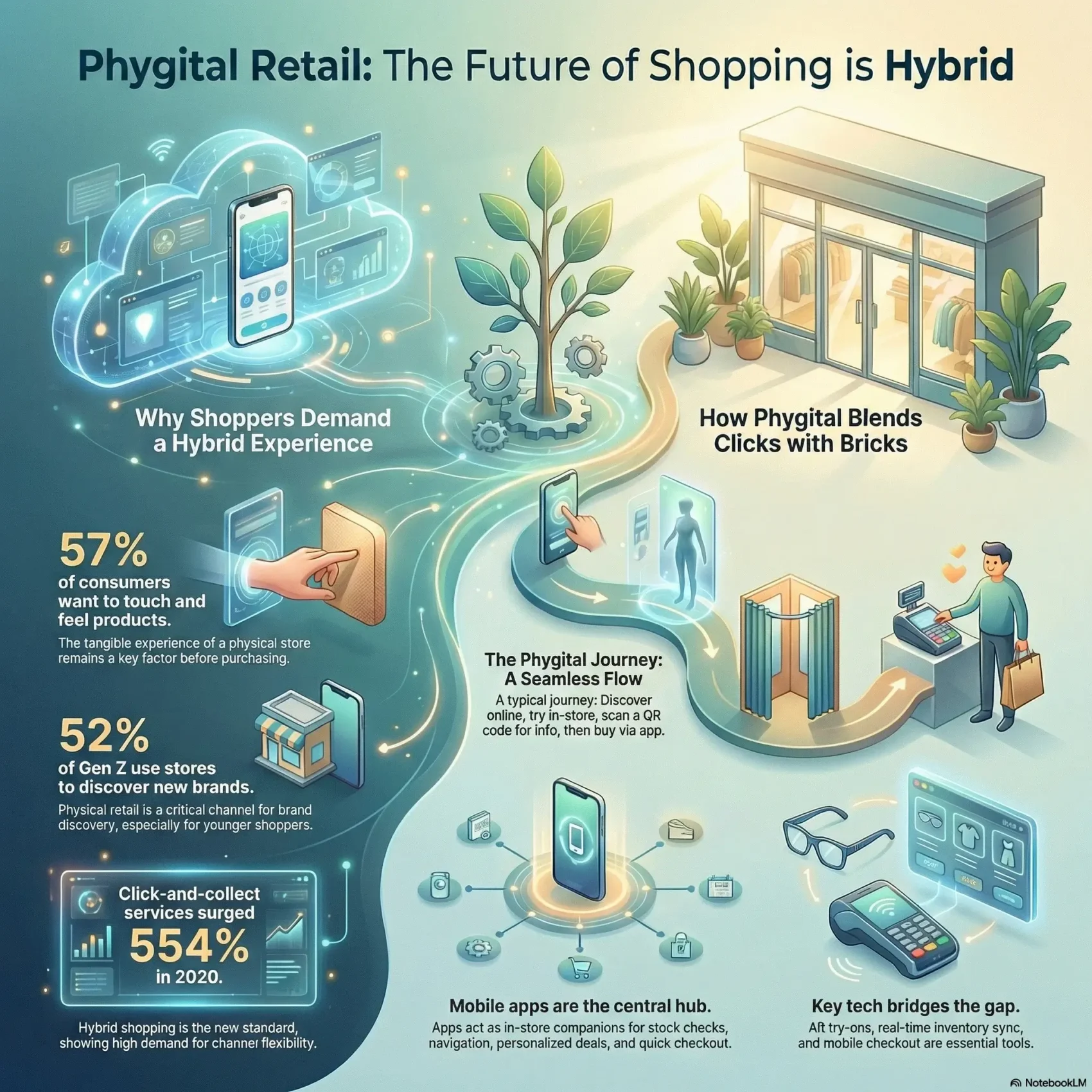
Phygital retail is a blend of the words physical and digital. It describes a shopping journey that runs across both, so a customer can research on a phone, test the product in a shop, and pay wherever it suits them.
The idea matters because most buying still happens in stores. In the second quarter of 2026, online sales made up 17.1% of total US retail sales, according to the US Census Bureau. Roughly five out of six retail dollars are still spent in a physical location. At the same time, almost every one of those purchases is influenced by something the shopper saw on a screen first.
So the practical question is not online versus store. It is how well the two fit together. This guide explains what phygital retail involves, what the current data supports, which technology is worth the money, and where these projects usually fail.
Key Takeaways
- Stores still carry the sales: Online is 17.1% of US retail; the rest happens in person.
- Click-and-collect is now mainstream: US pickup orders are forecast at about $177.9 billion in 2026.
- The app is the connector: Stock checks, navigation and fast payment link the two worlds.
- Integration beats gadgets: A smart mirror cannot fix inventory data that is wrong.
- Start small: Pilot in a handful of stores, measure, then scale what worked.
- Rules apply now: EU transparency duties for AI in customer contact took effect in August 2026.
What phygital retail actually means
A phygital journey is simply one purchase that crosses channels without the customer having to start over.
Here is a typical example. Someone sees a jacket on their phone in the evening. The next day they check the retailer’s app, see that their local branch has it in stock, and go in to try the size. The jacket fits but the color they want is not there. An assistant orders it from another store through the checkout system, and it arrives at their home two days later.
Nothing in that story is futuristic. What makes it work is that stock data, the app, the checkout system and the delivery system all refer to the same set of records.
The four building blocks
- Shared inventory data: one live view of what exists and where it sits.
- One customer profile: so loyalty points and order history follow the person, not the channel.
- In-store digital tools: QR codes, kiosks, staff tablets, augmented reality try-ons.
- Flexible fulfillment: pickup, home delivery, or shipping directly from a shop floor.
Augmented reality, usually shortened to AR, means digital images layered onto a live camera view. In retail it is used for makeup try-ons, glasses fitting and placing furniture in a room. Our guide to AR in e-commerce covers what these tools can and cannot do today.
Phygital, omnichannel and unified commerce: how they differ
These three words get used as if they meant the same thing. They do not, and the difference is useful.
Phygital describes what the customer experiences: the try-on, the QR code, the click-and-collect counter.
Omnichannel describes the promise you make across channels. Same price, same promotion, same service standard, whether someone shops on the app or walks in.
Unified commerce describes the plumbing underneath. It means point of sale (the checkout system), online store, stock and customer records all run from a single source of data rather than separate systems that sync overnight.
The order matters. Visible features are cheap to launch and easy to demo. They also break loudly when the data behind them is wrong. A shopper who drives to a store because the app said the item was there, and finds an empty shelf, trusts you less than if you had shown nothing at all.
For deeper planning, read practical omnichannel strategies that align your marketing and technology teams for reliable execution.
Why the hybrid journey became normal
Two forces pushed this along: shoppers wanting certainty before they travel, and retailers wanting to use store stock to fill online orders.
Click-and-collect is no longer a niche
Buy online, pick up in store is usually abbreviated to BOPIS. It means paying online and collecting the goods yourself, either at a counter or at the curb.
US BOPIS sales are forecast to reach about $177.9 billion in 2026, roughly 11.6% of US e-commerce sales, according to Statista data compiled by Capital One Shopping. The same research puts regular users at around 97 million Americans and reports that 87% of retailers now offer the option.
That combination is the point. Pickup is cheap for the retailer, fast for the customer, and it brings people into the building where they often add something to the basket.
People still want to touch things
EY’s Future Consumer Index, published in July 2024, found that 57% of consumers want to see and feel a product before buying, and 32% said personal service is a reason to visit a shop rather than order online. Those figures are a couple of years old now, but the direction has not reversed: the Census data above shows in-store spending still dominating.
The honest reading is that digital tools did not replace the store visit. They moved it later in the process. People arrive already informed, having compared prices and read reviews, and they expect staff to know at least as much as they do.
Where discovery happens
Product discovery has scattered across search, social feeds, marketplaces and increasingly AI assistants. Our overview of current e-commerce trends looks at how that shift changes who owns the customer relationship, and agentic commerce covers the newer case where software places the order on the shopper’s behalf.
What customers actually gain
It helps to be concrete about the benefit, because “seamless experience” means nothing on its own.
- No wasted trips: accurate stock display tells someone whether the item is really there.
- Shorter queues: mobile payment and self-checkout cut waiting at peak hours.
- Fewer returns: a virtual try-on or size guide reduces the “ordered three, kept one” pattern.
- Better advice: staff who can see a customer’s order history give more useful recommendations.
- More delivery choice: same-day pickup, curbside, or shipping from the nearest shop.
Each of those is measurable. If you cannot put a number against a feature after a pilot, it is decoration rather than strategy. Our guide to customer experience trends covers which metrics hold up over time.
How to build it: a practical sequence
Most retailers get better results by fixing the boring layer first and adding visible features afterwards.
Step 1: Map one real journey
Pick a single common path, such as “research online, collect in store”. Write down every handoff where a customer has to repeat information. Those handoffs are your list of problems.
Step 2: Fix the inventory data
Decide how often stock counts update, and be honest in the app about the margin of error. Showing “2 left, last updated an hour ago” is more useful than a confident number that is wrong.
Step 3: Connect the customer record
One profile should carry purchases, returns and loyalty status across channels. A customer data platform is the usual way to do this, though a smaller retailer may manage with the CRM already in place.
Step 4: Add the visible features
Now the QR codes, try-ons and store mode in the app have something reliable behind them. Pilot in a few locations, run for a full season, and compare against similar stores that did not get the feature.
Step 5: Train the people
Staff are the part of the system most likely to be forgotten. If an assistant cannot find a pickup order quickly, the whole promise collapses at the counter.
The technology stack, without the hype
Try-on and visualization tools
Virtual try-ons work well where fit or appearance drives hesitation: cosmetics, eyewear, furniture. IKEA’s Kreativ tool, which replaced the older IKEA Place app, lets shoppers scan a room and see furniture placed in it. Sephora and Ulta have run makeup try-on tools for years for the same reason.
They work less well for categories where texture, weight or comfort decides the purchase. A running shoe is still a shoe you need to walk in.
Sensors and connected shelves
The Internet of Things, or IoT, means everyday objects with sensors that report data over a network. In a shop that covers shelf sensors, RFID tags on stock, and temperature monitors in chilled sections. The payoff is inventory accuracy, which feeds everything else. Our guide to IoT in business explains where the costs sit, and 5G in retail covers the connectivity these sensors need.
Processing that sensor data locally, rather than sending everything to a central cloud, is what edge computing does. It matters when a camera feed needs a response in milliseconds.
Store mode in the app
Store mode is a setting that changes what the app shows once someone is inside a branch: aisle location, what is in stock in that building, the loyalty card, and a way to pay. It is one of the cheapest phygital features to build and one of the most used. See our overview of mobile commerce trends for how shopping behavior on phones has shifted.
Payments
Contactless and wallet payments are the default in most markets. Newer options such as biometric payment systems and buy now, pay later have had mixed results in stores, and both carry compliance questions worth checking before rollout.
Operations: where the promises get kept or broken
Everything customer-facing depends on fulfillment working. A pickup promise is only as good as the staff member who has to find the parcel.
Real-time stock and order routing
Order routing decides which location fills an order: a shop, a distribution center, or a third-party logistics provider (a 3PL, meaning an outside company that stores and ships goods for you). Good routing balances speed against cost rather than always choosing the nearest option.
Keep the underlying data tidy. Consistent product codes, barcodes and attributes are what let systems talk to each other during peak trading. Our guide to supply chain resilience covers how to plan for the weeks when volumes spike.
Turning stores into small warehouses
Shipping from a shop shortens delivery distance and uses stock that is already paid for. It also adds picking work to a team hired to serve customers. Budget for the labor, the packing materials and the scanners, or the saving disappears into overtime.
Metrics worth tracking
- Inventory accuracy, measured by spot counts against system records.
- Pickup dwell time, from customer arrival to handover.
- Order cancellation rate caused by stock that was not actually there.
- Return rate for items bought after using a try-on tool, against those bought without.
Data, privacy and trust
Phygital retail runs on customer data, which makes trust an operating requirement rather than a public relations topic.
What changed in 2026
The EU Artificial Intelligence Act brought transparency duties into force on 2 August 2026. In plain terms, people must be told when they are dealing with an AI system rather than a person, and certain AI-generated content must be labeled. If you run a chatbot on your site or an AI assistant in your app and serve EU customers, that obligation applies to you.
Separately, biometric tools that infer emotions in a workplace or classify people by sensitive characteristics have been prohibited under the same law since February 2025. That rules out several in-store camera analytics products that vendors were selling a few years ago.
Practical steps
- Collect less: data you do not hold cannot leak. Start from what a feature genuinely needs.
- Ask directly: information a customer volunteers, known as zero-party data, is more accurate than behavior you infer.
- Make opting out easy: as easy as opting in, and reflected across every system.
- Explain in plain language: what you store, for how long, and who can see it.
Our guides to first-party data strategy and data privacy trends go into the detail, and current cybersecurity trends cover the threats aimed at retail systems.
What the Amazon retreat teaches
The most instructive example of 2026 is a failure.
On 27 January 2026, Amazon announced it was closing all of its Amazon Fresh and Amazon Go stores in the US and UK, as reported by Grocery Dive. The company said it had not created “a truly distinctive customer experience with the right economic model needed for large-scale expansion”, and is putting its physical grocery investment into Whole Foods instead.
Those stores were the flagship demonstration of checkout-free shopping. Cameras and sensors tracked what you picked up, and you walked out without queuing. The technology worked. The store format around it did not earn enough to justify the cost.
The lesson is not that in-store technology is a waste. It is that a clever feature cannot carry a weak retail proposition. Our analysis of autonomous retail looks at where checkout-free formats still make sense, which is mostly small-footprint settings such as stadiums, airports and offices.
Compare that with quieter successes. Retailers that put effort into reliable pickup, honest stock display and staff who can access a customer’s order history rarely make headlines, and rarely have to reverse the decision either. Brands that started online and later opened stores, covered in our guide to direct-to-consumer brands in retail, have generally treated the shop as a service point rather than a technology showcase.
What comes next
Three developments are worth watching, without betting the budget on any of them.
AI assistants that shop on your behalf. If an agent compares products and places orders, the retailer’s product data becomes the thing being judged, not the website design.
Personalization that stays inside the store. Recommendations generated on a device, rather than in a central database, reduce both privacy exposure and latency. Our guide to AI personalization covers the trade-offs.
Resale inside mainstream retail. Trade-in counters and refurbished ranges are appearing alongside new stock, a trend we cover in recommerce.
None of these replaces the basics. They sit on top of accurate stock, a single customer record and staff who know what the app told the customer.
Conclusion
Phygital retail is less a technology program than an integration problem with a customer-facing surface.
Fix the data layer first, because every visible feature inherits its reliability. Add the try-ons, QR codes and store mode once they have something solid to stand on. Pilot in a few locations, measure against comparable stores, and drop what does not earn its keep.
Amazon’s closure of Go and Fresh shows what happens when the feature is impressive and the economics are not. The retailers doing well with this are usually the ones who made collection reliable, made stock counts honest and gave staff the same information the customer already has.
Found this useful?
Make SmartKeys a preferred source on Google, and our articles will surface more often in your Top Stories, AI Overviews, and AI Mode.
Add as Preferred Source