Agentic commerce changes how you shop online. Instead of browsing page after page, you give an AI a goal. Intelligent agents can compare options, apply your rules, and complete authorized purchases on your behalf. You stay in control while the agent handles the routine steps.
The plumbing arrived quickly. OpenAI and Stripe published the Agentic Commerce Protocol on 29 September 2025 and switched on Instant Checkout inside ChatGPT. Google released its Agent Payments Protocol in the same month and handed it to the FIDO Alliance, the industry body behind passkeys, on 29 April 2026. Visa, Mastercard and Cloudflare added ways for a merchant to tell a trusted agent apart from a scraper.
Adoption is more modest than the announcements. Gartner expects 33% of enterprise software applications to include agentic AI by 2028, up from less than 1% in 2024. An IBM study run with the National Retail Federation, published in January 2026, surveyed more than 18,000 consumers across 23 countries. It found that 45% already turn to AI somewhere in the buying journey. McKinsey puts the global opportunity at $3 trillion to $5 trillion by 2030. This guide covers how agents actually buy, which rails carry the payment, where the first wave stalled, and what to fix in your own store.
Key Takeaways
- An agent acts on a goal you set, not just a question you ask.
- Three open protocols carry agent commerce: ACP from OpenAI and Stripe, AP2 from Google, and Google’s UCP with its large retailer coalition.
- 45% of consumers already use AI somewhere in the buying journey.
- Checkout inside ChatGPT was rolled back toward discovery in March 2026.
- Marketplaces and courts are still deciding which agents may transact.
Agentic Commerce Explained in 6 Minutes (Video)
Prefer to watch? In just 6 minutes, this video shows you how AI agents actually buy for you, why the first wave of agent checkout stalled, and what retailers should fix first.
What Is Agentic Commerce?
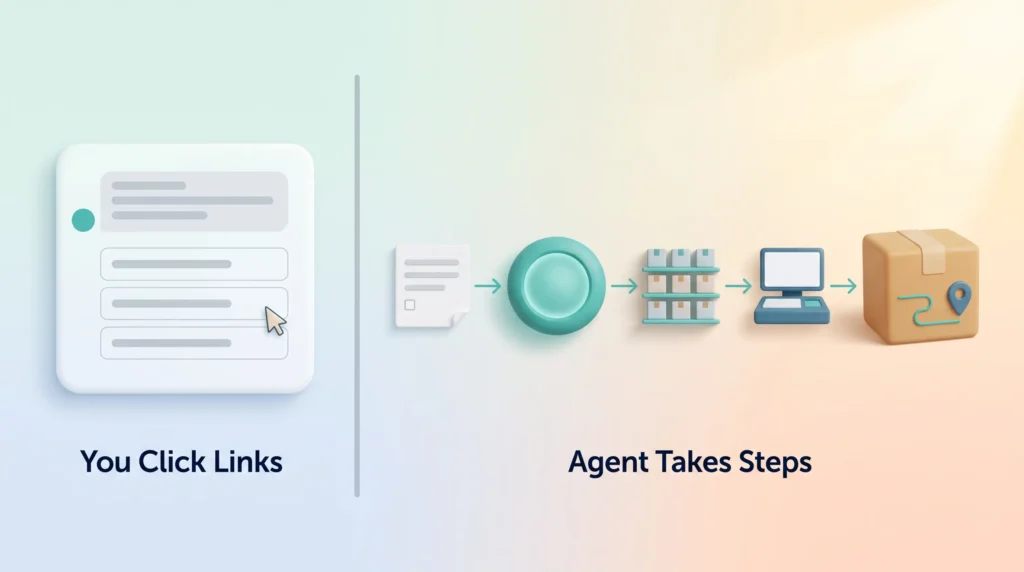
Agentic commerce lets you hand an AI a goal rather than a query. The system reviews product information, weighs your stated preferences, and takes the steps you approved. That is a different job from a shopping chat window, where you still click every link yourself. It sits one layer above conversational commerce, which keeps the human in every step of the exchange.
How AI Agents Differ From Chatbots
A chatbot answers a prompt. An agent reasons, plans, and acts across several systems, which is the same pattern behind AI agent workflows in the back office. Assistants built on ChatGPT, Gemini or Perplexity connect natural conversation with product catalogs, prices and live inventory.
Three traits set them apart. Autonomy means the agent takes steps without being prompted for each one. Reasoning means it weighs trade-offs instead of matching keywords. Interoperability means it works across systems that were never built to talk to each other, such as a retailer catalog and your payment provider. Together those traits let an agent revise its recommendation when a product sells out or a delivery date slips, and hand a complex decision back to you.
Why Autonomy Needs Limits
The Gartner forecast is worth reading carefully. It says 33% of enterprise software applications will include agentic AI by 2028, up from less than 1% in 2024. That is a statement about software features, not about a third of companies running autonomous buyers. AI in business operations is spreading faster than genuine end-to-end autonomy.
Autonomy is never unlimited. Businesses set permissions, budgets and guardrails so an agent can serve the customer without breaking pricing rules or payment controls.
How Agentic Commerce Works
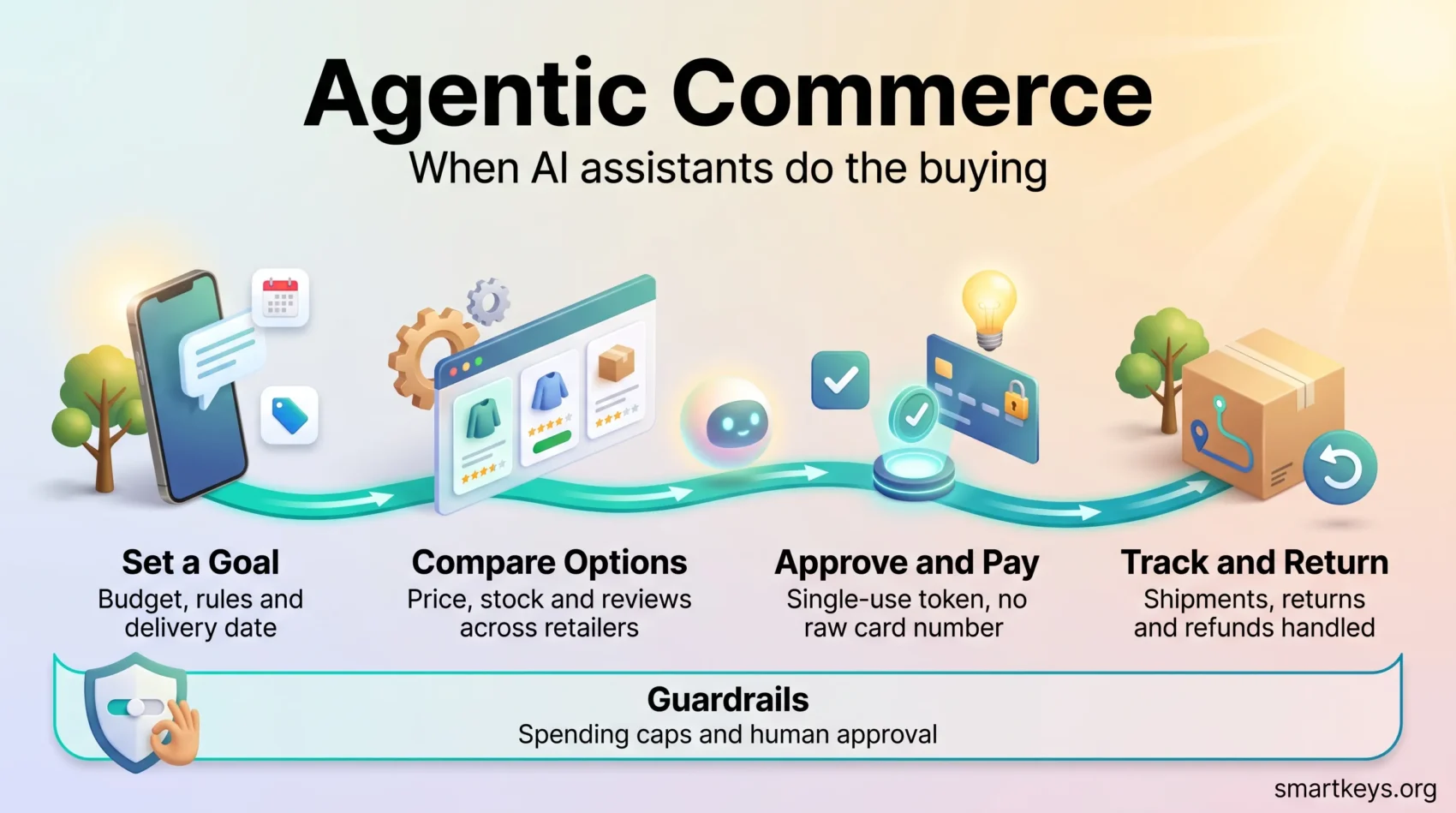
Your request becomes a set of explicit steps. Ask for a camping tent under $150 delivered by Friday, and the agent parses the budget and the date, checks availability, and confirms whether it has authority to pay.
From a Natural-Language Goal to a Completed Order
The agent compares products, applies your limits, and returns a short list. If you approve, it can place the order. Several routine tasks collapse into one guided action, and the handoff points are where you keep control.
Product Data, APIs, and the Payment Rails
Clean product data decides whether an agent can even consider your catalog. Two standards do most of that work. Schema.org markup is a shared vocabulary that tells software what each field on a page means. GS1 identifiers are the global product numbers behind barcodes. Together they make price, size, material, compatibility and sustainability claims machine readable. APIs, the connections that let one system query another, then link catalogs, inventory, pricing, fulfillment, returns and payment.
Payment is the harder half. The Agentic Commerce Protocol lets a merchant accept a delegated payment token. That token is a single-use credential authorizing one purchase, so the agent never sees the raw card number. It works without changing payment processors, and the merchant still approves the order and handles fulfillment. That work sits close to embedded finance, and the same authorization questions apply to buy now, pay later at agent checkout.
Guardrails, Permissions, and Human Approval
Automation needs a ceiling. Set spending caps, approved sellers and review points. Low-risk repeat purchases can run on their own, while anything expensive or unusual waits for you. Salesforce built its Einstein Trust Layer around exactly this idea. It records what an agent did and enforces which data the agent may touch.
The Protocol Race Behind Agent Payments
Three protocols now compete for the same job, with a fourth standard handling identity underneath them. A merchant will likely touch all of them.
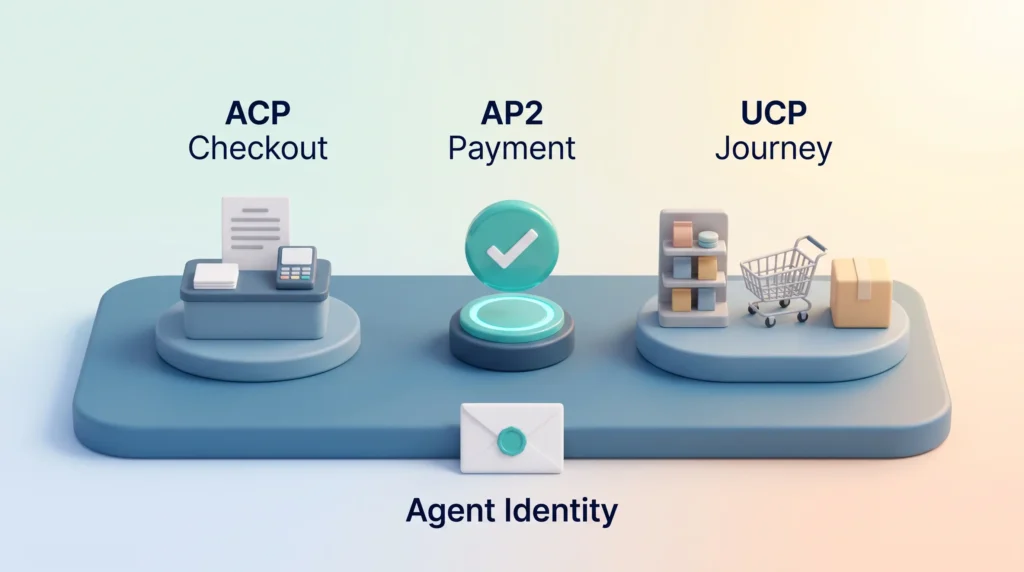
The Agentic Commerce Protocol came from OpenAI and Stripe and was open-sourced on 29 September 2025. It launched with U.S. Etsy sellers, then Shopify merchants, and Salesforce announced support in October 2025. Mirakl and J.P. Morgan Payments later built enterprise checkout on the same idea.
The Agent Payments Protocol takes a different route. Google published AP2 in September 2025 and donated it to the FIDO Alliance on 29 April 2026, alongside version 0.2 and its “human not present” mandate. That mandate covers purchases you approve in advance, such as buying a concert ticket the second it goes on sale. Mastercard co-developed a companion standard, Verifiable Intent, that keeps an auditable log of what a user actually authorized.
The Universal Commerce Protocol is the third and broadest. Google introduced UCP at NRF in January 2026 with roughly twenty major retailers signed on, including Shopify, Target, Walmart and Etsy, alongside Visa, Mastercard and PayPal. Where ACP standardises checkout and AP2 standardises payment authorization, UCP aims at the whole journey across platforms without custom integrations per merchant. Its retailer coalition is the widest of the three, which makes it the one to watch even though it arrived last.
Identity is the fourth piece, and it cuts across all of them. Cloudflare announced Web Bot Auth with Visa and Mastercard on 24 October 2025. It uses signed HTTP messages, a cryptographic signature the agent attaches to every request, instead of the user-agent label that any script can fake. Visa’s Trusted Agent Protocol and Mastercard’s Agent Pay both sit on that layer, which is the commerce cousin of decentralized identity work in customer onboarding.
How AI Assistants Change Product Discovery
Discovery starts to feel like a conversation rather than a search. You describe the goal, and the assistant turns it into a comparable set of options across retailers.
Comparing Products Across Retailers and Marketplaces
Agents weigh price, availability, delivery window and review signals at once. Structured attributes are what make listings comparable, which is the same discipline behind good mobile commerce and AR-assisted e-commerce experiences.
- One view can consolidate offers from several marketplaces.
- Live inventory data removes products you cannot actually buy.
- Review signals add context a spec sheet does not carry.
- Standard attributes let an agent compare like with like.
Recommendations That Match Your Preferences
With your consent, an assistant can carry your budget, sizes and preferred brands between sessions. The IBM and NRF study found 45% of consumers turn to AI during the buying journey, with 41% researching products, 33% interpreting reviews and 31% hunting deals. On the retailer side, this is a customer data platform problem before it is an AI problem.
What AI Shopping Agents Can Do for You
Daily errands get easier when a helper handles routine buying and the paperwork after it. You set the limits once and let a trusted agent work inside them.
Buying, Reordering, and Managing Subscriptions
An assistant can reorder consumables when stock runs low and reuse your saved brand, price and delivery preferences. Amazon retired its Rufus chatbot on 13 May 2026 and replaced it with Alexa for Shopping, a sign that platforms want the buying agent to be their own. Resale is moving the same way, and the recommerce market gives agents a second inventory pool to search.
Subscription tools add control. An agent can flag unused services, propose a downgrade, or switch providers after a price change, with the sensitive actions still routed to you.
Tracking Orders, Returns, and Refunds
After checkout, agents can track shipments, answer “where is my order” questions, open returns and request refunds. That removes a large share of repetitive contacts from customer service teams, and it pairs naturally with autonomous delivery.
- Review status updates in one place.
- Set approval rules for refunds and exchanges.
- Get accessory suggestions tied to what you already own.
Agentic Commerce Use Cases for Businesses
Companies are wiring the same capability into their own operations, with people kept in the decisions that matter.
Retail, Marketing, and Customer Support
Retail agents can spot excess inventory, match it to a segment and launch a promotion. They also improve on-site search, answer product questions and manage orders across channels. Salesforce Agentforce Commerce embeds this in the CRM, the system holding customer records and order history, while Mirakl Nexus offers one shared API across thousands of sellers. The store experience question runs through phygital retail and autonomous retail formats, and the underlying tooling is part of the wider AI shift in SaaS.
Procurement and Supply Chains
On the buying side, agents research suppliers, confirm approved vendors, compare terms and find alternatives when a shortage appears. This is the practical edge of digital procurement, and it depends on the same traceability that blockchain in logistics tries to provide.
Where the First Wave Stalled
The honest part of the 2026 picture is that agent checkout has not gone to plan.
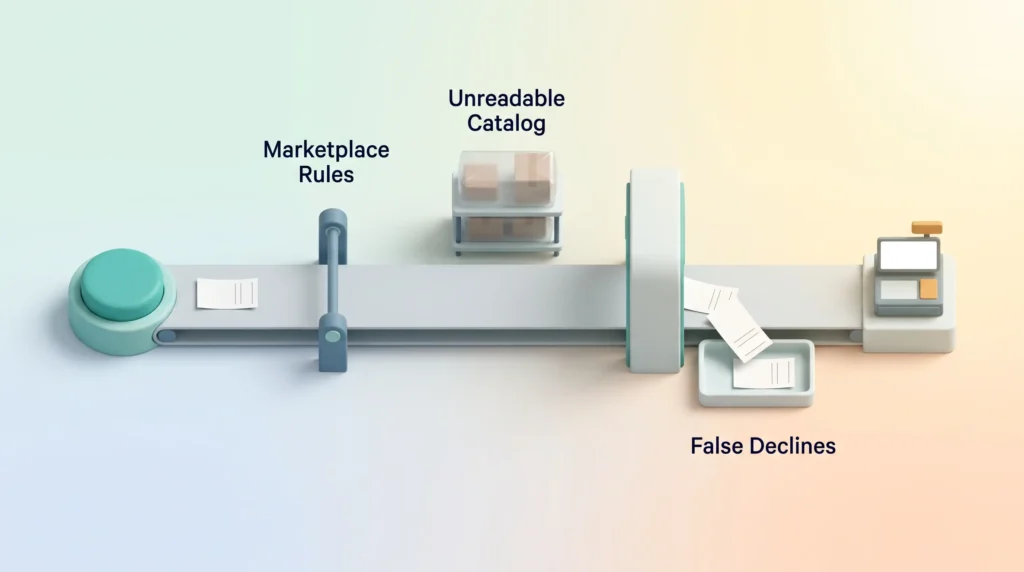
OpenAI changed course on 24 March 2026, saying the first version of Instant Checkout “did not offer the level of flexibility that we aspire to provide.” Retailers such as Walmart now run discovery inside ChatGPT and send the shopper back to their own checkout, with account linking and loyalty intact.
Marketplaces pushed back too. eBay announced a revised user agreement in January 2026, effective 20 February, that bars “buy-for-me agents” and any end-to-end flow placing orders without human review. Amazon sued Perplexity in November 2025 over its Comet agent and won an injunction in March 2026. The Ninth Circuit vacated that order on 4 August 2026. Its reasoning: when a user directs an assistant to act on Amazon.com, it is the user who accesses the site, not the software vendor. The case continues, so the question of whether terms of service can lock agents out is still open.
Readiness is the quieter obstacle. Mirakl reported in August 2026 that fewer than 1% of product pages are ready for large language models to parse. If your size chart sits inside an image and your stock count is drawn by a script, an agent can read neither. Most catalogs are invisible before any protocol question arises.
There is a second readiness problem that costs money today rather than in future. Riskified found that 55% of agent-driven traffic is being falsely declined, because fraud engines were built to recognise human behaviour and classify everything else as a bot. That figure was one of the reasons the FIDO Alliance moved on agent authentication in April 2026. It also means merchants can be losing legitimate orders from agents right now, before they have made any decision about protocols or catalog structure. Reviewing how your risk stack classifies agent traffic is a far smaller job than restructuring product data, and it is the faster win of the two.
The Benefits of More Autonomous Shopping
Used within limits, agents turn a long search into a short decision.
Saving Time and Reducing Checkout Friction
An agent gathers requirements, checks product data and compares delivery options in one pass, then completes the order after you approve it. Fewer tabs and fewer forms is a real gain, and with 45% of consumers already using AI somewhere in the journey, the habit is forming ahead of the infrastructure.
Personalization, Scale, and Loyalty
Businesses can scale guidance without scaling headcount in the same proportion. Connected APIs keep the experience consistent across channels, and modern customer service expectations now assume that continuity. McKinsey’s $3 trillion to $5 trillion estimate for 2030 includes roughly $1 trillion of U.S. retail sales that an agent would arrange from search to payment. That slice is where most of the near-term investment is aimed.
Privacy, Security, and Trust
Trust starts with scope. An assistant should touch only the data an approved task requires, and nothing beyond your stated goal. Delegated payments, account credentials and transaction records all need protecting once an agent acts for you.
You should be able to answer three questions after any agent action:
- What did the agent decide?
- Which information did it use?
- When did it complete the action?
Signed-agent standards are one answer, because a merchant that can cryptographically identify an agent can also apply a policy to it instead of blocking every bot. Auditable intent records, such as the Mastercard and Google work donated to FIDO, are the other half. Neither removes your responsibility to set spending limits and review transactions.
Conclusion
Agentic commerce is real, but it is earlier than the headlines suggest. The protocols exist, the payment networks are committed, and consumers already lean on AI to decide. Three things are missing: machine-readable catalogs, settled rules about which agents may transact, and evidence that shoppers want to hand over the final click.
That gap is an opportunity. Retailers who fix product data now are ready whichever standard wins, and the same work improves ordinary search and comparison shopping today.
Keep control where it matters, and let trusted agents handle the routine.
Listen to the Podcast Episode
Found this useful?
Make SmartKeys a preferred source on Google, and our articles will surface more often in your Top Stories, AI Overviews, and AI Mode.
Add as Preferred Source