Some opportunities are too big to take alone. You need a distribution network you do not have, a licence you cannot get quickly, or a technology that would take three years to build. Buying the company that has it is slow and expensive; building it yourself is slower still.
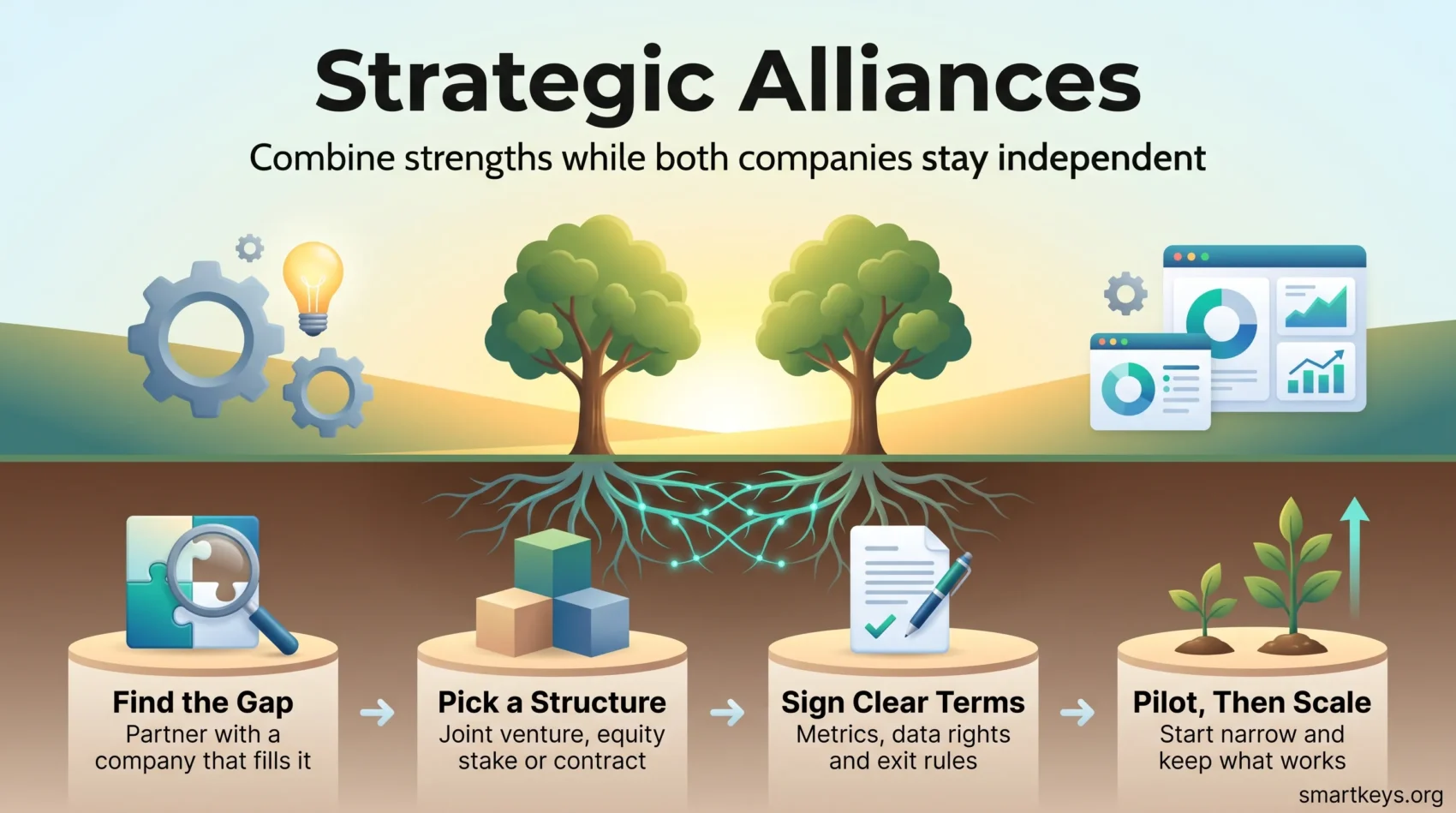
A strategic alliance is the third option. Two companies agree in writing to combine specific resources toward a shared goal, while each stays a separate business with its own owners, brand and accounts. Nobody is acquired, and the scope stays narrow: one product, one market, one channel.
This guide covers how to judge whether a deal is worth doing, which structure to use, what the contract has to cover in 2026, and what five real examples teach.
Key Takeaways
- An alliance shares resources with another company while both stay independent. It is not a merger.
- Written goals, named owners and shared metrics do more for the outcome than goodwill.
- Pick the structure (joint venture, equity, or non-equity) from your capital and control needs.
- Agree data rights, AI model rights and exit terms before launch, not after the first dispute.
- Start with a scoped pilot and a fixed review cadence, then scale only what it proves.
What a Strategic Alliance Is, and What It Is Not
A strategic alliance is a formal agreement in which two companies pool named resources to reach a goal neither would reach as quickly alone. Each keeps its own ownership, management and balance sheet. That is the line separating an alliance from a merger, where one set of owners ends up controlling both businesses.
The point is access without ownership. A software firm gets a bank’s regulated payment rails without applying for a banking licence. Both keep their independence, and both now depend on someone else’s execution.
Three shapes are common. A joint venture creates a new company both parents own, with its own staff and profit and loss. An equity alliance means one partner buys a minority stake in the other to align incentives. A non-equity alliance is a contract only: co-marketing, distribution, licensing or a technical integration, with no shares changing hands.
What Makes an Alliance Strategic Rather Than Just Convenient
Most companies have more partnership offers than they can staff. The useful question is not whether a deal looks attractive but whether it changes how you compete. Five tests separate the two.
- It serves a primary goal. The alliance advances something already on your plan, such as entering a market or cutting cost to serve.
- It builds a capability you want to keep. Working alongside a partner is a fast way to learn a skill, provided you assign people who stay.
- It closes a route for a competitor. Partnering with the one strong distributor in a region denies a rival an easy way in.
- It creates future options. A good alliance leaves you a customer base, a data set or a product you keep even if the partnership ends.
- It reduces a real risk. Dual sourcing a critical component spreads exposure you would otherwise carry alone.
A deal passing fewer than three is usually better handled as a supplier contract: a cheaper structure for a smaller ambition.
Turning intent into something you can measure
“Grow together” is not a goal. Convert each objective into a metric with a number, a date and a named owner on each side. Instead of “improve joint pipeline”, write “180 qualified opportunities sourced through the partner channel by 30 June, owned by the partner sales lead on each side.”
Two supports keep that honest: an executive sponsor on each side who can unblock what the working teams cannot, and a standing review, monthly at working level and quarterly at leadership level. The discipline behind internal goal setting applies here too, with the complication that half the owners do not report to you.
Fit also matters. Watch how the other company decides under time pressure: a partner that needs six weeks to approve a landing page will not survive a joint launch.
Choosing Between the Three Structures
The structure decides how much control you get, how much capital you commit, and how hard the deal is to unwind.
Joint venture: a new company for a long commitment
A joint venture suits work that needs its own brand, staff and profit and loss over several years, especially where regulation demands a distinct legal entity. Microsoft and GE Healthcare formed Caradigm in 2012 as a 50/50 venture to build a healthcare data platform, then sold it to Inspur in 2018 once the market had moved. That arc is normal: a joint venture is a vehicle for a phase, not a marriage. The cost is speed, since you negotiate a shareholders’ agreement before any customer sees anything.
Equity alliance: capital as a commitment signal
An equity alliance works when both sides need proof the other will not walk away mid-project. Panasonic invested $30 million in Tesla in 2010, an early step in a battery collaboration that later ran to a shared factory. Equity is worth the complication when the joint work needs years of investment before it pays, and is overkill for a co-marketing campaign.
Non-equity alliance: contract only, and usually the right answer
Most alliances should start here. A contract covering distribution, co-marketing, licensing or a technical integration can be live in weeks. Starbucks reaches customers through licensed cafés inside retailers such as Target, with no shares changing hands.
Non-equity deals are also the easiest to end, which is why they suit a first pilot. Prove the commercial logic on a contract, then decide whether it deserves a heavier structure. That escalation sits behind most partner ecosystem strategies and the licensing that makes the franchise model and white-label SaaS reselling work.
Benefits and Costs, Honestly Weighed
The gains are specific. You reach a market faster because the partner already has the customers, the shelf space or the regulatory approval. You acquire capabilities without a hiring cycle and spread investment in a product neither side would fund alone. A respected partner’s name also shortens the trust-building part of a sales cycle, which matters most to young companies still proving a go-to-market strategy.
The costs arrive first. Coordination is expensive: someone has to run the joint plan and prepare the steering committee, and leaving that role unfilled is the most common way an alliance stalls. Benefits rarely split evenly, so put rebalancing triggers in the agreement rather than discovering the imbalance in month nine. Your brand also sits partly in someone else’s hands, which makes review rights cheap insurance.
Choosing a Partner and Writing the Objectives
Start from the gap, not the logo. List what you cannot do today that the goal requires: distribution into German pharmacies, a payments licence, a data set you do not hold. Rank the gaps, find companies that fill the top two or three, then check four things about each.
- Complementary strength. They are genuinely good at what you lack, with customers who will confirm it.
- Overlap without conflict. You serve similar buyers but do not compete for the same purchase.
- Decision speed. Their approval cycle is compatible with yours.
- Track record. They have run alliances before and can describe how the last one ended.
If you cannot explain in one paragraph what the partner gains, you are not ready to ask for their commitment.
Governance and exit belong in the agreement, not in a later conversation. Fix the shared metrics and their owners, write down who sits on the steering committee and how a disagreement escalates, and agree a wind-down timeline. Clear exit terms are not pessimism. They are what lets both sides commit, because neither is trapped.
Running the Alliance: A Repeatable Sequence
1. Shortlist and build the case together
Shortlist three or four companies already serving your customers well, then draft the revenue impact, the cost to serve and the resources each side commits, with your preferred partner in the room. A case written alone is a proposal; one written together is a shared plan.
2. Sign an agreement that survives contact with reality
Cover milestones, service levels, intellectual property, data and model rights, brand use, and the triggers that end the deal.
3. Set an operating rhythm
Joint working group weekly, steering committee quarterly, one shared dashboard both sides can see without asking. Agree the metric definitions in advance: two companies almost never count a “qualified lead” the same way.
4. Pilot, then scale what worked
Launch narrow: one segment, one region, one product, with a fixed budget and end date. Keep what performed and cut what did not. The same staged approach works for scaling a startup and for any serious business model innovation.
What Alliance Contracts Have to Cover in 2026
Two things have changed recently, and both belong in the contract now.
The first is data. Most alliances involve sharing customer, usage or sensor data, and in the EU that sits inside a specific legal framework. The EU Data Act has applied since 12 September 2025 and sets rules on access to data generated by connected products and on switching between cloud providers, according to the European Commission. If either partner operates in the EU, write into the agreement which data is shared, on what basis, and what happens at termination.
The second is artificial intelligence. If a joint product involves a model, decide in writing who owns the trained model, who may use the training data afterwards, and whether either side can build a competing model from it. The same question now sits at the centre of data-as-a-service arrangements and most integration deals built on the API economy.
Three older terms still earn their place: a change-of-control clause, so an acquisition of your partner does not hand a competitor your integration; a rebalancing mechanism if the value split drifts; and a customer transition plan.
Five Alliance Examples and What Each One Teaches
Uber and Spotify: convenience as a differentiator
In November 2014 the two companies launched an integration that let riders play their own Spotify music through the car’s speakers. The feature was small, but it shows how an alliance can improve an existing product without either side building anything large, giving each exposure to the other’s users at almost no acquisition cost. The limit is that such integrations are easy to switch off again.
Starbucks with Target and Barnes & Noble: buying dwell time
Licensed Starbucks cafés inside retail stores keep customers in the building longer, which lifts the chance of another purchase. The retailer gets a reason to stay; Starbucks gets locations it never had to lease. Shared space is one of the cheapest forms of distribution when two brands serve the same visit, and the logic drives many distribution channel and distribution strategy decisions.
Disney and Chevrolet: a sponsorship that became an experience
Test Track at EPCOT, presented by Chevrolet, ties a vehicle concept to a ride and a showroom at the exit. The attraction reopened in a reimagined version in July 2025 and kept the Chevrolet association. The lesson is duration: a partnership built into an experience people plan a trip around outlasts any campaign, which puts it closer to brand storytelling than advertising.
Red Bull and GoPro: two brands, one content engine
Neither company sells the other’s product. They share an audience and a subject, and footage from extreme sports events serves both. Content alliances work when audiences overlap and revenue does not, the same condition that makes B2B influencer marketing work.
Apple Pay and Mastercard: borrowed trust at launch
When Apple Pay launched in the United States in October 2014, the major card networks were already on board. Apple gained instant credibility in payments, a category where trust decides adoption; the networks gained a place in a platform that would shape how people paid. In trust-heavy categories, launching with an established partner beats earning trust alone.
For bringing partner channels together, see omnichannel strategies. If the ambition is geographic, an alliance is often the entry step in a wider global expansion strategy, which raises the questions covered in managing cross-border teams.
Conclusion
A strategic alliance lets you reach a goal you cannot reach alone, without giving up independence or buying another company. It works when the deal serves a goal already on your plan, the structure matches your capital and control needs, and the agreement is specific about metrics, data, intellectual property and exit.
The failure mode is almost always the same: two companies agree in principle, launch without named owners or shared numbers, and quietly stop meeting months later. The fix is unglamorous. Written objectives, one accountable person on each side, a fixed review rhythm, and a pilot small enough that stopping it costs nothing.
Your next step is short. Write down the capability gap blocking your biggest goal this year, list three companies that could close it, and sketch what each would gain from working with you. If you cannot fill that last column, you have found the real work.
Found this useful?
Make SmartKeys a preferred source on Google, and our articles will surface more often in your Top Stories, AI Overviews, and AI Mode.
Add as Preferred Source