A partner ecosystem is the network of companies you work with so that your customer gets a complete solution instead of a pile of separate products.
Those companies might build integrations into your software, resell it, install it, run it as a managed service, or simply recommend you to their clients. What makes it an ecosystem rather than a contact list is that the relationships are ongoing and the results are shared. One-off referral deals produce one-off revenue; a structured ecosystem produces repeatable pipeline, and it opens channels you could not reach alone.
Why the topic is getting attention: in Salesforce’s State of Sales research, 84% of sales professionals said partner selling has a bigger impact on revenue than a year earlier. Forrester’s 2025 Partner Ecosystem Marketing Survey points the same way: two-thirds of the B2B channel and ecosystem marketers surveyed expected the revenue their partners transact to grow faster than it had the year before.
What this guide covers: how to pick partners, how to govern the relationship with metrics you can defend, and how to bundle products so the result feels like one thing to the buyer.
Key Takeaways
- A partner ecosystem is a long-term network, not a set of one-off referral agreements.
- Most programs fail on governance, not on recruitment.
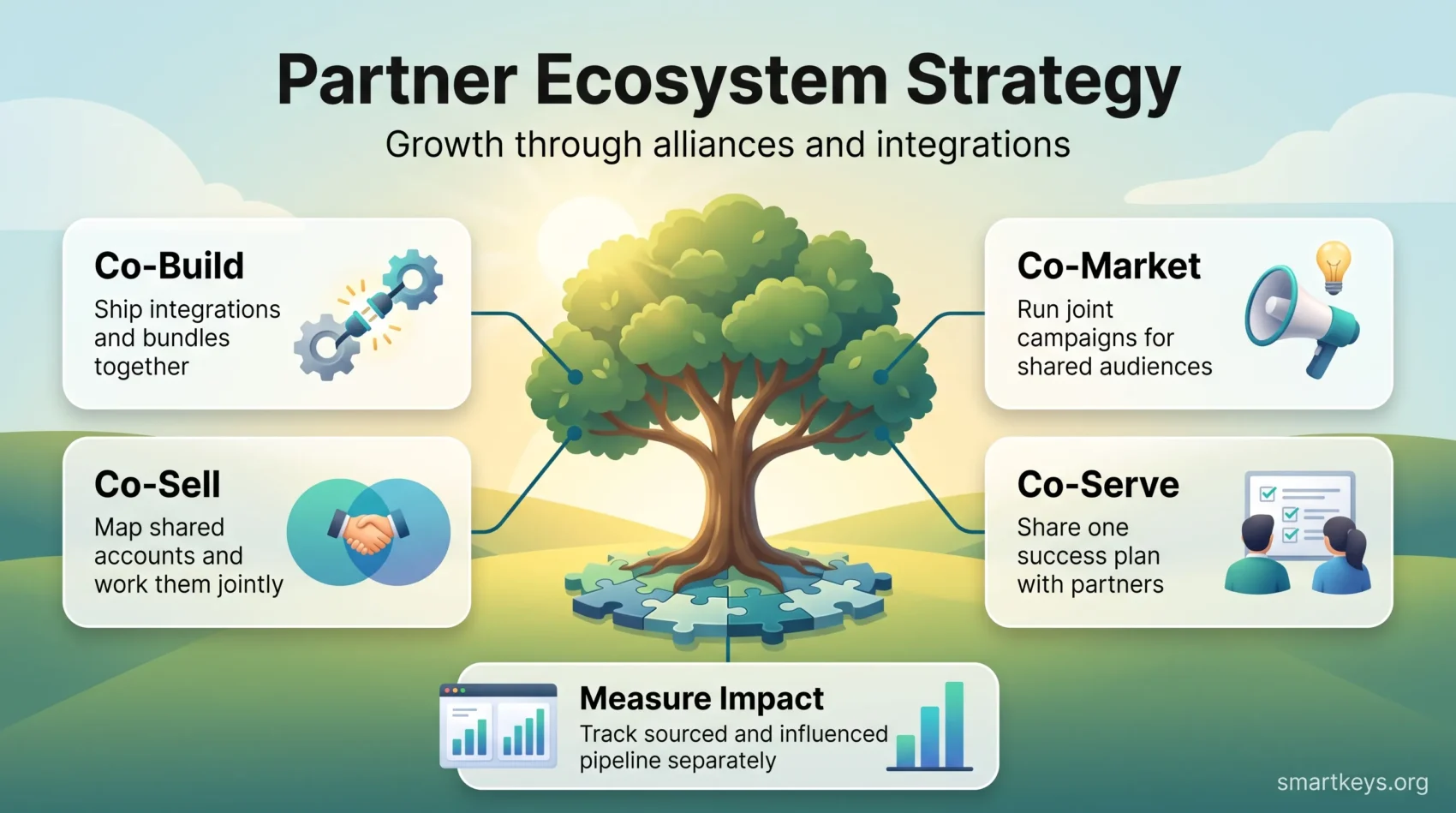
- Four motions carry the revenue: co-build, co-sell, co-market and co-serve.
- If you cannot measure sourced and influenced pipeline, you cannot defend the budget.
Partner ecosystem fundamentals: what it is and why it matters now
An ecosystem connects complementary capabilities from several companies so a buyer does not have to assemble the solution themselves.
Picture a mid-sized retailer buying an inventory system. Alone, they buy the software, find someone to connect it to their accounting package, then hire someone else to train the warehouse team. In an ecosystem, the vendor, the integration partner and the trainer arrive as one package with one plan. Less friction, and a shorter path from signature to working system.
Why the timing matters
Two things changed. Buyers now expect software to connect to whatever they already run, which makes integrations a purchase requirement rather than a nice extra. And go-to-market costs rose, so paying a partner a share of a deal they helped win often costs less than chasing it cold. Forrester’s 2025 survey found most channel marketing decision makers expecting their partner count to grow, with the strongest expectations around technology partners and digital routes to market.
Programs versus the wider ecosystem
These two words get used interchangeably, and they should not be. A partner program is the formal structure: how you recruit, certify, reward and measure. The ecosystem is everyone you work with, including relationships that never sign a program agreement. The ecosystem gives you reach; the program gives you consistency. Run the program to scale what repeats, and keep the wider network loose enough to catch what does not fit.
Business benefits you can unlock with a mature ecosystem
The commercial case comes down to three things: cheaper access to customers, faster capability, and shared risk.
Expanded reach and warmer paths to customers
A partner who already sells to your target account has a working relationship and a reason to call. In figures compiled by Crossbeam from its 2023 State of the Partner Ecosystem Report, deals with a partner involved were 53% more likely to close. Treat that as a direction rather than a guarantee, since it reflects companies that measure partner influence closely.
Faster innovation and bundled solutions
Co-development pairs your engineering with a partner’s specialist knowledge. A payroll vendor that integrates with a time-tracking tool does not have to build time tracking, and the customer gets one working chain instead of two products and a spreadsheet in between. Bundles also raise deal size, because you sell an outcome rather than a licence. That depends on how you structure the platform itself and how open your APIs are, a question the API economy has pushed to the front of product roadmaps.
Lower costs, less risk, and stronger retention
Sharing go-to-market work cuts acquisition cost. Sharing delivery work cuts the risk of a bad implementation in a market you do not know, because a local partner already understands the procurement rules, the language and the competitors. That is why partner-led entry is a common first move in expanding into new markets.
Retention improves too. Once a customer connects your product to two or three tools they rely on, replacing it becomes a project rather than a decision. Crossbeam’s compiled data puts integration users as 58% less likely to churn.
Common challenges, and how you will handle them
Three problems stall most programs: choosing badly, failing to build trust, and letting the operating model sprawl.
Finding fit and building durable trust
Write a scoring rubric before you talk to anyone. Score each candidate on solution fit, customer overlap, technical compatibility and cultural alignment. That turns a subjective conversation into a comparable score, and it stops you signing the first company that shows enthusiasm. Trust follows from the same discipline: share pipeline data, set incentives that only pay when both sides win, and agree in advance what joint success looks like.
Managing complexity and coopetition
Coopetition means competing with the same company you partner with, which is normal in software: a cloud vendor may host a rival’s product, and a consultancy may implement two competing systems. Handle it by naming it. Write down where you compete, where you collaborate, and who owns which account. Then build the plumbing that keeps it visible:
- One source of truth for partner data, deal registration and shared content.
- Standard playbooks for delivery and handoffs, so every partner runs the same sequence.
- Named people with time to run the program, not partnerships bolted onto a sales manager’s existing job.
Most partner conflicts are about one contested account, and a written escalation rule settles them fast.
Types of partners and roles within your ecosystem
Different partners solve different problems. Mixing them deliberately turns a contact list into a working ecosystem.
Technology partners and ISVs
Technology partners build integrations connecting your product to theirs. ISVs, short for independent software vendors, build and sell their own software, often on top of a larger platform.
Salesforce’s AppExchange is the clearest example of that second pattern. An independent count by sfapps.info recorded 5,877 public listings there on 3 June 2026, the first year the number moved down rather than up. Marketplaces mature: depth matters more than listing counts.
Coordinated roadmaps make these partnerships worth the effort. If your partner ships a breaking change without warning, the integration becomes a support ticket instead of a selling point. Many companies route this through an integration platform rather than maintaining every connection by hand.
Resellers, distributors, and MSPs
Resellers sell your product under their own commercial relationship and sometimes install it. Distributors handle logistics, billing and contracts at volume, which is how vendors reach hundreds of small resellers without managing each directly.
MSPs, or managed service providers, run technology on the customer’s behalf for a monthly fee. Bundling your product into their service produces recurring revenue, and the MSP handles daily support. Deciding which route fits is the core question of choosing distribution channels.
System integrators and GSIs
System integrators design and deliver large change programs, and GSIs are the global versions that run multi-country rollouts. They bring methodology and industry knowledge, and they fit when the buyer’s problem is organisational rather than technical.
Advisors, referrers, and marketing allies
Consultants, accountants and review sites shape shortlists before a vendor is ever contacted. Intuit’s QuickBooks ProAdvisor network is the clearest example: accountants recommend software they already know, and that carries more weight with a small business owner than any advertisement.
- Sort partners by whether they help you land new customers or expand existing ones.
- Segment by capability, geography and industry so deals reach the partner best placed to win them.
Partner ecosystem strategy: your step-by-step roadmap
Start with the outcome you want and work backwards to the partners who can produce it.
Define goals, customer needs, and an ideal partner profile
Set goals tied to numbers you already report: sourced pipeline, influenced revenue, adoption, retention. Vague goals such as “build an ecosystem” cannot be reviewed, which is why many programs quietly lose their budget. Then list the gaps: what your product cannot do, and which markets you cannot reach. The answer becomes your ideal partner profile. Aligning it with how your own teams sell is easier when sales and marketing already agree on the target account list.
Recruit and assess fit: value exchange, alignment, and readiness
Lead your outreach with the value exchange. State plainly what the partner gets, what you provide, and what joint success looks like in the first two quarters. Then test readiness: does the partner have people who can be trained, and will they give you a named contact? A short pilot on two or three accounts tells you more than any signed agreement.
Onboard, enable, and govern: programs, incentives, and clear roles
Put everything a partner needs in one portal: training, certification, demo scripts, pricing guidance and deal registration. Registration matters most, because it is how a partner knows their work will be credited. Pair enablement with money: commission on sourced deals plus MDF (market development funds, a budget partners spend on joint marketing). Then govern with named roles, defined territories and a regular pipeline review.
Iterate using feedback, data, and partner input
Track activation, sourced and influenced opportunities, win rates and cycle time, then act on what they show. If certified partners are not registering deals, the problem is usually the process, not the partner. Ask partners what slows them down, and publish joint case studies when something works. Nothing recruits the next partner faster than a named result with a real customer in it.
Go-to-market motions that drive revenue with partners
Four motions produce almost all partner revenue. Most programs try all four at once and do none well; picking two to start with works better.
Co-build and integrate to create differentiation
Co-building means shipping something together: an integration, a joint roadmap, a packaged bundle. It is the slowest motion and the hardest to copy, which is why it creates durable differentiation. Reward it properly: if your engineers get no credit for shipping a partner integration, it will always lose to the next feature on the internal roadmap.
Co-sell and account mapping to accelerate pipeline
Account mapping compares your customer list with a partner’s to find shared accounts and open whitespace. It is the highest-return activity in most young programs, because it turns a vague partnership into a named list two sellers can work together.
Keep the process simple: a shared account list, a fortnightly call, and a one-click way for a seller to request an introduction. If you already run an account-based approach, partner overlap data slots straight into it, and short review cycles keep the joint list current.
Co-market and co-serve to increase adoption
Co-marketing means joint webinars, co-authored research and campaigns into a defined segment. It works when both audiences genuinely overlap and falls flat when the pairing is opportunistic. Aligning it with your wider omnichannel strategies keeps the message consistent wherever the buyer meets it.
Co-serving is the least glamorous and often the most valuable: your delivery team and theirs share one success plan, one go-live date and one escalation path. It is where customer success tooling earns its keep, because both sides need the same adoption data.
Your technology stack for partner ecosystem management
The stack turns a plan into something repeatable. Get the data model right first: both systems must agree on what counts as an account and what counts as an opportunity, or every attribution report will be argued about.
PRM, CRM, and co-selling platforms as your single source of truth
Your CRM (customer relationship management system) holds the customer record. Your PRM (partner relationship management system) holds partner-facing content, training and deal registration. A co-selling platform sits between you and your partner to share account overlap securely, without either side handing over its customer list.
Most vendors run this on their existing CRM rather than buying separately, one reason partner features keep appearing in mainstream CRM roadmaps. If you are on Salesforce, partner functionality is likely available inside the platform you own.
Analytics, attribution, and connected tools
Instrument the basics: sourced and influenced pipeline, engagement, adoption, retention. Build one dashboard per audience. Attribution is where disputes start, so define sourced and influenced in writing on day one. The discipline is the same one behind revenue operations forecasting: agreed definitions first, dashboards second.
Connect email, calendars and marketing automation so partner work happens in the tools your teams already open, and define data-sharing rules explicitly, including what a partner may never see. Vendors offering a white-label version need this earliest, because the partner’s brand sits in front of the customer.
Measure what matters: metrics to prove ecosystem impact
Measure things a CFO would recognise. Partner programs lose funding when they report activity, such as partners recruited, rather than outcomes.
Sourced and influenced pipeline
Sourced means the opportunity would not exist without the partner. Influenced means the partner materially helped a deal you already had. Both are legitimate; reporting them as one number is not, and it is the fastest way to lose credibility with finance. Set a target for partner-sourced pipeline as a share of the total, and review it quarterly alongside your other go-to-market plans.
Engagement, activation, and partner productivity
Activation tells you whether a partner has actually started: onboarding finished, certification passed, first deal registered. A program with 200 signed partners and 12 activated ones has a recruitment habit, not an ecosystem. Productivity covers opportunities created, win rate and cycle time. Compare partners against each other, not against your direct sales team, since the motions differ.
Adoption, retention, and white space versus overlap
Check whether jointly delivered customers adopt more of the product and stay longer than customers who bought direct. That comparison is the clearest evidence the ecosystem does something a discount could not.
Then run two analyses. White space shows accounts your partner reaches and you do not, which is where expansion comes from. Overlap shows shared accounts, where cross-sell lives. Product-led companies often find their strongest signal here, since usage data already shows which integrations correlate with retention, a pattern in most product-led growth playbooks.
Real-world examples to inspire your approach
Large platforms show what the mature version looks like. You will not copy their scale, but the mechanics are the same at any size.
Salesforce and Microsoft: programs, certifications, and scale
Salesforce combines a marketplace with certification and separate tracks for consultancies, ISVs and resellers. Certification lets a customer tell a genuine specialist from a company with a logo on its website.
Microsoft’s program was renamed as it evolved. What was long the Microsoft Partner Network is now the Microsoft AI Cloud Partner Program, with solution partner designations replacing the older gold and silver tiers. If your material still refers to Microsoft gold partners, it is out of date.
AWS and Google Cloud: networks that fuel innovation
The AWS Partner Network and Google Cloud Partner Advantage both tie partner status to technical validation rather than sales volume alone. Their marketplaces matter as much as their programs: buying through one lets a customer draw on cloud spend they already committed, which shortens procurement considerably. That is a practical reason to list your product there, whatever your size, and one factor behind continued consolidation across the SaaS market.
Communities and service marketplaces
Notion built an ambassador and certified consultant community that produces templates, training and implementation help the company would otherwise staff itself. Squarespace’s designer directory works the same way, connecting customers with people who can build the site for them and removing the most common reason a signup never becomes a live website. Industry-specific vendors follow a similar path, as the vertical SaaS landscape shows.
Conclusion
Start small, measure honestly, and scale what works.
Pick three partners, not thirty. Run one motion properly, usually account mapping, before adding the rest. Agree what sourced and influenced mean before the first deal closes. Give the program a named owner with time to do it, and publish the first joint win internally so your sales team stops treating partner deals as someone else’s revenue.
An ecosystem compounds slowly and then quickly. The companies that get there are rarely the ones with the biggest program. They are the ones that made it easy to work with them.
Found this useful?
Make SmartKeys a preferred source on Google, and our articles will surface more often in your Top Stories, AI Overviews, and AI Mode.
Add as Preferred Source