A platform business model makes money by connecting groups of people who need each other, instead of making and selling a product itself. Uber does not own cars. Airbnb does not own apartments. Their value comes from matching drivers with riders and hosts with guests, then taking a share of each completed exchange.
This guide explains how that model works in plain terms: why network effects (each new user making the service more valuable for others) drive growth, how to design the one transaction your platform exists to repeat, and how to earn money without scaring away either side. Updated September 2026 with the latest changes on EU gatekeeper enforcement, app store commissions and AI shopping agents.
Key Takeaways
- A platform creates value by connecting two or more groups that depend on each other, not by owning inventory.
- Network effects turn early traction into momentum, but only if you protect quality as the network grows.
- Design the core transaction first; audience, matching, tools and rules all exist to make it repeatable.
- Charge the side that is less sensitive to price and subsidise the side that is harder to attract.
- In 2026, regulation, shifting commission rates and AI agents are strategy inputs, not afterthoughts.
What Is a Platform Business Model? A Plain-English Definition
A platform business model creates value by making it easy for separate groups to find each other and trade. The company owns the means of connection (the app, the rules, the payment flow), not the goods or services being exchanged.
Those groups are called “sides”. A food delivery app has three: restaurants, couriers and hungry customers. Each side joins because the others are already there.
How platforms create value
Good platforms cut two kinds of cost. The first is search cost: the time and effort it takes to find the right match. The second is transaction cost: the risk and hassle of actually completing a deal with a stranger. When both costs fall, people trade more often, and the platform earns a share of every trade.
Platforms can also let outsiders add supply. Every app a developer publishes makes a phone more useful, and the phone maker did not have to build it.
A platform is a business model, not a technology
Many software companies call their product a “platform”. That label only fits if success depends on interactions between distinct groups. If you build a tool and sell it to one type of customer, you run a linear business, however sophisticated the software is.
A quick test: if your best customer would still get full value when every other user left, you are probably not running a platform.
Linear vs. Platform: How Value Creation Differs
The contrast becomes clear when you compare a carmaker with a car-sharing app. The carmaker builds each vehicle, so its costs rise with every unit. The car-sharing app connects owners and renters, so it can add thousands of cars without buying one.
Linear businesses such as General Motors or Walmart produce or buy goods, hold inventory and sell to customers. Growth requires more factories, stores or stock.
Platform businesses such as eBay and Airbnb govern interactions instead of inventory. Growth comes from more participants, and much of the cost of supply sits with those participants. The same logic sits behind the sharing economy, where people rent out assets they already own.
| Dimension | Linear business | Platform business |
|---|---|---|
| Who creates value | You produce the product | Participants produce; you enable the exchange |
| Main asset | Inventory, facilities, licences | Users, data, matching logic, governance |
| Cost of growth | Rises roughly with volume | Rises far slower than volume |
| Quality control | Internal QA and procurement | Rules, ratings, verification, moderation |
| Biggest failure mode | Demand falls below capacity | Liquidity stalls or trust breaks |
“Liquidity” in the last row means having enough buyers and sellers active at the same time that most searches end in a match. Hybrids exist. Amazon sells its own stock and also runs a marketplace for third-party sellers. If you mix both, decide which logic leads your strategy, because they call for different investments.
Network Effects: The Engine of Platform Growth
Network effects explain why platforms can grow so fast once they take off. A network effect exists when each additional user makes the service more valuable for others.
Direct and indirect network effects
Direct (same-side) effects happen within one group. A messaging app becomes more useful to you as more of your contacts join it.
Indirect (cross-side) effects happen between groups. More drivers mean shorter waits, which attracts more riders. More riders mean more fares, which attracts more drivers. Social networks show both loops at once; for how those loops are changing, see our overview of social media trends and how they turn into sales through social commerce.
When network effects turn negative
Growth can also destroy value. Too many sellers competing for too few buyers, spam, fake reviews or fraud all make the network worse as it gets bigger. A dating app flooded with fake profiles loses the users it most needs to keep.
You manage this with governance, meaning the rules and systems that decide who may join and how they must behave:
- Verify identities and remove fraudulent accounts early.
- Use ratings and reviews to reward reliable participants.
- Rank results by relevance so the best matches surface first.
- Limit or queue new supply when one side is oversaturated.
A practical tip: start in a narrow niche where you can create a dense network quickly. Airbnb, for example, spent its early years winning specific cities rather than launching everywhere at once. Track time-to-match and the share of searches that end in a completed transaction to see whether your network effects are actually getting stronger.
The Core Transaction: Your Platform’s Value Engine
Every platform exists to repeat one central exchange. For Uber it is a ride. For Etsy it is a sale. For YouTube it is a view. Designing this core transaction well matters more than any other decision, because everything else supports it.
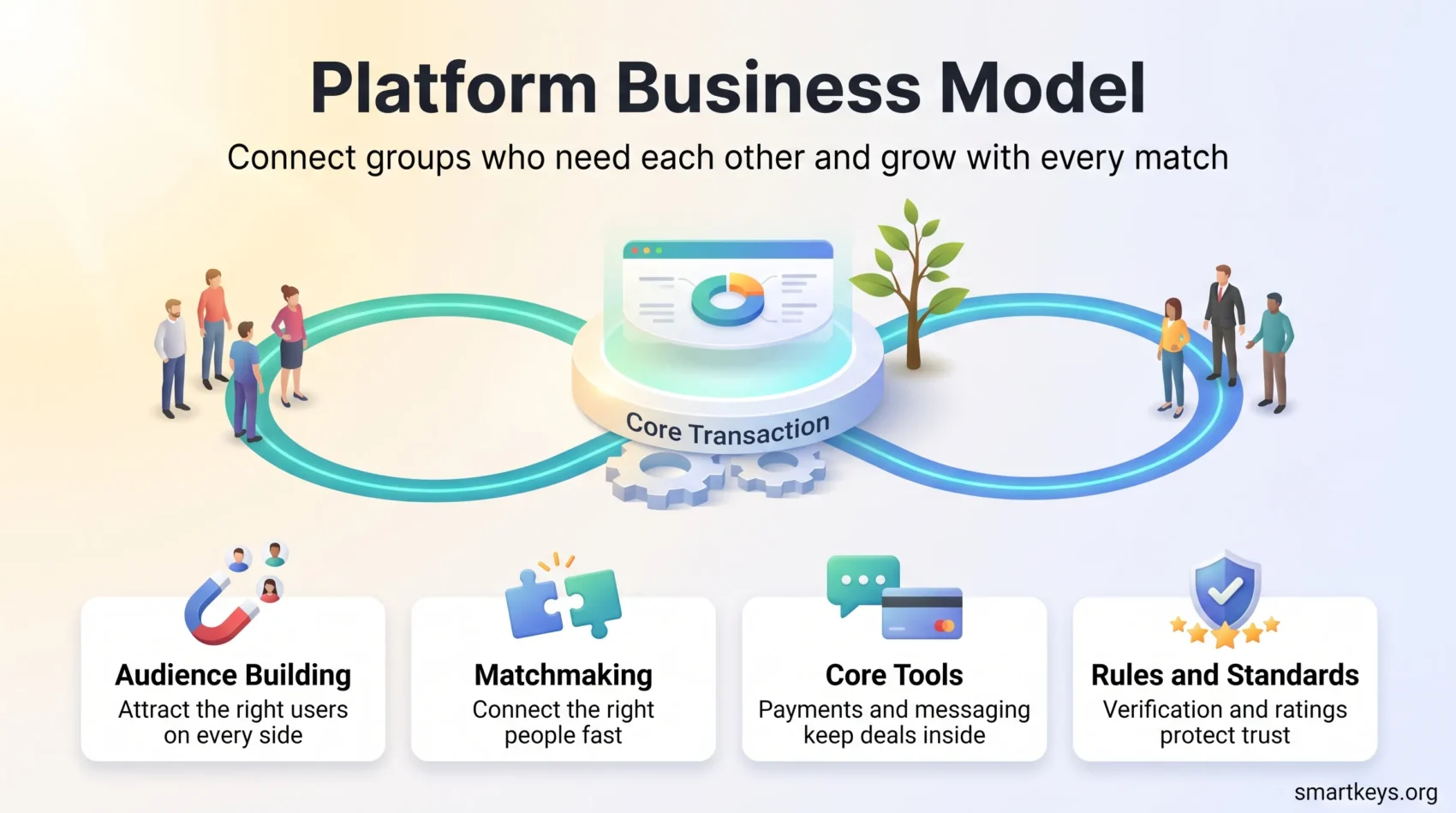
Four steps that make a transaction repeatable
- Attract the right participants on each side, so supply and demand line up.
- Match them quickly, using profiles, location, availability and past behaviour.
- Complete the exchange with built-in payment, messaging and delivery tools.
- Collect feedback through ratings and data, so the next match is better.
Trust as a multiplier
People hesitate to pay strangers. Ratings, identity checks, money-back guarantees and clear dispute processes remove that hesitation and raise the share of started deals that actually complete.
To find bottlenecks, measure each step: how long a new user takes to get first value, how often matches succeed, how often transactions are cancelled and how many people come back.
The Four Core Functions Every Platform Needs
The core transaction only repeats at scale if four supporting functions work together. Weakness in any one of them slows the whole system.
1. Audience building
You need enough of the right users on every side. Early on this usually means incentives, partnerships and focused outreach to a single niche. Many B2B platforms grow this side through a partner ecosystem of resellers and integrators.
2. Matchmaking
Matching connects the right people fast. Simple filters work at first; as data grows, ranking algorithms and recommendations take over. Clean, unified customer data makes this far more accurate.
3. Core tools and services
Payments, messaging, scheduling, logistics and analytics keep participants on the platform instead of taking deals elsewhere. Payment features in particular are increasingly built directly into the product, a trend covered in our guide to embedded finance.
4. Rules and standards
Clear policies, verification and dispute handling protect quality. Users invest time and money only when they trust that others will play fair.
For each function, pick one metric to watch: acquisition cost per side, match rate, tool adoption and the rate of policy violations. That tells you where the next investment will pay off.
Platform Types: Where You Can Play
Choosing a platform type starts with what gets exchanged. Each type needs different tools, onboarding and trust signals.
- Exchange platforms match buyers and sellers of products or services (eBay, Uber, Upwork).
- Development platforms let third parties build on your technology (iOS and its App Store, Salesforce AppExchange).
- Content platforms connect creators with audiences and advertisers (YouTube, TikTok, Spotify).
- Standards-based networks set shared rules that many companies build on, such as open blockchains; this overlaps with Web3 business models, where ownership is part of the incentive design.
Some companies combine several types in one app. These super apps, such as WeChat and Grab, bundle messaging, payments and services, although the model has proved hard to export outside Asia.
Two design choices follow from your type. First, how open you are: closed platforms control quality more tightly, while open ones attract more outside innovation. Second, regulation: payments, investment and health use cases carry legal requirements you should plan for from day one.
Strategy Choices: Build, Partner or Protect
Not every company should build its own platform. Many do better by participating in someone else’s, at least at first.
When to build and when to partner
Build when you have an advantage others cannot copy quickly: proprietary data, a trusted brand, or a core transaction nobody else serves well. Expect a long, expensive period before the network reaches critical mass.
Partner when speed and reach matter more than control. Selling through an existing marketplace or integrating with a larger ecosystem lets you test demand cheaply. Our guide to digital marketplaces compares the trade-offs in more depth, and the API economy article covers which capabilities to open to partners and which to keep.
Protecting your control points
Control points are the assets that decide who captures the profit: direct access to customers, first-party data and distribution channels. Hand these over and a larger partner can squeeze your margins or replace you.
- Set clear API terms and limits on what data partners may keep.
- Keep the customer relationship, including account and billing, where possible.
- Define milestones that would trigger a move from partnering to building, such as steady repeat demand and profitable unit economics.
Building a Platform Step by Step
Most successful platforms follow a similar sequence: identify, build, seed, scale, monetize and expand. Skipping a step, especially charging too early, is a common reason young platforms stall.
Identify
Find the single friction that, once removed, unlocks repeated exchanges. Ask which need you solve and why others cannot copy your solution fast.
Build
Decide how open to be and build modular technology that can grow without a rewrite. Salesforce, for instance, opened its AppExchange marketplace so outside developers could extend its CRM, which made customers far less likely to switch.
Seed
Solve the chicken-and-egg problem: buyers will not come without sellers, and sellers will not come without buyers. Common tactics include paying early suppliers, supplying one side yourself, or offering tools that are useful even before the network exists. John Deere took this route by first offering farmers its own equipment data service, then opening it to partner software.
Scale and monetize
Define what “critical mass” means for you in retention and match rates, and delay heavy fees until you reach it. Facebook built engagement for years before introducing its main advertising products. If you use a free tier, our guide to the freemium model explains how to set its limits.
Expand
Use your data and user base to enter adjacent markets. Grab grew from ride-hailing into food delivery, payments and financial services. Expansion often changes what kind of company you are, so treat it as deliberate business model innovation rather than a side effect of growth.
Monetization: Capturing Value Without Killing Growth
A platform only earns money if it captures a fair share of the value its users create. Charge too little and the business never becomes profitable. Charge too much and participants leave or trade off-platform.
Common revenue models
- Take rate: a percentage of each transaction, as marketplaces and app stores charge.
- Advertising: selling attention, as social networks and search engines do.
- Subscriptions: recurring fees for access or premium features.
- Listing or lead fees: charging suppliers to appear or to receive enquiries.
- Data products: aggregated insights sold to partners, covered in our guide to data monetization.
Subsidies and pricing by side
Platforms often charge one side and subsidise the other. Job boards typically let candidates search for free and charge employers. Many ride apps adjust fares with demand; if you consider that approach, read our guide to dynamic pricing strategies first, because opaque surges damage trust.
Test price changes on small groups before rolling them out. Watch contribution margin per side, lifetime value by cohort and the effect of any fee on match rates.
Shifting Work to Participants Without Losing Quality
Platforms keep costs low by letting participants do work a linear company would pay for. Facebook users create the content. Travelers on booking sites assemble their own trips. Sellers on Etsy photograph and describe their own products.
This only works with the right incentives and good tools. Offer reach, revenue share, badges or analytics so contributors feel rewarded. Provide templates and automated checks to raise the baseline quality. Invest in moderation where trust matters most, because low-quality contributions trigger the negative network effects described earlier.
Why Investors Value Platforms Differently
Investors often value successful platforms more highly than linear peers with similar revenue. The reasons are structural. Network effects make market positions hard to attack, costs grow more slowly than revenue, and data from every transaction improves the product.
That premium is not guaranteed. Valuations fall when interest rates rise or growth slows, and for the largest networks regulatory risk is now an explicit factor. An unresolved commission dispute or a pending gatekeeper decision can weigh on how analysts value a company.
To make the case to investors, show a clear path from liquidity to monetization to profit. The metrics they expect include active users, engagement depth, take-rate stability, retention and margin per transaction.
Technology and Infrastructure for Scale
Platform infrastructure has to handle sudden spikes in demand and constant integration with partners. Three design principles help.
- Modular services and stable APIs. An API (application programming interface) is the defined way other software talks to yours. Versioned APIs let partners plug in without breaking when you ship updates.
- Reliable data pipelines. Collect and clean signals from every step of the core transaction, so ranking, fraud detection and reporting run on accurate data.
- AI for matching and safety. Machine learning models rank search results, spot fraud and personalise recommendations. Keep them honest with ongoing A/B tests.
Set clear targets for uptime, time-to-match and transaction completion. Release changes in small steps with the ability to roll back quickly, so a bad update affects few users.
What Changed for Platforms in 2026
The principles above are durable. The conditions around them shifted noticeably in 2026, and three developments deserve a line in any platform plan.
EU gatekeeper rules moved from paper to penalties
The EU’s Digital Markets Act (DMA) is a law that places extra obligations on very large platforms it designates as “gatekeepers”. In April 2025 the European Commission issued its first non-compliance decisions under the act, fining Apple €500 million and Meta €200 million.
In July 2026 the EU General Court rejected Apple’s challenges to its gatekeeper designation for the App Store and iOS. The designation therefore stands.
What this means for you: if you aim to become a key gateway between businesses and consumers in the EU, size brings duties around self-preferencing (favouring your own products), interoperability and data access. Build audit trails and data-portability tools early; adding them after a designation costs far more. Our guide to building a privacy compliance framework covers the data side.
Commission rates are being renegotiated
The cost of building on someone else’s platform changed in both major markets.
- United States: after the Epic v. Apple litigation, US apps can link users to their own web checkout. Apple currently may not charge a commission on those purchases. The Supreme Court agreed in June 2026 to review part of the contempt ruling, and a decision is not expected before 2027. What Apple may eventually charge remains open.
- European Union: in August 2026 Apple announced that its per-install Core Technology Fee will be replaced by a 5 percent commission on digital sales in apps distributed outside the App Store, effective 1 October 2026, alongside revised App Store rates.
The lesson reaches beyond Apple. A commission you treat as fixed can be reset by a court or regulator within months. Model your unit economics at several take rates, and know which side of your market you could subsidise if costs move.
Your newest participant is an AI agent
AI assistants increasingly search, compare and sometimes buy on a person’s behalf. In late 2025, OpenAI and Stripe introduced an open protocol for checkout inside ChatGPT, and Google published a protocol for agent payments. We cover the wider shift in our guide to agentic commerce.
For platforms, this changes the four core functions:
- Matchmaking: agents compare many options at once, which puts pressure on systems built for human browsing.
- Tools: product data, prices, availability and trust signals must be machine-readable, not just visually clear.
- Rules: you need a policy on which agents may read your data, quote prices and place orders.
- Audience: the “buyer” you optimise for may never see your interface.
Keep this in perspective. Adoption is uneven, and many consumers remain cautious about letting software spend their money. A sensible middle path is to make your catalogue readable by agents while keeping the checkout, payment and customer relationship inside your own ecosystem. That is the control-point logic from earlier, applied to a new layer. Data that customers share with you directly, known as zero-party data, becomes more valuable when an agent sits between you and the buyer. For the consumer side of this shift, see mobile commerce trends.
A short checklist for 2026
- Stress-test unit economics at two or three different take rates.
- Publish structured, machine-readable product and availability data.
- Define an agent access policy.
- Track governance metrics you would be comfortable showing a regulator.
- Decide which control point (data, distribution or customer access) you will not trade away for growth.
Regulation, Governance and Risk
Legal scrutiny grows with a platform’s size. Beyond competition law, the main pressure points are privacy, content safety and labour rules.
- Privacy: collect only the data you need and give users real controls over access and portability.
- Content and safety: measure fraud rates, dispute outcomes and how quickly you remove harmful listings.
- Labour: if your supply side is made up of individuals, worker-classification rules decide your cost base; see gig economy regulation for the current state.
- Sensitive sectors: payments, investment and health carry licensing requirements that are expensive to retrofit.
Treat compliance as part of the product, not a legal afterthought. Platforms that can show regulators clear records tend to move faster when entering new markets.
Case Studies: How Leading Platforms Won
Real examples show how the principles above play out in practice.
- Meta: prioritised user growth and engagement for years, then monetized that attention through advertising.
- Google: matches search intent with advertiser demand, earning money on the most valuable moment in a user’s journey.
- Apple: built a tightly controlled developer ecosystem with strict review rules, a model now under pressure from regulators and courts.
- Uber and Airbnb: solved liquidity, matching and trust in markets where they own none of the supply.
- Amazon Marketplace: added third-party sellers to its own store, then earned fees on logistics and advertising services for those sellers.
- Salesforce and John Deere: turned products into development platforms by opening them to partner software.
- Grab: expanded from rides into payments and financial services, using its user base to enter adjacent markets.
The shared patterns: win a narrow market first, set rules that protect quality, and delay heavy monetization until retention is stable.
Conclusion
A platform business model wins by connecting people who need each other and making every exchange between them easier, safer and faster. Start by defining your core transaction. Then build the four functions that support it: audience, matching, tools and rules.
Choose where you play, protect your control points, and follow the sequence from identifying a friction to seeding, scaling and only then charging. In 2026, add three questions to that plan: how regulation affects you as you grow, what happens if the commissions you pay or charge change, and whether AI agents can read and trust your offer. Track liquidity, match success, retention and unit economics, and you will know which lever to pull next.
Found this useful?
Make SmartKeys a preferred source on Google, and our articles will surface more often in your Top Stories, AI Overviews, and AI Mode.
Add as Preferred Source