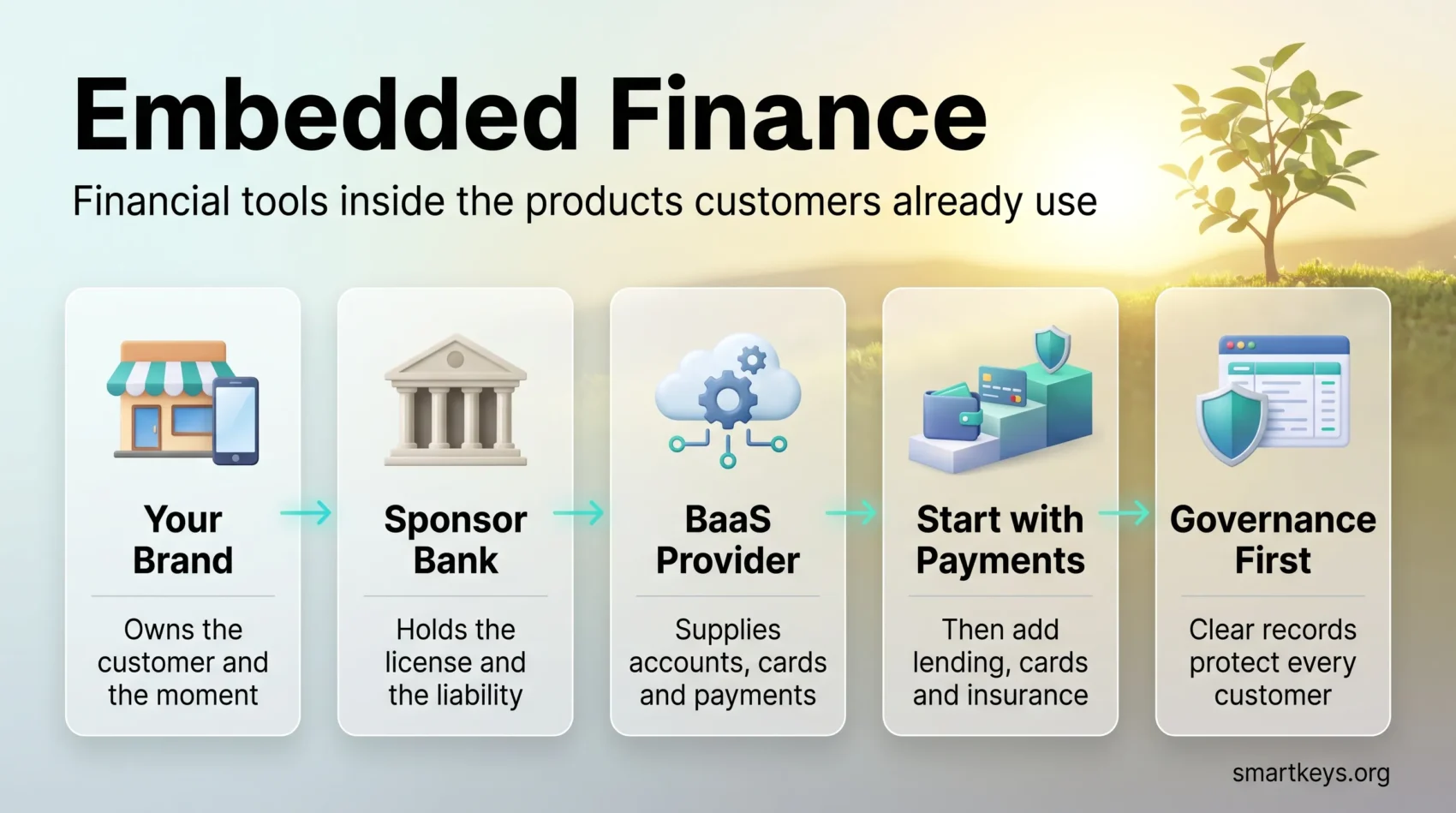
Nonfinancial brands now put banking-like tools directly into their own apps and stores. Payments, loans and insurance appear at the exact moment a customer needs them, without a detour to a bank. A furniture retailer offering a payment plan on the checkout page, a rideshare app paying drivers out the same evening, an invoicing tool advancing cash against an unpaid invoice: all of it is embedded finance.
The point is not that these companies have become banks. They have not. They own the moment and the interface, while a licensed bank and a technology provider handle the regulated part behind the scenes. That split is what makes the model reachable for ordinary businesses rather than only for banks. It also sits at the center of several wider fintech business trends reshaping how money moves.
This guide explains what embedded finance actually is, how big the market really is once you check the sources, how the partnerships work, what the risks look like after the failures of the past two years, and how to sequence a launch.
Key Takeaways
- Embedded finance means offering payments, lending, banking or insurance inside your own product, at the moment of need.
- You almost never build it alone. A sponsor bank holds the license, a Banking-as-a-Service provider supplies the technology, and you own the customer experience.
- Bain projected US embedded finance transaction value would more than double from $2.6 trillion in 2021 to roughly $7 trillion by 2026.
- Revenue comes from interchange shares, transaction fees and revenue splits on lending and insurance, not from the product itself.
- The Synapse failure in 2024 showed how badly this can go wrong when records and responsibilities are unclear. Governance is not paperwork here, it is the product.
- Start with payments or wallets, prove the economics, then add lending, cards and insurance.
What embedded finance is, and why it differs from traditional banking
Embedded finance means placing a financial product inside a non-financial experience. Your customer pays, borrows, insures or gets paid without leaving your app, site or store.
The contrast with traditional banking is about location, not capability. A bank asks the customer to come to it. Embedded finance brings the capability to wherever the customer already is. A few concrete forms:
- Payments and wallets: stored card details and one-click checkout, so a repeat purchase takes a tap instead of a form. Digital wallets are the most common entry point.
- Point-of-sale lending: installment offers shown at checkout. This is the pattern most people know as buy now, pay later.
- Insurance and warranties: cover offered when someone buys a bike, a laptop or a flight, priced for that specific item.
- Accounts and payouts: a balance or debit card inside a platform, so sellers and gig workers reach their earnings faster.
“You meet the customer’s need in context, not in another tab.”
Underneath, the split is consistent. You own the front end: the interface, the timing, the relevance of the offer. A regulated partner owns the back end: the license, the ledger, the money movement. Modern APIs, the interfaces that let two systems exchange data automatically, are what make that split practical. The growth of the wider API economy is a large part of why this model became affordable at all.
How big the market really is in 2026
Embedded finance attracts loud forecasts, and many of them trace back to vendors selling into the category. The figure worth citing comes from Bain and Company with Bain Capital, which projected in 2022 that US embedded finance transaction value would more than double from $2.6 trillion in 2021 to about $7 trillion by 2026. That would lift embedded finance from roughly 5% to about 10% of total US transaction value.
Treat that as a direction of travel rather than a measured result. It is a forecast made four years ago, and no official statistics agency publishes an “embedded finance” line item. What is observable is narrower and more useful: installment lending is now a standard checkout option at large US retailers, marketplace and gig platforms routinely run their own payout accounts, and software vendors increasingly sell payments alongside their subscription.
What actually drives the growth is unglamorous:
- Cheaper integration. What once needed a bank partnership and a two-year build is now a documented API and a contract.
- Distribution advantage. A retailer with 20 million monthly users can put a credit offer in front of more qualified people than a bank branch network can.
- Margin pressure elsewhere. Payments and lending revenue looks attractive to platforms whose core product is commoditizing, a pattern visible across SaaS consolidation.
Where the value actually comes from
The business case rests on three effects, and they are worth separating because they behave differently.
Fewer steps between intent and completion
Every redirect, extra form and second password is a place where customers leave. Removing them lifts completion rates. The honest version of this claim is that in-flow payment and instant approval reduce abandonment compared with sending the customer elsewhere. The size of the lift depends entirely on your basket value, your audience and how bad the old flow was, so measure your own funnel rather than trusting a headline percentage.
Practical first moves: find the step where your funnel leaks most, add stored payment credentials there, and test an installment option on baskets above a threshold where price is the objection.
Stronger loyalty when money lives in your product
A balance, a reward or a card inside your app raises the cost of switching. A driver whose earnings arrive in a platform account is less likely to move to a competitor. A shopper who keeps store credit comes back to spend it. This is the same mechanic behind conventional customer loyalty programs, with the wallet moved inside the product.
Personalization makes it sharper. Because you hold first-party data on what the customer actually does, you can show the right offer at the right time, which is the core idea behind e-commerce personalization.
A revenue line that did not exist before
Payments and lending generate their own income. A retailer earning a share of interchange on a branded card is being paid on spend it was already receiving. That is genuinely new margin, and it is why direct-to-consumer brands and marketplaces moved first.
“Value isn’t only revenue. It’s lower churn and a more memorable experience.”
Inside the ecosystem: sponsor banks, BaaS providers and your brand
Almost every program rests on a three-way relationship. Getting the roles clear early prevents most of the trouble later.
Who does what
The sponsor bank holds the charter. It has access to payment systems such as ACH, the US network for bank-to-bank transfers, and to card networks like Visa and Mastercard. Crucially, it carries the regulatory liability. If your program onboards a customer it should not have, the bank answers for it.
The BaaS provider supplies the technology layer. Banking as a Service, usually shortened to BaaS, means a company packaging a bank’s regulated capabilities into APIs that other businesses can call. In practice that means card issuing, payment processing, deposit ledgers and compliance tooling. Marqeta, Galileo, Unit and Stripe are examples of providers operating in this space.
Your brand owns the customer relationship, the interface and the decision about when an offer appears.
The short way to hold the distinction: embedded finance is the product your customer sees. BaaS is the plumbing that makes it legal and functional.
The three structures you will encounter
- Direct with a bank. Most control, most work, longest timeline. Suits large programs with in-house compliance staff.
- Through a BaaS provider. Fastest to launch. You inherit the provider’s bank relationships and controls, and their weaknesses too.
- Bank-led. The institution runs most of the program and you distribute it. Least risk, least differentiation.
Before signing anything, map where customer data goes, who is contractually accountable for each control, and what happens to your customers if the provider fails. That last question used to be theoretical.
Risk and compliance after Synapse
This section changed more than any other between 2024 and 2026, and it is the part most guides still skip.
Synapse Financial Technologies, a middleware provider connecting fintech apps to partner banks, filed for Chapter 11 bankruptcy on 22 April 2024. Within weeks its partner banks lost reliable access to the records showing who was owed what. End users of consumer apps built on Synapse found their money frozen. Of roughly $219 million held in custodial accounts, about $165 million had been returned to end users by September 2024, and a court-appointed examiner’s analysis identified a shortfall of somewhere between $65 million and $95 million between the funds banks held and the amounts customers were owed.
Two lessons follow directly. First, “FDIC insured” protects against a bank failing, not against an intermediary losing track of the ledger. Second, if you distribute a financial product to your customers, they will hold you responsible when it breaks, whatever your contract says.
Regulators responded. In September 2024 the FDIC proposed a recordkeeping rule that would require banks to maintain direct, continuous and unrestricted access to the records of any third party managing a deposit ledger on their behalf. Check its current status before you rely on it, but the supervisory direction is unambiguous, and sponsor banks have tightened diligence accordingly.
Not all regulation moved in one direction. The Consumer Financial Protection Bureau rescinded its 2024 interpretive rule that had treated BNPL lenders like credit card issuers, and confirmed in 2025 that it would not reissue a revised version, calling the original procedurally defective. BNPL in the US is therefore governed by general consumer credit and state law rather than a dedicated federal rule. That is a lighter burden today and an open question tomorrow, so read the wider data privacy and compliance picture before you assume today’s rules will hold.
The controls you cannot skip
Whichever structure you choose, some obligations do not move:
- KYC and AML. Know Your Customer means verifying who someone is before opening an account. Anti-Money Laundering means monitoring transactions for signs of criminal use. Both must sit in onboarding and in continuous monitoring, not just at signup.
- Sanctions screening and fraud monitoring, layered across device signals, identity verification and behavioral scoring so you block abuse without rejecting good customers.
- Joint governance. A shared risk committee, scheduled control testing, and agreed reporting on transaction volume, disputes and fraud trends.
Identity is where most of this friction concentrates, which is why approaches such as decentralized identity are drawing attention for onboarding. And because customers judge the whole program by whether their money behaves predictably, digital trust is a commercial asset here, not a compliance chore.
“Design governance and reporting first. Products follow faster when risk rules are clear.”
What you can embed, and in what order
Sequence matters more than ambition. Each product adds a different amount of regulatory weight.
Payments and wallets are the natural first step. Stored credentials and one-click checkout cut abandonment and carry the lightest compliance load. The Starbucks app is the canonical example: preloaded balance, instant payment, rewards attached.
Lending and BNPL raise average order value on higher-priced items. Providers such as Klarna, Affirm and Afterpay handle underwriting and collection. Make the repayment terms unmissable at checkout; unclear terms are where reputational damage starts.
Accounts and branded cards deepen the relationship and open interchange revenue. This is heavier: deposit ledgers, card issuance, dispute handling.
Insurance and warranties attach naturally at purchase, sold through embedded brokers such as Extend or Boost. Attach rates can be strong because the risk is obvious to the buyer at that exact moment.
Investing and marketplaces suit specific audiences. PayPal and Venmo let users buy assets without leaving the app. A comparison marketplace lets customers pick between third-party offers while you earn a referral fee.
For each one, define success before launch: approval rate, attach rate, time to payout, and the fraud loss you are willing to absorb.
Where it works across industries
Retail and e-commerce
Branded cards and stored wallets lift repeat purchase and basket size. Target’s RedCard, which ties a 5% discount to paying with the card, is the clearest example of trading margin for loyalty and payment-cost savings. Installment options at checkout have become standard across e-commerce.
Mobility and gig platforms
Faster access to earnings is the strongest retention lever these platforms have. Uber’s Pro Card and Lyft Direct both give drivers a debit account with same-day access to fares instead of a weekly transfer. For workers managing irregular income, that timing matters more than the headline rate, a point often missed in discussions of the global gig economy.
B2B software platforms
Invoicing and accounting tools sit on top of exactly the data a lender needs: real revenue, real payment behavior. That makes revenue-based financing inside the platform far easier to underwrite than a cold application. The same logic supports embedded payments in vertical software, and it changes the economics of a subscription business model by adding transaction revenue on top of seat fees.
Telco, hospitality and media
These sectors add financial products through partners rather than licenses, surfacing them at booking, renewal or invoice moments. The technique matters more than the sector: place the offer where intent is already high.
For a related view of how programmable money changes settlement between businesses, see DeFi and business transactions.
How the money is made
Embedded finance rarely earns money from the financial product itself. It earns from the flow around it.
- Interchange sharing. A slice of the fee merchants pay when a card is used. Small per transaction, meaningful at volume, and steady.
- Transaction fees. A per-payment or per-payout charge, common in platforms that process on behalf of sellers.
- Revenue share on lending and insurance. Your partner underwrites, you distribute, you split the margin.
- Premium tiers. Instant payout, higher limits or richer analytics sold as a subscription upgrade.
Two cautions. Interchange economics differ sharply between debit and credit and between bank sizes, so model your own case rather than copying a published benchmark. And every fee you add is visible to the customer eventually, so weigh short-term take rate against churn. Insights from customer data are more useful here than industry averages.
Build, partner or buy
Build gives full control and takes the longest. It only makes sense when the financial product is central to your strategy and you can staff compliance permanently.
Partner is the default for most companies. You launch in months instead of years and inherit a working control environment, at the cost of customization and some margin.
Buy is fastest to scale and rarest, since acquiring a licensed entity brings the regulator with it.
Data and integration
Account verification services such as Plaid reduce onboarding drop-off by confirming bank details directly instead of asking users to type them. Use webhooks and event streams so settlement and risk signals are observable in real time, and build retry logic, because payment infrastructure fails occasionally and silence is worse than an error.
The regulatory backdrop for this data access is shifting, and it is worth tracking alongside open banking developments in both the US and Europe.
A realistic roadmap
- Discovery. Pick one customer problem and one product. Vague ambitions fail diligence.
- Compliance readiness. Agree KYC, AML and reporting duties with the sponsor bank in writing before development starts.
- Pilot. One segment, one product, real money, small volume.
- Scale. Only after you have dashboards for approvals, declines, fraud and settlement health.
For decisioning and risk scoring, the groundwork overlaps heavily with predictive analytics in finance.
Programs worth studying
Starbucks runs one of the longest-lived embedded payment programs: a preloaded balance and one-tap payment tied to rewards, which also reduces card processing costs on every stored-value transaction.
Target RedCard shows the loyalty trade directly. A 5% discount funded partly by lower payment costs, in exchange for repeat visits and a payment method the retailer controls.
Uber and Lyft demonstrate the payout model. The Uber Pro Card and Lyft Direct give drivers a debit account and same-day access to earnings, addressing a real cash-flow problem rather than adding a feature.
Shopify Balance extends the pattern to merchants, moving payouts and spending into the platform where sellers already run their business.
The common thread is not technology. Each of these solved a specific friction the company could already see in its own data, then chose partners to deliver it.
Embedded finance trends shaping the next few years
The relationship between brands and banks keeps rearranging as more distribution moves to non-financial companies. Three shifts are worth planning around.

Distribution and licensing keep separating
Banks increasingly compete to supply capability rather than to own the customer. Expect more specialized providers targeting narrow verticals, and expect your bank partner to care as much about your compliance culture as your volume.
Supervision tightens where consumers are exposed
The Synapse aftermath pushed regulators toward clearer accountability for who holds the ledger and who answers when it breaks. Programs with clean records, tested controls and honest reporting will find partners. Programs without them will find their bank exiting the relationship, which has already happened repeatedly across the sector.
Underserved segments remain the real opportunity
The strongest cases are still where conventional finance serves people badly: irregular-income workers, small merchants with thin credit files, niche industries with unusual cash cycles. Your first-party data is the advantage a bank cannot replicate, and the same data discipline that powers AI in business operations applies here.
“Design multi-year roadmaps that balance growth with risk-adjusted returns.”
Conclusion
Embedded finance is no longer novel. It is a normal way to add revenue and reduce friction, available to any company with enough customers and a partner willing to underwrite the regulated part.
The failure mode has also become clear. Programs that treat the bank relationship as procurement and compliance as documentation are the ones that end badly, sometimes taking customer money with them.
So start narrow. Pick the single friction your own data already shows you, choose the lightest product that fixes it, agree responsibilities in writing before you build, and prove the economics on a small cohort. Payments first, then lending, then accounts and insurance. The companies that scale this well are rarely the ones that moved fastest. They are the ones that knew exactly who was responsible for what.
Found this useful?
Make SmartKeys a preferred source on Google, and our articles will surface more often in your Top Stories, AI Overviews, and AI Mode.
Add as Preferred Source