Last reviewed and updated: September 2026.
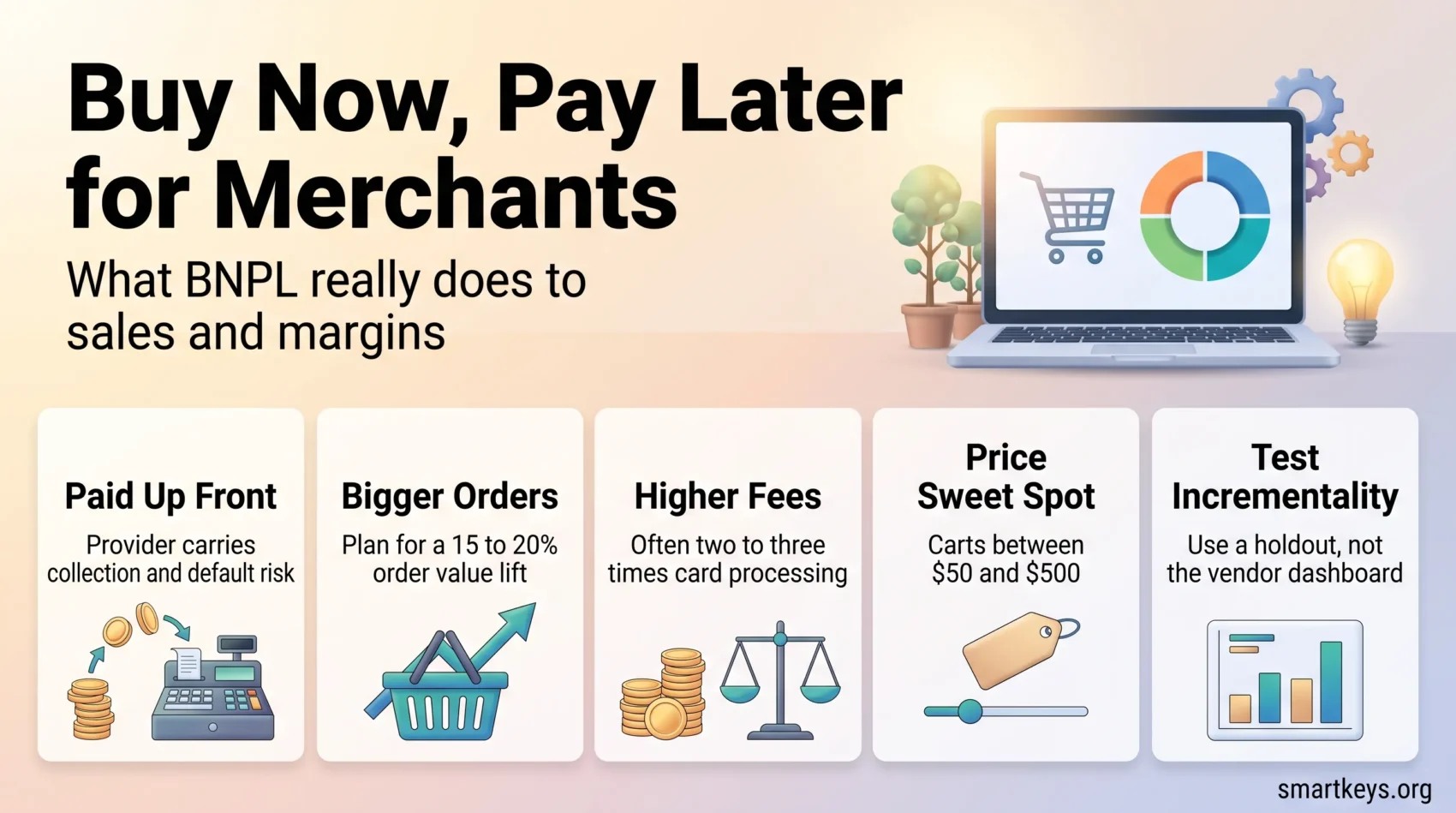
Buy now, pay later has stopped being a novelty and become plumbing. BNPL, short for buy now, pay later, is a small loan offered at the checkout: your customer splits a purchase into four interest-free installments, you are paid up front minus a fee, and the provider carries the collection and default risk.
The scale is now well documented. Adobe Analytics recorded $20 billion in BNPL-funded online spend across the 2025 US holiday season (1 November to 31 December), up 9.8% year over year. Cyber Monday became the first single day to cross $1 billion, at $1.03 billion. A 2026 economic brief from the Federal Reserve Bank of Richmond puts total 2025 US BNPL transaction value near $70 billion. That is roughly 1.1% of US credit-card purchase volume, growing about 20% a year.
So: real, mainstream, still small next to cards. That framing matters, because it tells you BNPL is a conversion lever, not a payments strategy on its own.
Key takeaways
- BNPL reliably lifts conversion and average order value. The honest, independently grounded lift is closer to +17% than the +87% figures providers market.
- You are paid up front, so cash flow improves. You pay for it in fees that typically run 2 to 3 times card processing.
- The federal regulatory picture reversed. The CFPB withdrew its 2024 rule treating BNPL like credit cards in May 2025 and confirmed it will not reissue it. States are filling the gap, and New York is building a full licensing regime.
- Credit reporting is fragmenting. Affirm now furnishes data to Experian and TransUnion, while Klarna and Afterpay hold back their US pay-in-four data.
- Consumer stress is rising. Self-reported late payments climbed from about 34% of users in 2024 to roughly 47% in 2026, a reputational and returns risk you inherit at the counter.
How BNPL actually works at your checkout
The core US product is a closed-end pay-in-four loan. Closed-end simply means it is a fixed loan for one purchase, not a revolving credit line you can draw on again. The shopper repays over six to eight weeks and pays no interest. Klarna, Afterpay, Affirm and PayPal handle instant approval, collection and default risk. You receive settlement quickly, usually within a few days, minus the provider’s fee.
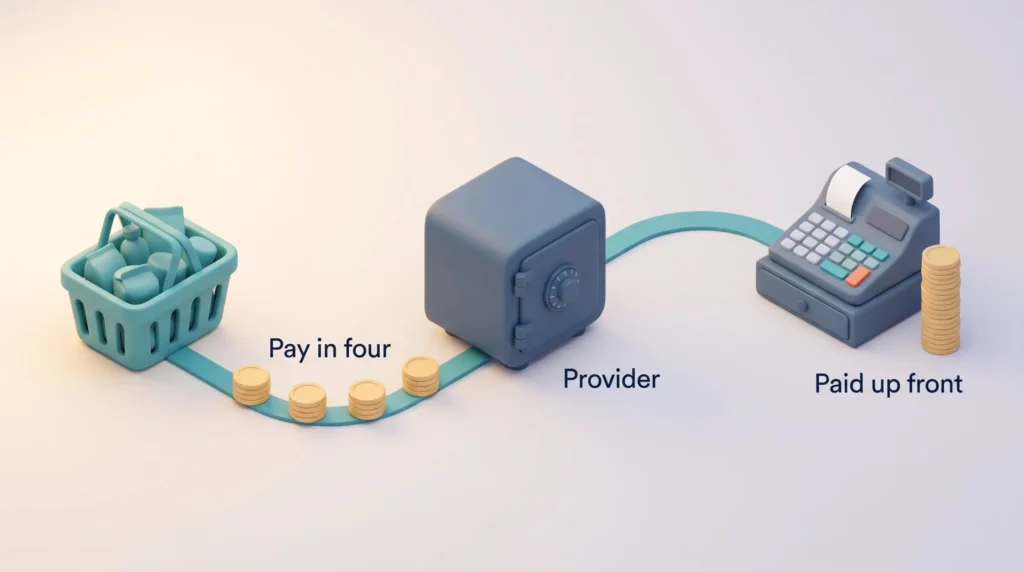
The mechanism is simple psychology: you remove the sticker total as a barrier. A $240 cart reads as four payments of $60, and the hesitation that would have produced an abandoned cart produces an order instead.
Two details matter before you evaluate providers:
- Mobile is the channel. Adobe found 82.2% of holiday BNPL purchases happened on smartphones, against 56.4% of online holiday orders overall. If your mobile checkout is slow, the option will not perform. The wider shift is covered in our guide to mobile commerce trends.
- The average ticket is modest. The Richmond Fed puts the average US BNPL transaction at about $131, which tells you where in your catalog the option belongs.
BNPL is one expression of a broader shift in which non-financial brands offer financial products directly. If you are weighing pay-later against wallets, branded cards or lending, our guide to embedded finance maps the wider landscape, and our overview of digital wallets in payments covers the closest alternative at the checkout.
The upside: what the numbers actually support
Be careful with vendor benchmarks. Published claims for the lift in average order value range from a conservative +17% to marketed figures of 45%, 91% and merchant case studies claiming triple-digit gains. Only the low end is independently grounded. The rest is selection bias dressed as evidence: high-intent shoppers who would have converted anyway simply choose the pay-later button.
Use this planning range instead:
- Conversion lift: model a modest single-digit to low-double-digit improvement, concentrated on higher-ticket carts.
- Average order value: plan on roughly +15% to +20%, and treat anything above that as upside you have to prove in your own data.
- New customers: the more defensible benefit. BNPL reaches shoppers who lack or avoid credit cards, which genuinely expands reach rather than reshuffling existing demand. Whether those buyers come back is a separate question, and one your customer retention strategy has to answer.
- Cash flow: unambiguously positive. You are funded up front while the provider carries the receivable, which matters most to the seasonal businesses covered in our guide to cash flow management.
Measure incrementality, not attribution
The single most common mistake is reading the BNPL dashboard as proof of value. Incrementality means the revenue you would not have earned otherwise. That dashboard shows orders that used BNPL, not orders that only happened because of BNPL.
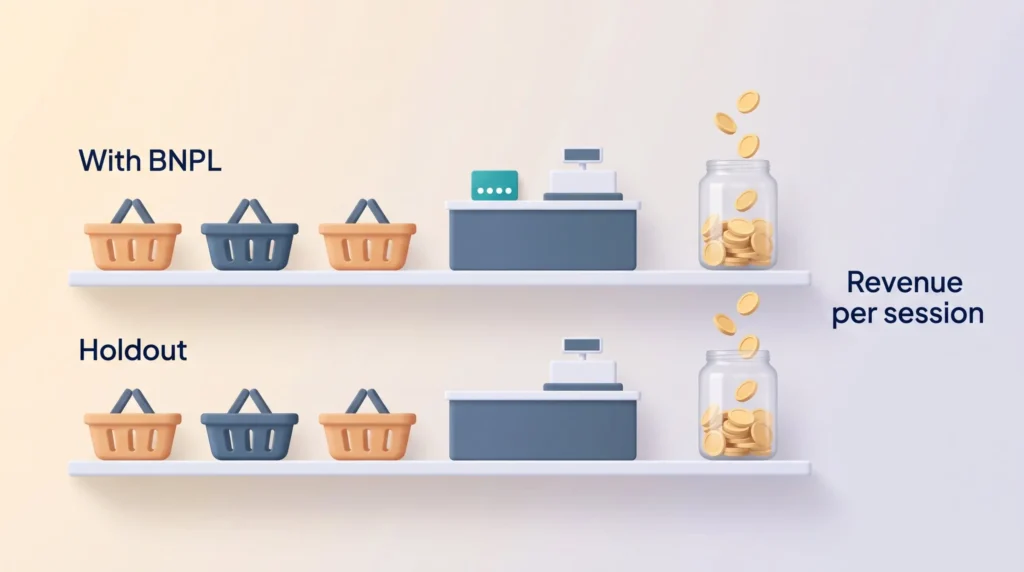
Run a holdout instead. Show the option to one traffic segment, withhold it from a matched segment, and compare total revenue per session across both. If the two segments earn the same per session, BNPL moved margin to a provider without adding sales.
Pair the test with behavioral analytics to see which segments respond and where the option merely cannibalizes card payments. The same discipline applies to any checkout change, including the tactics in our guide to e-commerce personalization.
The trade-offs: fees, returns, and who owns the customer
Fees compress margin faster than you expect
BNPL acceptance fees commonly run about 1.5% to 7% per transaction, against roughly 1.5% to 3.5% for card payments. Work through what that costs you. On a 40% gross margin, an extra four points of payment cost eats a tenth of your margin on every BNPL order. That is why the lift in average order value has to be real rather than assumed.
| Factor | Cards | BNPL (pay-in-four) |
|---|---|---|
| Typical merchant fee | ~1.5% to 3.5% | ~1.5% to 7% |
| Settlement to you | 1 to 3 days | Up to a few days, in full |
| Default risk | Issuer | Provider |
| Dispute mechanics | Mature chargeback rails | Provider-specific, less standardized |
| Best-fit ticket size | Any | Roughly $50 to $500 |
Returns get more expensive and more confusing
Reverse logistics, meaning the cost of getting returned goods back and resold, is already a serious line item in retail. Installment payments add a second layer: the refund has to unwind against a payment schedule that may be partly complete.
A customer who has made two of four payments and sends the item back expects a clean resolution, and they will call you first, regardless of who holds the loan.
Customers contact the merchant first for questions about installments, late fees and refunds, even when the provider handles collections entirely.
Write the support scripts before you launch, not after the first escalation. Slow or contradictory answers here damage exactly the loyalty signals tracked in our overview of customer experience trends.
Operational overhead is real but bounded
Expect sandbox testing, accreditation and reconciliation work across a new settlement stream. Choosing a provider with a native plugin for your platform removes most of this. Custom gateway work does not.
Is BNPL a fit for your price points and customers?
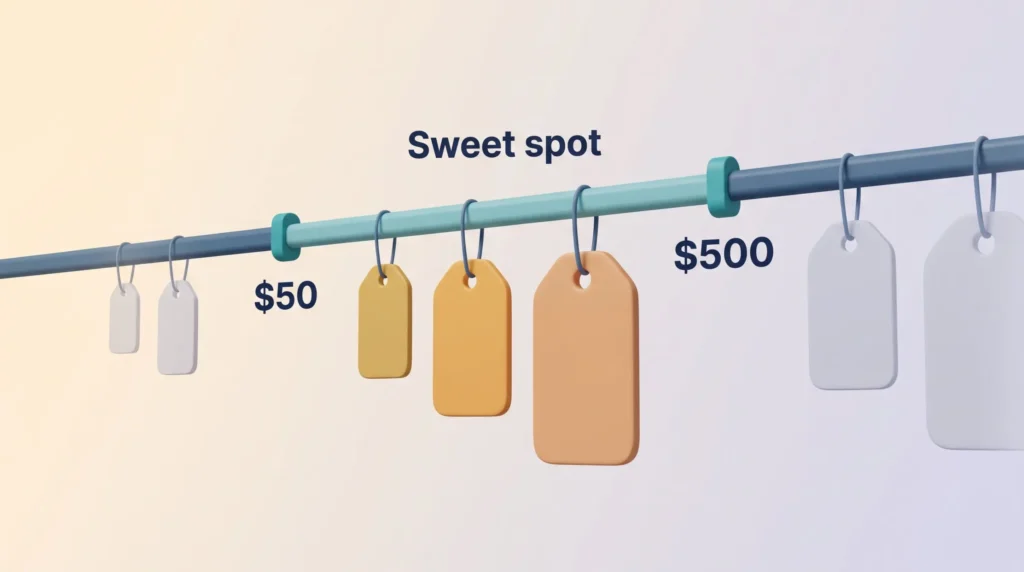
The sweet spot for most merchants sits between roughly $50 and $500. Below that, the fee overwhelms the benefit and the installment framing is meaningless. Far above it, approval rates fall and default risk pushes providers to decline.
Adoption still skews young, and the categories are consistent: Adobe’s consumer survey found shoppers most likely to reach for BNPL on electronics, apparel, toys and furniture. Those are also the categories where the direct-to-consumer brands in our D2C retail analysis compete hardest on checkout experience.
Practical filters before you switch it on:
- Set a minimum order threshold so low-ticket items never route to a high-fee method.
- Exclude categories with structurally high return rates.
- Show installment amounts on product pages, not just at checkout. That is where the hesitation happens.
- Track conversion, returns and repeat purchase rate by price band, not in aggregate.
- Check whether a price change would serve you better than a payment change, using the tests in our guide to dynamic pricing strategies.
If most of your revenue is recurring rather than transactional, the calculus is different. The friction you are fighting is subscription fatigue, not sticker shock, and installments will not solve it.
What changed in 2025 and 2026: regulation and credit reporting
This is the section most BNPL articles still get wrong, because the direction of travel reversed at federal level and then restarted at state level.
The CFPB rule was withdrawn
In May 2024, the CFPB issued an interpretive rule treating BNPL providers with “digital user accounts” as credit card issuers under the Truth in Lending Act and Regulation Z. That would have brought billing statements, dispute rights and refund-crediting requirements with it.
That rule is gone. The CFPB withdrew it on 12 May 2025 as part of a broader rescission of guidance documents, and in June 2025 told a federal court it does not intend to reissue it, describing the original as procedurally defective and a poor fit for what are structurally closed-end loans.
What this means for you: the compliance burden you may have budgeted for in 2024 did not arrive. Ask providers directly how they handle disputes and refund crediting, because there is no longer a federal baseline forcing consistency between them.
States are now writing the rules instead
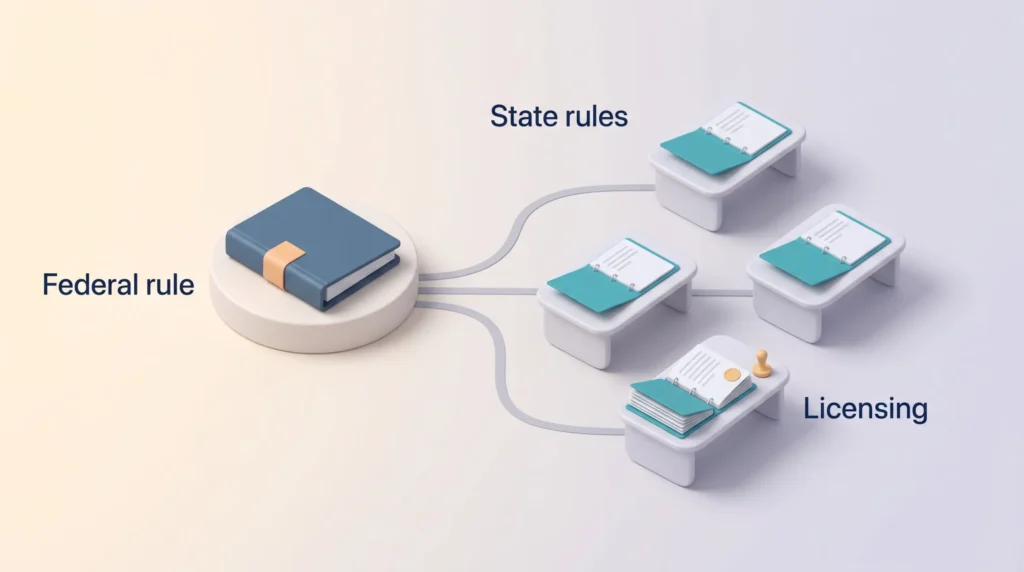
Federal restraint pushed the work to state regulators, and New York has moved furthest. Its Buy-Now, Pay-Later Act creates a licensing regime that reaches well beyond classic pay-in-four products, covering fintechs, bank partnership programs and some buyers of BNPL loans on the secondary market.
The New York Department of Financial Services published a proposed rule on 15 July 2026, following a pre-proposal in February 2026. As drafted, it caps charges at the state’s 16% civil usury limit, restricts late fees, requires pre- and post-transaction disclosures including an annual percentage rate, and obliges lenders to give borrowers an accessible interface showing balances and due dates. Final rules take effect 180 days after publication, and non-exempt lenders then have 45 days to apply for a license.
You are not the licensee here, your provider is. The practical consequence is still yours: if a provider withdraws from a state or changes its terms to comply, your checkout changes with it. Ask providers which states they are licensed or exempt in before you sign. This is the same compliance patchwork described in our guides to regtech solutions and fintech trends.
BNPL is entering credit files, unevenly
The more consequential shift is on the data side:
- Affirm began furnishing all pay-over-time products to Experian on 1 April 2025 and TransUnion on 1 May 2025.
- Klarna and Afterpay have declined to furnish US pay-in-four data, arguing that legacy scoring models would unfairly penalize their customers.
- FICO announced FICO Score 10 BNPL and 10 T BNPL on 23 June 2025, originally expected that autumn. As of late 2026 they are not yet in market at scale, and bureaus generally tag BNPL tradelines and exclude them from the scores most lenders read.
The practical read: the “BNPL now affects your credit score” headlines ran ahead of reality, but the infrastructure is being built. When it lands, loan stacking becomes visible to underwriters, approval rates may tighten, and your conversion lift could compress. Build that scenario into any multi-year forecast. The same plumbing that makes consumer credit data portable is described in our guide to open banking trends, and the consent questions in data privacy trends.
Watch the consumer-stress signal
Charge-offs stay low. The Richmond Fed put the BNPL charge-off rate at 1.83% in 2023, against 4.19% for credit cards at US commercial banks in the same period. Self-reported late payments, however, have climbed sharply: about 34% of users in 2024, 41% in 2025 and roughly 47% in 2026.
Most of those are only days late, so this is a demand-quality signal rather than a credit crisis. Still, a payment method associated with financial strain carries brand risk, and placement matters. Nudging a struggling customer into a fifth concurrent plan is not a growth strategy, and the borrower-side dynamics are similar to those in our analysis of peer-to-peer lending.
Implementing BNPL without breaking your margins
Run the breakeven math first
Before a sitewide rollout, build a simple model: incremental orders multiplied by incremental gross margin, minus the fee gap against cards, minus expected additional return costs. If the answer only works at a +45% assumption for average order value, you do not have a business case. You have a provider’s pitch deck.
If the fee gap is the problem, the fix is usually upstream in your pricing strategy framework rather than in the payment method itself.
Pilot narrowly, then expand
- Start with two or three categories in the $50 to $500 band.
- Run for a full return cycle, not a fortnight. Return costs surface late.
- Track support ticket volume as a first-class metric, not an afterthought.
- Compare at least two providers on approval rate for your audience. The spread between them is often larger than the fee spread.
Train the team before launch
Align finance and support on settlement timing, partial refunds and reconciliation across payment methods. Your agents need one clear answer to “I returned it but Klarna still charged me”, and they need it on day one.
Review provider performance monthly: approval rates, effective fee rate, dispute volume and satisfaction. Renegotiate as volume grows, because fee tiers are far more negotiable than published rates suggest.
Conclusion
Treat BNPL as one lever among several, sized to your margin structure. The upside is real but smaller than the marketing implies, the fees are certain, and the environment that looked restrictive in 2024 has loosened federally while states and credit bureaus quietly reshape the risk picture.
Pilot it, measure incrementality with a holdout rather than a vendor dashboard, and set thresholds that keep low-margin items away from high-fee rails. Done that way, pay-later earns its place at your checkout. Bolted on because competitors have it, it mostly moves margin from you to a provider.
For wider context on how payment and ownership models are reshaping retail, see our analysis of the recommerce trend, our overview of e-commerce trends, and our look at conversational commerce.
Found this useful?
Make SmartKeys a preferred source on Google, and our articles will surface more often in your Top Stories, AI Overviews, and AI Mode.
Add as Preferred Source