Dynamic pricing means letting your prices move with demand, stock levels and competitor moves instead of sitting still for months. An airline seat, a hotel room and a Black Friday listing all work this way. The idea is old. What changed is that software now makes the same approach practical for an ordinary online shop or a mid-size retailer.
This guide covers dynamic pricing strategies for e-commerce and retail: how they work, which rules keep them safe, and what United States law now demands of you. For the wider question of how to set prices in the first place, start with our guide to building a pricing strategy. That last part changed a lot in 2026, so it is worth reading even if you already run a pricing program.
One distinction matters more than any other. Adjusting a price because demand rose is legal almost everywhere. Adjusting a price because of what you know about the individual shopper is now restricted in several states and is the main target of regulators. Everything below keeps those two ideas separate.
Key Takeaways
- Dynamic pricing reacts to market signals such as demand, stock and competitor prices, not to who the shopper is.
- Personalized or “surveillance” pricing uses someone’s personal data to set their price. New York, California, Maryland and New Jersey now regulate it.
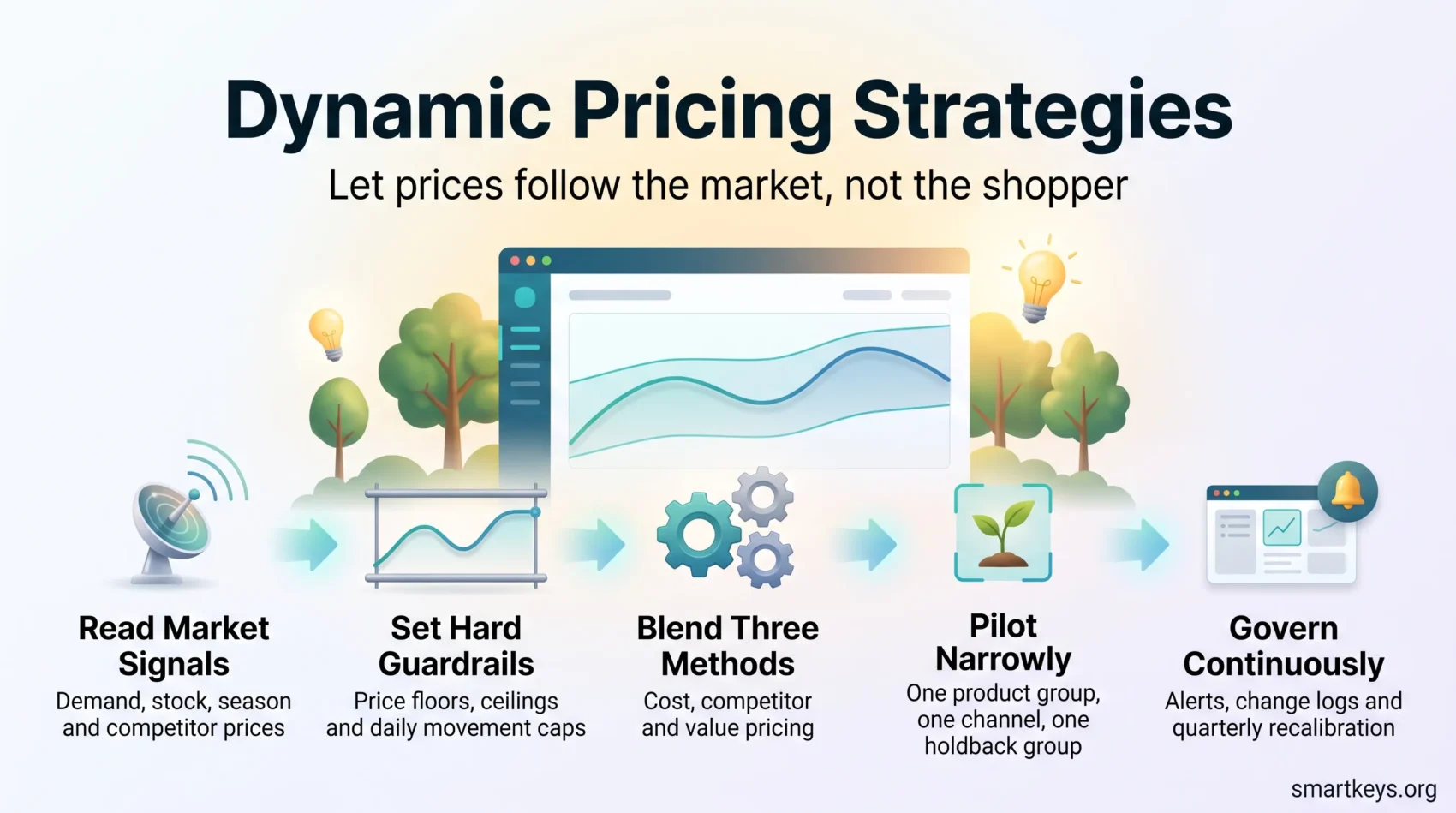
- Clean data and hard price floors and ceilings matter more than a clever algorithm.
- Small, explained price moves keep customers calm. Large, silent ones cost you trust.
- Start with one product group and one channel, measure the result, then expand.
Why dynamic pricing matters now
Static price lists assume the market stands still for a quarter. It does not. Stock runs out, a competitor drops a price, a holiday weekend lands, and a price you set in January is wrong by March.
What changed for smaller sellers
Large retailers have repriced automatically for years. The tooling that made that possible is now sold as an ordinary subscription, so a shop with a few thousand products can do the same thing.
The pressure runs the other way too. Your customers compare prices in three browser tabs before they buy. If your price sits above the market for a week because nobody updated a spreadsheet, you lose the sale and never hear about it.
What it actually gets you
Three things, in plain terms. You capture more margin in the short windows when people are willing to pay more, such as the last days before an event. You clear slow stock with a targeted discount instead of a sitewide sale. And you stop losing sales to a competitor who moved while you were not looking.
The size of the gain depends entirely on your category, your data quality and how disciplined your rules are. Be skeptical of vendors quoting a single headline percentage. Measure your own baseline first, then judge.
Dynamic pricing, defined
Dynamic pricing adjusts a price automatically based on market conditions. Those conditions are things like current demand, how much stock is left, the time of day, the season, and what competitors charge. Everyone who visits your page at a given moment sees the same number.
What it is not
It is not random markup, and it is not a license to raise prices whenever you can get away with it. A working system has boundaries: a floor below which you never sell, a ceiling above which you never go, and a limit on how far a price can move in one day.
It is also not surge pricing in the narrow sense. Surge is one tactic inside dynamic pricing, used when supply is genuinely short.
How it differs from personalized pricing
This distinction now carries legal weight, so it is worth stating carefully.
Dynamic pricing responds to the market. Personalized pricing, often called surveillance pricing, responds to the person. It uses browsing history, location, device type, past purchases or inferred income to decide what one specific shopper should pay.
Regulators treat these very differently. Dynamic pricing remains lawful. Personalized pricing carries disclosure duties in New York, an enforcement sweep in California and outright bans in some categories elsewhere. The legal section below covers the detail.
Where it fits best
- Online shops where stock and demand shift week to week. Our overview of e-commerce trends covers the wider context.
- Time-sensitive goods: event tickets, travel, electronics, seasonal items.
- Retailers running electronic shelf labels, the small digital price tags that update from a central system, so shelf and website stay in step. This is part of the broader phygital retail shift.
- Subscription and software businesses moving toward usage-based pricing, where the bill follows consumption.
It fits badly where customers buy the same item every week. People notice when their regular purchase costs more on Thursday than it did on Monday, and they resent it.
The data behind real-time pricing decisions
Bad inputs produce bad prices faster than a human ever could. Get the data layer right before you automate anything.
What you need to collect
Start with your own numbers: page visits, conversion rate, order velocity and live stock levels. These tell you what demand is doing right now.
Add competitor prices from a monitoring feed. Add the calendar: holidays, local events, school terms, paydays. Weather helps in some categories and is noise in others.
Feeding all of this into one place is the hard part. A customer data platform or a well-built warehouse does the job. Getting real-time data into the model is what separates a system that reacts in minutes from one that reacts next week.
How the moving parts work together
Three components do the work, and it helps to keep them separate in your head.
A rules engine holds your hard limits: floors, ceilings, maximum daily movement, exceptions for flagship products. It never changes on its own.
An elasticity model estimates how much demand shifts when the price moves. Elasticity is simply the answer to “if I raise this price 5%, how many fewer units do I sell?” The model learns this from your sales history.
A forecast predicts near-term demand so the system can act before the peak rather than during it.
The rules engine always wins. The model suggests, the rules decide what is allowed. Getting this order wrong is how companies end up with a $9,000 listing for a garden hose.
Connect the systems that hold stock
Your pricing tool has to see your real inventory. If it does not, it will discount things you cannot ship and raise prices on things sitting in a warehouse.
Connect the point-of-sale system, the ERP and the online store through APIs that update in both directions. Then add change logs, approval steps for large moves, and alerts for anything outside normal range.
The three pricing methods you will combine
No single method works alone. Each answers a different question, and a working system uses all three with clear priority. Our pricing strategy framework covers how these fit into a wider commercial plan.
Cost-plus sets the floor
Price equals cost plus your target margin. It is the simplest method and the least clever, but it stops you selling at a loss. Use it as a hard floor that nothing else can override.
Make sure “cost” includes shipping, returns and payment fees. Many teams discover their floor was too low only after a quarter of thin margins.
Competitor-based keeps you in the race
Track what rivals charge and decide in advance when you match, when you undercut and when you hold. Write those decisions down as rules before you automate them.
The trap here is obvious once you name it. If everyone reprices off everyone else, prices spiral down. Set a floor, exclude a few competitors you do not want to follow, and cap how often you react to the same rival. Thinking about your position first, using something like a competitive strategy review, prevents most of this.
Value-based captures what people will pay
Value-based pricing starts from what the product is worth to the buyer rather than what it cost you. In a dynamic system, you approximate that with sales history, ratings, return rates and elasticity estimates.
This is where the upside sits, and where the risk sits too. Push value-based logic too hard on everyday goods and customers feel exploited.
Blending them
Weight the three by category and lifecycle. A commodity item leans on cost and competitor rules. A differentiated product leans on value. A product at end of life leans on stock clearance.
“Use rules to set floors and ceilings. Let the model suggest increments between them.”
Report results by method so you can see which input earned the gain. Attribution is what lets you tune the system instead of guessing.
Tactics you can deploy now
Start with the tactic that matches a pattern you already understand. Each of these is testable on its own.
Time-based pricing for predictable cycles
Schedule price windows around events you can see coming: weekends, holidays, the start of a season. Set modest increases during peak hours and automate the rollback so nobody forgets.
This is the safest place to begin because you control the timing completely.
Demand and inventory triggers
Raise the price when traffic and conversion climb together, since that combination means real demand rather than idle browsing. Lower it when stock ages past a threshold you set.
Inventory-driven rules do double duty. They protect margin and they protect cash flow, because stock that does not move is money you cannot spend.
Geographic pricing
Vary prices by region to reflect local competition, delivery cost and purchasing power. Keep the gaps defensible and be ready to explain them, because customers do compare across regions.
Loyalty offers instead of personalization
Here is the safer version of personalized pricing. Rather than quietly charging one shopper more, give known customers a visible reward: a coupon, a bundle or loyalty credit they opted into.
The price stays the same for everyone. The discount is earned and transparent. That approach supports customer retention without creating the legal exposure the next section describes, and it strengthens customer loyalty rather than eroding it.
“Limit how far and how fast prices move. Small, tested steps reduce customer surprise.”
Run A/B tests by category so you can separate a real gain from ordinary seasonal noise.
How the well-known examples actually work
Borrow the mechanics, not the scale.
Amazon reprices continuously against demand, stock and competitors. The often-quoted figure of 2.5 million price changes a day comes from a Profitero analysis reported by Quartz in 2013, so treat it as a historical illustration rather than a current number. The lesson that holds is structural: automation paired with strict rules, not automation alone.
Balancing supply with demand
Uber raises fares where demand outstrips available drivers, then lets them fall as supply catches up. The price signal is doing a job: it pulls drivers toward the busy area. That works because the shortage is real and temporary.
Selling limited capacity
Airlines built yield management decades ago. Fares move with the season, the days remaining before departure and the seats still unsold. If you sell anything with fixed capacity, such as workshop places or hotel nights, the same logic applies.
Guardrails with a human override
Airbnb adjusts suggested nightly rates by season and location, but hosts can set a minimum the system cannot go below. That combination, automation plus a human floor, is the pattern most businesses should copy.
Software pricing
Software companies rarely reprice by the hour. They use tiers, usage-based billing and periodic list changes instead. Our look at subscription business trends covers how those models are evolving.
What to expect from the results
Tie every price move to a number you already track. Otherwise you will not know whether the program worked.
Watch average order value, gross margin, sell-through rate and inventory turns. Compare against a holdback group that keeps static prices, because seasonality will otherwise take credit for your work.
Clearing slow stock
Targeted markdowns on specific slow items move inventory without training every customer to wait for a sitewide sale. This is usually the fastest measurable win, and it feeds directly into profitability.
Staying competitive without a price war
React selectively. Matching every competitor move teaches customers that your prices always fall if they wait, which is an expensive habit to break.
“Real-time competitor monitoring lets you stay strategic, not reactive.”
For a practical playbook on aligning revenue and ops, see RevOps business trends.
Risks and how to contain them
The failure mode is not a wrong price. It is a wrong price nobody caught.
Public backlash is real and it lasts. In 2022, Ticketmaster’s dynamic pricing pushed some Bruce Springsteen seats past $4,000, and the story followed the tour for months. The mechanism was legal. The damage came from customers feeling ambushed.
Keeping customers on side
Move prices in small steps and explain them where the customer sees the price. A short line stating that prices reflect current demand does more good than a policy page nobody reads.
Avoid frequent moves on everyday purchases. Customers who buy the same item weekly notice changes that a once-a-year buyer never would.
Understanding what actually drives your buyers helps here. Behavioral analytics can show you which price movements cause people to abandon a basket.
Practical guardrails
- Freeze automatic increases on high-frequency staples.
- Set floors and ceilings per category, not one global pair.
- Cap movement per day and per week.
- Require human approval above a threshold you define.
- Commit publicly to no price increases during emergencies, and enforce it with an automatic rule.
When the algorithm gets it wrong
Broken feeds produce absurd prices. Build outlier alerts, a one-click rollback and a prepared customer message before you scale, not after your first incident.
Keep a log of every change: which rule fired, which data it used and who approved it. That log is your defense if a regulator asks, and it is also how you debug.
United States law in 2026: what changed
Pricing law moved faster in the last eighteen months than in the previous decade. If your compliance notes predate 2026, they are out of date.
The line regulators draw
Enforcement rests on one distinction. Adjusting prices for supply, demand, time of day or general market conditions is dynamic pricing and remains lawful. Using an individual’s personal data, such as browsing history, location or inferred income, to set their price is surveillance pricing, and that is what regulators are pursuing.
Federal action
The Federal Trade Commission issued information orders to eight companies in July 2024 and published its findings on surveillance pricing in January 2025. On 19 August 2026 it proposed an enforcement policy statement on personalized pricing. The Commission acknowledged it cannot ban the practice outright, but signaled that failing to disclose the use of personal data in setting a price may violate the FTC Act.
Separately, the Rule on Unfair or Deceptive Fees has applied since 12 May 2025. If you sell live event tickets or short-term lodging, the total price including mandatory fees must be shown up front. Drip pricing, where fees appear only at checkout, is prohibited.
State laws now in force or scheduled
- New York has required a disclosure since 10 November 2025. Where personal data sets the price, the shopper must see the words “THIS PRICE WAS SET BY AN ALGORITHM USING YOUR PERSONAL DATA”. Penalties reach $1,000 per violation, enforced by the Attorney General.
- California banned common pricing algorithms that use competitor data under AB 325, effective 1 January 2026. The Attorney General also opened an enforcement sweep on surveillance pricing on 27 January 2026, starting with grocery, travel and retail.
- Maryland restricts large food retailers and delivery services from using personal data to charge more for food, effective 1 October 2026.
- New Jersey passed the Fair Price Protection Act in July 2026. Its grocery surveillance pricing ban takes effect 1 August 2027, with treble damages available under the state consumer fraud law.
- Connecticut restricts surveillance pricing by retailers and delivery services from 1 July 2027, with a required disclosure for others.
Dozens more bills are pending in other states, several of them covering electronic shelf labels. Check the states you actually sell into rather than assuming a single federal standard will arrive.
What this means for your program
Keep personal data out of price-setting unless you have checked the rules in every state where you sell. Document why each price moved, and keep pricing decisions independent of competitors so nobody can allege coordination.
Review your data handling against your wider privacy compliance framework, and watch how data privacy rules keep shifting. If you do personalize anything, our guide to AI personalization and to e-commerce personalization covers where the safe boundaries sit.
Choosing pricing software
Pick the tool that matches your catalog size and how fast your category actually moves. Paying for hourly repricing when your market shifts weekly is money wasted.
What to compare
- How often the tool checks competitor prices, and how many sources it covers.
- How quickly a decision reaches your storefront.
- Which systems it connects to: your store platform, ERP, point of sale and analytics.
- Whether it supports rules, machine learning or both, and whether you can override it.
- What happens when a data feed fails. The honest answer is “it holds the last known good price”, not “it guesses”.
The vendor landscape
Tools cluster by size. Some target small and mid-market shops with a few thousand products and focus on competitor tracking. Others serve enterprise catalogs with six-figure product counts and deep ERP integration. A third group focuses on price experiments and A/B testing on a single platform such as Shopify.
Ask for references from companies your size in your sector. A tool that shines with 200,000 electronics listings may be wrong for 800 handmade products.
How to roll it out
Pick one goal before you touch a price. Revenue growth, margin protection and stock clearance pull in different directions, and a system optimizing for all three optimizes for none.
Set the target and the measure
Choose the KPI you will judge this by. Decide now how you will attribute results, including the holdback group you will compare against.
Turn the goal into rules
Write the floors, ceilings and triggers as plain sentences first. If a rule is hard to say in one sentence, it is too complicated to trust.
List your exceptions explicitly: hero products, loss leaders, contract-priced items, anything under a promotional commitment.
Pilot narrowly
Start with one product group in one channel. Run it long enough to cover a full demand cycle. Measure, then expand where the evidence is clear.
Keep channels in step
If you sell in a shop and online, the two prices must move together. Electronic shelf labels and synced APIs handle the mechanics. Train staff on what to say when a customer asks why a price changed, because they will be asked before your marketing team is.
“Start small, measure clearly, and scale only after you prove the play works operationally.”
Measuring and governing over time
A pricing program is not a project that finishes. It needs a review rhythm or it drifts.
The numbers to watch
Track revenue and margin by category. Track your price index against the market. Watch conversion rate and inventory turns together, since a rising conversion rate with falling margin means you are simply discounting.
Let the model keep learning
Elasticity estimates improve as more sales data arrives. Feed results back in continuously, but filter short-lived noise so a single odd weekend does not reshape your rules.
Governance rhythm
- Dashboards and automatic alerts for anything outside the expected range.
- A weekly review of exceptions and overrides.
- A quarterly recalibration of floors, ceilings and category weights.
- A compliance check whenever a state law you are subject to takes effect.
“Instrument, test, and govern, then scale what proves repeatable.”
Conclusion
Dynamic pricing works when it is boring. Clear floors, clear ceilings, small moves, honest explanations and a log of every decision.
The 2026 legal picture makes one choice easier than it used to be. Let your prices follow the market, not the shopper. That keeps you clear of the disclosure duties and bans now appearing across the states, and it is also what customers consider fair.
Start with one category and one channel. Prove the gain against a holdback group. Then widen it, and keep the rules tight as you go.
Found this useful?
Make SmartKeys a preferred source on Google, and our articles will surface more often in your Top Stories, AI Overviews, and AI Mode.
Add as Preferred Source