Usage-based pricing means a customer pays for what they actually consume instead of a flat monthly fee. Cloud platforms, phone plans and electricity bills have worked this way for years. Software is now moving in the same direction.
Why it matters: the way your vendors bill you is changing, and if you sell software, the way you bill is under pressure too. Software agents that work without a human logged in have made the old “price per seat” question awkward. If one person triggers 400 automated support replies, what exactly is the seat?
This guide explains how the model works, what the 2026 benchmark data actually shows about growth and retention, which charging structures exist, and what to watch out for. It is written for founders, finance leads and operators who need to make a decision, not for pricing specialists.
Key Takeaways
- Usage-based pricing charges for measured activity such as API calls, gigabytes stored or tasks completed.
- Pure consumption pricing is still a minority model. Hybrid plans, a fixed base plus metered usage, are far more common and perform better on retention.
- Gartner expects at least 40% of enterprise software spend to move toward usage, agent or outcome pricing by 2030.
- The hard part is not the price. It is metering, billing and forecasting.
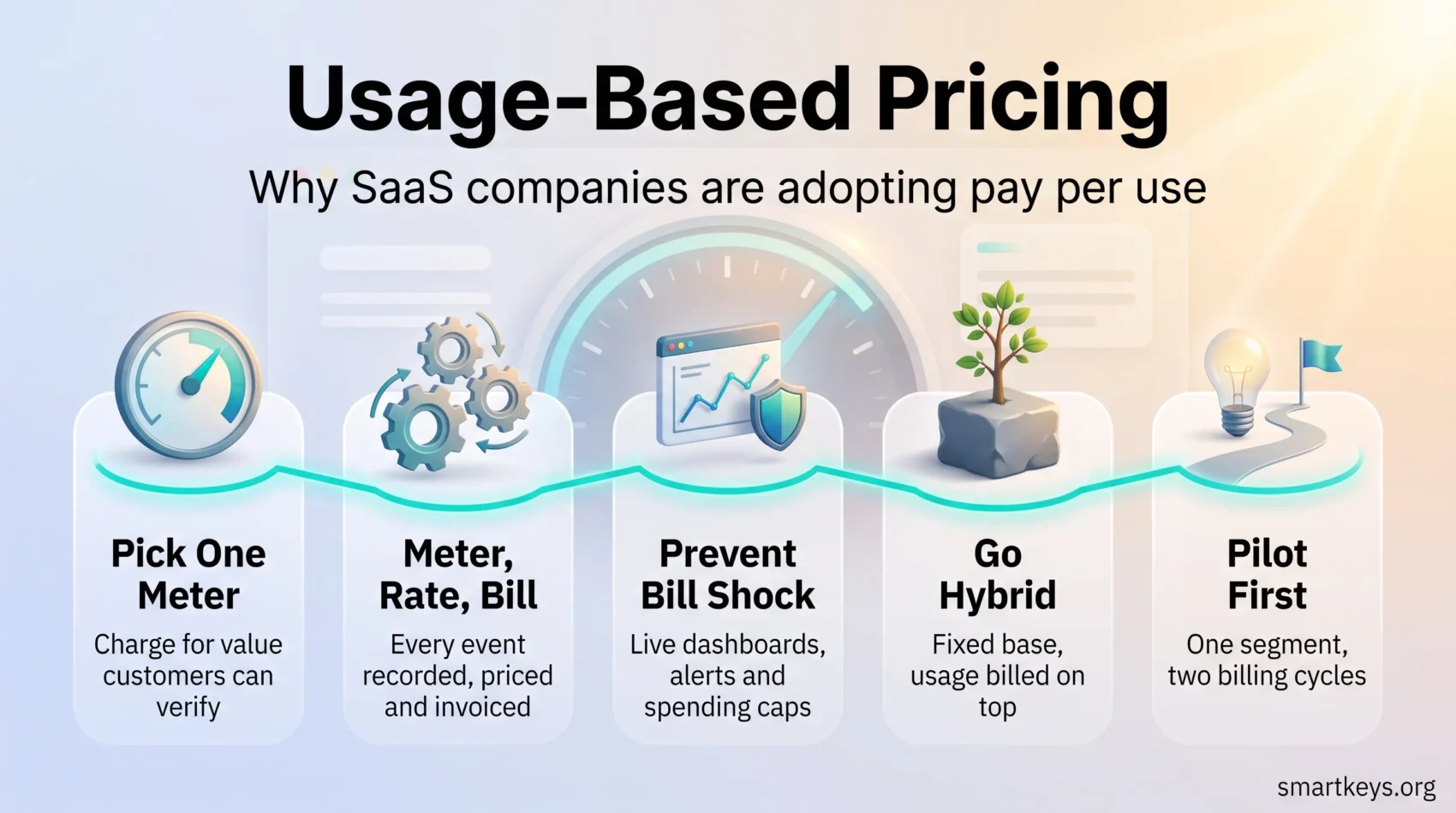
- Start with one pilot segment and one meter that customers can verify themselves.
What usage-based pricing is, in plain terms
The short version: you count something the customer does, and you charge for it. That something is called the meter. It might be API calls (requests one piece of software makes to another), gigabytes of data stored, compute minutes, messages sent, or documents processed.
Because the bill follows real activity, a small team pays a small amount and a large one pays more. Nobody buys 50 licences and uses 12.
How the metering actually works
Three things have to happen behind every invoice. Metering records each billable event. Rating applies your price list to those events. Billing turns the result into an invoice the customer can check.
If any of the three is sloppy, customers dispute the bill and your finance team spends its month on credits instead of collections. That is why this model is an operations project before it is a pricing project.
Why the model is spreading in 2026
Two forces are pushing it. The first is that software increasingly runs without a person watching. An AI agent that resolves support tickets overnight creates value on a schedule that no seat count describes.
The second is buyer pressure. Finance teams have spent three years cutting unused licences, and a plan that charges only for what gets used is an easier internal sell. That pressure is part of a broader shift toward judging software spend on returns rather than on headcount.
The direction is clear, but the pace is often overstated. Gartner, cited in Deloitte’s 2026 technology predictions, expects at least 40% of enterprise SaaS spend to shift toward usage, agent or outcome pricing by 2030. That is a meaningful move over several years, not a switch being flipped this quarter.
Usage-based pricing vs. subscription: what the data actually shows
This is where a lot of pricing advice gets ahead of the evidence. The honest picture is more mixed than the enthusiasm suggests.
Predictability against flexibility
A flat subscription gives both sides a number they can plan around. Procurement approves it once, finance forecasts it easily, and the customer never gets a surprise.
Consumption pricing gives up that certainty in exchange for fairness. When demand swings month to month, customers stop paying for capacity they never touch. The trade is real: you gain fairness and lose predictability, on both sides of the invoice.
What the retention numbers say
It is often claimed that usage-based pricing lifts net revenue retention, the share of last year’s revenue you keep from the same customers after churn, downgrades and expansion. The benchmark data does not support that as a blanket statement.
In High Alpha’s 2025 SaaS Benchmarks work, hybrid pricing produced the highest median net revenue retention at 105%. Subscription pricing came next. Pure consumption and pure outcome models sat at the bottom of that comparison. Adoption follows the same pattern: among companies monetising AI, 53% still used subscription pricing, 31% hybrid, 11% pure usage-based and 5% pure outcome-based.
Growth tells a different story. The same work found outcome and consumption models posting the highest year-on-year median growth rates. Benchmarkit’s 2025 pricing survey of 316 companies found hybrid models leading on median growth at 21%.
The practical reading: consumption pricing can grow an account fast, but it also lets the account shrink fast. Hybrid plans hold a floor under the relationship. That is why most companies that “move to usage-based pricing” end up somewhere in the middle, and why you should design for that outcome from the start rather than discovering it after a bad quarter.
Pick one value metric and build everything on it
The single most important decision is what you count. Get it right and the pricing page explains itself. Get it wrong and every renewal turns into an argument. This one choice does more to shape your overall pricing strategy framework than the numbers on the rate card.
A good meter passes four tests. It rises when the customer gets more value, not when they merely make more calls. The customer can check it themselves. It is hard to game. And your own costs move roughly in step with it, so growth does not quietly destroy your margin.
Common meters and who they suit
- API calls or requests: fits developer tools and search or data services.
- Data stored or processed: fits analytics platforms and business intelligence tools.
- Messages or contacts: fits communications and marketing platforms.
- Tasks or resolutions completed: fits AI agents and automation products.
- Compute time: fits infrastructure, where cost genuinely tracks usage.
Avoid vanity meters. Charging per dashboard view inflates the bill without reflecting anything the customer cares about, and buyers notice quickly. If you are weighing a meter against a straight value-based pricing approach, the question is the same one: what outcome are you actually selling?
The benefits you can reasonably expect
A lower barrier to the first purchase. A team can start with a small monthly spend instead of a signed annual contract. That shortens the sales cycle and suits self-serve buying, which is the core of any product-led growth playbook.
Expansion without a renegotiation. When a customer uses more, they pay more automatically. There is no upsell meeting and no new order form. Revenue grows as adoption grows.
A wider addressable market. Buyers who could never justify a 20-seat minimum can now start at a few dollars a month. Some of them grow into serious accounts.
Better product signals. Usage data shows you which features carry the value, which accounts are ramping and which are quietly going cold. That feeds directly into customer retention work.
Two honest caveats. Cheaper entry only improves payback on customer acquisition cost if onboarding actually drives usage. And low-commitment customers churn more easily than contracted ones, which is exactly why the retention numbers above look the way they do.
The risks, and how to contain them
Bill shock
This is the risk that ends relationships. A customer runs a bad script, a traffic spike hits, and the invoice is five times normal. Trust does not survive that twice.
Contain it with live spend dashboards, projected month-end totals, alerts at defined thresholds, and hard caps the customer controls. Cloud providers learned this the hard way, which is why cloud cost optimization became an entire discipline.
Purchase orders, cash collection and admin
Enterprise procurement runs on approved amounts. A bill that cannot be predicted is a bill that cannot be pre-approved, so invoices sit unpaid while someone raises a purchase order. That stretches your cash cycle and adds work.
The standard fix is prepaid credits or a committed spend that draws down over the year. Finance approves one number up front, and consumption runs against it. Automating the metering-to-invoice chain matters here too, which is part of the wider case for finance automation and disciplined cash flow management.
Forecasting
Your revenue now depends on customer behaviour rather than contract dates. Forecasting shifts from counting renewals to modelling cohorts, seasonality and ramp curves.
Watch leading indicators: time from signup to first meaningful usage, the shape of the first-quarter ramp, and whether usage holds after onboarding ends. For the modelling side, see predictive analytics for business.
Margin
If your delivery cost per unit is higher than your price per unit, heavy users become expensive. This bites hardest on AI features, where every call has a real inference cost. Model your unit economics at high volume before you publish a rate card, not after.
The main charging structures
Pay-as-you-go
Straight per-unit billing with no commitment. Transparent, easy to explain, and the natural fit for self-serve products and early adoption. It is also the least predictable option for both sides.
Pay-as-you-go is not the same as dynamic pricing strategies, where the price per unit itself moves with demand. Here the rate stays fixed and only the quantity changes.
Overage and drawdown
Overage includes an allowance in the plan and charges per unit above it. Familiar from mobile phone contracts, and easy for buyers to understand.
Drawdown lets the customer prepay a pot of credits and spend it over the term. Datadog is a well-known example: committed spend plus rollover gives finance one approvable number while usage stays flexible.
Tiered, volume and stair-step
Tiered pricing charges different rates for different bands, so the first 10,000 units cost more per unit than the next 10,000. Volume pricing applies the cheapest reached rate to everything. Stair-step pricing charges a fixed price per band, which makes bills simple but creates cliff edges at each boundary.
Publish a rate card with worked examples at three usage levels. A customer who cannot estimate their own bill will not buy, and a self-serve calculator is often the highest-converting page on a go-to-market site.
Where consumption pricing fits best
Cloud infrastructure and data platforms
AWS, Azure and Google Cloud bill for compute hours, storage and data transfer. The fit is close to perfect: the provider’s own costs rise with each unit delivered, so price and cost move together. Snowflake’s credit system works the same way, with a prepaid balance drawn down by query activity.
Telecommunications and utilities
Phone plans blend an allowance with overage. Electricity and water meters have charged for consumption for over a century. Buyers in these markets already understand variable bills, and the lesson worth borrowing is the allowance: a generous included amount removes most of the anxiety.
APIs and communications software
Twilio charges per message and per minute. Search, mapping and payment platforms charge per request or per transaction. These products sit in the API economy, where there is often no user interface to put a seat behind in the first place.
AI agents and per-outcome pricing
This is the newest and fastest-moving case, and it is where published prices are worth reading closely. Intercom charges $0.99 for each conversation its Fin agent resolves end to end without a human. Salesforce offers Agentforce either at $2.00 per conversation or through Flex Credits, sold at $500 per 100,000 credits, with a standard action costing 20 credits. Zendesk bills for automated resolutions its own system verifies, and left assisted escalations free.
The design question these vendors are all answering is what counts as a billable outcome. Charging per conversation bills you whether or not the problem got solved. Charging per verified resolution does not. That distinction matters more to a buyer’s bill than the headline rate does, and it is worth checking in any AI chatbot deployment you are evaluating. Maxio’s survey work found 83% of AI-native SaaS companies already offering some form of usage-based pricing, which is why this corner of the market is moving fastest.
Is usage-based pricing right for your business?
Answer four questions honestly before you commit.
Does customer value grow with use? If a customer gets the same benefit from ten uses as from a thousand, a meter just makes your product feel expensive.
Do your costs scale with use? If they do, metered pricing protects your margin. If they do not, you may be leaving money on the table with heavy users and overcharging light ones.
Is demand variable? Steady, predictable usage is an argument for a flat plan. Spiky, seasonal or growth-driven usage is an argument against one.
Can you meter it reliably today? Not “could we build it”. Can your product emit accurate, auditable usage events now, and can billing and support handle disputes about them?
If three of the four are yes, pilot it. If two or fewer are, a hybrid plan or a well-designed freemium model will get you most of the benefit with much less operational risk.
How to roll it out without breaking things
Map the journey and set the metering points
Trace the customer path from signup to full adoption, and mark every action that creates value. Those actions are your candidate meters. Choose the smallest set that tells the whole story, ideally one primary meter and no more than two secondary ones.
Design rate cards, discounts and guardrails together
Write the rate card, the commitment discounts and the spend controls in the same session. They interact. A discount that rewards volume without a cap is how you end up with an account whose bill nobody at either company expected.
Pilot with a defined cohort
Start with one segment or one product line. Measure adoption, revenue per account, support volume and, importantly, sentiment. Give the pilot at least two billing cycles before you judge it, because the first invoice is always the informative one.
Communicate the change before you make it
Lead with what improves for the customer, not with billing mechanics. Show a worked example of a typical bill under both the old and new model. Segment the message: new customers need a calculator, existing customers need a migration path, a grace period and, where the new model costs them more, a transition credit.
Being generous during migration is cheaper than winning the customer back. Be equally clear about what does not change, because uncertainty about a bill drives more churn than the bill itself.
Getting product, sales, CS and finance aligned
A pricing change fails in the gaps between teams. Align everyone on one value metric and one definition of a healthy account.
Product builds the telemetry: time to first value, ramp rate, and whether usage holds. Marketing teaches the market what the meter means, which is now a content job as much as a campaign job.
Sales needs its commission plan rewritten. If reps are paid on contract value at signature, they will not nurture accounts that grow over 18 months. Pay on consumption growth or the model will not work. This is the point where the difference between product-led and sales-led growth stops being a theory and starts showing up in payroll.
Customer success gets the most useful upgrade: live usage data turns guesswork into an early warning system. A dip in usage is visible weeks before a renewal conversation, which is where customer success tools earn their cost. Finance updates revenue recognition, forecasting and the dispute process.
The systems you need
Accurate metering is the invisible backbone of the whole model. Customers forgive a high price far more readily than a wrong one.
Connect quoting, CRM and billing so an agreed deal becomes a correct invoice without anyone retyping it. Modern CRM platforms and configure-price-quote tools, which turn a chosen set of options into a priced quote, are increasingly built for this.
Give customers a live dashboard showing current usage and projected charges. Give your own teams the same view. Most billing disputes are really visibility disputes, and real-time data resolves them before they start.
Add anomaly detection. A model that flags a 400% jump in usage on Tuesday lets you call the customer on Wednesday rather than argue on the first of the month. Teams running this well often borrow from FinOps practices, where cost visibility is a daily habit rather than a monthly report.
Hybrid pricing: predictability plus upside
Most companies that adopt consumption pricing end up here, pairing a fixed base with metered usage on top. It is also the structure the benchmark data favours, so it deserves more than a footnote.

The four common hybrid structures
Base plus overage. A subscription covers an included allowance, and usage above it is metered. The simplest hybrid and the easiest to explain.
Pooling. Several teams or departments share one allocation. This removes the internal fight over who owns which licence and simplifies chargebacks.
Credits or virtual currency. Customers buy credits and spend them across different features at different rates. It makes procurement easy, though it obscures the real unit price, so publish the conversion rates plainly.
Minimum commitments. The customer commits to a floor in exchange for a lower rate. This is what gives you the revenue predictability that pure consumption pricing gives away.
Designing discounts that do not cap your upside
Tie discounts to volume bands and contract length rather than to a fixed ceiling. Reward the commitment, keep the meter running above it, and resist adding so many options that buyers freeze. Three clear plans beat seven clever ones.
What to measure after launch
Track a short list and actually look at it monthly.
Time to first meaningful usage. How long from signup until the customer does the thing that matters. This is your clearest early warning signal.
Ramp curve by cohort. Group customers by start month and compare how their consumption grows. Weak cohorts point to onboarding problems, not pricing problems.
Net revenue retention. The clearest measure of whether the model is working. Watch it by segment, because an average can hide fast growth in one group and quiet contraction in another.
Gross margin per unit at volume. Recheck this every quarter. It is where consumption models go wrong slowly and then all at once.
Forecast variance. Compare predicted to actual consumption. Shrinking variance means your model is maturing. Growing variance means something changed in customer behaviour that you have not understood yet.
Conclusion
Usage-based pricing is a genuine improvement when your product’s value grows with use and your costs do too. It lowers the barrier to a first purchase, it grows accounts without a renegotiation, and it gives you data most subscription businesses never see.
It is not a free upgrade. The benchmark data is clear that pure consumption pricing trades retention for growth, and that most successful implementations land on a hybrid: a committed base that finance can approve, with a meter running on top of it.
If you are considering the move, start narrow. Pick one meter your customers can verify, pilot it with one segment, run it for two billing cycles, and fix the metering and the dashboards before you scale it. The pricing page is the easy part. The billing system, the commission plan and the customer conversation are the work.
Found this useful?
Make SmartKeys a preferred source on Google, and our articles will surface more often in your Top Stories, AI Overviews, and AI Mode.
Add as Preferred Source