You know the conversations you keep postponing. Telling someone their work has slipped. Breaking up a feud between two colleagues. Saying no to a promotion request. Most managers reach these moments with no rehearsal at all.
AI soft skills training is a practical answer. Instead of reading about feedback, you talk to a simulated employee: a chatbot, a voice avatar, or a character in a virtual reality (VR) headset. It plays a role, pushes back, and afterwards shows how your wording and choices looked from the other side.
This guide covers what these simulations do well, which tools are worth shortlisting, what they cost, and the European rules that decide which features you may switch on. For the immersive end of the market, our guide to VR employee training covers headsets and production costs.
Key Takeaways
- Practice beats theory. Reading about feedback does not build the habit of giving it.
- Start with one conversation type and a short list of observable behaviours.
- Tool choice follows format: text chat scales, voice adds realism, VR adds pressure.
- Emotion detection is banned at work in the EU, which rules out some vendor features.
- Treat vendor ROI claims carefully and measure your own before and after data.
Why managers need reps, not another course
The people running these conversations are under real strain. Gallup’s State of the Global Workplace 2026 found manager engagement fell from 31% in 2022 to 22% in 2025, a nine point drop, while engagement among non-managers barely moved. Disengaged managers avoid hard conversations, and avoided conversations become resignations.
Skill demand is moving too. The World Economic Forum’s Future of Jobs Report 2025 found employers expect 39% of workers’ core skills to change by 2030, and that 59% of the workforce will need some training. Much of that is technical, but the human part of a manager’s job is what AI is least likely to take over. Our overview of future job skills looks at where demand is heading.
What a simulation actually does
Picture a shift lead who has to tell a long-serving employee that their punctuality has become a problem. The manager types an opening line. The simulated employee replies defensively. The manager either holds the point or backs off, and the conversation branches from there. A short report then flags what happened: the opening took four sentences to reach the point, no specific example was given, no follow-up date was agreed.
That is the whole value: repetition and a record. A classroom role play gives you one attempt and a polite reaction. A simulation gives you ten attempts and an unflattering transcript.
Where it does not help
Simulations teach structure and wording. They cannot repair a culture where honest feedback is punished. If managers avoid hard talks because leadership never models them, training is not the fix. Our piece on remote leadership skills covers the habits that come first.
A method you can run this month
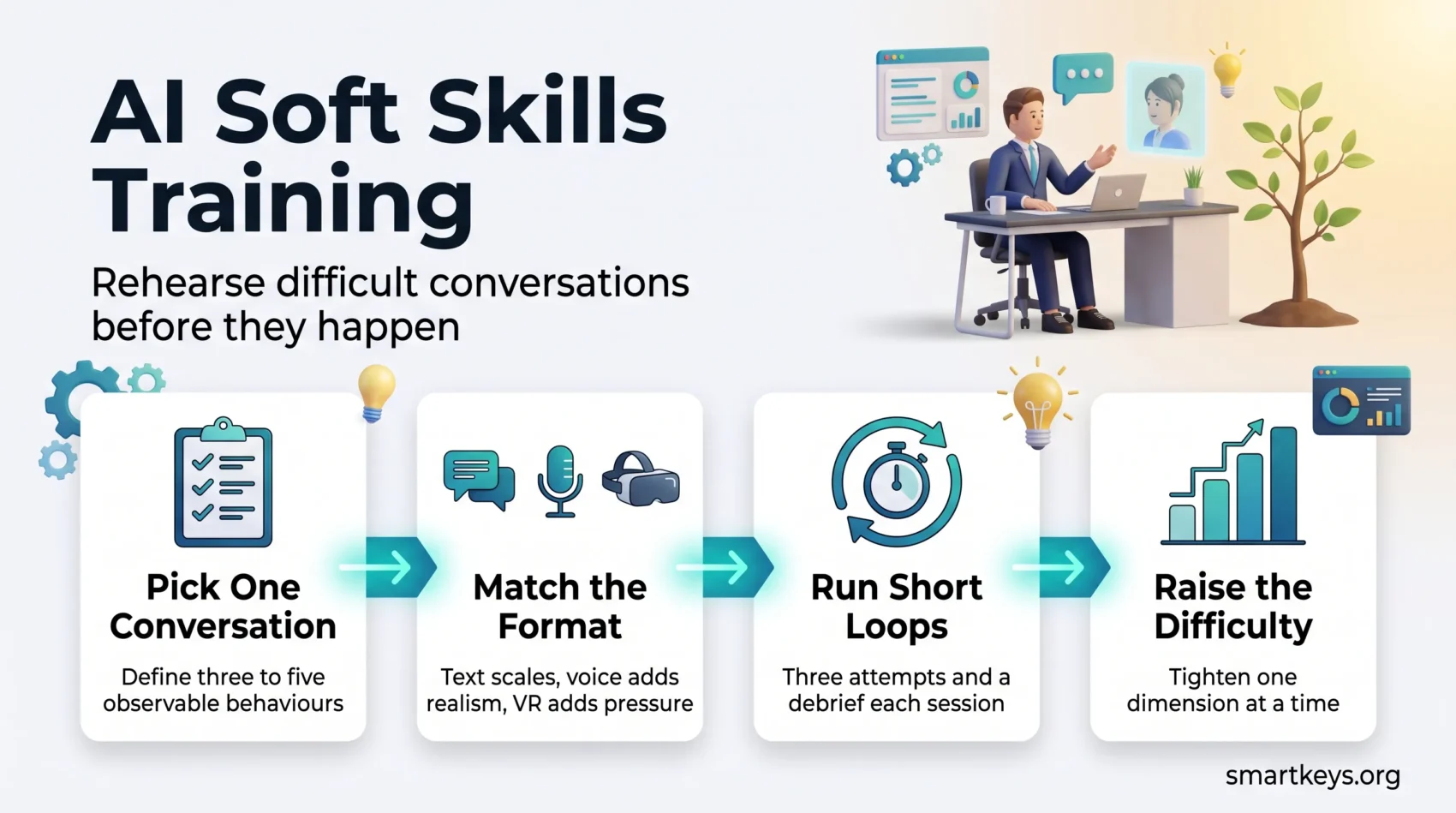
1. Pick one conversation and define success
Choose a single scenario: a missed deadline, a peer conflict, a rejected pay request. Then write three to five observable behaviours that count as success: naming a specific example, stating the consequence clearly, agreeing a date. Vague goals like “show empathy” cannot be scored.
2. Match the format to the stakes
Text-based role play is cheap and scales. Voice adds tone and interruption, which is where most managers struggle. VR adds physical presence and nerves, and costs the most to produce. Start with text unless the conversation is genuinely high stakes.
3. Run short loops and record them
Twenty minutes is enough for three attempts and a debrief. Managers learn more from rereading their own opening line than from any dashboard.
4. Raise the difficulty deliberately
Once the basic version feels comfortable, tighten it: give the employee a counter-argument, remove information the manager expected to have, or add time pressure. Raise difficulty in one dimension at a time.
Tools worth shortlisting
Learning paths and microlearning
Coursera offers structured leadership and communication paths for teams that want a curriculum rather than a simulator. Note one change: EdApp, long recommended for microlearning (short lessons of a few minutes), has been retired and folded into SafetyCulture’s SC Training, so older guides point at a product that no longer exists. Our guide to microlearning strategy covers how to structure short lessons, and our roundup of AI learning platforms compares the wider market.
Speech and delivery practice
VirtualSpeech runs AI role plays across a library of workplace scenarios and gives feedback after each session. Individual access is listed at $45 a month or $399 a year, with custom pricing for organisations. It is the easiest low-commitment starting point for a single manager.
Immersive group practice
Virtway provides multi-user 3D environments where several people practise together, with sessions recorded and passed into a learning management system (LMS), the platform holding your training records.
Enterprise content and mentoring
360Learning is built around colleagues creating and reviewing each other’s courses, which suits companies with strong internal expertise. Didask turns existing documents into guided scenarios. If you are weighing full course platforms, our LearnWorlds review covers that category.
Vendor case studies here are almost all self-published, so treat headline improvement figures as marketing until you have your own numbers.
The EU rule that decides which features you can use
This matters more than most buyers realise. Article 5(1)(f) of the EU AI Act prohibits AI systems that infer emotions from biometric data in the workplace or in education. The ban has applied since 2 February 2025 and covers voice patterns and facial expressions, in physical and virtual settings alike. The only exceptions are strictly medical or safety uses. Penalties reach 35 million euros or 7% of global annual turnover, whichever is higher.
In plain terms: a tool that scores whether a manager “sounded frustrated” by analysing their voice or face is a compliance problem in the EU. A tool that analyses what was said, the words, the structure, whether a next step was agreed, is not. Ask vendors exactly which signals the feedback comes from, and get it in writing.
A second date matters. The Digital Omnibus agreement reached in May 2026 pushed the deadline for Annex III high-risk systems, which include AI used in employment decisions, from August 2026 to 2 December 2027. That buys time for tools feeding into promotion or performance decisions. It does not touch the emotion recognition ban, already in force. Our EU AI Act compliance guide covers the full timeline, and AI employee monitoring explains where the line sits between training and surveillance.
The practical rule: keep practice data out of performance records unless you have said clearly that it will be used that way. A rehearsal space that quietly feeds appraisals stops being one.
Designing scenarios people recognise
Start with the conversations your organisation actually gets wrong. For most teams that means three: performance and missed expectations, conflict between colleagues, and sensitive topics such as pay fairness or inclusion. Our guide to AI performance coaching goes deeper on the first.
Make each persona specific. Not “a difficult employee” but “a senior developer, eleven years here, who thinks the new review process is theatre.” Specificity makes managers respond honestly instead of performing.
Branch on the decision points that matter. If the manager softens the message, the employee should leave without understanding there is a problem. That outcome teaches more than a score. Vary the channel too, since words written in chat land differently from the same words spoken in a one to one. Our notes on running effective meetings apply here.
Measuring whether it worked
Keep measurement light or it will not survive a busy quarter. Three levels are enough.
First, did behaviour change in the simulation? Score the same scenario before and after using your observable behaviours. This is the only measure fully under your control.
Second, did anything change at work? Useful signals: how long issues sit before being raised, how many disputes escalate to HR, and what engagement surveys say about feedback quality. Our overview of continuous performance management covers where that data lives.
Third, is it worth the money? Compare licence and time cost against something concrete, such as replacing one manager who left. Our guide to upskilling ROI sets out that calculation. Attribution is hard: a quarter with fewer escalations may simply have been quieter.
Rolling it out without losing trust
Pilot with eight to fifteen managers who volunteer. Run a fixed period, six weeks is usually enough, with a few scenarios rather than a full library.
Say plainly, in writing, who can see recordings and how long they are kept. Ambiguity turns a useful tool into a rumour about surveillance. Involve HR and legal before the pilot, especially on consent and on the biometric question above. Our piece on AI ethics at work covers governance, and data privacy at work covers employee data rules.
Give managers a facilitator for the debriefs at first. The report says what happened; a person helps them work out what to do differently. Our overview of remote corporate training covers running that at a distance.
Conclusion
Pick one conversation your managers avoid. Write down what a good version looks like. Give them a way to practise it ten times before it happens for real.
That is a smaller project than most learning strategies and it shows results within a quarter. Check the compliance question early, keep practice data out of appraisals, and expand once the first group asks for more. For the broader picture, see our coverage of soft skills in the future of work, upskilling trends and HR trends.
Found this useful?
Make SmartKeys a preferred source on Google, and our articles will surface more often in your Top Stories, AI Overviews, and AI Mode.
Add as Preferred Source