Training is one of the easiest budget lines to cut, because its benefits usually stay invisible. This guide shows you how to make them visible. You will learn how to define upskilling ROI, what to measure, and how to connect a course to a business result your finance team will accept.
Two definitions first. Upskilling means teaching people new skills for the job they already hold. Reskilling moves them into a different role. (Our guide to upskilling and reskilling for future jobs covers the strategy side in depth.) Both cost real money, and both can pay for themselves. What separates a renewed program from a canceled one is usually measurement, not teaching.
Key Takeaways
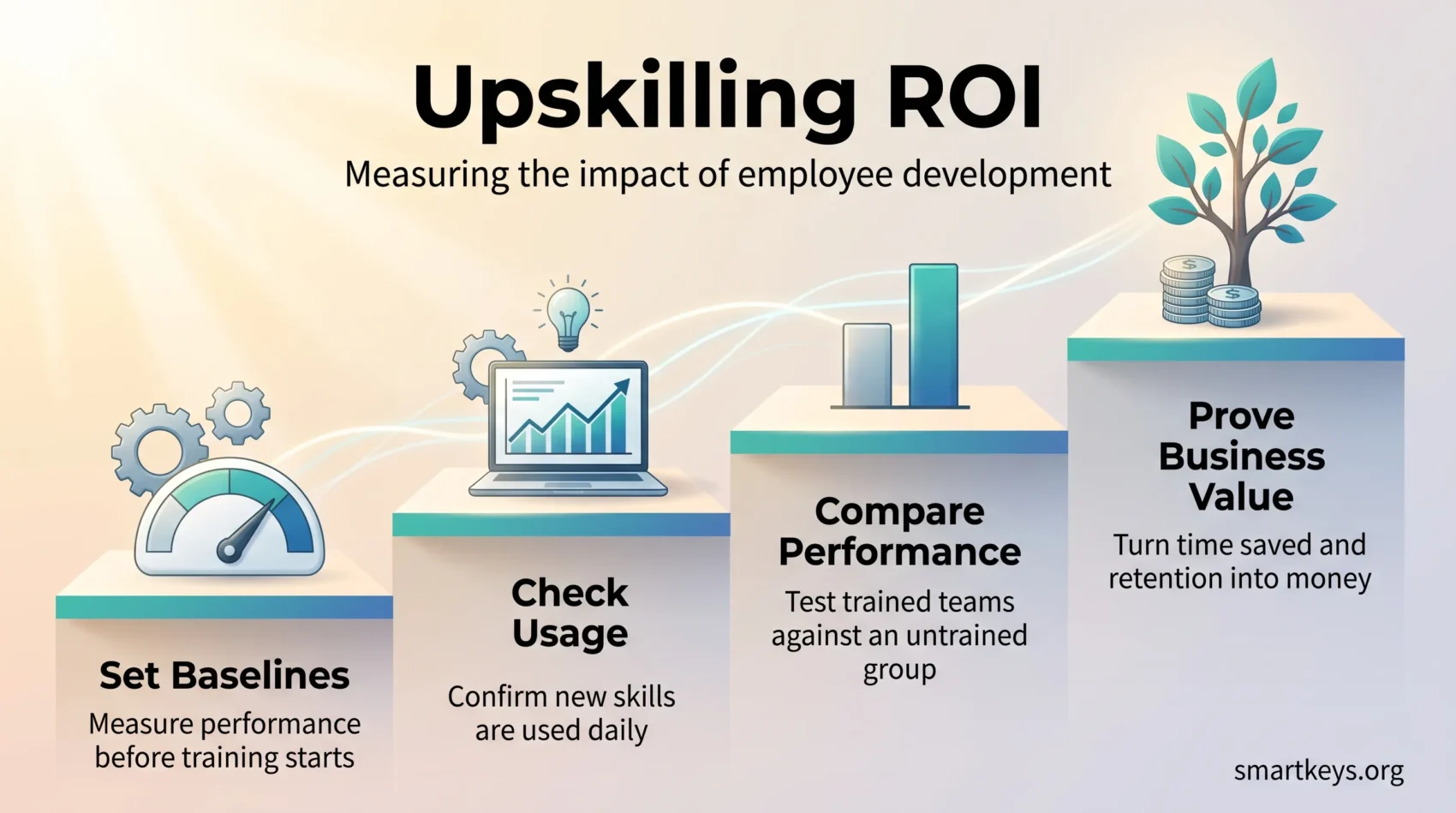
- Measure four things, in this order: skills, adoption, performance, business outcomes.
- Set baselines before the first session. Without them, you have no lift to report.
- Gallup links strategic investment in development to 11% higher profitability and double the retention.
- Turn avoided turnover into money using role-specific replacement costs.
- Report at 30, 60 and 90 days, then review again at six months.
Why Upskilling ROI Matters Right Now
Two pressures meet inside most L&D budgets. L&D stands for learning and development, the function that runs internal training. Skills are changing quickly, and budgets are being questioned line by line.
The World Economic Forum’s Future of Jobs Report 2025 found that employers expect 39% of workers’ core skills to change by 2030. The same report estimates that 11 workers in every 100 will need training they currently have no access to. That gap is where a structured skills gap analysis earns its keep.
The spending is real. Training magazine’s 2025 Training Industry Report put total US training spend at $102.8 billion, up nearly 5% year on year, with $874 per learner. Average training hours per employee fell to 40 from 47. Budgets grew while delivered hours shrank, which invites hard questions from finance.
Engagement adds a third reason to measure. Gallup’s State of the Global Workplace 2026 report put global employee engagement at 20% in 2025, its lowest level since 2020. Development is one of the few levers a line manager pulls directly, so it belongs in any serious talent retention plan.
The payoff is documented. Gallup finds that organizations making a strategic investment in employee development report 11% greater profitability and are twice as likely to retain their employees. Measurement is how you claim credit for that.
What Upskilling ROI Actually Means
A definition you can put on one slide
ROI stands for return on investment. Applied to training, it is the value the business gains divided by what the program cost, shown as a percentage. The standard formula is net benefits divided by program costs, multiplied by 100.
Costs are the easy half: course or platform fees, trainer time, and wages for hours spent learning instead of working. Benefits are harder. They arrive in four shapes: time saved, quality improved, turnover avoided, revenue gained.
The four levels of evidence
Donald Kirkpatrick’s model, published in the 1950s and still the field standard, sorts training evidence into four levels. Reaction asks whether people liked the session. Learning asks whether they can do something new. Behavior asks whether they work differently. Results asks whether the business changed. Jack Phillips later added a fifth level: ROI in money.
Most programs stop at level one. A satisfaction score of 4.6 out of 5 says the trainer was likeable. It tells your CFO nothing.
Baselines and targets
Capture current performance before anyone attends anything. Useful baselines include task completion times, error rates, customer ratings, attrition in the target roles, and how often the relevant software gets opened. Then commit to a target, such as 10% faster ticket resolution.
Phase the expectations so nobody demands proof too early:
- Short term (30 days): tool adoption and error reduction.
- Medium term (90 days): shorter ramp time and better first-pass quality.
- Longer term (6 months): retention lift and avoided hiring costs.
The chain is simple. Activities produce behaviors, behaviors produce performance, performance produces outcomes. If you cannot name the next link, the program is not ready to launch.
How to Measure Upskilling ROI
Map every measurement onto work people actually do each day. That link separates a training report from a business case.
Pick productivity indicators tied to real tasks
Choose two or three role-specific numbers, not ten. Support teams can use average handling time and reopened-ticket rate. Sales teams can use conversion rate and deal cycle length. Engineering teams can use cycle time and defect escape rate. Manufacturing teams can use first-pass yield, the share of units passing inspection without rework.
Measure each one before and after, then compare against a team that did not take the course. That comparison group is your best defense when someone argues the gain came from something else. Workforce analytics tools make the comparison less painful than a spreadsheet.
Check whether the new tool is actually being used
Training on software only pays off if the software gets opened. Track login frequency, use of the features you taught, and how often people fall back on the old workaround.
Adoption is your earliest warning signal. If usage has not moved after 30 days, patience will not produce a performance gain later. Fix the barrier now, whether that is missing permissions, an awkward handoff, or a manager who never asked. Short, repeated formats help, which is why a microlearning strategy often beats one long workshop.
Track engagement and sentiment
Use a short pulse survey before the program and again at 30 and 90 days. Three or four questions is enough. Ask whether people feel equipped, whether they see a path forward, and what is still in the way.
Free-text answers matter more than the score. They tell you which part of the program transferred to the job and which part stayed in the classroom. If you already run an employee NPS process, add one development question there instead of launching a separate survey.
Connect the result to revenue or avoided cost
Some benefits translate into money directly, such as more upsells, fewer escalations, or faster delivery on billable work. Others translate through avoided cost, such as less contractor spend, less overtime, or fewer replacement hires.
Where no direct link exists, use time saved multiplied by a fully loaded hourly rate, and say openly that it is an estimate. A stated method survives scrutiny better than a precise-looking number nobody can trace.
Run the arithmetic
Here is the shape of the calculation, with round invented figures to show the mechanics. A program costs $40,000 in fees plus $20,000 in learning hours, so $60,000 total. Twelve agents each save 30 minutes a day, worth about $60,000 a year at a $40 loaded hourly rate. Two resignations do not happen, at $30,000 each, adding $60,000. Net benefit is $60,000, so ROI is 100%.
Those figures are illustrative, not a benchmark. What matters is the structure: named costs, named benefits, and a stated assumption behind each one.
“Measure adoption first, performance next, business outcomes last. In that order.”
Segment results by cohort, role and location. A program that works in one team and fails in another is telling you something about managers, not the course.
Retention, Margins and Innovation
Retention is usually the largest and most credible line in an upskilling business case. Turnover costs are already tracked by most finance teams, so you are speaking a language they accept.
Start with retention rates for the trained cohort and a comparable untrained group. Multiply the difference in leavers by the replacement cost for that role, which normally covers recruitment fees, onboarding, and productivity lost while a new hire ramps up.
Margins improve more quietly. Work moves in-house instead of to an agency, rework falls, and projects ship without a contractor. Those land in operating expenses, not in a training report, so you have to go and find them. Retention analytics inside HR systems surface the turnover half automatically.
Innovation signals are softer but still countable. Count new processes documented, automations built by non-specialists, and analyses run by people who previously asked someone else. A data literacy program becomes easy to justify once business teams build their own reports.
LinkedIn’s 2025 Workplace Learning Report found 88% of organizations concerned about retention. Yet only 15% of employees said a manager had helped them build a career plan in the past six months. Closing that gap costs a conversation, not a platform license. An internal talent marketplace keeps those conversations going.
Industry Spotlight: Measuring Upskilling ROI in Healthcare
Clinical settings make the retention case unusually easy to quantify. The 2026 NSI National Health Care Retention and RN Staffing Report puts the average cost of one registered nurse turnover at $60,090, with national RN turnover at 17.6%. Retaining a single nurse therefore pays for a substantial amount of training.
Focus on roles where an internal pathway genuinely closes a gap. Entry-level and support roles with high turnover are the best starting point, since certification rules limit how far internal training reaches in licensed roles.
Track engagement and task-level productivity first, then look for movement in patient-facing measures such as wait times and satisfaction scores. Be careful with causal claims there. Staffing levels, case mix and seasonality move those numbers too, so treat them as supporting evidence, not proof.
- Compare agency and temporary staffing costs against a structured internal development track.
- Measure time-to-competence, meaning how long until someone works unsupervised.
- Check certification completion rates, since an unfinished pathway delivers no value.
Simulation helps where mistakes are expensive, and VR employee training has a documented record in those scenarios. Wider digital transformation in healthcare also sets the pace many training programs have to match.
Designing Programs That Earn Their ROI
Short and specific beats long and general. A two-hour course aimed at one measurable behavior usually outperforms a two-day course covering everything.
Build for speed and transfer
Use part-time or online formats so people stay productive while learning. Break content into stackable modules, each ending in something the learner applies that week. Platforms marketed as AI learning platforms adapt the sequence per learner, which mainly helps by skipping material someone already knows.
Define success before launch. Name the metric, the baseline and the target in writing. If nobody will commit to a target, that is a signal about how much the program is really wanted.
Balance technical and human skills
Technical training moves task-level numbers quickly. Communication, feedback and problem-solving move slower measures such as team engagement and customer sentiment. Both belong in the plan, but evaluate them against different metrics. Formats like AI-supported soft skills practice suit the human half better than a lecture does.
Manager involvement drives transfer more than any content choice. If a manager never asks about the course, the learning stays theoretical. Build one short check-in into the plan and treat it as part of the program. Regular continuous performance conversations give that check-in a natural home.
Point the program at where the roles are going
Training for today’s job description ages fast. Check the skills your roles are moving toward and broader trends in employee development first. Cross-training and mid-career retraining hold their value longer than tool-specific courses, because the capability outlives the software.
Four Mistakes That Break the ROI Case
Most weak business cases fail for the same handful of reasons.
Missing baselines come first. If you did not measure before, you cannot claim a lift afterwards, and reconstructing history rarely convinces anyone.
Second, counting completions as results. Completion rates measure attendance. They say nothing about whether work changed.
Third, claiming everything. A quarter with a product launch, a reorganization and a training program will not give you clean attribution. Claim your share, name the other factors, and use a comparison group where you can.
Fourth, reporting too late. One deck at month twelve is worth less than short updates at 30, 90 and 180 days. Frequent reporting also lets you repair a program while repair is still possible. Tools such as AI performance coaching shorten that loop, provided a human reads the output.
Conclusion
A defensible upskilling ROI case is built, not discovered afterwards. Set baselines, verify adoption, measure performance against a comparison group, then translate the result into money using assumptions you are willing to show.
Keep the reporting short. Two or three numbers a leader can repeat beat a dashboard nobody opens. State clearly what you cannot attribute. That credibility is worth more than an inflated figure.
Do this consistently and the argument shifts. Instead of defending the training budget each year, you choose which programs deserve to grow. Pair the habit with sound onboarding and training practice and the wider HR trends shaping 2026.
Found this useful?
Make SmartKeys a preferred source on Google, and our articles will surface more often in your Top Stories, AI Overviews, and AI Mode.
Add as Preferred Source