Remote work stopped being an emergency measure years ago, but remote onboarding is still the part most companies get wrong. Hiring someone you will rarely stand next to changes what the first weeks have to accomplish. The paperwork is the easy half. Building context, relationships and confidence without a shared office is the hard half, and it does not happen by accident.
The numbers make the gap plain. Gallup finds that only 12% of employees say their company does a good job of onboarding, and roughly one in five report poor onboarding or none at all. Only 29% of new hires feel fully prepared and supported to excel in their role once onboarding ends. The upside is just as clear: employees who describe their onboarding as exceptional are 2.6 times as likely to be extremely satisfied with their workplace, and 70% of them say they have the best possible job. Getting virtual onboarding right is one of the cheapest retention levers a company has.
Key Takeaways
- Hybrid is now the default context for onboarding, so programs have to work for people who are rarely in the office.
- Most onboarding still fails on its own terms: only a small minority of employees rate it well.
- Managers, not HR portals, are the strongest single factor in whether onboarding lands.
- Automation belongs on the paperwork layer. Connection has to stay human.
- Onboarding is a quarter, not a week, and it needs measurement like any other business process.
Where Remote Onboarding Stands in 2026
The working pattern new hires enter has settled into something stable. Data from the Survey of Working Arrangements and Attitudes (WFH Research) shows that in May 2026 about a quarter of paid days in the United States were worked from home. Among full-time employees, roughly 62% are fully on site, 26% work hybrid and 12% are fully remote.
That mix matters more than any single number. It means most new hires are not fully remote, but they are also not present every day. A clear hybrid work policy tells a newcomer which days are for focused solo work and which are for the in-person moments that build trust fastest. Without that, week one becomes a guessing game.
It also means the old assumption that onboarding happens by osmosis is dead. Nobody absorbs how decisions get made by sitting near the right desk any more. The digital onboarding process has to state explicitly what an office once communicated implicitly: who owns what, where decisions are recorded, and how to ask a question without feeling like an interruption.
Interestingly, satisfaction with onboarding barely differs by work model. TalentLMS research puts hybrid onboarding satisfaction at 75%, in-person at 73% and remote at 71%. Remote is not inherently worse. It is just less forgiving of a weak program, because there is no informal office contact to cover the gaps.
What Still Goes Wrong
The failure modes in remote employee onboarding are consistent, and most of them are fixable.
The first is information dumping. Around 42% of employees say onboarding overwhelmed them with too much information at once, according to TalentLMS. A five-hour video call on day two is not training; it is a fire hose. Splitting content into short sessions spread across weeks respects how people actually retain things, which is why microlearning approaches have moved from nice-to-have to standard practice.
The second is missing human contact. Roughly 31% of employees say their onboarding lacked human interaction. When 32% report leaning on AI tools rather than colleagues to get answers, that is a signal about how hard it feels to ask a person. It is also a warning sign for retention: 39% of employees say they had second thoughts about the job during onboarding.
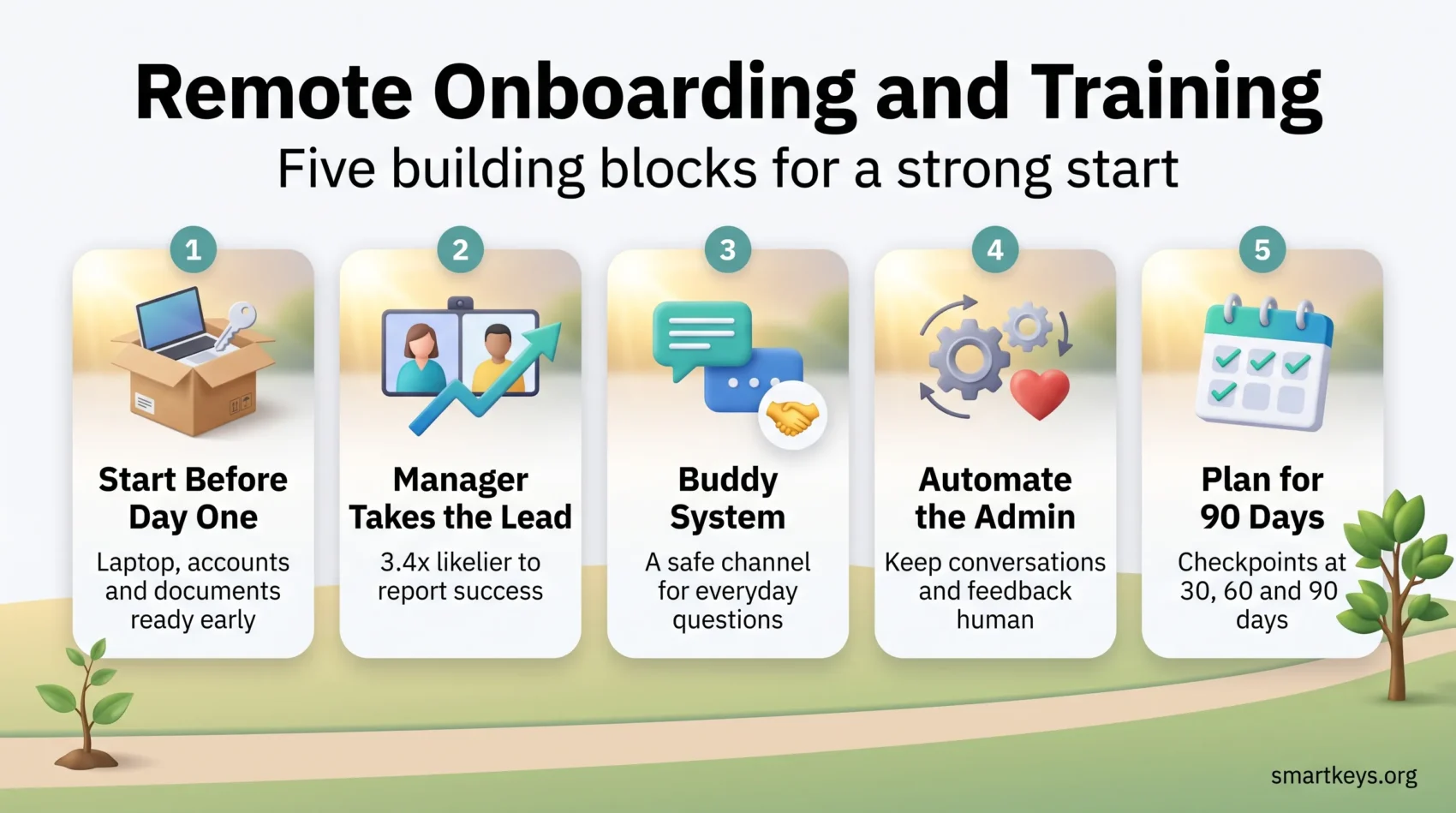
The third is manager absence. Gallup finds new hires are 3.4 times as likely to say their onboarding was successful when their manager takes an active role. Delegating the whole thing to an HR platform is the most common and most expensive shortcut.
Two further problems are structural rather than cultural. Proximity bias quietly disadvantages the people who joined remotely, and cross-border hires bring payroll, tax and compliance obligations that vary by country. Companies hiring across markets increasingly handle that through global payroll platforms rather than improvising per country.
The Building Blocks of a Strong Remote Onboarding Program
Effective virtual onboarding solutions tend to share the same skeleton, regardless of company size.
Preboarding Before Day One
The gap between signing and starting is wasted time in most companies. Sending the laptop early, granting accounts, sharing the team page and letting the new hire read a few real project documents turns day one from an administrative slog into actual work. It also removes the single most demoralising remote start: waiting for IT access while everyone else is busy.
Clear Communication Channels
New hires need to know which channel is for what, and how fast a reply is expected in each. That is a written norm, not a vibe. Teams that run on asynchronous communication tools should say so explicitly, because a newcomer who assumes silence means disapproval will spend their first month anxious. Strong communication habits are the foundation everything else sits on.
A Named Buddy or Mentor
Assigning a specific colleague as the low-stakes question channel is the highest-return, lowest-cost move in remote onboarding. It gives the new hire somewhere to ask the things they would be embarrassed to raise with a manager. Larger organisations formalise this through mentorship matching platforms; smaller teams just need someone named and briefed.
Remote Onboarding Training Best Practices
A structured process makes new hires feel expected rather than merely processed, and it shortens the time to useful contribution. TalentLMS reports that 69% of employees say onboarding training accelerated their ability to contribute, so the payoff is not abstract.
Incorporating a Welcome Kit
Starting with a welcome kit sets a positive first impression. A useful kit contains:
- Working hardware, delivered and tested before the start date
- Clear organisational policies and a handbook people will actually read
- A virtual onboarding checklist covering the first 30, 60 and 90 days
- Company swag, which matters less than the three items above but still helps
Encouraging Peer-to-Peer Communication
Connecting new hires with current team members is the part that never automates well. Practical formats include:
- Short scheduled introduction calls with every direct collaborator in week one
- A recurring virtual watercooler slot with no agenda
- Structured remote team-building sessions in the first month
These interactions are what turn a list of names in a directory into colleagues. They are also the first thing cut when a quarter gets busy, which is exactly when they matter most.
Technology That Actually Helps
Tooling for onboarding has matured, and the useful pattern is now clearer than it was a few years ago: automate the administration, keep humans on the relationship work.
AI Agents and Chatbots for the Admin Layer
TalentLMS finds that 62% of HR managers are automating tasks with AI. In onboarding, the strongest use cases are unglamorous: provisioning accounts, chasing documents, scheduling introductions and answering the same policy questions for the hundredth time. HR chatbots handle the repetitive question layer well, and AI agent workflows can chain the setup steps that used to sit in someone’s inbox.
The caveat is the 31% who already say onboarding lacked human interaction. Automation that replaces the human layer rather than clearing space for it makes that number worse.
VR and AR for Hands-On Roles
Immersive training earns its cost in specific places: safety-critical procedures, equipment handling, clinical and field work, and anything where practising on the real thing is expensive or risky. VR employee training and augmented reality training fit those cases well. For a software or operations hire, a well-run shadowing week beats a headset. Match the tool to the job rather than to the trend, and route the rest of the curriculum through structured remote corporate training.
Designing an Inclusive Onboarding Experience
An inclusive onboarding process decides early whether someone feels they belong. Getting it right is not a separate diversity, equity and inclusion (DEI) project bolted onto week one; it is a set of small design choices.
Record and caption sessions so that people in other time zones and people who process written information better are not disadvantaged. Publish norms rather than expecting newcomers to infer them, which matters particularly for neurodivergent employees. Avoid scheduling the important informal moments at times that only work for the headquarters time zone, a recurring failure in cross-border teams.
Regular check-ins in the first month give new employees a sanctioned place to raise what is not working. Broader diversity and inclusion practices only hold if they show up in the first two weeks, when someone is still deciding how much of themselves to bring to work.
Onboarding Runs Longer Than a Week
Gallup puts the typical time for a new employee to reach their peak performance potential at around 12 months. Most onboarding programs end after five days. That mismatch explains a lot.
Extended onboarding means keeping a light structure running across the first quarter and beyond:
- 30, 60 and 90-day checkpoints with explicit goals rather than vague catch-ups
- A second wave of training once the new hire has enough context for it to stick
- A deliberate handover from onboarding into continuous performance management
- A path into ongoing development, which 84% of employees link to career progression
Personalisation helps here too. TalentLMS reports 68% of employees say their onboarding was tailored to their role, which means roughly a third still sat through content written for somebody else’s job.
Automation With a Human Layer
Many firms lean on automation to make onboarding efficient, then discover they have optimised the wrong half. Paperwork completed quickly is worth little if the new hire still does not know who to ask about anything.
The workable split is simple. Automate document collection, account provisioning, equipment logistics, compliance training assignment and reminders. Keep manager one-on-ones, buddy conversations, team introductions and feedback loops firmly human. The time automation saves should be spent on those, not banked.
Regular check-ins are the mechanism that makes this work. A manager who runs a genuine weekly conversation for the first three months will catch the doubts behind that 39% second-thoughts figure while they are still fixable. Remote leadership skills are what separate managers who do this well from those who default to status updates.
Gamification and Engaging Remote Training
Remote training competes with everything else on a laptop screen. TalentLMS reports that 70% of employees admit to multitasking during training, and 37% say they lack the time to finish mandatory training at all. Light game elements can help here: a progress bar on the learning path, short quizzes that check understanding, or a team challenge that gives a new hire a reason to message a colleague. Keep it modest and tie every element to something the person actually needs to learn. For the design details, see our guide to onboarding gamification mechanics such as progress bars, badges and streaks, including how to measure whether they work.
Reboarding and Return-to-Office Transitions
Reboarding strategies matter whenever the working arrangement changes underneath people: a return-to-office mandate, a team moving from fully remote to hybrid, or someone coming back from extended leave. Employees hired during a fully remote period may never have built the in-person habits their colleagues take for granted.
Effective reboarding covers a few predictable areas:
- Restating norms that changed, in writing, before the change takes effect
- Role-specific refreshers rather than a generic all-hands announcement
- Direct manager conversations, which employees consistently prefer over broadcast communication
- Feedback collection in the weeks after, so the policy can be adjusted
Phasing the transition helps more than doing it all at once. Combining changed expectations with practical support, including upskilling opportunities, turns a disruptive announcement into something people can plan around. It also protects the culture built during the remote period rather than treating it as an accident to be undone.
Measuring Whether Onboarding Works
Onboarding is one of the few HR processes with clear, available signals, and most companies still run it on assumption.
Worth tracking: time to first meaningful contribution, 90-day and 12-month retention, completion rates on training paths, and a short pulse survey (three to five quick questions) at 30 and 90 days. Employee net promoter score taken early gives an honest read before someone has learned to give diplomatic answers.
The qualitative signal is often better than the quantitative one. Ask new hires at 90 days what confused them in week one, while they still remember and before they normalise it. That single question, asked consistently, will improve a program faster than any dashboard. Feed the answers back into wherever the process is documented, so the fix outlives the person who spotted the problem.
Conclusion
The future of remote onboarding is not a technology story. The tools to automate provisioning, personalise learning paths and simulate hands-on work already exist and keep improving. What separates a program that works from one that does not is whether managers show up, whether the structure lasts longer than a week, and whether someone is measuring the result.
The evidence points the same way every time. Onboarding is rated well by a small minority of employees, and the ones who rate it highly are dramatically more likely to be satisfied at work. That is an unusually large return on an unusually cheap intervention. Fix the manager involvement, extend the timeline past the first week, automate only the paperwork, and ask new hires what confused them. Most of what is broken in remote employee onboarding comes down to those four things.
Found this useful?
Make SmartKeys a preferred source on Google, and our articles will surface more often in your Top Stories, AI Overviews, and AI Mode.
Add as Preferred Source