AI performance coaching means software that gives an employee feedback on how they work, lets them practice a skill, and records whether they got better. It is not a chatbot that answers questions. It watches a task or a conversation, scores it against a standard, and tells the person what to change next time.
That distinction matters, because the same label now covers very different products. One is a helper built into an online course. Another is a five minute daily prompt on a phone. A third is a simulated performance review with an artificial conversation partner. A fourth is a copy of your own software that new hires can practice in without touching live customer records.
This guide explains what each type actually does and what the main platforms cost in 2026. It also covers how to judge whether one is working, and the privacy rules that decide what you may deploy at all. For the wider picture on training technology, see our guide to AI in personalized employee training.
Key Takeaways
- A coaching tool prompts practice and measures change. A chatbot only answers questions.
- Entry pricing is low: TalentLMS starts at $119 a month, Rocky.ai at $19.90 per seat.
- Match the tool type to the problem: course help, habit practice, conversation roleplay or system simulation.
- Keep humans for judgment calls. Send repetition and drills to software.
- In the EU, software that infers employees’ emotions is banned outright, whatever the vendor claims.
Why companies are buying this now
The pressure comes from managers, not from technology.
Gallup’s State of the Global Workplace 2026 report puts global employee engagement at 20%, its lowest level since 2020. Manager engagement fell furthest: 22% in 2025, down from 31% in 2022. Gallup notes that few managers have natural management talent and many never received the training they need.
The UK’s Chartered Management Institute found the same gap from the other side. In its research on so-called accidental managers, 82% of people who move into a management role arrive with no formal management or leadership training. They were promoted for being good at the job, not for being good at running people.
Traditional coaching does not close a gap that size. A human coach costs several hundred dollars an hour and reaches the senior few. Software reaches everyone at a fraction of the cost, but only for the parts of coaching that can be standardized. Understanding which parts those are is the whole decision. Our overview of leadership trends in 2026 covers the management side of the same problem.
What these platforms actually do
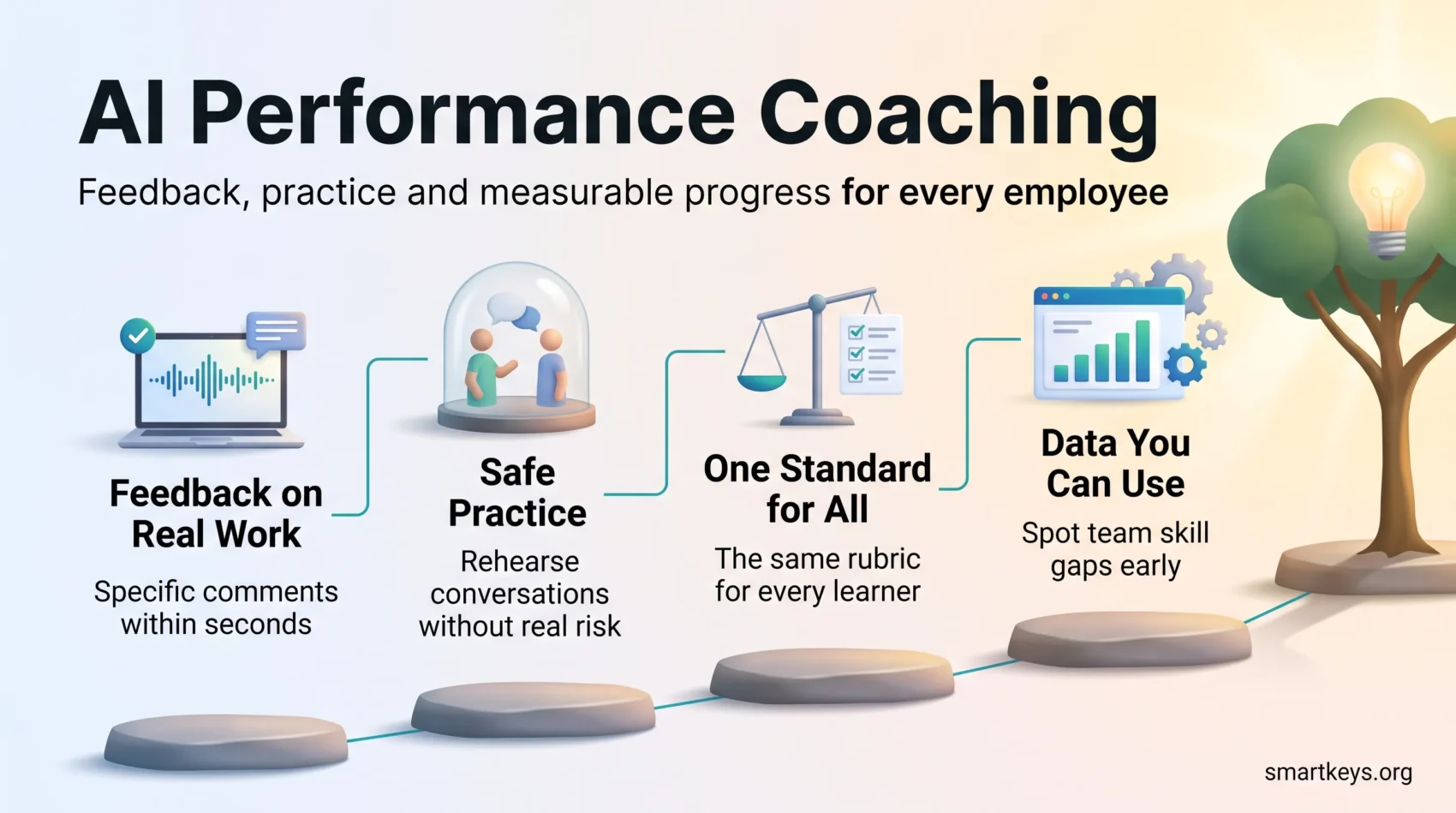
Strip away the marketing and there are four things on offer. Most products do one of them well and the rest adequately.
Feedback on real work
The tool observes something a person did, a sales call, a support ticket, a completed lesson, and returns a specific comment: you interrupted three times, you skipped the confirmation step, you scored 4 of 10 on the comprehension check. The value is speed. A manager gives that feedback next week, if at all. The software gives it in seconds, while the person still remembers what they did.
Practice in a place where mistakes are free
Roleplay simulators let someone rehearse a redundancy conversation, a price objection or a performance review against an artificial counterpart that pushes back. System simulators do the same for software: a copy of your CRM that behaves like the real one but writes to nothing. New hires can get a process wrong ten times before they get near a customer. Our guide to simulating difficult conversations for managers goes deeper on the conversation side.
The same standard for everyone
Two managers rating the same presentation rarely agree. Software applies one rubric to every learner in every region. That consistency is what makes the results comparable, and it is also why bias in the underlying model is a real risk rather than a theoretical one.
Data you can roll up
Individual sessions aggregate into a view of where a team is weak. That is useful for planning, and it is exactly the point at which employees start asking who sees what. Answer that question before you launch, not after. A structured digital skills gap analysis is a cleaner way to plan curriculum than reading dashboards alone.
Where a human coach still wins
Software is good at repetition and bad at context.
Keep human coaches for anything with real consequences attached: a manager handling a grievance, a leader whose team has lost trust in them, a career decision, a conflict between two people with history. These need someone who can read a room, hold confidence and be accountable for the advice.
Send to software the parts that repeat: practicing the same framework until it is automatic, drilling a script, rehearsing a routine conversation, checking whether a lesson landed.
The practical split most companies land on is simple. Live sessions at milestones, roughly monthly. Software in between, weekly or daily. The software work makes the human sessions better, because people arrive having already practiced rather than needing the basics explained. Our article on remote leadership skills covers what those human conversations should focus on.
The platforms worth shortlisting in 2026
Six products cover the main categories. Prices below are list prices published by the vendors in 2026 and exclude the discounts most of them offer for annual billing.
TalentLMS AI Coach: help inside the course
TalentLMS is a learning management system, the software companies use to host and track online courses. Its AI Coach sits inside a lesson and answers questions about that lesson, summarizes what the learner just read, and generates short quizzes to check understanding.
Pricing starts with a free plan for up to five users. The Core plan is $119 a month for up to 100 users, Grow is $229 a month for up to 500, and Pro is $449 a month. All plans carry a 20% discount when billed annually, and the AI Coach is included from the entry paid tier upward.
It suits small and mid-sized companies that already run courses and want fewer learners stalling halfway through. It is not a leadership coach.
Rocky.ai: short daily prompts
Rocky.ai runs micro-coaching, meaning sessions of a few minutes rather than an hour. It asks a reflective question, records the answer, and follows up the next day. The goal is habit formation rather than instruction.
The team plan is $19.90 per seat per month, with volume discounts. Individual plans start at $9.99 a month and there is a free tier for testing. Rocky.ai also sells a white-label version, meaning you run it under your own brand and domain: $99 a month for five users, $199 a month for twenty, with per user pricing for larger deployments.
It fits coaching businesses and L&D teams that want steady reinforcement between real sessions.
CYPHER Agent: answers tied to learner history
CYPHER Learning’s agent answers questions inside self-paced courses using the learner’s own progress as context, so the reply reflects what that person has already covered. The point is fewer people dropping out of a module because they got stuck and had nobody to ask. Administrators get data on which passages generate the most questions, which is a useful signal that the content needs rewriting. CYPHER does not publish pricing; you have to ask.
Skillsoft CAISY: conversation rehearsal
CAISY is a conversation simulator for leadership and communication scenarios. A manager talks through a difficult conversation with an artificial counterpart and gets specific feedback afterwards on what worked. Skillsoft made CAISY generally available inside its Percipio platform, added custom simulations through a limited preview program, and made the simulator available inside Microsoft Viva Learning. Pricing is enterprise and quoted on request.
It suits large organizations that need the same scenarios practiced consistently across regions.
CoachHub AIMY: human coaches plus software
CoachHub’s core product is a network of certified human coaches with matching to pair each leader with a suitable one. AIMY is the software companion that provides reflective prompts between sessions. CoachHub launched AIMY 2.0 as its next step in delivering coaching at scale.
This is the option to look at when you want accredited human coaching but cannot afford it for everyone. The software keeps momentum going between the sessions you can pay for. Pricing is quoted on request.
Whatfix Mirror: practice in a copy of your own systems
Mirror creates a simulated version of the applications your staff actually use, so someone can complete a real workflow without touching production data. Whatfix has since added AI roleplay training to Mirror, combining conversation practice with the system simulation.
It is the strongest option for onboarding into complex software and for compliance-heavy processes where a mistake on live data is expensive. Pricing is quoted on request.
How to choose without a six month evaluation
Start from the problem, not the feature list.
If people abandon courses halfway, you need in-course help, so look at TalentLMS or CYPHER. If managers freeze in difficult conversations, you need roleplay, so look at CAISY. If new hires make errors in your systems, you need simulation, so look at Whatfix Mirror. If behavior change is the goal and you already have human coaches, look at Rocky.ai or CoachHub.
Then test three things in a pilot:
Is the feedback specific? Ask a demo to critique a real recording or a real workflow. Generic encouragement is worthless. You want a comment a person could act on tomorrow.
Does it connect to your systems? Check integration with your LMS and your HRIS, the human resources information system holding employee records. Without that link, someone maintains user lists by hand and adoption dies quietly.
Can you get the data out? Ask what the analytics export looks like before you sign, not after. Our guide to measuring upskilling ROI sets out which numbers are worth exporting.
Prefer vendors that offer a free trial and publish their prices. Both are decent proxies for how the relationship will go.
Privacy, ownership and the rules you cannot negotiate
Coaching software records how people speak, what they get wrong and how they respond to criticism. That is sensitive employment data, and in the EU some of it is simply off limits.
Emotion inference is banned at work in the EU. Article 5 of the EU AI Act prohibits systems that infer emotions of a person in the workplace or in education, with narrow exceptions for medical and safety purposes. That prohibition has applied since 2 February 2025. If a vendor advertises sentiment scoring or confidence detection on employees, it cannot lawfully be deployed for your EU staff, whatever the contract says. Our article on emotion recognition AI at work explains where the line sits.
Beyond that, put four things in the contract:
- Data handling: where records are stored, who inside the vendor can read them, how long they are kept and how they are deleted on request.
- Content ownership: written confirmation that your scenarios and materials will not be used to train models serving other customers.
- Anonymization: administrators should see aggregated patterns, not transcripts. If a manager can read what someone said in a practice session, nobody will practice honestly.
- Audit and incident terms: logs, breach notification timelines and a named contact.
Score these during selection rather than raising them at contract stage, when you have already told everyone which tool you picked. Our guides to data privacy at work, AI in employee monitoring and AI ethics in the workplace cover the wider obligations, and future work legislation tracks what is coming next.
Rolling it out
Pick one cohort with a visible problem. New managers and new hires are the usual choices because the before and after is easy to see.
Set goals you can check. SMART goals, meaning specific, measurable, achievable, relevant and time-bound, are the standard format: not “improve manager communication” but “cut average time to first solo customer call from 30 days to 20 by the end of Q2”.
Connect the platform to your LMS and HRIS before launch so accounts appear automatically. Then tell people plainly what the tool records, who sees it, and whether any of it reaches their performance review. Say “nothing here goes to your appraisal” if that is true, because everyone will assume the opposite otherwise.
Run six to twelve weeks, measure, then expand in waves using people from the pilot as advocates. Our guide to change management strategy covers the rollout mechanics, and remote onboarding and training covers the new hire cohort specifically.
How to tell whether it worked
Completion rates prove nothing. People finish things they learn nothing from.
Measure four levels instead, from cheapest to most convincing:
Adoption: how many of the cohort used it more than once. Anything below half means the rollout failed, not the tool.
Practice depth: sessions per person per month. A tool used once is a tool nobody trusts.
Skill change: the same assessment at week one and week twelve. Not a survey about confidence, an actual scored task.
Business outcome: the number the cohort was meant to move. Ramp time for new hires. Errors per hundred tickets. First-call resolution. Twelve month retention for the teams whose managers went through the program.
Only the fourth convinces a finance director, and it takes two or three quarters to see. Report the first three in the meantime so the program survives long enough to produce the fourth. Our guides to continuous performance management, employee engagement trends and talent retention strategies cover the outcome measures worth tracking.
Conclusion
AI performance coaching is worth buying when you have a specific, repeatable skill gap and a way to tell whether it closed. It is not worth buying as a general improvement in development, because that is not a target you can measure against.
Pick the tool type that matches your problem. Keep humans for the conversations that carry consequences. Be honest with employees about what is recorded. And check the EU rules before you deploy anything that claims to read how people feel. Then run a small pilot with one number attached to it. If that number moves, expand. If it does not, you have spent a quarter and a modest budget finding out, which is the cheapest possible answer.
For adjacent approaches, see our guides to microlearning strategy, AI-powered learning platforms, VR employee training and soft skills at work.
Found this useful?
Make SmartKeys a preferred source on Google, and our articles will surface more often in your Top Stories, AI Overviews, and AI Mode.
Add as Preferred Source