Most companies do not have a tools problem. They have a reading problem. Dashboards get built and reports get sent, then the numbers sit there because the people receiving them are unsure what the figures mean.
Data literacy is the ability to read, work with, analyse and argue with data. A data literacy program spreads that ability beyond the analytics team, so a shift supervisor, a marketer and a finance manager can act on the same report without waiting for a specialist to interpret it. It is the skills layer behind preparing your organisation for data-driven work, focused on training employees role by role.
Key Takeaways
- Data literacy means reading, working with, analysing and explaining data, not writing code.
- Most organisations report a data skills gap, and fewer than half train for it at scale.
- Role-based paths beat one generic course: a warehouse lead and a CFO need different things.
- Since February 2025, the EU AI Act has required staff who use AI systems to have sufficient AI literacy.
- Shared definitions matter as much as skills: teams cannot compare numbers they define differently.
- Measure behaviour change and decision quality, not course completions.
Why data literacy matters now
In a 2026 DataCamp survey of more than 500 enterprise leaders in the US and UK, run with YouGov, 60% reported a data skills gap, while only 42% deliver foundational data literacy training at scale.
The employee side has been stable for years. Accenture and Qlik surveyed 9,000 full-time employees across nine countries in September 2019 and found only 21% felt confident in their data literacy skills.
The link to AI returns
The same 2026 survey found 21% of leaders reported significant positive returns from AI investments overall. Among those who paired AI rollouts with structured upskilling, that rose to 42%. Gartner predicted in January 2024 that more than half of chief data and analytics officers would secure funding for data and AI literacy programs by 2027, precisely because generative AI projects were not delivering the expected value.
Buying an analytics platform does not change decisions. People do, and only if they understand what the tool shows them. That is why an analytics maturity model puts skills and governance alongside technology, not after it.
What the four levels mean
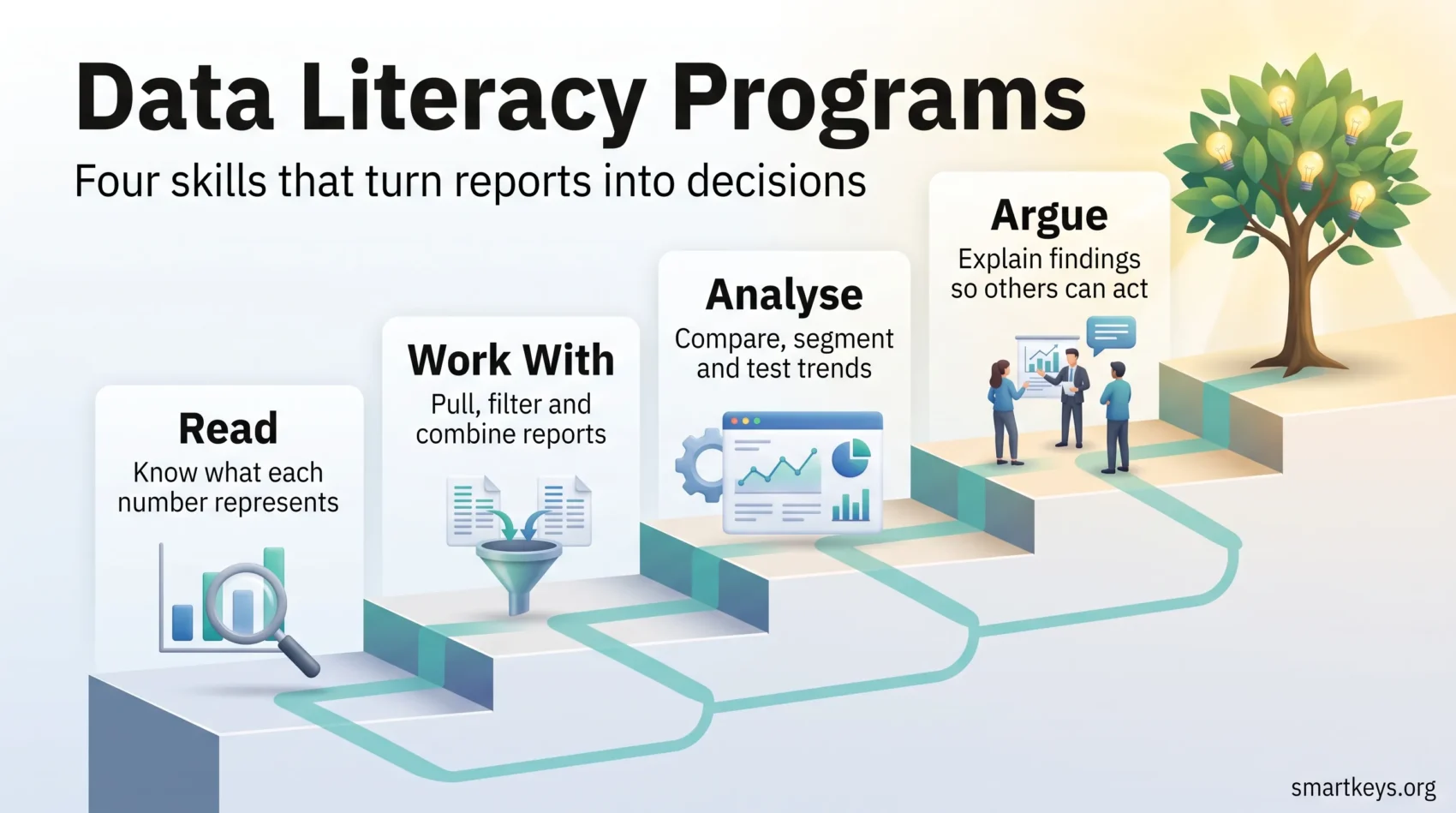
Data literacy breaks into four abilities.
- Read: knowing what a number represents. If churn is 4%, 4% of what, over which period?
- Work with: pulling a report, filtering it, joining two sources, noticing a column is half empty.
- Analyse: comparing, segmenting, checking whether a trend survives a second look.
- Argue: explaining the finding so a colleague can act, including what it does not prove. Most programs underrate this; data storytelling addresses it directly.
Nobody needs all four at the same depth. A sales manager mostly needs to read and argue; an operations analyst needs all four. Sorting that out before buying courses is the biggest saving available.
What the EU AI Act requires
Since 2 February 2025, Article 4 of the EU AI Act has obliged providers and deployers of AI systems to ensure a sufficient level of AI literacy among staff who operate or use them. It applies to ordinary employers, not only technology vendors, and the level required depends on role and risk.
AI literacy is not the same as data literacy, but the overlap is large, and the rule turns a nice-to-have into a documented duty. Our guide to EU AI Act compliance covers the wider obligations, and an AI governance model gives the training somewhere to sit.
How to build the program in five steps
1. Run a baseline assessment
Test a sample of each role group on the four abilities using your own reports, not generic exercises. A 20 minute assessment usually shows the gap is narrower than leaders assume. A wider digital skills gap analysis is worth running alongside.
2. Agree the definitions first
If marketing and finance calculate “active customer” differently, no training will make their numbers agree. Write a short metric glossary with one owner per definition. That belongs to your data governance strategy, but the program stalls without it.
3. Build role-based paths
Three or four paths is enough. Executives learn to interrogate a chart and ask what would change the conclusion. Managers learn to coach with numbers. Frontline staff learn the reports that govern their own work. Analysts go deeper into method.
4. Teach on real work
Every module should end with a task the learner must do next week. Short formats help: a microlearning strategy fits a working day better than a two-day offsite, and AI learning platforms adapt difficulty per learner. AI performance coaching and corporate training technology sustain practice afterwards.
5. Measure decisions, not completions
Course completion tells you nothing. Pick two or three decisions that take too long or get reversed often, then track time from question to answer and how many definition disputes reach the analytics team. Tie the program to a documented decision making model so there is something concrete to improve. HR teams that want to track adoption across departments can pair the program with workforce analytics software.
Access matters as much as training
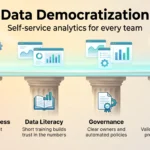
Training fails if people cannot reach the data afterwards. That is the argument for data democratization: governed access to the numbers that concern your work, with a maintained catalogue and sensible permissions.
Modern business intelligence tools have lowered the bar, and augmented analytics now summarises a chart in plain language. That helps beginners, but raises the value of the “argue” skill rather than removing it: someone still has to judge whether the summary is right. Where decisions depend on real-time data, misreading a chart gets more expensive.
Where these programs fail
Training without access. People finish the course, return to their desk and find the data behind a request form.
Tool training instead of thinking. A course on clicking through a dashboard teaches the interface, not the judgement. The interface changes next year.
No executive use. If leaders keep asking for the same untraceable spreadsheet, staff learn the official numbers are optional. Visible use from the top is what makes any rollout stick, an employee experience platform included.
One-off delivery. Skills fade. Budget for refreshers and new joiners, and connect the program to your upskilling plans.
Conclusion
A data literacy program is not a course you buy once. It is a standing capability: shared definitions, governed access, role-based skills, and leaders who use the numbers in public.
Start narrow. Pick one department, one baseline assessment and two decisions to improve. Prove it there, then widen. For a broader foundation, our guide to digital literacy for business is the place to start.
Found this useful?
Make SmartKeys a preferred source on Google, and our articles will surface more often in your Top Stories, AI Overviews, and AI Mode.
Add as Preferred Source