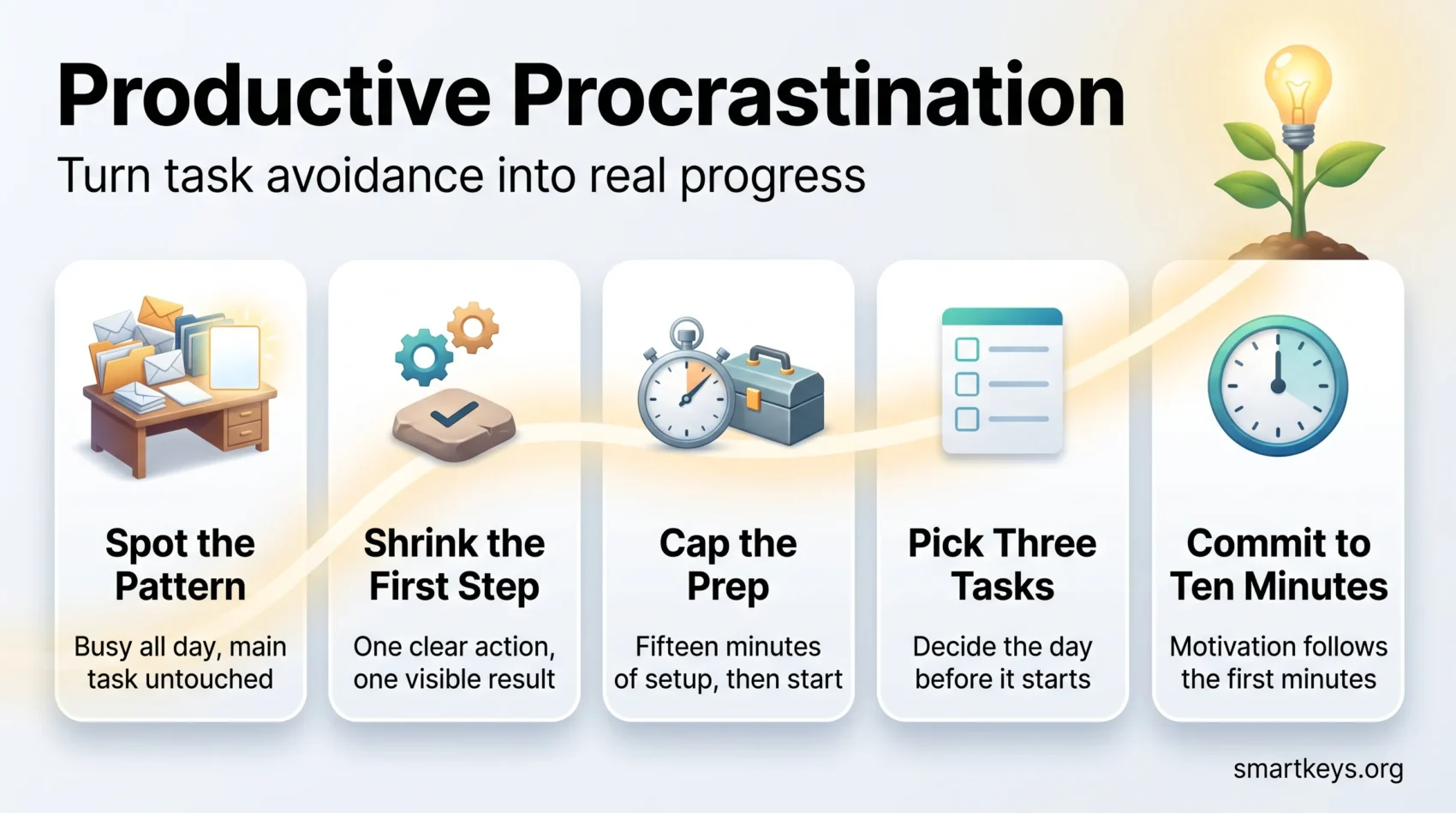
You can be busy all day and still not move your main project forward. That pattern has a name: productive procrastination. You work through smaller, genuinely useful chores so you can avoid the one hard task that actually matters. Things get ticked off. You feel relief. The important work sits untouched.
A typical version: you answer email, tidy your desk and rename a folder, instead of writing the report due on Friday. None of that is lazy. It is what your mind reaches for when the real task feels vague or risky. The relief is real but short. The hours are gone, the deadline is closer, and the task you avoided is now harder.
This guide explains where the habit comes from, how to spot your own version, and which small changes give the time back.
Key Takeaways
- Productive procrastination means finishing useful small tasks in order to avoid one important task.
- The relief arrives immediately. The cost, in time and stress, arrives later.
- Waiting for a last-minute rush is not a strategy. Research has not found a personality type that genuinely works better under deadline pressure.
- Naming your own avoidance pattern is the step that makes it fixable.
- A short first step, a hard cap on preparation and a three-item daily list recover most of the lost hours.
What Productive Procrastination Looks Like in Your Day
The giveaway is simple. At the end of the day you can list eight finished tasks, and none of them was the one you planned to do.
Some signs are easy to spot. You clear the inbox or rewrite your to-do list before you start. Others are quieter: an hour choosing a font for a resume, or hunting for the right image for one slide.
The pattern repeats because each detour is defensible. Nobody criticizes you for tidying a shared drive. That is exactly why it works as an escape route.
Three shapes cover most cases:
- Polishing. You improve something that is already good enough, because improving is easier than starting.
- Endless prep. You research, gather and set up, and the setup never reaches an end point.
- Admin drift. You handle small requests as they arrive, so the day fills itself.
Pick the one you recognize, and fix only that one for now. If you regularly lose track of how long a detour took, time blindness is a separate problem worth understanding.
Why You Avoid the Task: Certainty, Anxiety and the Urgency Trap
Avoiding a hard task is not a character flaw. It is a predictable response to work with no clear first move and no guaranteed result. A small chore offers both. That is the whole mechanism.
Starting is a skill of its own
Psychologists call the mental functions that plan, start and sustain an activity executive function. Starting is a separate skill from doing. Plenty of capable people work easily once they are in it, and still lose an hour getting there.
With ADHD, initiation and sustained effort are harder, so the pattern shows up more often. Treat it as a systems question, not a discipline question. Specific productivity systems that suit ADHD exist for that reason.
Why the last-minute rush feels so effective
Many people explain their delay by saying they work better under pressure. The research does not back this up.
Piers Steel tested the idea in Personality and Individual Differences in 2010. He looked for the “arousal procrastinator,” someone who delays on purpose to gain a boost from the deadline. He found no empirical support for the type. Procrastination behaved as one thing: irrational delay, not a deliberate technique.
That matters for planning. If the last-minute surge is mostly relief rather than better output, building your week around it is a bet that does not pay.
“Waiting for panic is not a schedule.”
The feeling underneath the avoidance
Under most avoidance sits one of three feelings. Fear that the result will not be good enough. Uncertainty about what the first step even is. Or plain reluctance, because you are not in the mood.
The first is perfectionism, and a deliberately low standard for the first draft defuses it. The second responds to a written first action. The third responds to a timer, because ten minutes is small enough to accept on a bad day.
Productive Procrastination Defined, and Why It Is So Convincing
Definition: productive procrastination is completing secondary tasks in order to avoid the primary one. You gain a sense of progress. The goal that matters does not move.
It is convincing because the output is real. You did clear the inbox. What you spent was the part of the day when you had attention for demanding work.
Structured procrastination and the other names for it
The behavior travels under several labels, which makes it easy to miss.
The best-known is structured procrastination, from a 1995 essay by the Stanford philosopher John Perry, later expanded into his book The Art of Procrastination. Perry observed that procrastinators rarely do nothing. They do “marginally useful things” as a way of evading something higher on the list. His suggestion was to exploit that: put a genuinely daunting item at the top, so the useful work further down gets done as avoidance.
The same behavior also travels as procrastivity or positive procrastination. The labels differ; the pattern is identical.
Why it feels good now and costs you later
The short-term payoff is relief. The longer-term picture looks different.
A 2023 study in JAMA Network Open followed 3,525 university students in Sweden over nine months. Higher procrastination at the start was associated with slightly worse outcomes later, including stress, poor sleep quality, loneliness and economic difficulty. The effects were small, and the authors were explicit that other traits could explain part of the link. It is not proof that procrastination causes harm. It is a reason not to treat the habit as harmless.
A quick test helps in the moment. Ask: if I had only 30 minutes of good attention today, would I spend it on this? If not, the task is not urgent. It is just available.
Spot Your Own Pattern: From Organizing First to Overengineering
The fastest way to interrupt the habit is to catch it early, in the first ten minutes. Below are the three stages where it usually starts.
The obvious stalls
Tidying the desk or shopping for a better tool is reasonable, and it has a natural end point. It becomes a stall when it runs past the window you gave it.
Fix: give preparation a stated time, not a stated standard. Fifteen minutes of setup, then you start, ready or not.
The quiet drains
A minute checking a font becomes forty. These feel like quality control, which is why they are hard to catch.
Fix: decide in advance which details may take time and which get one pass. Formatting rarely belongs in the first group. A single-tasking habit helps, because most drains start as a quick side trip.
Overengineering, and what “done” means
This one is expensive. A portfolio page becomes a custom website, and the job applications it was meant to support never go out.
Fix: write a definition of done for version one before you start. List the must-haves, park the nice-to-haves in a separate note, then ship. Work that expands to fill the time available has a name, Parkinson’s Law, and a fixed scope is the counter to it.
Practical Ways to Reduce the Delay
Start with the first one that fits today.
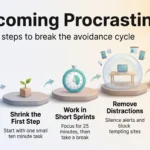
Shrink the first step until it is boring
Break the project into steps that each have one clear action and one visible result. The first step should feel almost pointless: open the file and write the opening sentence. A step you cannot argue with is a step you will take.
Two habits support this. The two-minute rule clears the small items that would otherwise distract you. Writing down the concrete next action for each project means you never open a task and have to work out what it means. For anything that feels too big to approach at all, a method for tackling big projects beats willpower.
Decide the day before the day starts
Start with a brain dump: write down everything on your mind, so you choose from a list instead of from memory.
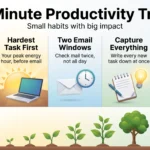
The Eisenhower Matrix separates urgent from important, which usually exposes the busywork. Then pick three items for the day and no more. The Ivy Lee method is a century-old version of the same discipline.
If one of the three is clearly the hardest, do it first. That is the idea behind eat the frog. An alternative is the daily highlight: pick the one thing that would make the day a success, and protect time for it.
Cap the rabbit holes
- Give research, formatting and design a fixed minute budget, then stop when it runs out.
- Reserve your best hours for thinking and creating. Move admin to when your attention is already low.
- Use time blocking to put the main task in the calendar as an appointment, not an intention.
- Work in fixed intervals. The Pomodoro Technique uses 25 minutes on and a short break. The interval matters less than the fact that it ends.
- If the detour is online, website blockers remove the decision instead of testing it.
Start without waiting for the mood
Motivation usually follows the first few minutes of work rather than preceding it. So the commitment is to ten minutes, not to the task. After ten minutes you are allowed to stop. Most of the time you will not. Short, bounded focus sprints run on the same principle.
Unfinished tasks also keep taking up attention in the background. Writing those open loops down frees the attention you need for the work in front of you.
Finally, track what you finished rather than what you planned. A record of completed blocks is more convincing than a memory of a busy day.
Beyond Urgency: Add Significance to Your Priorities
Most prioritization asks two questions. Adding a third changes which tasks survive.
Three questions instead of two
Stephen Covey popularized the split between urgency and importance. The author Rory Vaden added a third dimension in Procrastinate on Purpose: significance, meaning how long a decision will keep mattering.
So ask three things about a task:
- How soon does this matter? That is urgency.
- How much does this matter? That is importance.
- How long will this matter? That is significance.
The third question rescues work with no deadline. Writing a template, documenting a process or automating a report all score badly on urgency and well on significance. They are also the first things a busy week deletes.
Cut, automate or hand off the rest
Once you can see which tasks score low on all three, stop doing them yourself.
- Delete the ones nobody will miss. A not-to-do list makes those decisions once instead of daily.
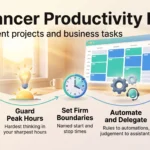
- Delegate what someone else can do to an acceptable standard, even if they do it differently.
- Consider outsourcing repetitive work when it costs less than the hours it frees.
- Protect the time you win back, which means being willing to say no.
“Choose the work that pays you back next month, not just this afternoon.”
Conclusion
Productive procrastination is convincing because the work you do instead is real. That makes it hard to notice and easy to defend.
The fix is not more discipline. It is a smaller first step, a hard limit on preparation, and a short list you set before the day started. Pick the detour you recognize most, give it a rule, and test it for a week.
If the wider habit of delay is the bigger problem, the guide to overcoming procrastination covers the causes in more depth. For protecting the blocks once you have them, see deep work.
Found this useful?
Make SmartKeys a preferred source on Google, and our articles will surface more often in your Top Stories, AI Overviews, and AI Mode.
Add as Preferred Source