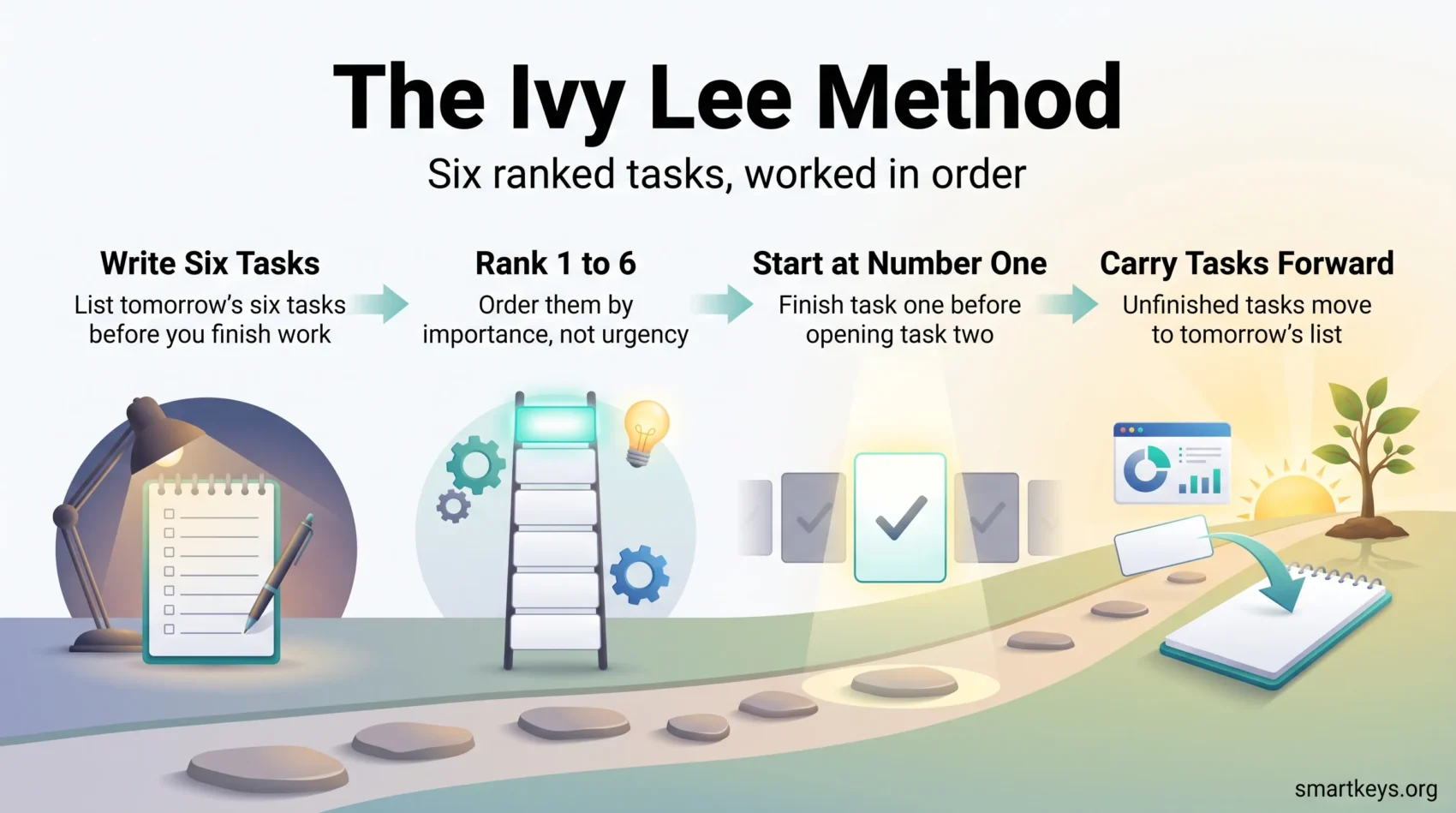
The Ivy Lee Method is a planning routine with one rule: before you finish work, write the six tasks that matter most tomorrow, rank them, and work through them in that order. No app, no system to maintain. A public relations consultant named Ivy Lee is said to have taught it to executives at Bethlehem Steel in 1918.
Why it still works: most of us do not lose time because we cannot work. We lose it deciding what to work on. If tomorrow’s order is already settled, your first twenty minutes go into the work instead of the choosing. This guide covers where it came from, how to run it, how to pick the six tasks, and where it breaks down.
Key Takeaways
- Write six tasks for tomorrow at the end of today, then rank them 1 to 6.
- Finish task one before opening task two.
- Six is a ceiling, not a target. Fewer is fine; more defeats the point.
- Unfinished tasks move to tomorrow’s list and keep their place in the order.
- It suits work you control, and fits reactive roles badly.
Why a six-item list changes your workday
The routine does two useful things.
It moves the decision. Choosing what to do is real work. At 9am it costs your freshest hour; at 5pm it costs an hour you were going to spend winding down anyway.
It caps the list. A to-do list with 23 items does not tell you what to do, it tells you what you are behind on. Six slots force a choice, and the choice is the point. Our guides to to-do lists you actually finish and the wider art of prioritization go deeper on ranking.
One claim to treat carefully: many articles say the method “eliminates decision fatigue,” the idea that choices drain a limited pool of willpower. That theory, called ego depletion, has held up badly under replication attempts over the past decade. The honest version needs no theory: a decision you made yesterday is one you are not making today. We weigh the evidence in our piece on decision fatigue at work.
Where the Ivy Lee Method came from
Ivy Lee was a public relations consultant, one of the first to do that job professionally. Charles M. Schwab was president of Bethlehem Steel and one of the wealthiest men in America.
The story goes that Schwab asked Lee to make his executive team more efficient. Lee took no fee up front and spent fifteen minutes with each executive, giving them all the same instruction: write your six most important tasks for tomorrow, rank them, start at number one and do not move on until it is done. Three months later Schwab sent a cheque for $25,000.
How much of that is verified
Less than the confident retellings suggest. James Clear, who did more than most to popularise the method, notes in his account that the earliest reference he could trace dates from the 1960s, and that many versions misdate the meeting to 1905. Treat the $25,000 as a good anecdote, not a case study. Try the method because it takes five minutes to test, not because of the cheque.
Single-tasking is the part that carries the weight
Strip away the story and one instruction does most of the work: finish task one before you start task two.
Every switch has a cost, because attention does not move instantly. Part of it stays with the thing you just left. Research by Gloria Mark at UC Irvine found that office workers stayed on a single screen for about two and a half minutes on average in 2004, falling to roughly 47 seconds by the late 2010s. A ranked list does not stop interruptions, but it removes their second cost: after each one there is exactly one correct next move. See our guides to single-tasking and the cost of task switching.
“A short, repeatable order beats a complex plan in a noisy world.”
How to run the Ivy Lee Method, step by step
Step 1: At the end of the day, write six tasks for tomorrow
Do this before you close your laptop. Ten minutes at the end of a workday is cheap; ten minutes at the start of one is expensive.
Write tasks, not topics. “Q3 report” is a topic and you will stare at it. “Draft the Q3 report intro and methods section” is a task, and you know when it is done. Anything longer than about two hours is a project and needs splitting. Folding this into an end-of-day routine makes it stick faster.
Step 2: Rank them 1 to 6 by importance
Assign actual numbers; a vague ordering will not survive a stressful Tuesday morning. Rank by importance, not urgency. Urgent work announces itself and gets done anyway. Important work is quiet and gets postponed, which is why it belongs at position one.
Step 3: Tomorrow, start at number one
Work on task one until it is finished or genuinely blocked, then move to task two. The rule people skip is the one that matters: no jumping ahead. Task four often looks more appealing at 10am because it is easier, and taking it turns your ranked list back into a menu.
Step 4: Carry unfinished tasks forward
Whatever you did not finish goes to the top of tomorrow’s list, keeping its priority. Then fill the remaining slots.
Watch one signal. If the same task rolls over four days running, discipline is not the problem. Either it is too big and needs breaking down, or you do not intend to do it, and it belongs on a not-to-do list.
How to choose the six tasks
This is where the method succeeds or fails. Six badly chosen tasks just get you through the wrong work efficiently.
Borrow one filter from other frameworks
The Ivy Lee Method tells you how to work the list, not what belongs on it. Two quick filters help. The Eisenhower Matrix reminds you to take at least two of your six from important but not urgent work: strategic tasks with no deadline pressing on them. An impact versus effort check, the practical form of the 80/20 rule, puts high-impact, low-effort items first and allows one large task per day, not two. For how these frameworks compare, see our overview of prioritization methods.
Mix the sizes
A workable pattern is one big task, two medium, three small. Six large tasks is not a plan, it is a wish. The 1-3-5 rule fixes the same proportions.
Two questions before an item earns a slot:
- Does this move a quarterly goal or a customer outcome? If neither, it may not belong in the top six.
- Would I be satisfied if this were the only thing I finished today? One item should pass. That is your daily highlight.
Most people underestimate how long tasks take. That bias has a name, the planning fallacy, and it is the usual reason a six-item list ends with four done.
Tools, guardrails and where the method fails
Keep the tool boring
An index card, a sticky note, or a plain note on your phone all work. The list has six items and lives for one day, so it does not need features. If you already run a task manager, keep tomorrow’s six as their own view rather than buried in a project.
Protect task one
Task one deserves your best hours. Put a calendar block on it so nobody books over it, and turn off notifications while you are in it. Time blocking pairs naturally with a ranked list, and deep work, meaning extended concentration without distraction, is what you are protecting. For small requests, the two-minute rule helps: anything under two minutes, deal with it and return to task one.
When the method does not fit
People often conclude they are undisciplined when they simply have the wrong job for the tool.
The method assumes you control most of your day. It suits writers, analysts, developers, designers and founders, and fits support, operations and clinical roles badly, where most of the day arrives from outside. If eight of every ten tasks you do were on no list this morning, a six-item plan is a list you fail to reach. The fix is to shrink it: pick two protected tasks and treat the rest as reactive work.
The other failure is quieter. A daily list keeps you moving but never asks whether the direction is right. Pair it with a weekly review, and if starting rather than choosing is your real problem, eating the frog attacks it from a different angle.
Conclusion
The Ivy Lee Method is five minutes at the end of the day: six tasks, ranked, done in order, with leftovers rolling forward.
Its value is not the 1918 anecdote, which is thinner than its retelling suggests. It is the constraint. Six slots force you to choose, and a number beside each item removes the question of what comes next every time you are interrupted. Run it for two weeks, and if your job is too reactive for six, run it with two.
Found this useful?
Make SmartKeys a preferred source on Google, and our articles will surface more often in your Top Stories, AI Overviews, and AI Mode.
Add as Preferred Source