The Swiss Cheese method is simple: instead of waiting for a free afternoon, you poke small holes in a big project with tasks that take five minutes or less. Over a day those holes add up, and the block of work that felt solid starts to look manageable.
The name comes from the picture. A large task is the block of cheese, and every quick action you finish is a hole. You are not eating it in one sitting; you are making it lighter, one bite at a time.
The idea is not new. Alan Lakein described it in his 1973 book How to Get Control of Your Time and Your Life. It works because it removes the one condition most methods quietly assume you have: a long, uninterrupted stretch of time.
One note before you start. A second, unrelated “Swiss cheese” idea exists in safety and healthcare, and it explains how accidents happen rather than how work gets done. This guide briefly separates the two, so you never mix them up.
Key Takeaways
- Break a stalled project into actions of five minutes or less, then do one now.
- Visible progress, however small, is what keeps motivation alive during long projects.
- A short timer turns a vague intention into a finished piece of work.
- The productivity method (Lakein) and the safety model (Reason) share a name and nothing else.
- Small slices support deep work; they do not replace it.
What the Swiss Cheese method actually is
Lakein’s core unit is what he called an instant task: an action connected to your project that you can finish in five minutes or less. Not a chunk of the project, not a session. A single, completed thing.
For a report, an instant task might be: open a blank document and write the title. Download the two files you need. Send one email asking for a number you are missing.

None of them finishes the report. All of them make it smaller, and each one gives you a place to start next time. That makes the method one practical tactic within the wider skill of breaking large goals into smaller, schedulable steps.
The method targets one specific problem: you know what you should be doing, the task feels too big to begin, so you do something else. If that sounds familiar, it helps to know that procrastination usually has a cause you can name, and “the first step is unclear” is among the most common.
What you gain on the first day
You do not have to wait weeks to see whether this works. Most of the benefit shows up the same afternoon.
You can start immediately. A five-minute action fits between a meeting that ended early and the one starting at the hour. Nothing has to wait for a perfect block of time.
The project stops feeling heavy. “Write the quarterly report” is intimidating because it is not one task, it is forty. Listing the forty is uncomfortable for ten minutes and a relief afterwards.
You build a record of progress. Three finished slices are evidence, and on a bad day evidence beats motivation. Even tired, you can finish one small slice and keep the project alive.
This is the same logic behind micro-habits and the two-minute rule: lower the cost of starting until starting is no longer a decision.
Swiss Cheese method versus Swiss Cheese model: two different things
These two ideas share a name, a picture and nothing else. Confusing them is common, so it is worth thirty seconds to separate them.
The productivity method (Alan Lakein)
Lakein’s version is about you and your calendar. Take one large task, break it into actions of five minutes or less, do them whenever a gap appears, and let the holes accumulate.
The safety model (James Reason)
The psychologist James Reason published his model in 1990 to explain how accidents happen in complex systems such as aviation, hospitals and power plants. Each safety measure is a slice of cheese. Every slice has holes, meaning weaknesses. Usually one slice catches what the previous one missed. An accident happens on the rare occasion when the holes in every slice line up and something passes straight through.
Reason also separated visible mistakes at the sharp end of the work from latent failures: weaknesses built into a system long before anyone gets hurt, such as two drugs stored in near-identical bottles. That is a tool for accident investigation, not for planning your week.
Which one you actually need
Finishing a project: Lakein. Investigating why something went wrong: Reason.
One idea does carry across. When the same blocker stops you week after week, that is a latent problem, not a task. No amount of slicing fixes an approval process with no named owner. Slice what you control, escalate what you do not.
Where the method comes from and why it works
Instant tasks and ABC priorities
Lakein paired instant tasks with a simple ranking. Label everything on your list A, B or C by importance, then number within each band: A-1, A-2, B-1 and so on. A-1 is what matters most.
The combination is what makes it work. Ranking alone tells you what matters but not how to begin; instant tasks alone give you motion without direction. Together they answer one question: what is the smallest thing I can finish right now that moves A-1 forward? That is close to what productivity writers now call finding the next action.
What the research supports
Two findings back the method up, and it is worth being precise about what they do and do not show.
Teresa Amabile and Steven Kramer studied daily diaries kept by people on demanding creative projects. Their conclusion, published in Harvard Business Review in 2011, was that nothing contributed more to a good day at work than making progress in meaningful work. Small wins counted, and setbacks hurt more than equivalent wins helped (Source: Amabile and Kramer, “The Power of Small Wins”, HBR, May 2011).
The second finding is about the noise in your head. E. J. Masicampo and Roy Baumeister showed that unfinished goals keep intruding on your thoughts, and that making a specific plan largely stops the intrusion even though the task is still unfinished (Source: Masicampo and Baumeister, “Consider It Done!”, Journal of Personality and Social Psychology, 2011). Naming your next slice is that plan, which is why open loops drain attention until you write down what happens next.
What the research does not show is anything about brain chemistry. You will often read that finishing a small task gives you a dopamine hit. Treat that as a metaphor rather than a measurement: the effect on motivation is documented, the mechanism is not.
How to apply the Swiss Cheese method step by step
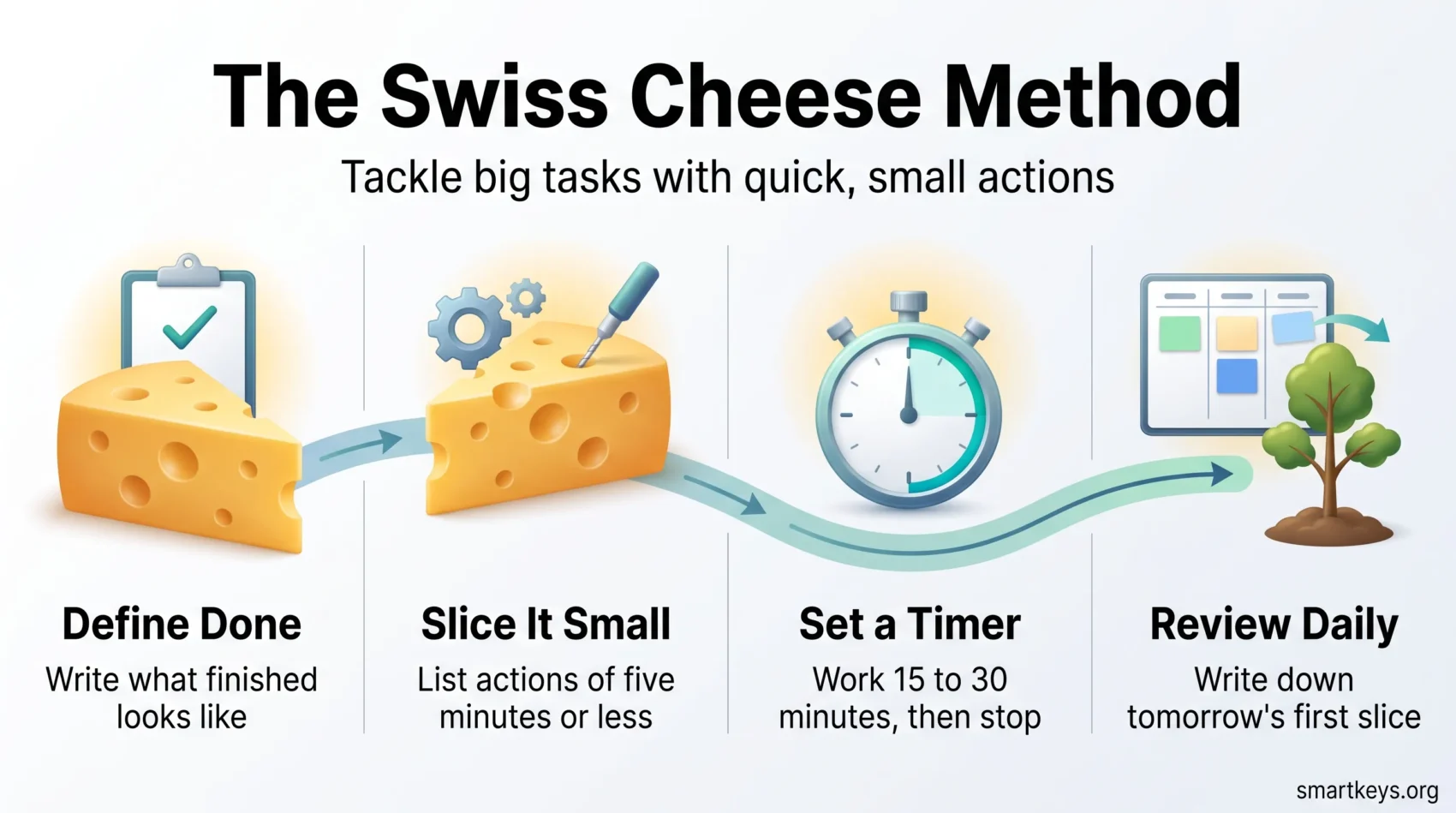
Step 1: name the big cheese and define done
Pick one project and write a single sentence describing what finished looks like. Not “improve onboarding” but “a new hire can complete day one without asking anyone for a link”.
That sentence is your filter: any slice that does not move it forward belongs to someone else’s project. If the sentence is hard to write, the goal is still vague, and setting a goal you can act on is the first piece of work.
Step 2: drill the first hole
List slices until you have at least ten that take five minutes or less, and be specific. “Research competitors” is not a slice; “open the three competitor pricing pages and screenshot them” is.
Then do one, now, before you finish reading this. The first hole is the only one that needs willpower; the rest run on momentum. For genuinely large projects it also helps to see how others go about tackling big projects.
Step 3: put a timer on it
Set 15 to 30 minutes and work until it stops. The timer creates mild urgency and gives you permission to stop, which is what makes starting cheap.
Any timer works: a phone, a kitchen timer, or a visual timer that shows the remaining time as a shrinking coloured disc. For a fixed rhythm, the Pomodoro Technique gives you 25 minutes of work and a five-minute break, repeated.
Step 4: review, adjust, and keep the holes visible
End the day with two minutes and three questions. What did I finish? What stalled, and why? What is tomorrow’s first slice? Write that last answer down: it is the difference between starting at 9:05 and starting at 9:40.
Keep finished slices visible. A personal Kanban board works well because the Done column grows in front of you, and a slightly longer weekly review catches the slices you keep carrying over.
Tools that make it stick
The method needs almost nothing. Resist the urge to spend your first hour configuring software instead of working.
Boards and lists
Four columns cover it: Backlog, Doing (timer on), Done Today, Done. Trello, Notion, your existing task app or a sheet of paper all work. Tag cards A, B or C and keep the five-minute slices as checklist items inside the card, so you can start one the moment a gap opens.
Timers
Pick one and stop shopping. The only requirement is that starting it takes less effort than thinking about it. A timer you must unlock, open and configure will lose to the task you were avoiding.
A one-page daily template
Keep it to four lines: your A-1 slice, three instant tasks, one stretch slice, and a two-minute review prompt. Anything longer becomes a form you fill in instead of work you finish. If you want a measure, track slices completed per day. It says more about a fragmented week than hours logged, and it does not reward sitting at a desk.
A day in the life
Say you have two big cheeses today: a long article and a quarterly plan.
8:40, fifteen minutes before a call. You draft the article outline and paste in three links you already had open. Two slices done.
10:15, between meetings. Twenty-minute timer, opening section written. It is rough. It exists.
11:30. The quarterly plan is blocked because nobody has confirmed who signs off. That is a latent problem, not a task, so you turn it into a slice you can actually do: send one message asking who owns the approval.
14:00. A protected 45-minute block for the hardest section. This part needs deep work, and slices cannot substitute for it. Using the deep focus routine complements the Swiss Cheese method and helps you protect energy across the day.
16:50. Two-minute review. Six slices finished, one blocker escalated, tomorrow’s first slice written down: “write the conclusion paragraph”. Nothing heroic happened, and the article still moved from nothing to two-thirds drafted in a day with four meetings in it.
Combining it with other systems
The Swiss Cheese method decides how small a step should be, not which step. Pair it with something that does.
Eisenhower Matrix: choosing the next hole
The Eisenhower Matrix sorts tasks into four boxes by urgency and importance. Use it weekly on your slice list, not hourly. Most big projects live in the important-but-not-urgent box, which is exactly why they never get started.
MoSCoW: protecting the scope that matters
MoSCoW labels every item Must have, Should have, Could have, or Won’t have this time. When the week gets short, the Won’t list saves you, because it is a decision you already made rather than one you improvise under pressure. If neither framework fits, other task prioritization frameworks are worth comparing.
Time blocking and deep work
Slices are for fragmented time. Time blocking is for the hours you can protect. Use slices to prepare a deep block (gather sources, clear the desk, write the first sentence) so the protected hour starts at full speed.
Inside a block, work on one thing. Single-tasking beats slicing for anything that needs held context. If your calendar never leaves room for it, a team-wide no-meeting focus time policy helps more than any personal tweak.
Where the method fails
Three limits are worth knowing before you rely on it.
Slices that are still too big. If you stall on a “five-minute” task, it was not five minutes. Halve it and shorten the timer to ten. Stall again and the problem is usually clarity, sequence or a missing file, not discipline.
Work that cannot be fragmented. Debugging, complex writing and design need context you rebuild every time you return. There, slices are the warm-up, not the method: tackle the hardest piece in one protected block, which is the argument behind eating the frog early.
Busy work disguised as progress. Finishing twenty tiny tasks that never touch A-1 feels excellent and moves nothing. Watch for this one, because from the outside it looks exactly like success.
Slice lists are also optimistic by default. Most people underestimate how long work takes, a bias consistent enough to have a name: the planning fallacy. Assume your ten slices are fourteen.
Conclusion
The Swiss Cheese method asks very little of you: one project, one sentence describing done, one action of five minutes or less, and a timer.
In return it gives you a way to make progress on days that offer no clean blocks of time, which is most days. The holes accumulate and the block gets lighter. Pick your big cheese, write one slice, start the timer.
Found this useful?
Make SmartKeys a preferred source on Google, and our articles will surface more often in your Top Stories, AI Overviews, and AI Mode.
Add as Preferred Source