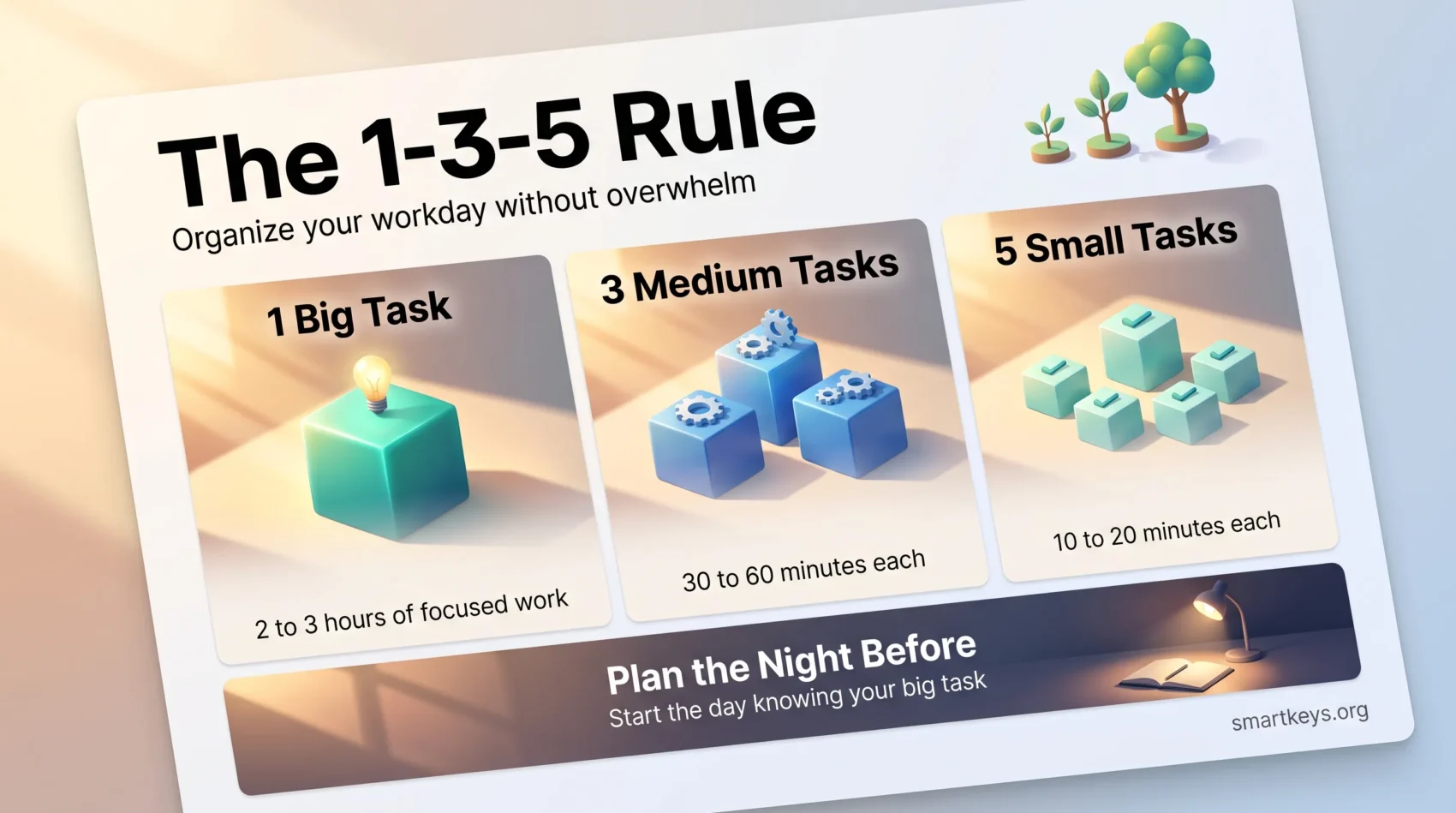
If your to-do list keeps growing faster than you can work through it, the 1-3-5 Rule is one of the simplest fixes available. The idea: plan each day around one big task, three medium tasks and five small tasks. Nine items. No more. That single constraint forces you to decide what actually matters before the day decides for you.
The method has become more useful, not less, as workdays have fragmented. Microsoft’s Work Trend Index found that knowledge workers are interrupted roughly every two minutes during core hours — around 275 pings a day from meetings, emails and chats — and that close to half describe their work as chaotic and fragmented. When your attention is being pulled apart that often, a nine-item plan you can hold in your head beats a fifty-item list you never finish.
Key Takeaways
- The 1-3-5 Rule caps your day at one big, three medium and five small tasks.
- The limit is the feature: it forces prioritization instead of endless list-building.
- It works best combined with time blocking and energy-aware scheduling.
- The ratio is adjustable — meeting-heavy days often need 1-0-5 or 0-3-5.
- Plan the list the evening before to remove morning decision fatigue.
- Completing small tasks builds visible momentum and reduces overwhelm.
What the 1-3-5 Rule Actually Is
The 1-3-5 Rule is a daily planning framework, not a full productivity system. Every morning (or better, the night before) you pick nine tasks in a fixed shape:
- 1 big task — the thing that would make today count. Usually two to three hours of focused work, often affecting other people or a project milestone.
- 3 medium tasks — meaningful but bounded work, roughly 30 to 60 minutes each. Think a draft, a review, a client call with prep.
- 5 small tasks — quick items of 10 to 20 minutes: replies, approvals, bookings, filing, follow-ups.
Total realistic commitment: around five to six hours of actual work. That leaves room for the meetings, interruptions and surprises that every real workday contains. Most overloaded to-do lists fail precisely because they assume eight hours of uninterrupted output.
Why the Limit Is the Point
An unlimited list feels productive to write and terrible to work from. Every time you look at it you re-run the same decision: what now? The 1-3-5 shape removes that decision. The big task is obvious, the medium tasks are queued, and the small ones are there for the fifteen-minute gaps between meetings.
It also makes overcommitment visible. If a fourth “medium” task genuinely cannot wait, something else has to leave the list — an explicit trade-off rather than a silent one. That is the same discipline behind focusing on fewer priorities and the Ivy Lee Method, which limits the day to six ranked tasks.
How to Build Your 1-3-5 List
Step 1: Start With a Brain Dump
Before you select anything, get everything out of your head. A quick brain dump — five minutes, no filtering, no ordering — gives you the full picture to choose from. Selecting from memory means you will pick whatever is loudest, not whatever is most important. The same principle applies to capturing tasks into a trusted system rather than carrying them mentally.
Step 2: Pick the Big Task First
Ask one question: if I only finish one thing today, which one makes the day worthwhile? That is your big task. It should connect to a project or goal you care about, not just to whoever emailed most recently. If you struggle to identify it, a structured prioritization approach helps separate urgent noise from important work.
Step 3: Fill In Medium and Small
Choose three medium tasks that support the same direction where possible, then five small ones. Be honest about size — a “small” task that turns out to be ninety minutes is a medium task in disguise and will wreck the plan. If something feels vague, it is probably too large; break it down using the approach in tackling big projects.
Step 4: Give the List a Shape in Your Calendar
A list without time attached is a wish. Block the big task first, ideally in your sharpest hours, then group the small tasks into one or two batches. Rough starting guide: about three hours for the big task, 40 minutes per medium task, 12 to 15 minutes per small one. Time blocking turns the plan into a schedule you can actually defend.
Step 5: Plan Tomorrow Before You Log Off
Writing the list at the end of the previous day is a small change with a large effect. You start the morning already knowing your big task instead of spending your best half-hour deciding. An evening routine that ends with tomorrow’s 1-3-5 removes that friction entirely.

What the Categories Look Like in Practice
The tiers only work if you apply them consistently. A few concrete examples:
- Team lead: big = build the quarterly plan; medium = one-on-one prep, budget review, hiring scorecard; small = approvals, calendar fixes, two short replies.
- Marketer: big = write the campaign landing page; medium = brief the designer, review ad copy, analyse last week’s data; small = schedule posts, update the tracker, chase an invoice.
- Freelancer: big = deliver the client project milestone; medium = proposal draft, invoice run, portfolio update; small = short client emails, receipts, follow-up calls.
Notice that the big task is never “do emails”. Email is a container for small tasks, and treating it as your main work is one of the quickest ways to end a busy day with nothing to show. Batching email into fixed windows keeps it in the small tier where it belongs.
Techniques That Pair Well With the 1-3-5 Rule
Match Tasks to Your Energy, Not Just the Clock
The big task belongs in your peak window — for most people the first two to three hours after starting, before the calendar fills. Low-energy stretches are where the small tier earns its keep. Scheduling around energy rather than raw hours often produces more improvement than any list format, and the same logic is explored in depth in managing energy, not time.
Batch the Small Tier
Five small tasks scattered across the day cost far more than 60 minutes, because each one interrupts something else. Group them instead: one batch late morning, one late afternoon. Task batching cuts the switching cost dramatically.
Protect the Big Block
A 1-3-5 list is worthless if the big block is open season for meetings. Mark it as busy, silence notifications, and if your team allows it, push for team-wide focus hours. Given how often the average knowledge worker is interrupted, protection matters more than planning.
Use Pomodoro Inside the Blocks
The 1-3-5 Rule decides what you work on; the Pomodoro Technique governs how you work through it. Twenty-five-minute intervals with short breaks fit neatly inside a two- or three-hour big-task block and make long stretches of focus sustainable.
1-3-5 Rule vs. Other Prioritization Methods
Compared to the Eisenhower Matrix
The Eisenhower Matrix sorts tasks by urgency and importance across four quadrants. It is the better tool for deciding what deserves your attention at all — including what to delegate or drop. The 1-3-5 Rule is weaker at that analysis but far faster to apply daily. Many people use both: the matrix weekly to clean the backlog, the 1-3-5 Rule each morning to shape the day. The 4 D’s of time management serve a similar filtering purpose.
Compared to the Ivy Lee Method
Ivy Lee gives you six tasks in strict priority order and forbids moving on until the current one is done. It is more rigid and better for people who struggle with task-switching. The 1-3-5 Rule is more flexible because the tiers let you match task size to whatever time gap you have.
Compared to Eat the Frog
Eat the Frog is essentially the big-task half of the 1-3-5 Rule: do the hardest thing first. The 1-3-5 Rule adds structure for everything that comes after, which is why the two combine naturally.
Common Problems — and How to Fix Them
“My Big Task Never Gets Done”
Almost always a scheduling problem, not a motivation problem. If the big task sits at the end of the day, meetings will eat it. Move it to the front, and shrink it: a big task should be finishable in one sitting. “Launch the website” is a project; “write the launch page copy” is a big task.
“Unexpected Work Blows Up My List”
Expect it. Leave the plan at roughly 60 to 70 percent of your available hours and treat the rest as buffer — the same reasoning behind time buffering. When something genuinely urgent arrives, swap it in and consciously drop something else rather than adding a tenth item.
“I Consistently Underestimate How Long Things Take”
Common and well documented — see the planning fallacy. The fix is data, not optimism: track actual durations for a week or two using a simple time audit, then size your tiers against reality.
“I Keep Adding a Tenth Task”
Keep a separate parking list. Anything that arrives after the day is planned goes there and gets considered tomorrow. A not-to-do list is a useful companion for the items that keep resurfacing but never deserve a slot.
Adapting the Ratio to Your Real Workload
The numbers are a starting point, not a rule of physics. Adjust deliberately:
- 1-0-5 for meeting-heavy days: one deep block plus small tasks in the gaps.
- 0-3-5 when no single task dominates — review days, admin days, catch-up days.
- 1-3-0 when small tasks are already handled and you want a clean focus day.
- 2-4-6 only if you have consistently finished 1-3-5 lists early for a couple of weeks.
Using the Same Shape for the Week
The structure scales upward. Pick one significant weekly outcome, three supporting deliverables and five smaller items, then let each day’s 1-3-5 list draw from it. That connection between daily lists and larger goals is what keeps the method from becoming busywork — the core idea behind weekly planning and personal OKRs.
Tools and Tracking
The method works on paper, and plenty of people keep it there deliberately. If you prefer digital, almost any task app supports it: create three sections or labels for big, medium and small, and keep today’s view limited to nine items. A personal Kanban board works well if you like seeing progress move across columns, and there are plenty of suitable productivity apps that handle the tiers cleanly.
Keep a Short Completion Log
Note each evening how many of the nine you actually finished and which tier failed most often. After two weeks the pattern is usually obvious — too many medium tasks, big tasks scheduled too late, small tasks expanding. A brief weekly review turns those notes into an adjustment rather than a vague sense of falling behind.
Conclusion
The 1-3-5 Rule works because it is small enough to actually use. Nine tasks, three sizes, one decision made before the day starts. It will not fix an unreasonable workload or a broken meeting culture, but it will stop you from ending the day busy and unsure what you achieved.
Start tomorrow: write the list tonight, put the big task in your first clear block, batch the small ones, and adjust the ratio after a week of real data. If you want to build the surrounding habits, effective task management, a solid daily routine and a reliable morning routine are the natural next steps.
Found this useful?
Make SmartKeys a preferred source on Google, and our articles will surface more often in your Top Stories, AI Overviews, and AI Mode.
Add as Preferred Source