Kate Northrup‘s Do Less argues something that sounds obvious and turns out to be hard: you get more of what matters when you commit to less. Not by working faster, but by cutting the list.
The book was published by Hay House in 2019, runs to 272 pages, and carries the subtitle “A Revolutionary Approach to Time and Energy Management for Ambitious Women.” Its structure is unusual for a productivity title. Instead of a system, it offers 14 experiments you run over about two weeks and keep only what works.
This summary covers the main ideas, the practical steps behind them, and the fair criticisms. It is written for anyone with more tasks than hours, whether or not you fit the book’s stated audience.
Key Takeaways
- Cutting your list frees attention, not just calendar space.
- The book contains 14 short experiments rather than one rigid system.
- Northrup plans around energy cycles instead of a fixed daily template.
- Rest is treated as part of the work, not a reward for finishing it.
- Some advice assumes flexibility that salaried or hourly workers do not have.
Why “Do Less” Resonates Now
The book landed during a broad reaction against hustle culture, the belief that constant busyness is proof of ambition. That reaction has only grown since.
The argument is simple. A packed schedule feels productive because it is visible. Progress on the two or three things that actually matter is much harder to see, so it loses out to whatever is loudest. The same problem shows up at company level, which is why more teams now judge work by outcomes rather than hours logged.
What changes when you commit to less is mostly attention. You stop paying the cost of switching between half-finished jobs. You have enough room in the day to respond to a problem instead of reacting to it. And you finish things, which is its own kind of fuel.
If you want the underlying research on why fewer commitments beat more, our guide to prioritization at work covers the evidence in more detail.
About the Book and the Author
Kate Northrup is an entrepreneur and author who writes about time and energy for women running businesses alongside households. Her central move is to treat energy, not hours, as the scarce resource.
That reframing matters because hours are identical and energy is not. Two hours on a Tuesday morning and two hours on a Thursday evening are the same block of time and rarely produce the same work.
Reviewers regularly note that parts of the book overlap with earlier time management writing. What is distinctive is the cyclical framing and the experiment format. You are not asked to adopt a system. You are asked to test one idea for a week.
“Small tests change how you spend hours and protect the energy for what matters.”
Chronos and Kairos: Two Ways to Think About Time
Northrup borrows two Greek words to separate quantity from quality.
Chronos is clock time. Hours, deadlines, the calendar grid. It is measurable and always in short supply.
Kairos is the felt quality of a moment: the stretch of work where you are fully absorbed and lose track of the clock. An hour of Kairos produces more than three hours of interrupted Chronos, which is why the distinction is useful rather than decorative.
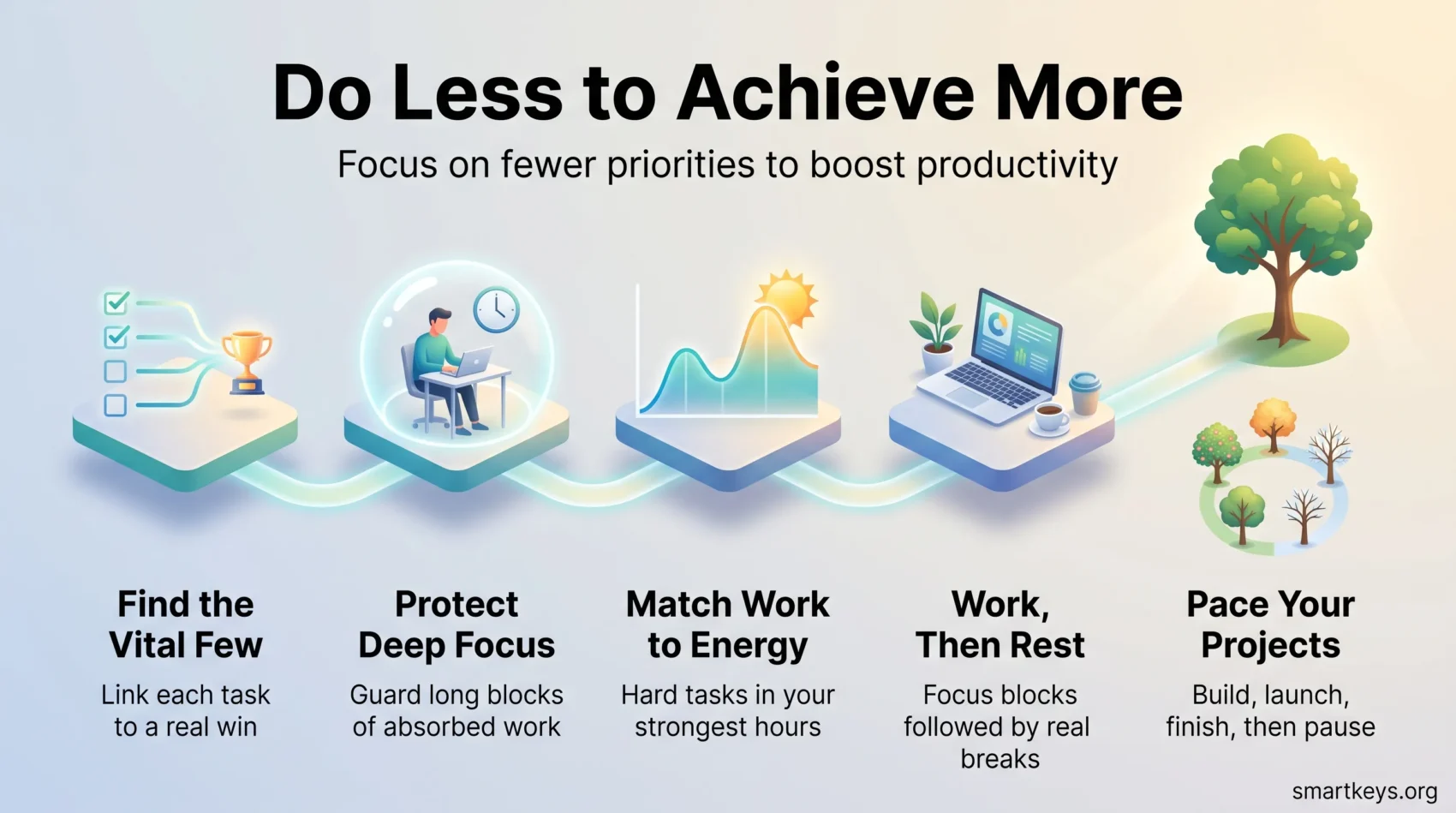
You cannot buy more Chronos. You can create conditions for more Kairos. In practice that means protecting a block long enough to get properly into a task, and defending it from meetings and messages. This is the same mechanism behind deep work, described in different language.
Small transitions help. A short pause between tasks, a walk before a hard piece of writing, a fixed way of starting the day. These are not rituals for their own sake. They are signals that tell your attention where to go next.
Cyclical Living: Planning Around Energy, Not a Fixed Template
Most planning tools assume every day is identical. You get the same grid on Monday as on Friday, and the same expectations in week one as in week three.
Northrup’s counter-argument is that energy moves in patterns, and that a fixed template quietly punishes you for the low points. Her framing draws on the menstrual cycle, the lunar month, and the seasons.
You do not have to accept the biological argument to use the practical part. The usable version is this: find out when your focus is reliably good and when it is reliably poor, then match the work to the window. Hard analytical work goes in the strong hours. Admin and email go in the weak ones.
Start with one week of observation. Note when concentration came easily and when it did not. Our guide to finding your productivity style is a useful companion here, and managing energy rather than time covers the same principle in more depth.
The Four Phases: Matching Task Types to Energy
The book maps four phases of the menstrual cycle onto the lunar month and the four seasons, then assigns a type of work to each. Here is the map, with the plain-language version of what each phase is for.
Menstrual, new moon, winter: rest and review
The lowest-energy phase. Northrup suggests reflection, strategy review, and quiet planning rather than visible output. This is a good window for asking whether a project is still worth doing.
Follicular, waxing moon, spring: generate and start
Follicular is the phase after menstruation, when energy typically rises. Use it for brainstorming, outlining, and starting things. New work feels lighter here than it will later.
Ovulation, full moon, summer: communicate and collaborate
The most outward-facing phase. Northrup puts calls, pitches, launches, and difficult conversations here, on the argument that social energy peaks alongside physical energy.
Luteal, waning moon, autumn: finish and refine
Luteal is the phase before menstruation. The book treats it as detail time: editing, checking numbers, closing loops. Fewer new ideas, more completion.
If you do not menstruate or track the moon, the structure still works. Substitute your own observed pattern. Many people run a weekly version instead: Monday for planning, midweek for focus, Friday for finishing and review. The point is that different work suits different states, not that the calendar has to be lunar.
Project Seasons: Pacing Work Without the Last-Minute Scramble
Northrup applies the same cyclical thinking to projects, splitting them into four stages.
Emergence is research and shaping. The work is invisible and feels slow, which is why it usually gets squeezed.
Visibility is launching and sharing. This is the phase most people think of as the whole project.
Culmination is finishing properly: fixing details, reviewing what the numbers say, tying off loose ends.
Fertile Void is the deliberate pause afterwards. No new project starts yet. The value is that the next Emergence begins from something you have actually thought about.
The practical claim is that skipping Culmination and the Fertile Void does not save time. It moves the cost. Rushed finishing produces rework, and starting the next thing while still depleted produces worse decisions. Teams that run projects back to back without a gap tend to see this as a mysterious drop in quality rather than a scheduling problem. Our guide to burnout prevention covers what that pattern does over a longer period.
Rest as Part of the Plan
The book treats recovery as a scheduled input rather than what is left over. Two specific practices come up.
Working in blocks with real breaks
The book points to a well-known figure from the time-tracking app DeskTime. Its 2014 analysis of user data found that the most productive 10% of its users worked in stretches of about 52 minutes, followed by roughly 17 minutes away from the screen (DeskTime).
Two caveats matter. This is observational app data, so it shows a pattern among productive users rather than proving the breaks caused the productivity. And DeskTime’s own later analysis found the ratio had drifted, reaching roughly 112 minutes of work to 26 minutes of break by 2021 as remote work changed habits.
The number is less important than the shape. Work in a defined block, then stop properly. A break spent scrolling on the same screen is not a break. Our summary of what the evidence shows on short breaks goes into the research, and structured downtime covers the longer-form version.
Yoga Nidra and deep rest
Yoga Nidra is a guided practice where you lie still and follow spoken instructions through a body scan, usually for 15 to 30 minutes. It is often described as producing the restoration of several hours of sleep. That claim is not supported by the current evidence.
A 2026 systematic review in Sleep and Breathing pooled the randomized trials and found effects that were large in size but not statistically significant, with the authors rating the certainty of the evidence as very low and calling the findings preliminary. Small samples and a narrow geographic base were the main limitations.
So it is worth trying and not worth claiming much about. If you want a rest practice with a stronger evidence base behind it, power naps are better documented.
The Vital Few: A Filter for Your To-Do List
The 80/20 rule, also called the Pareto principle, is the observation that a small share of inputs often accounts for a large share of results. Northrup turns it into an exercise rather than a slogan.
Take a sheet of paper. On the right, list your real wins from the last quarter: things that made money, moved a project, or mattered to you. On the left, list the tasks that fill your typical week. Then draw a line from each task to any win it contributed to.
Most tasks will have no line at all. The handful with several lines are your vital few. That is the whole diagnostic. To turn the result into a daily routine of three to five items, see our guide on how to work smarter, not harder.
What you do next is the harder part. For everything without a line, ask three questions in order. Does this need doing at all? Does it need doing by me? Does it need doing now? The answers point to deleting, delegating or outsourcing, and deferring.
Writing the discards down helps them stay discarded. A not-to-do list is a surprisingly effective way to stop the same task quietly reappearing, and a clear task management setup keeps the survivors visible.
Weekly Planning That Starts With Your Body
Northrup’s planning sequence inverts the usual order. Personal essentials go on the calendar first, work fits around them.
Step one: block the basics. Sleep, meals, movement, and one evening that belongs to you. These go in before any work commitments. The reasoning is that whatever gets scheduled last gets cut first, and these are the items that determine your capacity for everything else.
Step two: pick three priorities. Three for the week, not three per day. Give each a generous block rather than an optimistic one.
Step three: run everything else through the filter. Does it need doing at all, by you, right now? Anything that survives gets a slot. Anything that does not gets deleted, handed on, or moved.
Step four: review on Friday. Note what actually happened against what you planned. The gap is the useful information, because it tells you how much your week really holds.
Plan weekly rather than daily. A daily plan leaves no room for the unexpected, and something unexpected happens most days. Our weekly planning guide covers the mechanics, and the weekly review template gives you a structure for step four. If your three priorities keep changing, the problem is usually upstream in how the goals were set.
Asking for Help Early, Often, and Kindly
One of the book’s clearest experiments is about requests. Most people ask for help late, rarely, and apologetically. All three make it less likely to work.
Early means asking while the other person still has room to help. A request made during a crisis is really a demand.
Often means treating it as ordinary rather than exceptional. Small, regular requests build the kind of reciprocity that makes a bigger one easy.
Kindly means being specific enough that saying yes is simple. Name the task, the deadline, and why it helps. For example: “Could you take the client summary by Friday? That would free me to finish the proposal. I would appreciate it.”
The other half of asking well is declining well. If you cannot say no to incoming requests, delegating outgoing ones just adds to the pile. Our guides to saying no and setting boundaries cover the language for that.
Where the Book Falls Short
Two criticisms come up consistently, and both are fair.
It assumes flexibility not everyone has. Northrup writes as a business owner who controls her own calendar. Advice to move a meeting to a better week, or to pause a project, is not available to most salaried and hourly workers. Shift workers, people on fixed rotas, and anyone in a client-facing role will find whole sections inapplicable as written.
The lunar link is not evidence-based. The book connects the menstrual cycle to the phases of the moon. There is no good evidence for that connection. You can use the four-phase structure as a way of organizing task types without accepting the astronomical claim.
Neither criticism sinks the useful part. If your schedule is fixed, apply the ideas at the level you do control. Choose which of your existing hours get the hard work. Protect one recovery block a week. Run the 80/20 exercise on your own task list. Use time trades with colleagues where paid help is not an option.
Read the book the way it asks to be read: as a set of experiments, not a set of rules.
How to Test It in One Week
Pick one idea and run it for seven days. That is the whole method.
If your days feel fragmented, try the block-and-break pattern. If your list feels endless, run the wins-to-tasks exercise. If you are constantly behind, do one week of planning where personal essentials go in the calendar first.
Then check the result honestly. Keep what saved you time or reduced stress. Drop what added a layer of admin without paying for itself. If nothing changes after a fair test, that is information too, and it is cheaper than adopting a whole system on faith. Where the obstacle turns out to be starting rather than planning, our guide to overcoming procrastination is the better place to look.
Found this useful?
Make SmartKeys a preferred source on Google, and our articles will surface more often in your Top Stories, AI Overviews, and AI Mode.
Add as Preferred Source