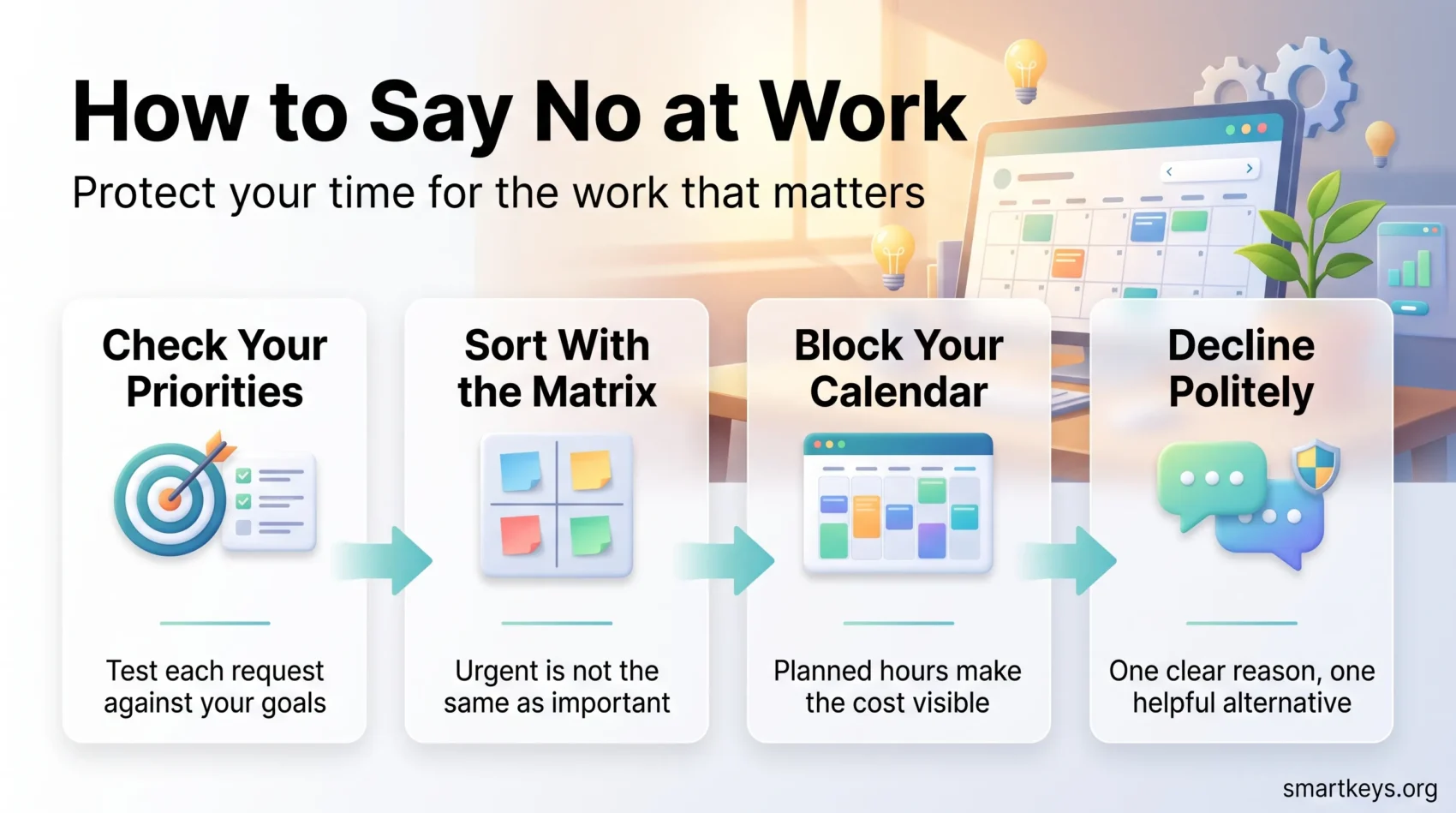
Saying no is one of the most useful productivity skills you can learn, and one of the least practiced. Most of us say yes to meetings, favors and side projects because refusing feels rude. Weeks later, the calendar is full and the important work is late. Learning to say no turns that around. Every request you decline hands you back time for the work that actually matters.
Each yes is a loan against your future time, and a full calendar is the interest. Steve Jobs put it plainly at Apple’s developer conference in 1997: focus does not mean saying yes to the thing you care about. It means saying no to the hundred other good ideas. This article explains why saying no is so hard, how to decide what deserves a yes, and how to say no at work politely, without damaging relationships. For the bigger picture of how work and personal time are being rebalanced, see our guide to the changing shape of work-life balance.
Key Takeaways
- Overcommitting is the most common reason good people miss their own priorities.
- Saying no keeps control of your time and energy in your hands instead of your inbox.
- Turning down good opportunities is what creates room for the great ones.
- A quick test helps: “If I had to do this today, would I still agree to it?”
- A clear, polite no costs less than a reluctant yes you later have to walk back.
- Fewer commitments mean less stress, better focus and a more sustainable workweek.
Why Saying No Is a Time Management Skill
Time management is usually taught as a set of planning tools: lists, calendars, priorities. Those tools only work if the list is realistic. Saying no is what keeps it realistic. It decides what gets onto the list in the first place. That is why it belongs at the start of any time management routine, not at the end.
The pressure on that list has grown. Microsoft’s 2025 Work Trend Index, based on Microsoft 365 usage data, found that the average employee is interrupted every two minutes during core working hours. Meetings after 8 pm were up 16 percent year over year. When demands arrive that often, the only way to protect a working day is to refuse a good share of them.
Creating Room for Growth
Nobody has a free afternoon to learn a new skill or think about their career. That time has to be made by declining something else. A few habits help once the space exists:
- Break big goals into small steps so that a spare hour is enough to make progress. Our guide to breaking large goals into achievable steps shows how.
- Work in short, focused intervals, such as the Pomodoro Technique of 25 minutes on and 5 minutes off.
- Notice when your energy peaks and reserve those hours for demanding work rather than for other people’s requests.
Growth time is the first thing cancelled when you have said yes to too much.
Protecting Yourself Against Burnout
Burnout is what happens when demands stay higher than your capacity for months at a time. Long hours are its most measurable form. In 2021 the World Health Organization and the International Labour Organization published a joint study on working hours. It linked 55 or more hours a week to a 35 percent higher risk of stroke and a 17 percent higher risk of dying from heart disease, compared with a 35 to 40 hour week. The study attributed about 745,000 deaths in a single year to long working hours.
Those hours rarely come from one big decision. They come from dozens of small yeses. Three habits reduce the load:
- Take real breaks during the day. Even short breaks restore focus better than pushing through.
- Cut interruptions by managing your notifications instead of reacting to each one.
- Delegate what someone else can do. Delegating is a form of saying no to work that does not need you. See our guide to effective delegation.
Managing your time well is not about fitting more in. It is about keeping the workload at a level you can sustain. Our article on burnout prevention covers the warning signs and what to change first.
What Saying No Actually Means
Saying no is not about being difficult. It is about being clear on where your time goes. When you decide what you are willing to take on, you draw a boundary. Everything inside it gets your full attention. Everything outside it gets a polite refusal or a referral to someone else.
Yes and no are the same decision seen from two sides. Agreeing to a Friday workshop means refusing the report you planned to finish that day. Once you see every request that way, the question changes. It stops being “can I fit this in?” and becomes “what am I giving up to fit this in?”
Boundaries Improve Focus
Clear limits protect you from drift. Without them, the day fills with other people’s urgencies and your own work slides into the evening. James Clear, the author of Atomic Habits, calls saying no the ultimate productivity hack. His reasoning is simple: a no costs you the moment, while a yes costs you the time it takes to deliver. Our guide to setting boundaries at work goes deeper on where to draw the lines.
Why Yes Comes So Easily
Most of us are trained from childhood to be agreeable. Refusing a colleague feels like a small social risk, so we avoid it and pay later with our time. Two ideas make the decision easier. The first is Derek Sivers’ “Hell yeah or no” rule: if a request does not make you think “hell yeah”, the answer is no. The second is a quick test: “If I had to do this today, would I still agree?” A yes that only works because the deadline is far away is usually a no in disguise.
Prioritization: Deciding What Deserves a Yes
Saying no well depends on knowing what matters. Prioritization means ranking tasks by how much they contribute to your goals. It gives you a defensible reason for every refusal: instead of “I don’t feel like it”, you can say “that would push back the launch”. Our guide to the art of prioritization covers the main methods.
Using the Eisenhower Matrix
The Eisenhower Matrix, named after the former US president, sorts tasks into four boxes: urgent and important, important but not urgent, urgent but not important, and neither. The first box gets done now. The second gets scheduled. The third gets delegated, and the fourth gets dropped. Most requests from other people land in the third or fourth box, which is exactly where a no belongs. Our walkthrough of the Eisenhower Matrix shows how to apply it to a real week.
Urgent Is Not the Same as Important
Urgent tasks demand attention now. Important tasks move you toward a goal. The two overlap less than most people assume. A colleague’s “quick question” is urgent to them and rarely important to you. Once you can tell the difference, you can decline urgent-only requests with a clear conscience.
Time Blocking: Giving Your No a Calendar
Time blocking means assigning specific tasks to specific hours in your calendar instead of working from an open list. It is the practical partner of saying no. If your calendar already shows two hours of report writing on Tuesday morning, a meeting request for that slot has a visible cost. Declining it becomes easy to justify. Our guide to time blocking explains how to set up your first week.
Dividing the Day into Segments
Time blocking turns a chaotic day into a sequence of planned segments. Cal Newport, the author of Deep Work, has estimated that a 40 hour time-blocked week produces roughly the output of a 60 hour week without structure. The exact ratio varies from person to person, but the point holds. Planned hours produce more than reactive ones, because reactive hours go to whatever arrived last. Blocking time also cuts the number of decisions you make: you decide once in the morning rather than fifty times during the day.
Less Multitasking, More Focus
Multitasking is mostly task switching, and every switch costs time while the brain reorients. Grouping similar tasks into one block, a practice called batching, removes many of those switches. Day theming (Mondays for planning, Tuesdays for client work) and timeboxing (a fixed time limit per task) build on the same idea. Our articles on why multitasking hurts productivity and task switching cover the research.
Overcoming the Fear of Saying No
Most people who struggle to say no are not disorganized. They are afraid of disappointing someone or damaging a relationship they depend on. Naming that fear is the first step. The second is noticing that the feared reaction rarely happens. Most colleagues accept a clear no more easily than a late or half-finished yes.
Social Pressure and Busyness
Many workplaces treat a full calendar as proof of commitment, so declining anything feels like opting out. But being busy and being useful are not the same thing. The people who deliver the most are usually the ones who protect their time most carefully. Once your commitments line up with the goals you have agreed with your manager, saying no to everything else is consistency, not confrontation.
How to Decline Politely
A good no is short, honest and leaves the door open. Three habits make it easier:
- Be clear and kind. Say what you cannot do and, briefly, why. Long explanations invite negotiation.
- Offer an alternative when one exists: a later date, a smaller version of the task, or a colleague with capacity.
- Practice assertiveness, which means stating your position calmly without apologizing for having one. Our guide to clear communication has practical wording.
Over time, colleagues learn that your yes is reliable because your no is honest. That reputation is worth more than the goodwill from any single favor.
Why Saying No Makes You More Productive
Every refusal is a decision about where your attention goes. People who make those decisions deliberately end up with calendars that reflect their priorities. People who do not end up with calendars that reflect everyone else’s.
Keeping Control of Your Time
There are two kinds of workers: schedule makers and schedule takers. Schedule makers, often knowledge workers like managers and analysts, have real control over how their day is arranged. That freedom is only useful if they exercise it. A schedule maker who accepts every meeting invite has quietly become a schedule taker.
Avoiding Time Debt
Time debt is the gap between what you have promised and what you can deliver. Like financial debt, it accumulates quietly and then arrives all at once, usually in the same week. The goal is not to refuse everything. It is to make each decision with the future week in view. A useful habit is a not-to-do list: a short written record of the requests you have decided to decline, so you do not re-argue the case each time.
Learning from People Who Say No Well
The clearest examples come from people whose work depended on focus. They had decided what mattered and treated everything else as a distraction.
Steve Jobs and Focused Decision-Making
When Jobs returned to Apple in 1997, one of his first moves was to cut the product line down to a handful of models. He told developers that year that focus means saying no to the hundred other good ideas. He added that he was as proud of the things Apple had not done as the things it had. The lesson applies to a working week as well as to a company: saying no to good options is what makes the great ones possible.
How Focused People Manage Commitments
People who protect their time connect every request to a specific goal before answering. They talk openly with their team about what a yes will cost, so the trade-off is visible. Our article on doing less to achieve more shows how that works in practice.
Strategies for Learning to Say No
Saying no is a skill, and skills improve with practice. The strategies below work because they move the decision out of the emotional moment and into a rule you set in advance.
Set Personal Limits
Decide your limits before the requests arrive:
- Evaluate every request against your current priorities before answering, even if it means saying “let me check and get back to you”.
- Tell colleagues what you are working on this month, so they understand your constraints.
- Give one honest reason when you decline. One reason is credible; five sound like excuses.
- Offer an alternative where you can, so the no still moves the other person forward.
Practice Assertiveness Daily
Assertiveness means stating your position calmly, without aggression and without apology. It gets easier with repetition:
- Prepare two or three standard phrases in advance, so you are not improvising under pressure.
- Listen to the full request before answering. A considered no lands better than a reflexive one.
- Stay calm and warm when you decline. The tone matters more than the wording.
- Ask a mentor or trusted colleague for a second opinion when a decision is difficult.
Long-Term Benefits of Saying No
The payoff compounds. In the first week, you notice an emptier calendar. Over a quarter, the important projects finish on time. Over a year, you are less tired, more focused and better at your job.
A Better Work-Life Balance
Work-life balance is mostly a question of where the hours go. Saying no at work keeps evenings and weekends free, because the work that would have spilled into them was never accepted. That time goes to rest, family and learning, which in turn make the working hours more productive. If late requests are the main problem, our guide to the right to disconnect after hours explains what you can and cannot refuse.
Better Mental Health and Focus
An overloaded schedule shows up as poor concentration, irritability and a constant sense of being behind. With fewer commitments, each one gets your full attention, which is both more productive and less stressful. Our guide to stress management at work covers the rest.
How to Communicate Your No
The wording matters. A blunt refusal damages relationships and a vague one gets ignored. Aim to be clear about the decision and warm about the person.
Keep It Clear and Respectful
Use plain language and do not bury the no. “I appreciate you thinking of me, but I need to stay focused on the product launch this month” does the job. It states the decision, gives one reason and shows respect. Avoid “maybe” or “I’ll see” unless you mean it. A soft no often turns into an unwanted yes.
Offer Alternatives When You Can
An alternative softens the refusal and still helps the other person. For example: “I can’t take this on this week, but Sarah has covered this area before and may have capacity.” Or: “I can’t do the full analysis, but I can spend 20 minutes on your draft on Thursday.” Both protect your time and keep the relationship intact. Our guide to deep work explains how to use the focus time your no has protected.
The Role of Mentorship
A good mentor makes saying no easier in two ways. First, they have faced the same pressure and can tell you which refusals cost them nothing and which they regretted. Second, they give you permission. Hearing an experienced colleague say “you should decline that” removes much of the guilt. When a request feels impossible to refuse, describing it to someone outside the situation often reveals that it is quite refusable. If your company has no formal program, mentorship matching platforms and internal networks can fill the gap.
The effect spreads. When a team lead declines a low-value meeting and explains why, the rest of the team learns that it is allowed. Over time, that creates a culture where people commit to less and deliver more of it.
Conclusion
Learning to say no is one of the highest-return skills in productivity. It protects your time for the work that matters, keeps your workload sustainable and gives your yes real value. The tools in this article, from the Eisenhower Matrix to time blocking to a few prepared phrases, all serve one purpose: making the decision before the pressure arrives.
The WHO and ILO evidence on long working hours shows that overcommitment is a physical problem, not only a productivity one. Saying no earlier is how you avoid paying for it later.
Start small. Decline one low-value request this week, explain it briefly and notice what happens. In most cases nothing happens, except that you get the hour back. That hour is where your best work lives.
Found this useful?
Make SmartKeys a preferred source on Google, and our articles will surface more often in your Top Stories, AI Overviews, and AI Mode.
Add as Preferred Source