You deal with a lot each day, and simple choices make the difference between busy work and real progress.
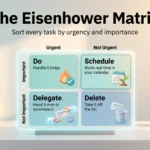
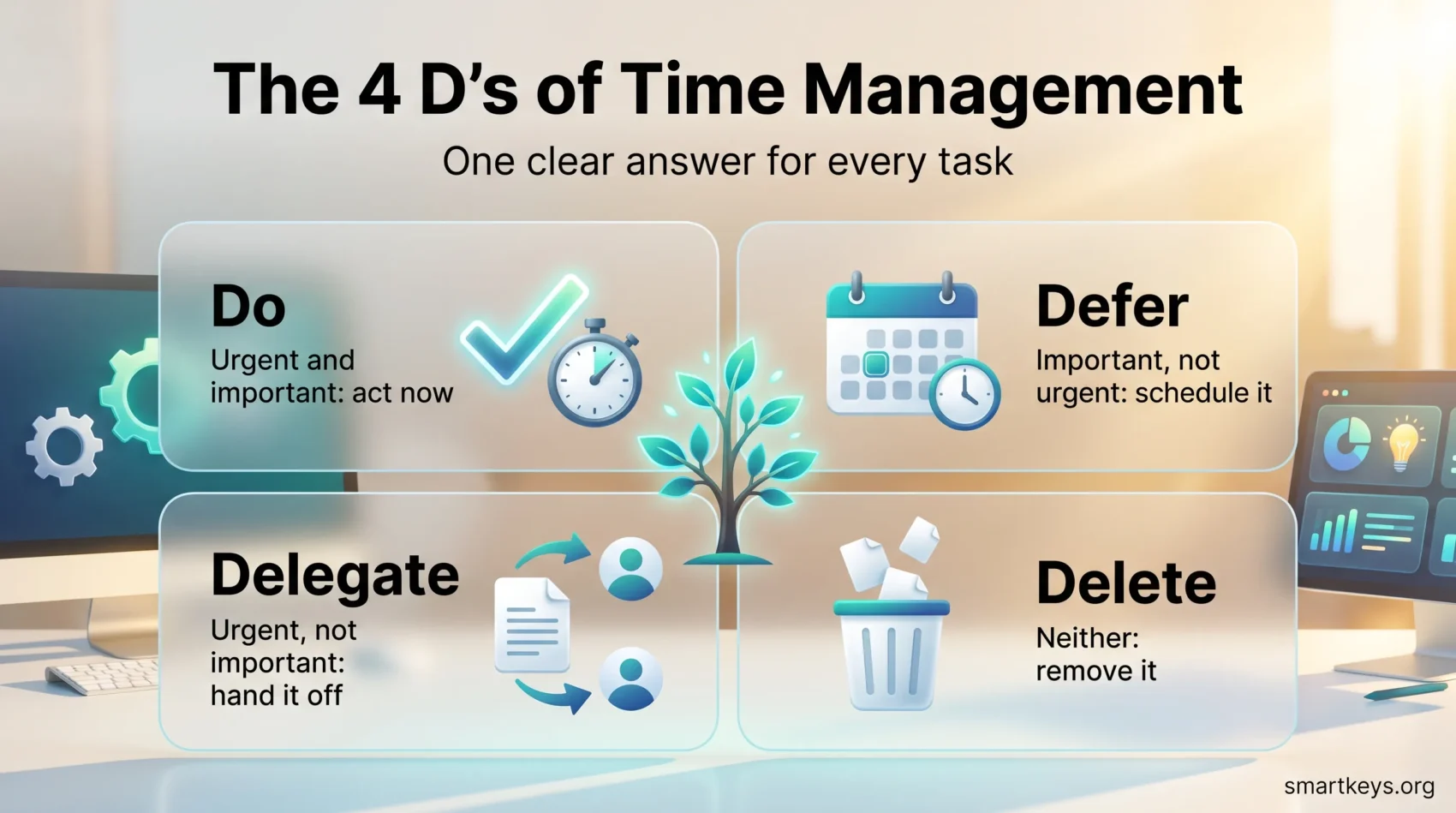
The 4 D’s give you four possible answers for every task that lands on your plate: do it, defer it, delegate it, or delete it. Nothing else. That constraint is the whole point, because most people lose time deciding what to decide.
The framework is a plain-language version of the Eisenhower Matrix, a prioritization grid that sorts work by two questions: is it urgent, and is it important. The idea goes back to a 1954 address by Dwight D. Eisenhower in Evanston, Illinois, where he quoted an unnamed former college president: “I have two kinds of problems, the urgent and the important. The urgent are not important, and the important are never urgent.” Eisenhower was repeating someone else’s line, not coining his own, and the grid itself was named after him much later.
Why does this matter now? Because attention is scarcer than it used to be. Gloria Mark, a professor of informatics at UC Irvine who has measured screen behaviour for two decades, found that office workers stayed on one screen for about two and a half minutes in 2004. In her more recent measurements that figure had dropped to roughly 47 seconds. She also found it takes around 25 minutes to get back to a task after attention moves away from it. A day full of small, unsorted decisions burns that budget fast.
Read on for a practical walkthrough so you can classify your workload, protect focus, and apply a repeatable process today.
Key Takeaways
- Every task gets exactly one of four answers: do, defer, delegate, or delete.
- Urgency and importance are different questions. Sorting by both stops reactive work.
- Deleting is an active decision, not neglect. It is what creates room for the rest.
- The framework scales from a personal to-do list to a team roadmap.
- Run the sort daily. It takes five minutes and it protects the other seven hours.
What you will accomplish with the 4 D’s today
Start your day by turning a messy list into a short plan you can actually finish. You clear low-value items, hand off work that someone else can own, park non-urgent projects with a note explaining why, and act on the few tasks that matter most.
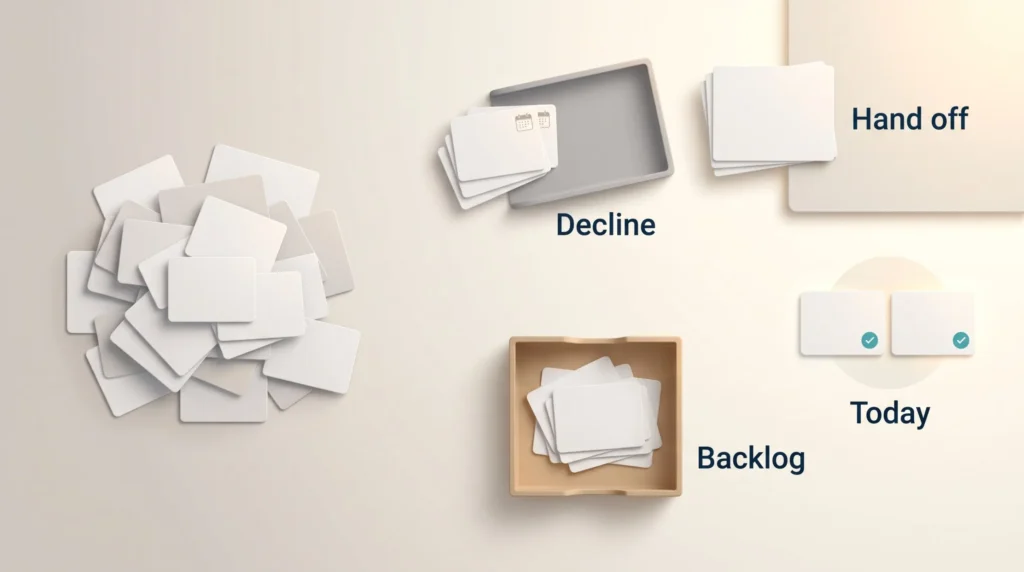
Here is what that looks like in practice. A team lead opens a list of 22 items on Monday morning. Six are meeting invitations without an agenda, and she declines four of them. Five are routine reports, and she hands them to a colleague who already has the data. Nine are project ideas with no deadline, so they go into a backlog with a review date. That leaves two tasks for the day, and both get finished.
Teams gain something similar: a shared vocabulary for saying no. When everyone uses the same four words, a request that gets deferred no longer reads as a personal snub. It reads as a decision with a reason attached.
“A short planning routine stops reactive work and channels energy into what moves the needle.”
- Build a short plan with one or two do-now items instead of an aspirational list of twelve.
- Cut noise so the hours you spend line up with the goals you were hired against.
- Delegate and defer without creating a bottleneck three weeks from now.
- Keep a light planning rhythm so momentum builds across the week.
For a broader set of time management tips you can apply right away, sort your list every morning and block focused stretches for the top items.
The framework at a glance: how the 4 D’s map to urgency and importance
Urgent means it has a deadline pressing on it. Important means it moves a goal you actually care about. Those two things feel the same in the moment, which is why so many days fill up with work that was loud rather than valuable.
The Eisenhower Matrix splits work into four boxes, and each box has one obvious action:
- Urgent and important: do it. The client contract that expires Friday.
- Urgent but not important: delegate it. The recurring status report someone else can compile.
- Important but not urgent: defer it, with a date. The hiring plan for next quarter.
- Neither: delete it. The newsletter you skim and never act on.
The same grid works at team level. Product groups use it to trim backlogs, to run planning sessions, and to explain why a request did not make this sprint. If you want to compare it with other scoring systems, see this overview of task prioritization frameworks.
Delete: remove low-value tasks to reclaim focus
Deleting is the step people skip, and it is the one that creates capacity. Everything else just moves work around.
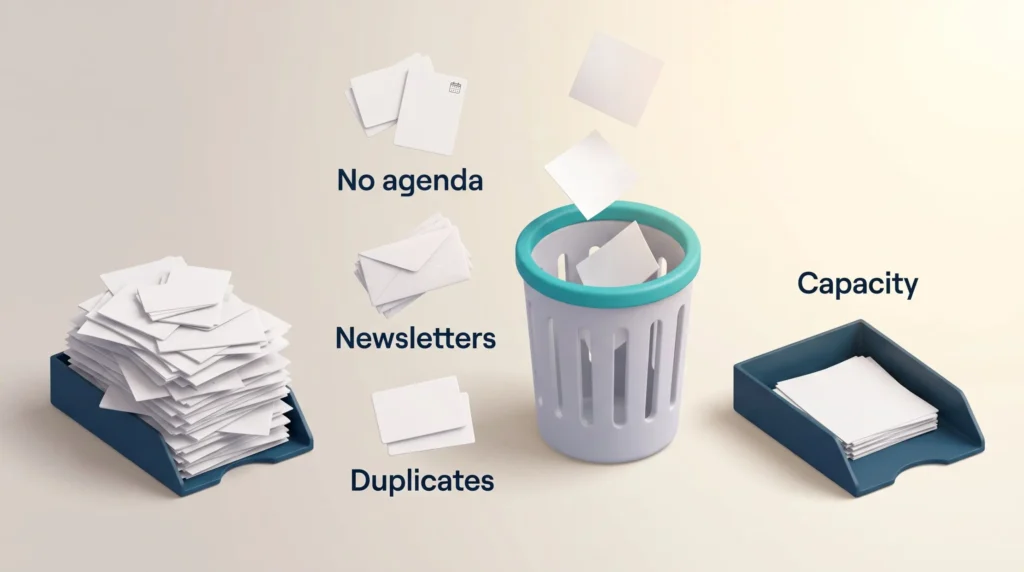
- Skip or shorten meetings with no agenda. A written update in a shared channel often replaces a 30-minute call.
- Archive newsletters and notification emails in bulk instead of triaging them one by one.
- Decline requests that duplicate work already in progress somewhere else.
Signals a task does not belong on your list
Three signs are usually enough. The task does not connect to any stated priority. Nobody can name what changes once it is done. Or someone else is already covering the same ground. A running not-to-do list makes these easier to spot the second time they appear.
A quarterly meeting audit is the fastest version of this. Look at every recurring meeting in your calendar and ask what would break if it stopped for a month. Most of the answers are uncomfortable.
How to say no gracefully
Keep it short and offer a route forward. “I can’t take this on this month, but I can send you the template I use” preserves the relationship and protects the week. Naming your current priority does most of the work, because it turns a refusal into a trade-off the other person can see. There is more on this in our guide to saying no without damaging relationships.
Delegate: assign work to the right people at the right time
Delegation moves ownership closer to whoever can act fastest. Done well, it frees your attention and grows someone else’s range at the same time.
What to hand off
Start with work that is repeatable and documented: invoicing, weekly reporting, scheduling, data pulls, first-draft research. These are good candidates because success is easy to describe and easy to check. Work that needs your specific judgment or authority stays with you. If nobody on the team has the bandwidth, outsourcing the task is often cheaper than doing it badly at 9pm.
How to delegate clearly
Hand over the outcome, not the keystrokes. Say what “finished” looks like, when it is due, what the person is allowed to decide alone, and where to escalate. A one-paragraph brief plus a link to last month’s version beats a 20-minute walkthrough. Then check in at agreed points rather than hovering. Our guide to effective delegation covers the handover in more detail.
Team-level benefits
Spreading decisions out shortens the queue. When three people can approve a routine request instead of one, work stops waiting on a single calendar. Teams that delegate well also develop faster, because stretch assignments are how most people learn the next role.
- Match tasks to strengths, not just to whoever answered first.
- Agree what “done” means before the work starts, not during review.
- Use stretch assignments deliberately, with support attached.
- More on this in our guide to delegating work for better productivity.
Defer: schedule valuable work that does not need attention now
Deferring is a scheduling decision, not a way of avoiding something. The difference is whether the task lands somewhere you will actually look again.
Good candidates to defer, and fake urgency to ignore
Defer work that is genuinely important but blocked on information, budget, or a decision that has not been made yet. Rewriting the onboarding documentation is a fair example: valuable, not time-critical, better done once the new tool is chosen.
Fake urgency looks different. A notification badge, an unread count, a message marked important by its sender rather than by its content. These pull attention without changing an outcome. Turning off non-essential work notifications removes most of them at the source.
Defer without procrastinating
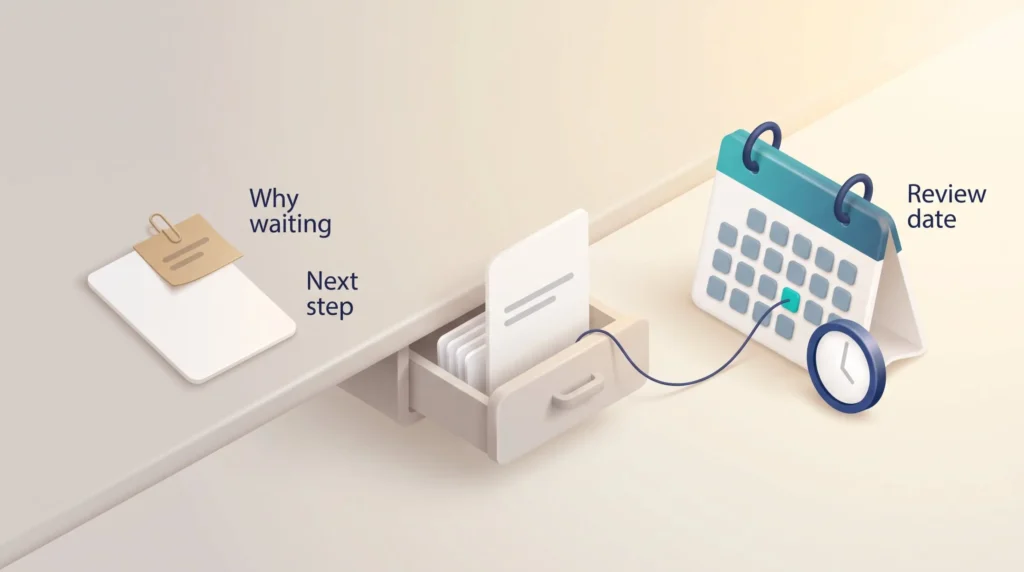
A deferred task needs three things written down: why it is waiting, what the next concrete step is, and when you will look at it again. Without those, “later” means “never” and you rediscover it as a crisis. A weekly planning session is where deferred items get reviewed and either promoted, rescheduled, or deleted.
- Separate important-but-not-urgent work from noise so attention stays where it counts.
- Record context, next step, and review date for anything you park.
- Put the review in your calendar. An unreviewed backlog is a list of regrets.
- Move non-urgent items off today’s list so deep work blocks survive.
Do: act on important tasks that need attention now
The “do” step is where the plan turns into output. Commit to a small number of items, clear the blockers, and finish them.
Quick wins, time blocking, and defining “done”
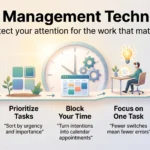
Pick one to three important tasks and give each a protected block. Switching between them costs more than people expect, given how fast attention moves in a normal working day. Time blocking is the simplest defence: the work has a slot, and the slot is visible to everyone who might interrupt it.
Define “done” before you start. “Draft sent to Maria for review” is a finish line. “Work on the proposal” is not, which is why proposals expand to fill whatever time is left.
- Handle anything under two minutes on the spot. The two-minute rule keeps small items from accumulating into an afternoon of admin.
- Work in short sprints and treat the block as a commitment, not a suggestion.
- Clear blockers early. Book the meeting, request the file, or escalate the dependency before it costs you a day.
End the day with something visibly finished. That is what makes the habit stick.
4Ds time management in your daily workflow
The framework only pays off if it becomes routine. Here is how to fit it into a normal week.
Build a list you will actually use
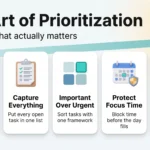
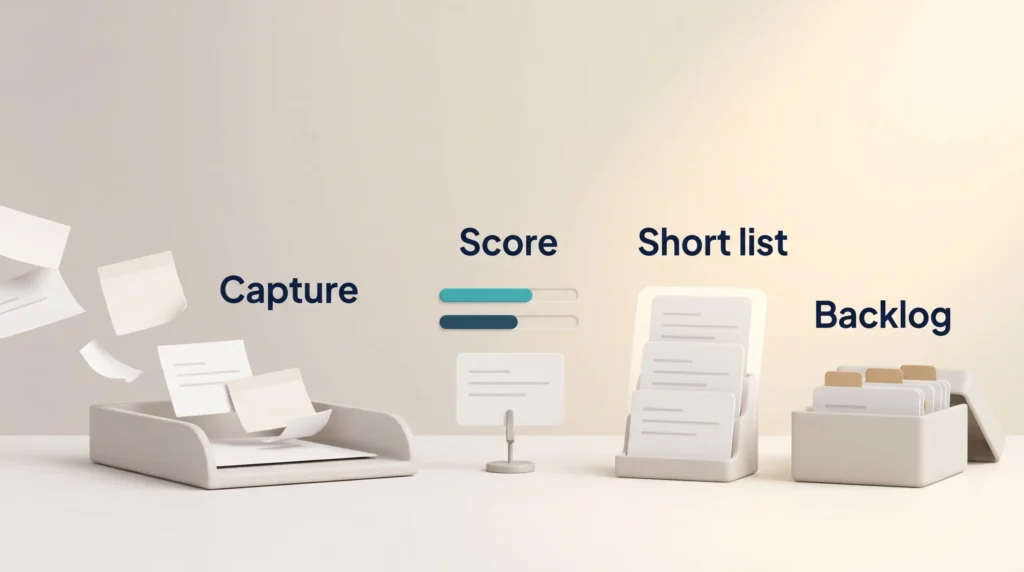
Capture everything in one place first. Trying to sort tasks while half of them live in your head is what makes prioritization feel hard, so start with a brain dump or a proper capture habit.
Then score each item on two things: how much it moves a goal, and how much effort it takes. Keep the top few on today’s list. Everything else goes to a backlog with a note. Our guide to task management covers the mechanics of keeping that list current.
Plan your day and week
Map the week before it starts. Flag dependencies, deadlines, and the meetings that genuinely affect delivery. Cluster meetings into a block or two so the rest of the week has room for concentrated work. A shared focus time policy makes those blocks defensible across a whole team.
Team strategy: align work with goals
Priority dilution happens when a team says yes to everything and finishes nothing. The fix is to connect each request to a stated objective, out loud, in front of the people making the request. When the criteria are visible, prioritization stops being about who asked most insistently. Tie the criteria back to goals you have actually set rather than to a general sense of what feels important.
“A short, scored backlog makes prioritization fast and defensible.”
Common pitfalls and how to fix them
Treating everything as urgent
This is the most common failure. Every request arrives flagged, so nothing is prioritized and the loudest voice wins the day. Apply the two questions before responding, and let the answer decide. A useful test: if this were due next Thursday instead of today, would anything actually change?
Over-delegating or under-delegating
Hand off too much and quality slips, because nobody has the context. Hand off too little and you become the bottleneck for your own team. The balance point is usually this: delegate execution, keep the decisions where your judgment changes the outcome.
Sorting once and calling it done
Priorities move. A framework applied once in January is a memory by March. Run a two-minute triage each morning and a slightly longer review each week. Pair it with clear boundaries on when you respond to messages, so new work arrives in batches rather than continuously.
“Stop reacting. Use simple criteria, document decisions, and make trade-offs explicit.”
Conclusion
Small, repeatable choices protect focus and move big projects forward. Delete the low-value asks. Delegate what someone else can own. Defer with a reason and a date. Do the few things that genuinely need you.
The value is not in the four words. It is in making the decision once, explicitly, instead of carrying every open item around all day. Keep a short list you trust, review it regularly, and let the framework take the weight of deciding.
Found this useful?
Make SmartKeys a preferred source on Google, and our articles will surface more often in your Top Stories, AI Overviews, and AI Mode.
Add as Preferred Source