Most people do not lose their day to a lack of effort. They lose it to a lack of order. Task prioritization frameworks are the structured rules that decide which work gets your attention first. Used well, they help teams concentrate on high-value work, spread workloads more evenly and cut the stress of never knowing what matters most.
The pressure on attention is measurable. Microsoft’s 2025 Work Trend Index special report found that employees are interrupted every two minutes during core hours by a meeting, email or notification, receive 117 emails a day and see 57% of meetings arrive as ad hoc calls with no invite. In a day shaped like that, an unprioritized list is a record of everything you did not get to.
The frameworks worth using are old, well documented and free. This guide covers what they are, which one fits which kind of work, and how to run one without turning prioritization into another meeting.
Key Takeaways
- Task prioritization frameworks rank work by agreed criteria instead of by whoever asked most recently.
- Personal frameworks such as the Eisenhower Matrix and the Ivy Lee Method suit individual workloads; MoSCoW, RICE and Kano are built for teams and roadmaps.
- RICE gives a single comparable score: Reach times Impact times Confidence, divided by Effort.
- RICE vs MoSCoW: MoSCoW fits a fixed deadline where scope has to flex; RICE fits fixed capacity and a long list of candidates.
- A framework only works if the inputs are honest. Weak estimates produce confident nonsense.
- Priorities decay. Schedule a short review rather than treating the list as settled.
Why Teams Need a Prioritization Framework
Effective task prioritization used to be a personal habit. In most teams it is now closer to an operating requirement, because requests arrive faster than anyone can answer them. If you want the general principles first (urgency versus importance, the 80/20 pattern, delegating and saying no), start with our guide to the art of prioritization. This article covers the next step: choosing a formal framework and running it.
The Cost of a Fragmented Day
Every item you have not consciously deprioritized still competes for attention. Deciding in advance what will not get done today is what makes deep work possible, and time blocking then gives the top-ranked items a protected slot in the calendar.
Common Challenges in Task Management
Prioritization fails in predictable ways. Teams lack a shared definition of “important”, so every stakeholder ranks by their own department’s needs. Workloads are assigned without visibility into what someone already carries. Estimates of effort are optimistic, a bias so consistent it has its own name in the research literature, the planning fallacy. And urgent requests arrive with more social pressure than important ones, so they win by default.
None of these are solved by working harder. They are solved by agreeing on criteria before the next request arrives, and by making the ranking visible enough to challenge. Solid task management habits give the framework something to operate on.
What Are Task Prioritization Frameworks?
Task prioritization frameworks are structured methods for ranking work against explicit criteria such as urgency, value, effort, reach or customer impact. Instead of debating each item on its own terms, you apply the same test to everything and compare the results.
Definition and Purpose
Every framework does two things. It forces you to name the criteria that matter, and it produces an ordering you can explain to someone else. That second part is what makes frameworks useful in teams: a ranking nobody can justify gets relitigated at every meeting.
They differ mainly in what they optimize for. Some sort by urgency and importance, some weigh value against cost, some measure customer satisfaction. Picking the wrong one means ranking by a criterion your organization does not actually care about.
Key Benefits of Using Frameworks
- Shared language: a common vocabulary for evaluating work, so cross-team debates are about the inputs rather than about taste.
- Reduced bias: explicit criteria make it harder for the loudest voice or the newest request to dominate.
- Transparency: anyone can see why an item ranked where it did, which makes the ranking easier to trust and easier to correct.
- Better resource allocation: effort goes to work with the highest expected return rather than to whatever was already in progress.
The Main Task Prioritization Frameworks
It helps to split the field in two. Some methods are built for one person’s workload. Others are built for teams choosing between competing pieces of work.
Frameworks for a Personal Workload
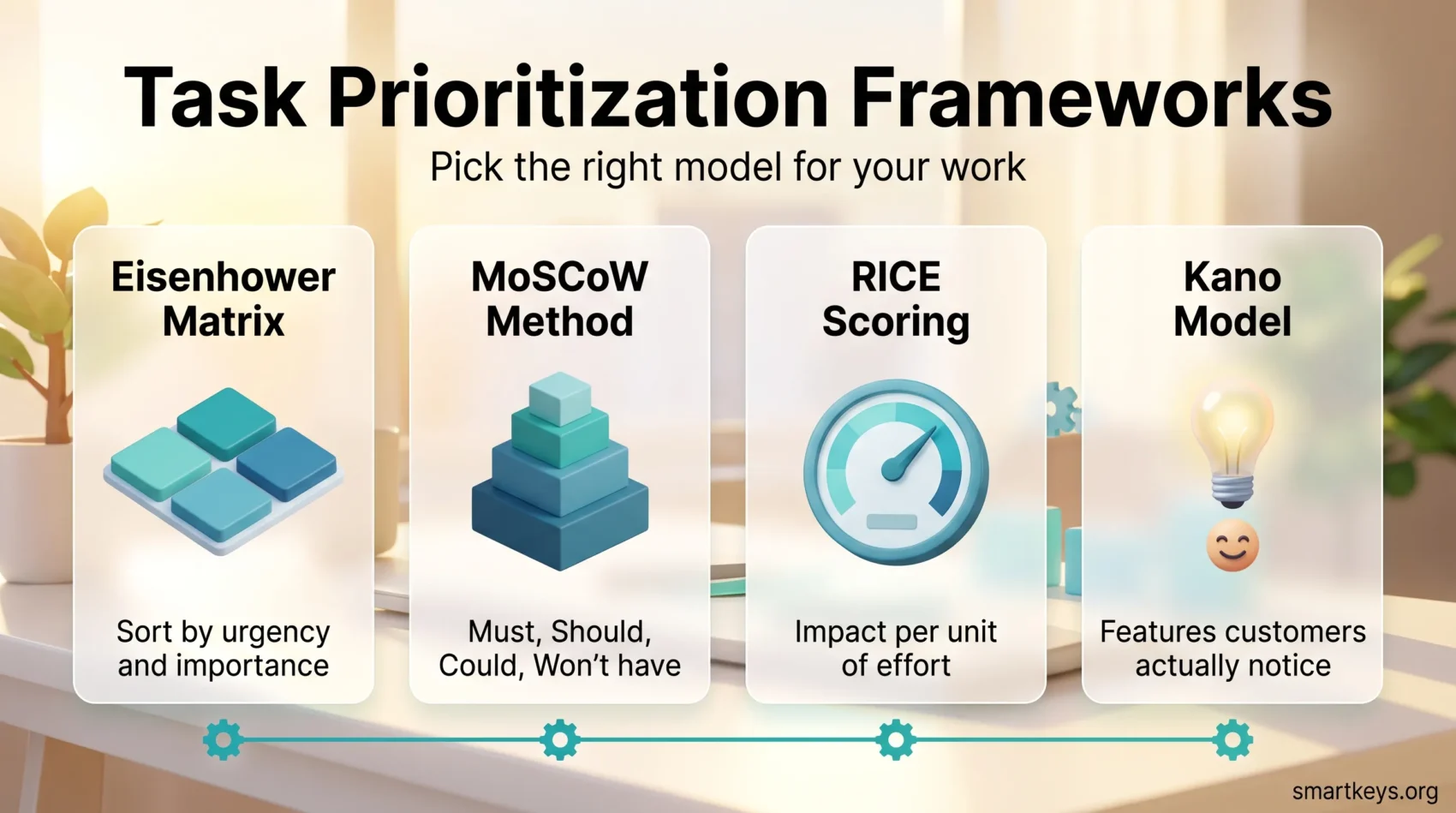
- Eisenhower Matrix: sorts tasks into four quadrants by urgency and importance. Popularized by Stephen Covey, it is most useful for exposing how much of your week sits in “urgent but not important”.
- Ivy Lee Method: six tasks for tomorrow, ranked, worked strictly in order. The constraint is the point.
- The 1-3-5 Rule: one large task, three medium, five small. A realistic shape for a day rather than an aspirational one.
- Eat the Frog: put the task you are most likely to avoid first, before the day fills up.
- The Pareto Principle: a heuristic, not a law. It prompts the right question: which small share of this list produces most of the result?
Frameworks for Teams and Roadmaps
- MoSCoW: sorts requirements into Must have, Should have, Could have and Won’t have. Developed by Dai Clegg in 1994 for rapid application development and used extensively with the Dynamic Systems Development Method, it pairs naturally with a fixed deadline: when the timebox cannot move, the scope has to.
- RICE: created at Intercom by Sean McBride and published in 2018. Score each item on Reach (people affected in a set period), Impact (3 for massive down to 0.25 for minimal), Confidence (100%, 80% or 50%) and Effort in person-months, then calculate Reach times Impact times Confidence divided by Effort. The output is impact per unit of work.
- ICE: a lighter cousin of RICE using Impact, Confidence and Ease. Faster to run, and correspondingly cruder.
- Kano Model: introduced by Noriaki Kano in the 1980s. It classifies features by how they affect satisfaction: must-be qualities that are only noticed when missing, one-dimensional qualities where more is better, and attractive qualities that delight but are not expected.
- Value vs. Effort Matrix: plots each item on two axes to surface quick wins in the high-value, low-effort corner and to make big bets visible as deliberate choices.
- Cost of Delay: asks what it costs per week to not ship something. Useful when several items are all valuable and the real question is sequencing.
Choosing the Right Framework for Your Needs
Three questions narrow the field quickly:
- Whose list is it? A personal day needs a fast heuristic. A shared roadmap needs a scoring model people can audit.
- What is scarce? If time is the binding constraint, MoSCoW and Cost of Delay fit. If engineering capacity is scarce, RICE surfaces the trade-off directly.
- How good is your data? RICE and Kano assume you know something real about reach and customer response. Without that, a simpler matrix is more honest than a precise-looking score.
Running two competing frameworks on the same list is usually a mistake. Pick one, use it for a full cycle, and change only if it consistently produces rankings the team refuses to act on.
RICE vs MoSCoW: Which One Fits Your Backlog?
These two are the most common choice for product and project teams, and they answer different questions. MoSCoW is categorical: it tells you what must ship by a fixed date and what can slip. RICE is numeric: it compares candidates of very different size by estimated impact per unit of effort.
Use MoSCoW when the deadline is fixed and the argument is about scope. Use RICE when capacity is fixed and the argument is about which of many ideas to build next. The two can also work in layers, because they rank at different levels: MoSCoW sets the scope of a release, then RICE orders the Should and Could items inside it.
Putting a Framework Into Practice
Effective task prioritization is a routine, not a one-time exercise. The sequence below works for a personal list and for a team backlog.
A Step-by-Step Process
- Capture everything first. You cannot rank a list you cannot see. Get every commitment out of your head and into one place before you sort anything.
- Choose one framework and write down the criteria, so the next person to add an item knows what it will be judged on.
- Score and analyze. Apply the framework item by item. Where estimates are guesses, record them as guesses rather than laundering them into a decimal.
- Communicate the result. Share the ranked list, including what fell below the line. The items you are not doing carry as much information as the ones you are.
- Re-assess on a schedule. A short weekly review catches drift before it becomes a missed commitment.
Turning the Ranking Into a Day
A ranked list is not yet a plan. Convert the top items into concrete next actions, give them a calendar slot, and cap how many things can be in progress at once. A personal kanban board with a work-in-progress limit does this well, because it makes overcommitment visible instead of theoretical.
Two habits keep the system honest. Delegate what does not need you; our guide to effective delegation covers how to hand work over without creating rework. And get comfortable saying no, because a framework that never rejects anything is just a sorted backlog.
Aligning Prioritization With Organizational Goals
A framework ranks work against criteria, and those criteria should come from your written goals. The simplest test is to name which objective an item advances. Items that cannot answer compete for leftover capacity, not for the top of the list.
Feedback Loops for Continuous Improvement
Continuous improvement in prioritization means checking your predictions against reality. Did the high-RICE item deliver the reach you assumed? Did the “must have” turn out to be optional once shipped? Scrum and Kanban both build in this kind of inspection through retrospectives and flow metrics, and the answers should change how you score the next batch.
If you manage several streams of work at once, the review matters more, not less. Our guide to handling multiple projects covers how to stop competing priorities cancelling each other out.
Prioritization Tools to Consider
Tools do not prioritize for you. They make the ranking visible, keep it current and stop it living in one person’s notebook.
Popular Software Solutions
Most mainstream work management platforms now support custom scoring fields, which is all a framework really needs. Smartsheet handles formula-based scoring well for teams that think in grids. Asana and ClickUp both allow custom fields for effort, impact and confidence, so a RICE score can be a calculated column rather than a side spreadsheet. Dedicated roadmap tools such as Aha! and Productboard ship with prioritization models built in, worth paying for only if prioritization is a recurring, contested process. For individual use, a plain list app is usually enough.
Integrating Tools With Existing Workflows
The integration question is more important than the feature list. A score that lives outside the system where work is actually tracked will go stale within two sprints. Before adopting anything, check that the tool can hold your criteria as structured fields, sort by them, and show the ranking to people who do not log in daily.
Where AI Fits
AI assistants inside these platforms can now draft effort estimates, cluster duplicate requests and summarize stakeholder input, which removes real busywork from scoring. What they cannot do is decide what your organization values. Treat generated scores as a first draft to argue with, and keep a human accountable for the final ranking.
Prioritization Best Practices for Teams
A ranking produced by one department tends to encode that department’s blind spots. Three practices keep a shared framework credible:
- Bring the people who will do the work into the scoring, because their effort estimates are more grounded than the requester’s.
- Keep the criteria, the current ranking and the reasoning for contested calls in one shared place, so the same debate does not restart next quarter.
- Review the ranking itself on a fixed cadence, and collect stakeholder input at that review instead of as interruptions.

Task Prioritization Framework Examples by Industry
The same framework behaves differently depending on what the organization is optimizing for. A few patterns recur.
Frameworks Tailored for Different Industries
- Software and product teams: MoSCoW for scoping a fixed release, RICE for comparing roadmap candidates that differ wildly in size.
- Retail and e-commerce: Kano and opportunity scoring, because the decisive question is which improvements customers actually notice.
- Operations and manufacturing: Cost of Delay, where the price of a late decision can be calculated in downtime rather than estimated.
- Small teams and solo operators: the Eisenhower Matrix or the 1-3-5 Rule, because scoring overhead has to stay near zero. Our guide to solopreneur productivity covers this constraint in more depth.
What Separates Frameworks That Stick
The organizations that get value from these methods share three habits rather than a particular framework. They apply one model consistently instead of switching after every difficult quarter. They keep the scoring inputs visible, so a low rank can be challenged with evidence. And they revisit the ranking on a fixed schedule.
Where these methods fail, the cause is usually the same: the score becomes a formality. Once a number is produced to justify a decision that was already made, the framework has stopped doing any work.
Conclusion
Task prioritization frameworks are a way of making a decision once, in public, using criteria you can defend, instead of making it repeatedly under pressure.
Pick the model that matches your situation: a fast heuristic like the Eisenhower Matrix or the Ivy Lee Method for personal work, a scoring model like RICE or MoSCoW where a team has to agree. Write down the criteria, apply them consistently, and review the ranking on a schedule rather than when something goes wrong.
The measure of success is not a tidier list. It is that the important work moves, the unimportant work is visibly and deliberately not moving, and nobody has to guess which is which.
Found this useful?
Make SmartKeys a preferred source on Google, and our articles will surface more often in your Top Stories, AI Overviews, and AI Mode.
Add as Preferred SourceFAQ
What are task prioritization frameworks?
Task prioritization frameworks are structured methods for ranking work against explicit, agreed criteria such as urgency, importance, value, effort or customer impact. Rather than judging each request on its own terms, you apply the same test to everything and compare the results. The practical benefit is twofold: the ranking is faster to produce, and it can be explained to someone who disagrees with it. Common examples include the Eisenhower Matrix, the MoSCoW method, RICE scoring, the Kano Model and the Value vs. Effort Matrix. They range from quick personal heuristics to scoring models designed for teams choosing between competing projects.
How do I choose the right prioritization framework for my team?
Start with three questions. Whose list is it: a personal day needs a fast heuristic such as the Eisenhower Matrix, while a shared roadmap needs a scoring model people can audit. What is scarce: if a deadline is fixed, MoSCoW and Cost of Delay fit well, whereas RICE surfaces the trade-off when engineering capacity is the constraint. And how good is your data: RICE and Kano assume you know something real about reach and customer response, so without that evidence a simple Value vs. Effort matrix is more honest than a precise-looking score. Pick one framework, run it for a full cycle, and change only if the team consistently refuses to act on the result.
How does the RICE scoring model work?
RICE scores each item on four factors and combines them into one number: Reach times Impact times Confidence, divided by Effort. Reach is how many people the work affects within a defined period. Impact uses a fixed scale, with 3 for massive, 2 for high, 1 for medium, 0.5 for low and 0.25 for minimal. Confidence expresses how much you trust your own estimates, typically 100% for high, 80% for medium and 50% for low. Effort is the total work in person-months across everyone involved. The result is impact per unit of work, which makes items of very different sizes comparable. The framework was created at Intercom by Sean McBride and published in 2018.
What does MoSCoW stand for, and when should I use it?
MoSCoW sorts requirements into Must have, Should have, Could have and Won’t have; the lowercase letters exist only to make the acronym pronounceable. It was developed by Dai Clegg in 1994 for rapid application development and became widely used with the Dynamic Systems Development Method. Its natural home is a fixed deadline. When the delivery date cannot move, scope has to absorb the pressure instead, and MoSCoW makes that trade-off explicit before the deadline arrives rather than during the final week. The Won’t have category does real work here: agreeing in writing what is out of scope for this timebox prevents it reappearing as an assumption later.
What is the Kano Model used for?
The Kano Model, introduced by Noriaki Kano in the 1980s, classifies features by how they affect customer satisfaction rather than by how much they cost to build. Must-be qualities are expected and go unnoticed when present but cause real dissatisfaction when missing. One-dimensional qualities improve satisfaction in proportion to how well they are delivered. Attractive qualities delight users who were not expecting them. The model is most useful when a roadmap is full of improvements that all look reasonable, because it separates the ones customers will actually register from the ones they will not. It does require customer research, so it works poorly as a desk exercise.
Why does prioritization fail even when a framework is in place?
The most common failure is that the score becomes a formality. Once numbers are produced to justify a decision that was already made, the framework has stopped doing any work. The second failure is bad inputs: effort estimates are routinely optimistic, a bias well documented as the planning fallacy, and a confident-looking score built on guesses is worse than an admitted guess. The third is inconsistency, where a team switches models after every difficult quarter and never accumulates evidence about whether the ranking was any good. Keeping the inputs visible, letting people challenge a low rank with evidence, and reviewing predictions against outcomes address all three.
Can software tools assist in task prioritization?
Yes, though the tool holds the ranking rather than producing it. Most work management platforms now support custom fields, which is all a scoring framework needs: fields for effort, impact and confidence let a RICE score live as a calculated column beside the work itself. Smartsheet offers formula-based scoring for teams that think in grids, while Asana and ClickUp handle custom scoring fields well. Dedicated roadmap tools such as Aha! and Productboard include prioritization models out of the box. The integration matters more than the feature list, because a score kept outside the system where work is tracked will go stale quickly.
How often should priorities be reviewed?
For personal workloads, a short weekly review is usually enough to catch drift before it becomes a missed commitment, combined with a brief daily pass to set the day’s top items. For team backlogs and roadmaps, most organizations review at the end of each sprint or month, with a fuller re-scoring each quarter when goals are revisited. The point of the review is not only to check progress but to test the ranking itself: whether the high-scoring item delivered the reach you assumed, and whether something labelled essential turned out to be optional once shipped. Those answers should change how you score the next batch, which is what turns prioritization into a skill rather than a ritual.