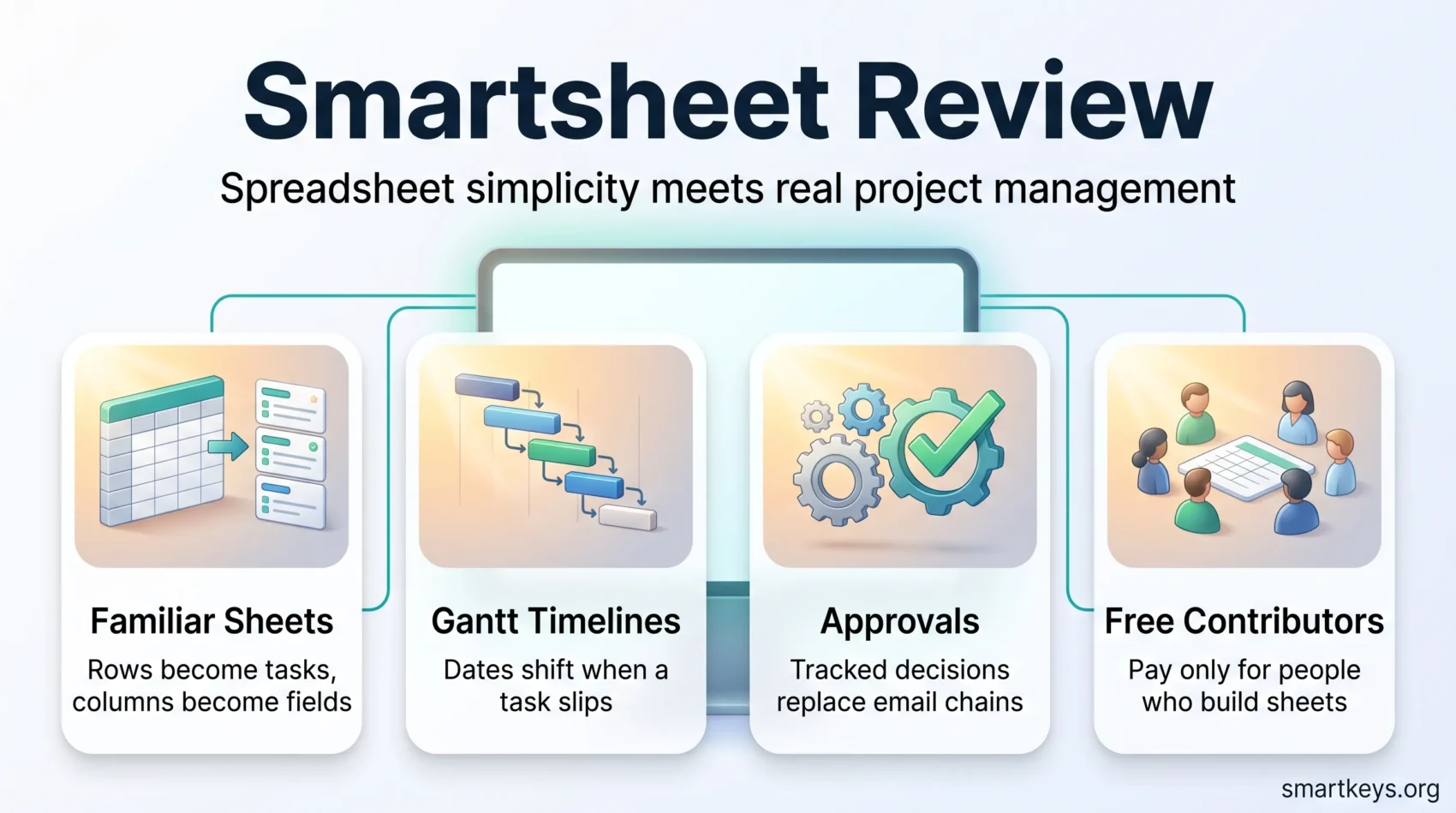
Smartsheet is a cloud-based work management platform that looks like a spreadsheet and behaves like a project management tool. Rows become tasks, columns become fields, and the same data can be viewed as a grid, a Gantt chart, a card board or a calendar. For teams that already live in spreadsheets, that familiarity is the whole appeal: nobody has to learn a new mental model before they can log a task.
Two things changed since this review was first published. Smartsheet retired its free plan for new signups, so the entry point is now a 30-day trial rather than a permanent free tier, and the company has pushed hard into AI with a family of features it calls Smart Assist, Smart Columns and Smart Agents. This 2026 review covers what the platform actually does, what each plan costs today, where the learning curve bites, and which teams are better served by something else.
Key Takeaways
- Smartsheet pairs a spreadsheet-style interface with real project management views: Gantt, board, calendar and grid.
- The Free plan closed to new signups in August 2024. New customers start with a 30-day trial.
- Paid plans start at $9 per user per month billed annually; Business is $19 and Enterprise is quote-only.
- Pro caps you at 10 members and 250 automations a month, which is the limit most growing teams hit first.
- Capterra reviewers rate it 4.5 out of 5, with ease of use scoring lower than value for money.
- Formula work and permission structures are where new users most often get stuck.
What Is Smartsheet?
Smartsheet is a cloud-based work management platform built around the sheet. Each sheet holds structured rows that can carry dates, dependencies, owners, attachments and comments, and every sheet can be reshaped into a different view without duplicating the data. Reports pull rows from multiple sheets into one place, and dashboards turn those reports into charts and metrics for people who never open the underlying sheets.
The platform sits between a spreadsheet and a full project management suite. It is more structured than a shared workbook, because it enforces column types, permissions and automation rules. It is less opinionated than a dedicated tool such as Jira, which expects you to work in sprints and issues. If you want a closer look at how the sheet-first model compares with a database-first one, our Smartsheet versus Airtable comparison covers that trade-off in detail.
Smartsheet also ships alongside sister products, including Brandfolder for digital asset management and Resource Management for capacity planning. These are sold separately rather than bundled into the core plans, which matters when you budget for a rollout.
Key Features of Smartsheet
The feature set is broad, so it helps to separate what you will use every day from what only larger accounts touch.
Sheets, Views and Role Permissions
Sharing in Smartsheet runs on named permission levels: Owner, Admin, Editor, Commenter and Viewer, applied per sheet or per workspace. That granularity is genuinely useful when a project touches finance data or client information, because you can invite an external partner as a Commenter without exposing the rest of the workspace. It also means permission design becomes real work on larger accounts. Teams that skip that step usually end up with a tangle of individually shared sheets that nobody can audit later. Workspaces exist precisely to avoid that, so set them up before the sheet count grows.
Gantt Charts, Timelines and Dependencies
The Gantt view is the strongest reason to pick Smartsheet over a general-purpose spreadsheet. Turn on dependencies and the platform calculates predecessor relationships, lag, critical path and rolled-up parent durations, then shifts downstream dates when a task slips. Baselines let you compare the current schedule against the plan you committed to. If your projects are genuinely schedule-driven, this is more capable than the timeline features in Asana or Basecamp, and closer to what you would expect from traditional scheduling software.
Automation and Task Tracking
Automation is built as visual rules: a trigger such as a date arriving or a cell changing, optional conditions, then actions such as sending an alert, requesting an approval, locking rows or moving a row to another sheet. Approval workflows are the feature teams tend to adopt first, because they replace a chain of emails with a tracked decision. Note the plan limit: Pro allows 250 automation runs per month, while Business and above are unlimited. A single busy sheet can burn through 250 runs faster than most buyers expect.
Smartsheet AI in 2026
Smartsheet announced its Intelligent Work Management push in November 2025, and the AI layer has been rolling out since. Smart Assist answers questions about project data in plain language, Smart Columns apply operations such as categorisation, translation or summarisation across rows automatically, and Smart Agents are positioned as domain assistants that flag risks and suggest changes. Alongside those, the platform offers AI formula generation, an AI dashboard builder and intelligent form fill. Treat the agent features as maturing rather than settled: several arrived through early adopter programmes rather than general availability, so confirm what is live on your plan before you build a process around them. The broader pattern is familiar across AI collaboration tools, where announcement and general availability can sit a year apart.
Smartsheet Pricing in 2026
Pricing is the part of this review that has changed most, and the older figures circulating online are out of date.
What Each Plan Costs
- Pro: $9 per user per month billed annually, or $12 billed monthly. One to 10 members, unlimited free contributors, 20 GB attachment storage, 250 automations per month.
- Business: $19 per user per month billed annually, or $24 billed monthly. Minimum three members, no upper limit, 1 TB storage, unlimited automations, workload tracking and document builder.
- Enterprise: Quote only, minimum 10 members. Adds SAML single sign-on, unlimited storage, directory integration and enterprise administration.
- Advanced Work Management: Quote only. Bundles Control Center, Dynamic View, Data Shuttle, DataMesh and the Salesforce and Jira connectors.
The jump from Pro to Business is more than a doubling of price, and it is usually forced rather than chosen: you hit the 10-member ceiling, or you run out of automation runs. Budget for that step rather than treating Pro as your long-term rate.
The Free Plan Is Gone for New Signups
Smartsheet closed its Free plan to new signups on 28 August 2024. Accounts that already had it keep it, with the original limits of three users, two owned sheets, 500 MB of attachments and 100 automation runs a month. Everyone else now starts with a 30-day trial. If a free tier is a hard requirement, this is the point at which to look at Trello or the free tiers covered in our ClickUp versus Asana comparison instead.
Members, Contributors and What Drives Your Bill
Smartsheet bills for Members, the people who create and own sheets. Contributors, who edit rows, comment and submit forms in sheets shared with them, are free and unlimited. That model rewards a small core team publishing work to a wider audience, and it punishes the opposite: if everyone needs to build their own sheets, your member count climbs quickly. Map your roles honestly before you compare the per-seat price with tools that charge for every editor, such as those in our Monday.com versus Notion comparison.
User Experience with Smartsheet
Smartsheet is easy to start and harder to master, and most reviewer complaints cluster at that second stage.
Getting Started
The onboarding path is solid. Templates cover common cases such as project plans, intake forms, event schedules and budget trackers, and the Learning Center, community forum and Smartsheet University courses are free to use. Most people can build a working project sheet in an afternoon. The friction appears later: cross-sheet formulas, cell linking, the difference between a report and a sheet summary, and permission inheritance across workspaces all take deliberate learning. Documenting your own conventions early pays off here, much as it does with any set of standard operating procedures.
What Reviewers Say
On Capterra, Smartsheet holds an overall rating of 4.5 out of 5 across roughly 3,500 reviews, with value for money at 4.4 and ease of use at 4.3. The gap between those two scores matches the qualitative feedback well: people rate what the platform does more highly than how quickly they got there.
What reviewers praise:
- Flexibility to model very different processes in one platform.
- Strong scheduling and dependency handling compared with lighter task tools.
- Free contributor access, which keeps costs predictable for wide audiences.
What reviewers criticise:
- A real learning curve around formulas, cell links and permissions.
- Performance slowdowns on very large sheets with heavy cross-sheet references.
- Advanced capabilities such as Control Center sitting behind quote-only tiers.
How to Use Smartsheet Effectively
A few habits separate accounts that scale cleanly from accounts that turn into sheet sprawl.
Best Practices
- Design workspaces first. Set permissions at workspace level so new sheets inherit them instead of being shared one by one.
- Standardise your column set. Agree on status, owner, dates and priority fields across projects so reports and dashboards actually work.
- Automate approvals before alerts. Approval requests remove more manual chasing than notification rules do, and they consume the same automation budget.
- Use reports as the working view. Let contributors work in a filtered report rather than opening every source sheet.
- Watch your automation count on Pro. Consolidate overlapping rules before you assume you need the Business tier.
Common Challenges and Solutions
- Sheet sprawl. Teams create a new sheet per project until nothing rolls up. Fix it with a template set, a naming convention and one portfolio report.
- Formula frustration. Cross-sheet formulas are the most common support question. Start with the AI formula generator, then rewrite what it produces once you understand the syntax.
- Performance on large sheets. Split oversized sheets by year or phase and connect them with reports rather than pushing a single sheet past its practical limits.
- Competing tools. If half the team already runs work in another platform, decide which system owns the schedule before rolling out. Running two is the fastest way to lose trust in both, a problem we cover in our guide to choosing between task management tools.
Integration and Collaboration Tools
Smartsheet connects to the tools most teams already use: Microsoft 365, Google Workspace, Slack, Microsoft Teams, Box, Dropbox, Google Drive and Adobe Creative Cloud. Salesforce and Jira connectors exist but sit in the Advanced Work Management bundle rather than the standard plans, which is worth checking before you promise a two-way sync to another department.
For anything not covered natively, Smartsheet is well supported by integration platforms. Routing data through a service such as those compared in our Workato versus Zapier review is usually faster than waiting for a native connector. On the collaboration side, row-level comments, attachments, proofing and update requests keep discussion attached to the work rather than scattered across Slack or Microsoft Teams threads.
Smartsheet Alternatives
No single tool wins on every axis, so the useful question is which trade-off suits your team.
Choose Smartsheet when schedules, dependencies and structured data matter, when many people need to contribute but few need to build, and when your team already thinks in rows and columns.
Look elsewhere in these cases:
- Asana or Trello if you want the lightest possible task tracking and a free tier that stays free.
- ClickUp if you want the widest feature surface for the lowest entry price and can tolerate the complexity that comes with it.
- Wrike or Teamwork if agency-style client work, proofing and billable time tracking are central.
- Airtable or Notion if you are really building a relational database or a knowledge base rather than running a schedule.
- Zoho Projects or Jira if software delivery workflows are the primary use case.
- A lightweight planner if all you need is a shared timeline without the administrative overhead.
- Document-first platforms if your work lives in written specs more than in task rows.
Verdict: Who Smartsheet Fits
Smartsheet earns its place when a project has real structure: dependencies that shift, approvals that need an audit trail, and a wide group of contributors who should see the plan without editing it. The Gantt engine, the permission model and the free contributor seats are the three things competitors rarely match together.
The reservations are equally clear. The end of the free plan removed the easiest way to evaluate it slowly. Pro’s 10-member and 250-automation ceilings arrive sooner than the price list suggests, and the step up to Business more than doubles the per-seat cost. The most capable features, Control Center and the Salesforce and Jira connectors among them, sit behind quote-only tiers. And the interface that makes Smartsheet approachable on day one is the same interface that makes cross-sheet formulas feel unforgiving in month three.
If you are a small team looking for the cheapest way to track tasks, this is not it. If you are running scheduled, multi-stakeholder work and you want the plan to stay legible to people outside the core team, Smartsheet remains one of the strongest options available in 2026. Use the 30-day trial on a real project rather than a test one, and pay attention to how many people genuinely need Member seats before you commit to an annual contract.
Found this useful?
Make SmartKeys a preferred source on Google, and our articles will surface more often in your Top Stories, AI Overviews, and AI Mode.
Add as Preferred Source