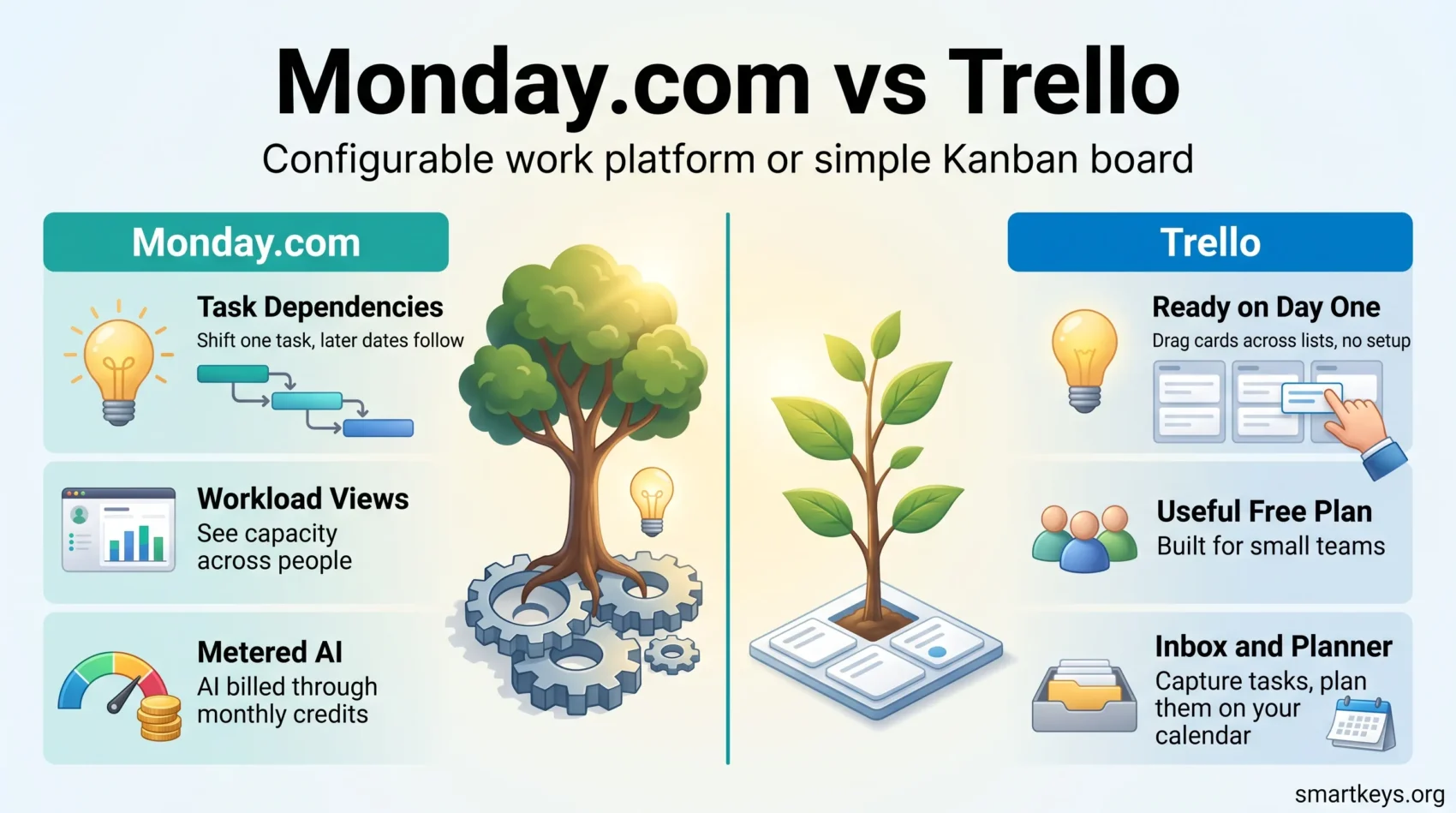
Monday.com and Trello both promise to organize your team’s work, but they solve different problems. Monday.com is a configurable work platform with dashboards, dependencies and automation. Trello is a Kanban board that stays out of your way. This Monday.com vs Trello comparison walks through what each one costs in 2026, what the paid tiers actually unlock, and which teams are better served by which tool.
Both vendors changed meaningfully over the last two years. Trello was rebuilt around a personal Inbox and Planner with AI-assisted capture. Monday.com pushed AI agents and credit-based billing into its plans. The old summary of “Monday.com for big teams, Trello for small ones” still holds, but the reasons have shifted.
Key Insights
- Monday.com suits teams that need dependencies, dashboards, workload views and heavy automation.
- Trello suits individuals and small teams who want a board that works on day one.
- Both have a free plan. Monday.com’s free tier is capped at 2 seats; Trello’s free tier allows up to 10 collaborators per Workspace.
- Monday.com’s paid plans require a minimum of 3 seats, so the real entry price is three times the sticker price.
- Trello’s free plan is not unlimited storage — individual file uploads are capped at 10 MB.
- Timeline and Gantt views sit behind Monday.com Standard and Trello Premium. Neither is a free-plan feature.
- Native time tracking is a Monday.com Pro feature. Trello needs a Power-Up for it.
What Each Tool Is Built For
Monday.com calls itself a work operating system, and the label is fair. A board is a flexible table: you choose the column types, build views on top of them, and layer automations and dashboards over the result. That flexibility is the product. It is also the reason a new Monday.com workspace takes real setup time before it earns its keep.
Trello inherited its design from physical Kanban. Boards hold lists, lists hold cards, and you drag cards across the board as work moves. There is almost nothing to configure, which is why Trello is still the tool people reach for when they want to start now rather than plan a rollout. If you have never used a board-based system, our guide to building a personal Kanban board is a useful starting point.
The practical test is simple. If you can describe your workflow as “cards move left to right”, Trello will hold. If you need to answer questions like “who is over capacity next month” or “which tasks slip if this one slips”, you need Monday.com or something in its class.
Monday.com vs Trello Pricing in 2026
Pricing is where most comparisons age badly, so here is what each vendor publishes today. All prices are per seat per month, US dollars, on annual billing unless noted.
Monday.com Pricing
Monday.com’s Work Management product runs on five tiers:
- Free: up to 2 seats, 3 boards and 3 docs
- Basic: $9 per seat per month
- Standard: $12 per seat per month
- Pro: $19 per seat per month
- Enterprise: custom pricing
Two details matter more than the headline numbers. First, paid plans start at a three-seat minimum, so Basic costs at least $27 a month even for a two-person team. Second, seats are billed in bands rather than one at a time, so adding a single person can push you into the next band.
Feature gating follows the tiers closely. Timeline and Gantt views begin at Standard. Time tracking, formula columns and dependency automations begin at Pro. Automation and integration actions are capped per plan — 250 actions a month on Standard, 25,000 on Pro and 250,000 on Enterprise — which is the limit teams hit first when they start automating in earnest.
Monday.com’s AI features are billed separately through a credit system. AI blocks, agents and the AI Notetaker each consume credits from a monthly pool, and you can buy more when the pool runs out. Budget for it if AI is part of your plan rather than assuming it is included.
Trello Pricing
Trello has four tiers:
- Free: up to 10 collaborators per Workspace, 10 boards per Workspace, 10 MB per file, 250 Workspace command runs a month
- Standard: $5 per user per month annually, $6 monthly
- Premium: $10 per user per month annually, $12.50 monthly
- Enterprise: $17.50 per user per month, billed annually
Standard removes the board cap and raises automation to 1,000 command runs a month. Premium is the tier most teams actually want: it adds Calendar, Timeline, Table, Dashboard and Map views plus unlimited command runs. Enterprise adds multi-Workspace administration, SSO and organization-wide permissions.
The honest summary on cost: Trello Premium at $10 lands close to Monday.com Standard at $12, and at that point you are comparing feature sets rather than budgets. Trello only wins decisively on price at the free and Standard tiers.
Features That Actually Differ
Both tools do boards, comments, due dates, labels and mobile apps. The differences worth choosing on are narrower than the marketing suggests.
Views and Project Visualization
Monday.com ships more than ten view types, including Gantt, workload, calendar and chart views, all reading from the same underlying board. Dependencies are first-class: shift one task and downstream dates can shift with it. This is the single strongest argument for Monday.com over Trello.
Trello added Timeline, Table, Calendar, Dashboard and Map views, but they live on Premium and remain lighter than Monday.com’s equivalents. Trello’s Timeline shows when work happens; it does not model what breaks when a date moves. For a heavier scheduling engine in the Atlassian ecosystem, our Trello vs Jira comparison covers the step up.
Automation
Trello’s Butler automation is genuinely approachable — rules are written in near-plain English and most people build their first one without documentation. The constraint is monthly command runs rather than capability.
Monday.com’s automation goes further: multi-step recipes, cross-board actions, conditional branches and integration triggers. It also carries the harsher action caps described above. If automation is central to how you work, read our overview of AI in project management before committing to either platform’s limits.
Time Tracking and Reporting
Monday.com includes native time tracking from the Pro tier and builds reporting dashboards from board data without extra tooling. Trello has no native time tracking; you add a Power-Up or connect a dedicated tool such as those covered in our Toggl Plan review. Trello’s Premium dashboards cover basic throughput and assignment stats but stop well short of portfolio reporting.
Recent Additions Worth Knowing
Trello’s rebuild introduced an Inbox that captures tasks from email, Slack and Microsoft Teams, and a Planner that syncs with Google or Microsoft calendars so you can drag cards onto real time slots. Atlassian Intelligence parses forwarded messages to pull out due dates and priorities. These features shipped to Free, Standard and Premium plans, with Enterprise following later.
Monday.com’s push has been agentic: AI blocks inside columns, an assistant layer, and agents that can take multi-step actions on boards. The capability is real; the billing model means you should treat it as a metered add-on rather than a bundled feature.
User Interface and Learning Curve
Trello is faster to learn by a wide margin. A new user can create a board, add cards and invite a colleague in under five minutes with no training. That accessibility is why Trello persists in teams that have tried and abandoned heavier tools.
Monday.com is denser. Color-coded status columns make a well-built board readable at a glance, but building that board requires deciding on column types, view configuration and automation rules first. Most teams need a designated owner to set it up and maintain it. If nobody owns the configuration, Monday.com degrades into an expensive spreadsheet.
Neither interface is objectively better. The question is whether your team has the appetite for setup that Monday.com’s flexibility demands. For a broader look at how tool choice interacts with daily habits, see our guide to effective task management.
Collaboration and Communication
Both platforms keep discussion attached to the work item. Monday.com’s updates feed collects comments, files and mentions under each item, and its notification system is more configurable — useful at scale, noisy if left on defaults. Trello keeps comments and checklists on the card, which is simpler and harder to misuse.
Neither replaces a chat tool. Both integrate with Slack and Microsoft Teams, and Trello’s new Inbox now pulls messages from both into actionable cards. If your team is still deciding on the chat layer underneath, our Slack review covers that side of the stack.
Integrations and Extensibility
Monday.com lists over 200 integrations covering Slack, Google Drive, Zoom, Salesforce, GitHub and the usual suspects, plus an API and app framework for building your own. Integration actions count against the same monthly cap as automations, which is easy to forget when planning a busy sync.
Trello extends through Power-Ups. The free plan allows unlimited Power-Ups per board, and the directory covers hundreds of tools including Jira, Slack, Dropbox and Google Drive. Our guide to the most useful Trello Power-Ups covers which ones are worth enabling. The trade-off is that a heavily extended Trello board can end up harder to maintain than a native Monday.com equivalent.
Scalability for Different Team Sizes
Where Monday.com Pulls Ahead
Monday.com holds up as team count and project complexity grow. Portfolio boards roll up multiple projects, workload views show capacity across people, and permissions get granular at Pro and Enterprise. Cross-department work — where marketing, ops and engineering share dependencies — is where the platform earns its price. Teams evaluating this tier usually also look at Smartsheet and Wrike, both of which target the same segment.
Where Trello Holds
Trello scales to more people than its reputation suggests, but not to more complexity. A 40-person team running independent boards is fine. Five people running interdependent projects with hard deadlines is where Trello starts to strain, because there is no native way to model those dependencies. The failure mode is not performance, it is losing the plot across boards.
Support and Customer Service
Monday.com provides a knowledge base, webinars and 24/7 support on paid tiers, with dedicated customer success at Enterprise. Response quality is generally reported as good, though complex configuration questions often route to partners rather than support.
Trello’s support tiers by plan: community forums for free users, standard support on paid plans, and priority support at Enterprise. Because Trello is simpler, most questions resolve in the documentation. When teams do need help, it is usually about a Power-Up rather than Trello itself — and Power-Up support comes from the third-party developer, not Atlassian.
Strengths and Weaknesses
Monday.com
Strengths: genuine flexibility, strong dependency and workload management, mature dashboards, deep automation, native time tracking from Pro.
Weaknesses: real setup cost, three-seat minimum, per-plan action caps that bite quickly, metered AI billing, and a learning curve that needs an internal owner. Teams comparing it against similar platforms should also read our Basecamp vs Monday.com and Monday.com vs Notion comparisons.
Trello
Strengths: immediate usability, the most generous genuinely useful free plan in this category, low paid pricing, approachable automation, and the new Inbox and Planner for personal workload management.
Weaknesses: no dependency modeling, no native time tracking, advanced views locked to Premium, a 10 MB per-file limit on free, and reporting that stays shallow. For alternatives at a similar level of simplicity, see our Asana vs Trello and Pipefy vs Trello comparisons.
Monday.com vs Trello: The Verdict
Choose Trello if you are a freelancer, a small team, or a department that wants boards without a rollout project. The free plan is a real product rather than a demo, Standard at $5 removes the board cap for very little money, and Premium at $10 adds the views most teams eventually want. Trello is also the safer choice when nobody on the team wants to own tool configuration.
Choose Monday.com if you manage interdependent projects, need to see capacity across people, or want dashboards that answer questions without exporting to a spreadsheet. Budget for the three-seat minimum, check the automation action cap against your intended usage, and treat AI credits as a separate line item.
If neither fits, the category is crowded. Our reviews of ClickUp, Asana, Basecamp and Jira Software cover the main alternatives, and ClickUp vs Asana and Teamwork vs Wrike compare the next tier up. For lighter-weight options, our roundup of productivity apps is a good place to start.
Both vendors offer free trials of their paid tiers. Run a real project through each for two weeks before committing — the difference between these two becomes obvious within days of actual use.
Found this useful?
Make SmartKeys a preferred source on Google, and our articles will surface more often in your Top Stories, AI Overviews, and AI Mode.
Add as Preferred Source