Productivity apps promise order: one place to capture commitments, a clear view of what is due, and fewer things held in your head. Used well they deliver exactly that. Used badly they become another set of notifications competing for the attention you were trying to protect.
This guide covers the categories of productivity apps that still earn their place in 2026 — task managers, note-taking tools, planners, project platforms and time trackers — and what their current plans actually include. Pricing and free-plan limits change frequently, so treat every figure here as a starting point and confirm the terms on the vendor’s own page before committing a team to anything.
Key Insights
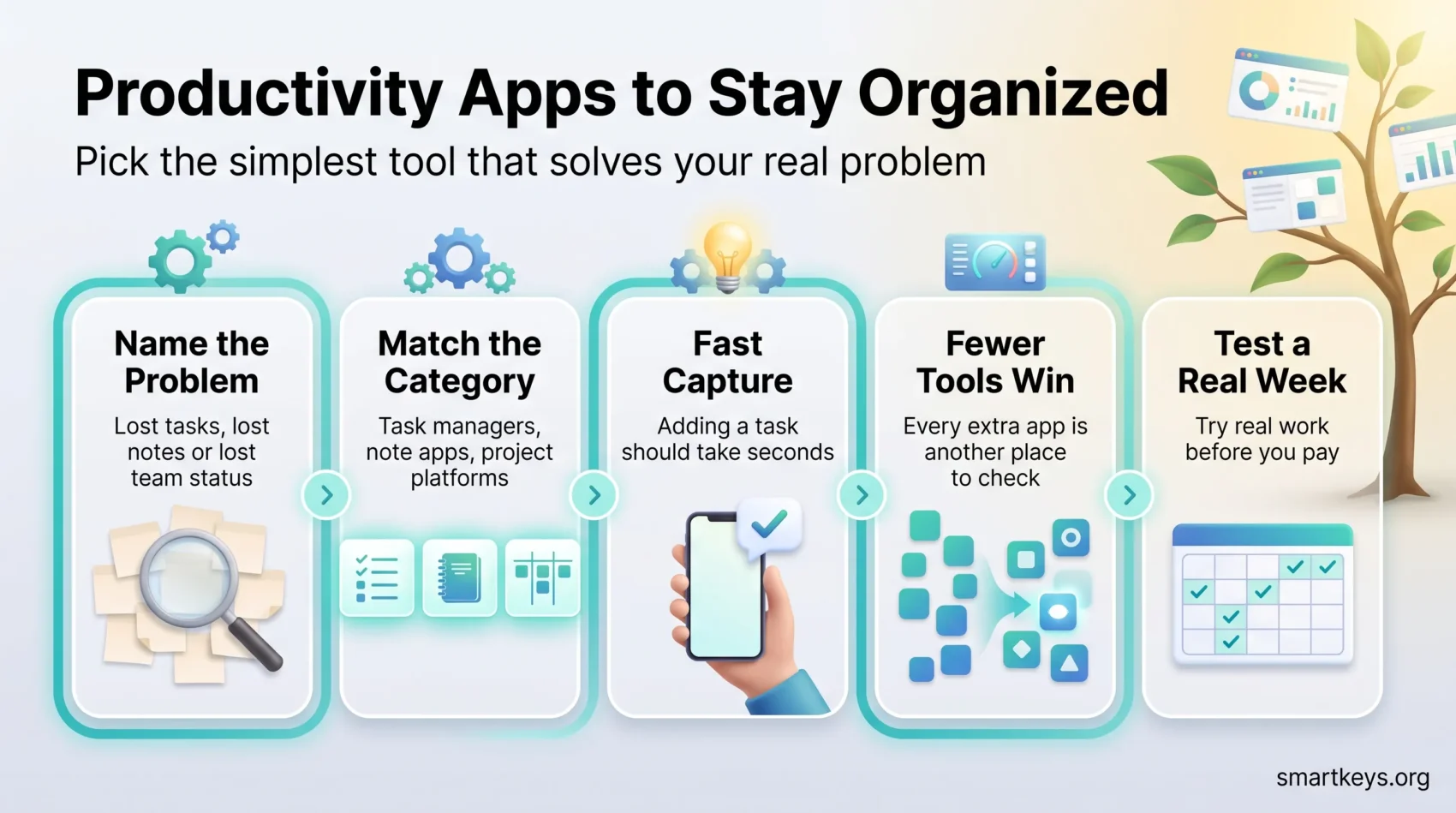
- The right app reduces friction; it does not supply discipline. Pick for how you already work.
- Free tiers have tightened noticeably — Evernote now caps its free plan at 50 notes in a single notebook.
- Task managers, note apps and project platforms solve different problems. Mixing them up is the most common mistake.
- Fewer tools usually beat better tools. Every app you add is another place to check.
- Test with a real week of work, not a demo project, before you pay for anything.
Why Productivity Apps Matter More Than They Used To
The problem these tools address has measurably worsened. Microsoft’s 2025 Work Trend Index found that employees are interrupted every two minutes during core working hours — roughly 275 times a day — and that the average worker receives 117 emails and 153 Teams messages on a weekday. Nearly half of employees (48%) describe their work as chaotic and fragmented.
A productivity app does not solve that. What it can do is remove one specific cost: the effort of remembering. When every commitment lives somewhere you trust, you stop rehearsing obligations in your head and spend that capacity on the work itself. That is a narrower claim than most marketing pages make.
The benefits worth expecting are modest but real:
- One source of truth: tasks stop living in three chat threads and a notebook.
- Visible deadlines: what is due surfaces without you going looking for it.
- Shared status: teammates can see progress without another check-in meeting.
- Honest capacity: a full list makes overload obvious before the deadline does.
For the habits that sit underneath the tooling, our guide to essential task management covers the capture, prioritization and review cycle these apps are meant to support.
How to Choose a Productivity App That Fits
Start by naming the problem rather than browsing features. Are you losing tasks, losing information, or losing track of what a team is doing? Those are three different products, and buying the wrong category is why so many people end up with four apps and no system.
A few criteria separate tools you will still use in six months from ones you abandon:
- Capture speed: if adding a task takes more than a few seconds on your phone, you will stop doing it. Getting everything out of your head and into a trusted system is the habit that everything else depends on.
- Cross-device sync: check how many devices the free tier actually covers. Several vendors now limit this.
- Calendar integration: a task list that never meets your calendar stays aspirational. Deliberate calendar management is what turns a list into a plan.
- Native integrations: direct connections to the tools you already use beat middleware you have to maintain.
- Simplicity: a tool you configure for a weekend is a tool you will resent. Beware spending more time organizing than doing.
- Longevity: check the changelog. Apps that have gone quiet tend to stay quiet, and migrating years of notes is painful.
If most of your capture happens away from a desk, weight the mobile experience heavily — our guide to working effectively from your phone covers what that changes.
Task Management Apps: Asana and Trello
Task managers track discrete pieces of work: what needs doing, by whom, by when. Asana and Trello are the two most widely adopted entry points, and they suit different temperaments.
Asana: Structure for Coordinated Work
Asana is built around projects, assignees, dependencies and workload views, which makes it a fit for teams coordinating work across several people rather than individuals tracking a personal list. Tasks can be viewed as lists, boards, timelines or calendars, so the same project reads differently depending on what you need from it.
Asana currently sells four tiers — Personal, Starter, Advanced and Enterprise — with the free Personal plan aimed at individuals and very small teams. The collaborator ceiling on that free tier has tightened over the years, so check the current limit on Asana’s pricing page before assuming your team fits. Our full Asana review goes deeper on features and day-to-day experience.
Trello: Visual and Easy to Adopt
Trello organizes work as boards, lists and cards. Its strength is how quickly a team understands it: drag a card from one column to the next and the status is obvious to everyone. That makes it a strong first shared board for teams that have never used one.
The free plan covers up to 10 boards per Workspace and up to 10 collaborators, with 250 automation command runs per month. Standard starts at $5 per user per month billed annually ($6 billed monthly), and Premium at $10 billed annually, according to Trello’s pricing page. Power-Ups extend the basics considerably — our guide to Trello’s Power-Ups covers the ones worth adding. If you are weighing Trello against a heavier alternative, see our Monday.com vs Trello comparison.
Note-Taking and Organization Apps
Note apps hold the material that tasks refer to: research, meeting notes, reference documents, half-formed ideas. Keeping them separate from your task list is usually cleaner than forcing one tool to do both.
Evernote: Powerful, but Check the Free Tier
Evernote remains a capable long-term notebook. Notes can be tagged and organized into notebooks, the web clipper saves articles and pages straight from the browser, search reaches inside attachments, and notebooks can be shared with collaborators.
The important 2026 caveat is the free plan. According to Evernote’s own plan comparison, the Free tier is limited to 50 notes in a single notebook, syncing to one device, with 1 GB of storage. That is a fundamentally different product from the free Evernote many people remember, and it makes the app a paid decision rather than a casual one. If you are choosing a note system from scratch, our guide to digital note-taking compares the approaches rather than just the brands.
Google Keep: Fast Capture, Little Structure
Google Keep is the opposite trade-off: almost no organizational depth, but capture is close to instant. It suits quick notes, checklists and reminders rather than a reference archive. Notes can be colour-coded and labelled, they sync across devices through your Google account, and they surface alongside Gmail and Google Calendar.
Keep also supports voice capture, which is worth using more than most people do — see our guides to voice dictation and to text-to-speech tools if you spend time away from a keyboard.

Planner Apps: Todoist
Planner apps sit between a note tool and a project platform. They are personal-first: fast to enter, organized around dates and priorities, and designed to be checked several times a day.
Todoist: Balancing Power and Simplicity
Todoist lets you create tasks, set deadlines, build recurring schedules and organize work into projects and labels, with natural-language input that turns “report every Friday at 4pm” into a properly scheduled task. It runs on web, macOS, Windows, Android and iOS, so capture is available wherever you are.

The free Beginner plan covers 5 personal projects with up to 5 people per project, three filter views and one week of activity history, per Todoist’s pricing page; Pro and Business lift those ceilings. Five projects is enough to test the app properly and tight enough that regular users generally end up paying.
Todoist integrates with calendars, email clients and chat tools, which matters more than any single feature: a planner that receives tasks from the places work actually arrives is one you will keep using. Pairing it with automated calendar reminders removes the last reason to hold deadlines in your head.
Project Management Apps for Teams
Once work involves dependencies, shared workloads and reporting, a task list stops being enough. Project platforms add the coordination layer — at the cost of more setup and more administration.
Microsoft Teams and the Microsoft 365 Stack
Teams is a communication platform first, combining chat, calls, meetings and file sharing in one place. Its task management arrives through the surrounding Microsoft 365 tools: To Do for personal lists and Planner for shared boards, both surfacing inside Teams and Outlook.
The argument for it is rarely that any single component is best in class; it is that the components are already licensed and already integrated. If your organization runs on Microsoft 365, the friction of adopting anything else is real. For how Teams compares on the meetings side, see our Zoom vs Microsoft Teams comparison, and our Slack review for the main alternative.
ClickUp: Configurable, With the Effort That Implies
ClickUp packs task assignment, multiple views, time tracking, docs, goals and reporting into one workspace. Its appeal is breadth: teams that would otherwise run three tools can often run one. Its cost is configuration — a clear process turns that flexibility into leverage, and the absence of one turns it into sprawl.
ClickUp sells Free Forever, Unlimited, Business and Enterprise tiers, with the Unlimited plan starting at $7 per user per month billed annually. Its AI assistant, ClickUp Brain, is billed separately rather than included in the core plans, so factor that in when comparing headline prices — the current rates are on ClickUp’s pricing page. Our detailed ClickUp review covers where the platform fits and where it does not.
Where AI Features Actually Help
Most project tools now ship AI: drafting subtasks from a brief, summarizing a project’s status, converting meeting notes into assigned actions. The useful pattern is drafting rather than deciding. Turning a messy transcript into a candidate task list saves real time; deciding which of those tasks matters this quarter does not transfer.
Note also that AI capability increasingly sits on higher tiers or separate add-ons, which changes the price comparison. The highest-value application is usually meetings — our guide to an AI meeting notes workflow and our overview of AI-powered project management tools cover where the gains show up.
Apps for Goals and Habits
Goal and habit apps address a different failure than task managers do. A task manager tells you what to do today; a habit tracker tells you whether you have done something consistently enough for it to count.
The mechanism is simple and well understood: define a behaviour, record whether it happened, and look at the streak. Apps such as Habitica, which frames habits as a role-playing game, add accountability and social pressure on top. Whether gamification helps depends entirely on the person — for some it is the difference between a two-week attempt and a two-year habit, for others it becomes another game to abandon.
Two cautions are worth stating. Habit apps work for behaviours that repeat on a schedule, not for outcomes that need judgement, and a tracker with fifteen daily habits in it is a tracker you will stop opening. Most task managers, Todoist and ClickUp included, handle recurring tasks well enough that a separate habit app is often unnecessary.
Time Tracking and Focus Apps for Remote Work
Remote and hybrid work removes the ambient signals that used to tell you where your day went. Time-tracking tools replace them with data.
RescueTime: Seeing Where the Time Goes
RescueTime runs in the background and categorizes the applications and sites you use, then reports how the week was actually spent. Its focus mode blocks distracting sites for a set period. The value is less in the blocking than in the first report, which usually contradicts what people believe about their own habits.
RescueTime offers a free Lite plan alongside paid Solo and Team tiers, with current rates listed on RescueTime’s plans page. Toggl Track covers the adjacent need: manual tracking against projects and clients, which is what you want if the goal is billing or estimation rather than self-observation.
A caveat on team deployments. Tracking that individuals choose for themselves tends to be useful; tracking imposed on a team reads as surveillance and reliably damages trust. If you are considering it, be explicit about who sees the data and why. For the wider set of techniques this supports, see our guide to time management for busy professionals.
Conclusion
The best productivity app is the one you will still be opening in three months. That usually means the simplest tool that covers your actual problem, not the most capable one available.
Start with a single category. If commitments are slipping, fix capture with a task manager. If information is scattered, fix that with a note app. If a team keeps asking each other for status, a shared board earns its place. Solving all three at once with one platform is possible, but it is a bigger project than it looks.
Then stop shopping. Trial fatigue is its own productivity problem, and switching apps returns far less than using one consistently. Give a tool a real month of ordinary work and keep it if the friction disappears rather than moves.
Found this useful?
Make SmartKeys a preferred source on Google, and our articles will surface more often in your Top Stories, AI Overviews, and AI Mode.
Add as Preferred Source