Big goals fail quietly. They sit in a note somewhere while the week fills up with everything else. A personal OKR fixes that by pairing one clear intention with a handful of numbers you update every week.
OKR stands for objective and key results: the objective is what you want, and the key results are the measurable proof that you are getting there. The format came out of Intel under Andy Grove, reached Google through investor John Doerr, and was made practical for teams by Christina Wodtke in her book Radical Focus. James McAulay then adapted it for private life in a Medium write-up that has been read more than 87,000 times.
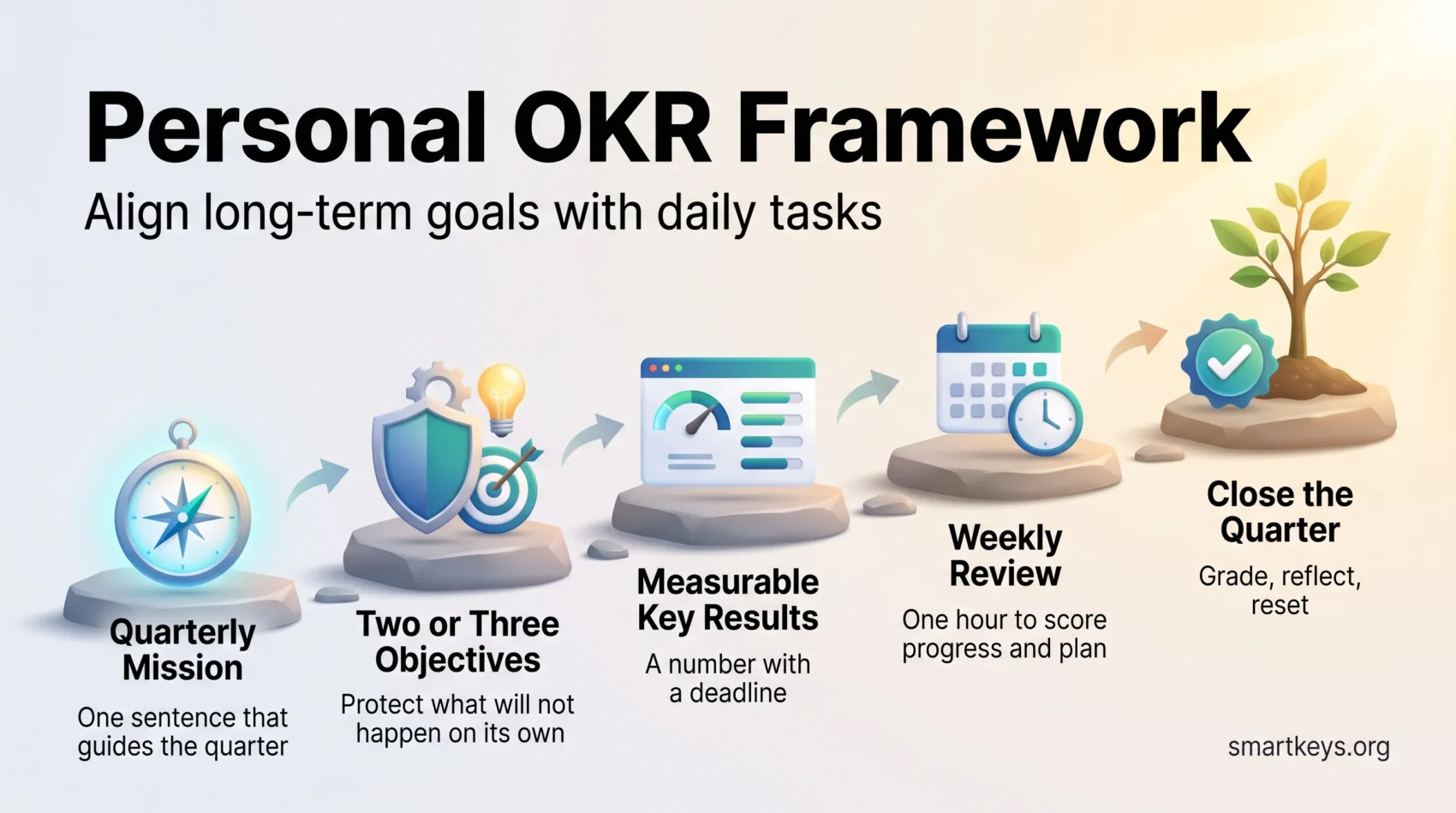
This guide shows you how to run that personal version: one quarterly mission, two or three objectives, key results you can score, and a weekly planning session that turns all of it into actual days. It stays a lightweight routine: one document, one review, one clear path.
Key Takeaways
- An objective is the outcome you want; key results are the numbers that prove progress.
- Run the system in quarters, with a short review every week.
- Write key results as counts, totals or dates so you can score them honestly.
- Keep it to one document and one recurring hour, or it will not survive a busy month.
- Aim your objectives at what would otherwise never happen.
What personal OKRs are, and why they work outside the office
Think of it as a dashboard for your own life. You set one clear objective, attach a few measurable key results, and update them on a fixed day each week. Because the numbers are visible, you notice a stalled goal in week three instead of week twelve.

Objectives and key results in plain English
The objective is what you want. The key results are how you prove you got there.
Keep key results numeric. An objective like “get fitter” is not scoreable on its own. Attach key results such as “run 100 km this quarter” or “go to the gym 25 times” and suddenly it is. Each week you give every key result a rough percentage, so the picture stays honest rather than hopeful.
This is not new psychology. The goal-setting research of Edwin Locke and Gary Latham found that specific, challenging goals produce better performance than telling yourself to do your best. A number is what makes a goal specific. If you want a broader tour of that ground first, see our guide to goal setting.
How personal OKRs differ from work performance goals
At work, OKRs mostly exist to align a lot of people around the same few priorities. Yours exist to protect the things you actually care about from the things that shout louder.
That changes what belongs on the list. A work objective might be tied to a review or a bonus. A personal objective is tied to a version of yourself: fitter, calmer, further through a difficult book. Nobody grades you but you, which is exactly why the weekly number matters.
- Companies use OKRs to point many people in one direction.
- Your version should stay small, human and honest about your real constraints.
- Borrow the structure, not the corporate scaffolding around it.
Set a quarterly mission, then write objectives that fit it
Start the quarter with a single sentence. That sentence is your filter for the next twelve or thirteen weeks: what you protect, what you schedule, and what you decline.
Write a one-sentence mission
A mission is not a slogan. It answers one question: what do I need to protect this quarter? McAulay’s own example for a winter quarter was to beat the seasonal slump and finish the year in better shape than he started it. Plain, specific, and easy to check a decision against.
If you find yourself writing three sentences, you are describing a year, not a quarter. Cut it back until one line survives.
Pick two or three life areas
Choose the areas where progress would actually change how your months feel: fitness, wellbeing, learning, finances, creativity, or the house. Two or three is the working limit for most people. A fourth tends to be the one that quietly gets dropped, which then makes the whole system feel like a failure.
Pick areas that connect to real moments in your week. “Learning” is vague. “Twenty minutes of reading before bed” is a moment you can find.
Turn the mission into two or three objectives
Now write two or three objectives that serve the mission and are realistic for one quarter. The useful test is blunt: what will not happen unless I deliberately protect it?
Anything already running on its own momentum does not need an objective. Your commute reading does not need one. Learning to swim properly probably does. If you have a big ambition that spans years, break it into a quarter-sized piece first: our guide on breaking large goals into smaller steps covers how.
Write key results you can actually measure
Every key result should be a number with a deadline. That removes the argument you would otherwise have with yourself in week ten about whether you are “basically on track”.
Make every key result a number with a deadline
Write key results as counts, totals or dates: “run 100 km”, “save $3,000”, “finish chapter four by week eight”. Then give each one a percentage every week.
Two or four key results per objective is plenty. More than that and the weekly update becomes a chore, and a chore is the thing you skip first when the week goes badly. If numbers themselves are the interesting part for you, our piece on personal productivity metrics goes deeper.
Tie key results to who you want to become
The number tells you whether you are on track. The reason tells you why you bother on a Tuesday when you are tired.
So write the reason down next to it. You meditate to be calmer in arguments, not to hit a streak. You read to stay the curious person you like being. Identity is a steadier fuel than discipline, and it is the same mechanism behind habit stacking: the behaviour attaches to something already true about you.
Examples for fitness, reading, finances and home projects
- Fitness: run 100 km, cycle 500 km, or complete 25 gym sessions in the quarter.
- Reading: 20 pages a day, or 6 books finished by quarter end.
- Finances: save $3,000, or cut discretionary spending by 15%.
- Home: clear out three rooms, or finish one major repair by week 10.
The fitness figures above are McAulay’s own from the quarter he documented, which is a useful reminder that these are ordinary numbers, not heroic ones. A simple habit tracker is often enough to keep count.
Protect what will not happen on its own
Do not write key results for work already in motion. Those inflate your score and teach you nothing.
Pick the outcomes that need deliberate effort, then defend the time. That usually means putting the block in the calendar before the week fills up, which is the whole argument behind time blocking, and often means saying no to something else. If that is the hard part, our guide on saying no without damage is a good companion. Use a simple system, a spreadsheet or a wall calendar, and a weekly confidence score so you can change tactics while there is still quarter left.
Build a weekly rhythm that connects the quarter to your days
The week is the joint between the quarter and your calendar. Without a fixed weekly moment, a quarterly plan is just a document you wrote in January.
Run a one-hour weekly review
Book roughly an hour on the same day each week. In it you update the percentage on each key result, note what actually moved last week, and choose the two or three things that will move next week. Then put those in the calendar rather than on a list.
That last step is what most people skip. A task without a slot competes with everything else in the day and usually loses. Our guides to the weekly review and to prioritization cover the mechanics in more detail.
Use confidence scores to stay honest
A confidence score is your own estimate, on a scale of 1 to 10, of whether you will hit a key result by the deadline. Write it down every week.
It sounds soft, but it is the earliest warning you get. A key result sitting at 4 out of 10 in week five is telling you to change the plan now, while a change still helps. McAulay suggests treating an average of around 70% completion across your key results as a good quarter, which is a deliberately imperfect target: if you hit 100% every time, you were aiming too low.
Track a couple of plain health signals alongside it, such as sleep, energy or mood. They explain most of the weeks that go wrong, and they matter more than any productivity number: our piece on burnout prevention covers the warning signs worth watching.
Close the quarter: grade, reflect, reset
At the end of the quarter, score each objective and write down two things: what helped, and what drained you. Ten minutes is enough.
Then decide what carries over. Some objectives deserve a second quarter, some were the wrong shape, and some quietly stopped mattering. Dropping one on purpose is a result, not a failure. A short monthly review in between keeps the quarter from drifting for eight weeks unnoticed.
Two modes: testing new approaches and scaling what works
Some quarters are for finding out what works. Others are for pushing harder on something you already know works. Mixing the two is how people end up busy and stuck at the same time.
When to test and when to scale
Test when you do not yet have evidence. Keep the experiments small and the feedback fast, so a bad idea costs you weeks rather than a year.
Scale when the numbers are already stable and repeatable. At that point the useful question is not “what should I try?” but “how do I do more of this without burning out?” Most people alternate between the two modes across a year, and that is normal.
Write an objective as a hypothesis
When a quarter is genuinely exploratory, phrase the objective as something that can be proved wrong. For example: I can write regularly and still make a living if I teach part-time.
Then choose two or three key results that would settle the question: drafts finished, income from teaching, readers gained. Run it for a quarter, log the outcome weekly, and let the evidence decide whether you scale it, reshape it, or stop. If you want a shorter testing loop than a quarter, focus sprints work well for the same purpose.
Tools and accountability that keep the system alive
Pick tools that make the weekly update take five minutes. Friction is what kills this system, not lack of ambition.
Pick one tracker and stay in it
One place for scores, next actions and notes. A Google Sheet is genuinely enough, and McAulay offers both a Sheets and a Notion version of his template. If you prefer a database-style setup, our comparison of Smartsheet and Airtable and our look at Notion against Coda both cover tools that handle this comfortably.
Whatever you pick, resist rebuilding it. Time spent redesigning the tracker is time not spent on the goals it tracks.
Find an accountability partner
Share the sheet with someone whose opinion you care about, and agree on a check-in every two to four weeks. Fifteen to thirty minutes is plenty: progress, blockers, next steps.
The value is not pressure, it is having to say your numbers out loud. It is much harder to quietly redefine a goal when someone else can see last week’s version. Our guide to accountability partners covers how to set that up so it lasts past the second meeting.
Log risks and blockers every week
Add a short “risks and blockers” line to your weekly note. List what is in the way, how much it matters, and what you plan to do about it.
Treat repeated blockers as information. If the same obstacle shows up four weeks running, the key result is wrong, or the plan around it is. That is also where procrastination tends to hide: what looks like avoidance is often a goal that was never realistic.
Conclusion
A quarterly mission is only useful if it reaches your Tuesday. One mission, two or three objectives, key results you can score, and one hour a week to connect them to real days. That is the whole system.
Expect bad weeks. The point of the weekly review is not to be perfect but to notice drift early and return to the plan without drama.
Start with one objective and one key result. Share your sheet with someone you respect, score it honestly, and grade it at quarter end. Over a few quarters, that ordinary routine does more for a long-term goal than any burst of motivation.
Found this useful?
Make SmartKeys a preferred source on Google, and our articles will surface more often in your Top Stories, AI Overviews, and AI Mode.
Add as Preferred Source