SE Ranking spent a decade as the value option in the SEO tool market: most of what Semrush and Ahrefs do, at a noticeably lower entry price. In 2026 that positioning shifted. The platform retired its Essential, Pro and Business tiers, replaced them with Core, Growth and a custom-priced Enterprise plan, raised the entry price, and pushed AI search visibility into the main product.
This review covers what SE Ranking does well, what the new plans actually cost, where the platform still beats the market leaders on value, and which teams should look elsewhere.
Key Insights
- SE Ranking restructured its line-up in 2026: Core, Growth and a custom-priced Enterprise tier replaced Essential, Pro and Business.
- Core lists at $129 per month, or $103.20 per month on annual billing. Growth lists at $279 per month, or $223.20 annually (SE Ranking pricing page, August 2026).
- Annual billing saves 20% on both published plans.
- Agency and API capabilities are paid add-ons: the Agency Pack is $69 per month and the API add-on $45 per month, both on annual billing.
- The AI Visibility Tracker covers Google AI Overviews, Google AI Mode, ChatGPT, Gemini and Perplexity.
- There is a 14-day trial with no card required, and no permanently free plan.
- SE Ranking holds 4.7 out of 5 on G2 across more than 1,500 reviews.
What is SE Ranking?
SE Ranking is an all-in-one SEO platform: keyword research, daily rank tracking, backlink analysis, technical site audits, competitor research and a content toolkit, all behind one login. It launched in 2013 and sells to in-house marketers, freelancers and agencies, with white-label reporting aimed squarely at the agency market.
The pitch has always been breadth at a lower price than the market leaders. That is still broadly true at comparable feature levels, but the gap narrowed considerably when SE Ranking repriced in 2026.
Before you shortlist tools at all, it is worth being clear about which channels you are investing in. Our overview of how digital marketing strategies have evolved and the guide to building a go-to-market strategy are better starting points than a feature comparison.

Key features
Keyword rank tracker
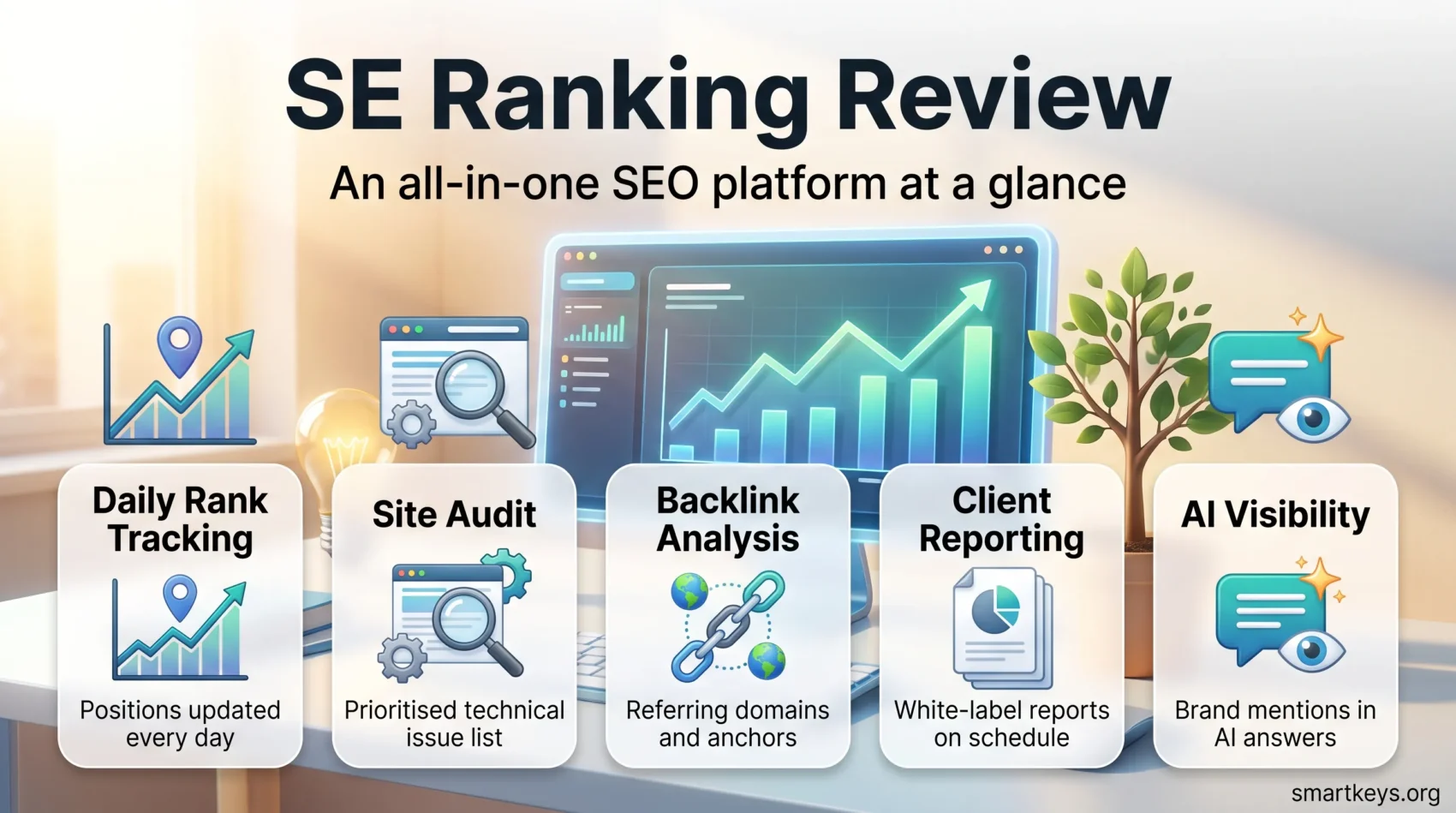
Rank tracking is the part of the platform that consistently earns praise. Positions update daily rather than weekly, and you can track the same keyword set across Google desktop, Google mobile, Bing, Yahoo and YouTube, with location targeting down to city level.
One thing to check before you size a plan: allowances are published as keywords tracked per day, and each search engine you monitor draws on that allowance. Map your real keyword list against the number of engines and locations you need before choosing a tier.
Backlink checker
The backlink tool profiles your own domain and your competitors’, reporting referring domains, anchor text distribution and lost or gained links over time. It is solid rather than category-leading. If link data is the primary reason you are buying a tool, compare it directly against Ahrefs before committing.
Website audit
The site audit crawls your domain and scores technical health across Core Web Vitals, mobile usability, indexation, redirects, structured data and HTTPS. The output is a prioritised issue list rather than a raw dump, which makes it usable by people who are not technical SEOs. Crawl allowances differ sharply between tiers, so check the page limit against your site size, particularly if you run a large store or a hosted site builder with heavy templating.
Content marketing toolkit
The content module generates briefs from SERP analysis, scores drafts against competing pages and includes an AI writing assistant. It is competent for optimisation work and weaker as a standalone writing tool, so most teams pair it with something else. Our reviews of AI writing platforms and Canva for visual assets cover the usual companions, and the piece on brand storytelling is a useful counterweight to brief-driven writing.
AI visibility tracker
This is the significant addition since our last review. The AI Visibility Tracker monitors whether your brand is mentioned and linked in AI-generated answers across Google AI Overviews, Google AI Mode, ChatGPT, Gemini and Perplexity, and compares your presence against competitors over time.
It matters because a growing share of informational queries now resolve inside an answer rather than a results page. If you are already thinking about how AI is reshaping marketing workflows, this is the reporting layer that tells you whether the shift is costing you visibility.
Ease of use and reporting
The interface is one of SE Ranking’s genuine strengths. Navigation is flatter than Semrush’s, the dashboards are readable without training, and a marketer who is not an SEO specialist can find what they need. That matters more than feature checklists when the tool has to be used by a whole team rather than one specialist.
Reporting is the other reason agencies stay. You can build white-label reports, schedule them, and pull in Google Analytics and Search Console data so a client sees rankings, traffic and conversions in one document. The templates are a decent default, though a report that simply lists numbers rarely lands: it is worth applying the principles in our guide to data storytelling before you send the first one. Teams running a regular reporting rhythm can fold this into an existing weekly review routine.

SE Ranking pricing in 2026
The plan names and prices circulating in older reviews are out of date. These are the current published figures from SE Ranking’s own pricing page.
What the plans cost
- Core: $129 per month, or $103.20 per month billed annually. One manager seat, 10 projects, 2,000 keywords tracked daily.
- Growth: $279 per month, or $223.20 per month billed annually. Three manager seats, 30 projects, 5,000 keywords tracked daily, plus historical data and API credits.
- Enterprise: custom pricing, negotiated with sales.
Add-ons and the real bill
The list price is a starting point. Extra manager seats start at around $16 per month, additional keyword capacity is sold in blocks, and two capabilities that many buyers assume are included are not: the Agency Pack, which unlocks the client-facing agency features, is $69 per month, and API access is a $45 per month add-on. Both are annual-billing only.
Two practical consequences. First, an agency running client reporting and an API integration is not paying the Core headline price. Second, teams migrating from the old Essential, Pro and Business tiers should model the new bill rather than assume parity, because the entry point moved.
There is a 14-day trial that does not ask for a card, and no free plan. Use the trial properly: load your real keyword list across the search engines and locations you actually need, and see what the allowance covers.
Pros and cons
Pros
- Daily rank updates across five search engines with granular location targeting
- An interface that non-specialists can use without training
- Strong white-label reporting with Analytics and Search Console integration
- AI visibility tracking built into the platform rather than sold as a separate product
- A genuine 14-day trial with no card required
Cons
- The 2026 repricing removed much of the budget advantage
- Agency features and API access are paid add-ons on annual billing only
- Backlink data is good but not best in class
- No free tier, so evaluation is limited to the trial window
- Support runs through email and chat rather than phone

How SE Ranking compares
Against Semrush, SE Ranking is simpler and cheaper at the entry tier, with better rank-tracking cadence; Semrush wins on database depth, keyword research and the sheer number of adjacent toolkits. Against Ahrefs, SE Ranking loses on backlink data and gains on price and reporting. Our comparison of Surfer SEO and Ahrefs covers the content-optimisation side of that trade-off.
The more useful question is where the tool sits in your stack. SEO data is most valuable when it connects to what happens after the click, which usually means a marketing platform such as HubSpot, an email tool like Mailchimp, and testing on the pages the traffic lands on, which is where A/B testing platforms earn their keep. Where a native connector is missing, an automation layer such as Workato or Zapier fills the gap, and teams working in short cycles will get more from the data if they run an agile marketing cadence.

What users say
SE Ranking rates 4.7 out of 5 on G2 from more than 1,500 reviews, which puts it in the same band as the larger platforms it competes with. The recurring praise is consistent with our own assessment: ease of use, accurate daily rank tracking and responsive support. The recurring complaints are equally consistent: backlink data that trails Ahrefs, and pricing that has moved upward.
Verdict
SE Ranking is still a good platform, and for a team that needs reliable daily rank tracking, clean reporting and a tool the whole marketing function can use, it is an easy recommendation. The AI visibility tracking is a real addition rather than a checkbox, and it arrived before most competitors treated the problem seriously.
What changed in 2026 is the reason to choose it. It is no longer the obvious budget alternative, so the decision now rests on fit rather than price. If rank tracking and client reporting are your core needs, it remains excellent value. If backlink analysis or keyword database depth is what you are buying, run the trial against Ahrefs or Semrush with your own data before signing an annual contract.
Found this useful?
Make SmartKeys a preferred source on Google, and our articles will surface more often in your Top Stories, AI Overviews, and AI Mode.
Add as Preferred Source