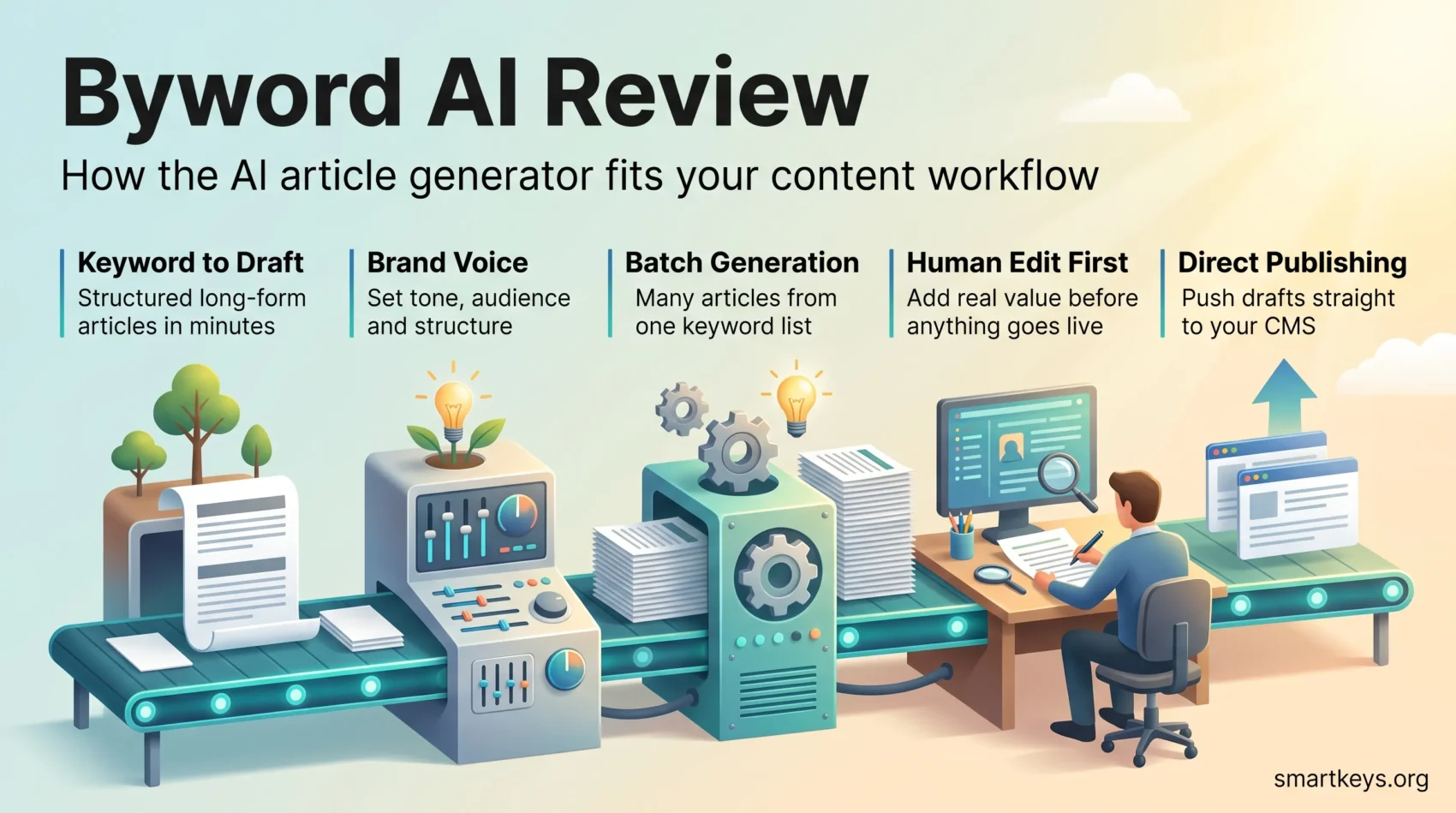
In marketing, the demand for publishable content keeps outrunning the hours available to write it. Byword AI is one answer to that squeeze: a generator built for marketers who need SEO-optimized articles in volume rather than one polished essay at a time. This review looks at what the platform actually does in 2026, what the plans cost, where the output holds up, and where it needs a human before it goes live.
Key Takeaways
- Byword AI turns a keyword or title into a long-form draft in minutes, with single and batch generation.
- The platform routes work through current frontier models, including GPT-5.4, Claude Opus 4.6 and Gemini 3.1 Pro.
- Public pricing runs from the Starter plan at $99 per month for 25 article credits up to Scale at $999 for 300.
- A free tier lets you generate five articles before paying anything.
- Direct publishing to WordPress, Webflow and other content management systems removes the copy-paste step.
- Google does not ban AI-generated content, but it does act against pages produced at scale that add nothing for readers.
- Editing is deliberately light, so plan for a human pass before anything is published.
What Is Byword AI?
Byword AI is a content generation platform built around long-form articles. You give it a keyword, a title or a spreadsheet of both, and it returns structured drafts with headings, internal structure and the on-page elements search engines expect. The pitch on the company’s own site is an article in under two minutes.
Overview of Byword AI
The product is deliberately narrow. There is no campaign planner, no social scheduler, no ad creative studio. It writes articles and publishes them. That focus is the reason marketers and content creators pick it over broader suites, and also the reason it frustrates anyone expecting a full marketing platform. If your bottleneck is drafting, this fits. If your bottleneck is strategy, look at a wider AI in marketing stack instead.
The Technology Behind Byword AI
Byword is a layer on top of frontier language models, not a model of its own. As of 2026 the site lists GPT-5.4, Claude Opus 4.6 and Gemini 3.1 Pro among the engines it can call, alongside its own keyword research and brand voice controls. That model-agnostic approach matters: it means output quality tracks the underlying models rather than a frozen in-house system, the same architectural choice you see in tools like Cassidy AI. For anyone tracking wider digital marketing trends, that layered pattern is now the norm rather than the exception.

Who Should Use Byword AI?
Byword suits a specific profile: teams with a defined keyword list and a publishing pipeline that can absorb more articles than they currently write.
Companies That Need Consistent SEO Output
For small in-house teams, the appeal is arithmetic. A freelance writer typically charges more per article than a Starter credit costs, so the tool changes what a modest content budget can cover. It works best when someone owns the keyword research, using a platform such as Semrush or SE Ranking, and Byword handles only the drafting. Treated as a writing engine rather than a strategy engine, it earns its place.
Content Creators and Bloggers
Solo publishers get the clearest time saving. Instead of a blank page you start from a structured draft, and spend your hours on the parts that carry your voice: the opening, the examples, the opinions a model cannot supply. Pair that with a distribution habit, whether that is a newsletter on Beehiiv or a steady presence in the channels covered in our social media guide, and one person can sustain a publishing schedule that used to need a team.
Agencies and Marketing Professionals
Agencies use batch generation to service multiple client blogs from one workflow, which is why the Scale plan exists at all. The economics resemble other white-label SaaS arrangements: the client sees deliverables, the agency sees margin. The risk is equally familiar. If every client site receives near-identical drafts, quality control stops being optional and becomes the whole job. Some agencies handle that by keeping editing in-house and outsourcing the lower-value tasks around it.
Key Features of Byword AI
Four capabilities define the product; the rest is packaging.
SEO-Optimized Article Generation
Each draft arrives with a heading structure, a title and meta description, and internal formatting aimed at search intent. The tool builds around the target keyword rather than bolting SEO on afterwards. It is not a replacement for a dedicated optimizer; if you need term coverage scoring and SERP analysis, that still belongs to tools compared in our Surfer SEO versus Ahrefs breakdown.
Batch Article Creation
Batch generation is the feature people actually pay for. Upload a list of keywords or titles and the platform produces every article in one run. For programmatic SEO projects, location pages or glossary entries, this collapses weeks of work into an afternoon. It is also the feature most likely to get you in trouble, for reasons covered below.
Publishing Integrations
Byword pushes finished drafts straight into WordPress, Webflow and several other content management systems. Removing the export and paste step sounds minor until you are handling eighty articles a month, at which point it is the difference between a workflow and a chore. Teams already building automated pipelines will recognise the pattern from our guide to AI agent workflows.
Brand Voice and Research Controls
You can set tone, audience and structural preferences so output does not read like every other generated blog. Keyword research is built in, which reduces tab switching, though it is shallower than a dedicated SEO suite. Byword is a writing tool with research attached, not the reverse.
How to Use Byword AI Effectively
The platform is easy to start and easy to misuse. A short process keeps output usable.
Steps to Start Generating Content
Sign up for the free tier, which includes five articles, and test it on topics you know well enough to judge. Then:
- Feed it specific keywords or working titles rather than broad themes, since narrow inputs produce sharper drafts.
- Configure brand voice before the first batch, not after you have spent credits.
- Set a target length that matches the query, since a 3,000-word answer to a simple question helps nobody.
- Read the first three outputs end to end before trusting a batch of thirty.
Getting Value From Batch Generation
Batch mode rewards preparation. Use it to:
- Clear a backlog of planned articles that already have approved briefs.
- Build systematic page sets where the structure repeats and only the subject changes.
- Produce first drafts for a human editor, rather than finished pages for immediate publication.
Budget editing time in the same breath as generation time. A batch of fifty drafts creates fifty editing jobs, and teams that skip that step are the ones who end up disappointed. The wider lesson from AI augmentation projects applies here too: the tool moves the work, it does not delete it.
Byword AI Pricing in 2026
Byword publishes its prices, which not every competitor does.
The Plans
The Starter Plan costs $99 per month and includes 25 article credits, which suits a solo publisher or a small business running one blog. The Standard Plan at $299 per month includes 80 credits and is the natural fit for an in-house marketing team with a real content calendar. The Scale Plan at $999 per month covers 300 articles and is aimed at agencies and publishers running several properties at once. Before any of that, the free tier gives you five articles.
Working Out the Real Cost
Per article, Starter works out at roughly $4, Standard at under $4 and Scale at a little over $3. Those numbers look cheap next to a freelance rate, but they are only half the ledger. Add the editor’s time, the fact-checking, and the images, and the true cost per published page rises considerably. Compare that honestly against your alternatives before switching your whole process over. The same arithmetic applies to other credit-based AI tools, as our AdCreative.ai review and Context.dev review both show.
Performance and Output Quality
Byword’s drafts are competent, structured and readable. They are also recognisably generated.
What the Output Looks Like
Expect clean heading hierarchies, sensible paragraph lengths and consistent coverage of the target keyword. Expect, too, a certain flatness: no strong point of view, no first-hand detail, and occasional confident statements that need checking. Quality has improved with each model generation, but the structural sameness across a batch remains the giveaway.
How It Compares
Against general-purpose writing assistants, Byword wins on volume and on publishing integration. It loses on editing depth: the built-in editor is basic, and most teams end up finishing drafts in their CMS anyway. Against dedicated SEO content platforms, it loses on optimization scoring and wins on speed. If your content programme extends beyond text, tools such as Synthesia for video or Jellypod for audio cover ground Byword does not touch, and lead generation sits with platforms like Clay rather than here.
AI Content and Google’s Spam Policies
This is the part that decides whether the tool pays off.
Google’s published spam policies do not prohibit AI-generated content. They prohibit scaled content abuse, which Google defines as generating many pages primarily to manipulate rankings rather than to help users, and the policy explicitly names “using generative AI tools or other similar tools to generate many pages without adding value for users” as an example. The method is not the issue; the absence of value is.
That distinction has direct consequences for how you use batch generation. A hundred articles that each answer a real question, with genuine expertise added in editing, sit inside the rules. A hundred articles spun from a keyword list to fill a sitemap sit outside them, whoever or whatever wrote them. Byword makes both equally easy, which is exactly why the editing step is not negotiable.
On detection tools, be realistic. Classifiers such as Originality.ai flag generated text with meaningful, though imperfect, accuracy, and heavy editing reduces but does not reliably eliminate their signals. If your business depends on passing a client’s detector, treat Byword output as a research draft rather than a deliverable. If it depends on serving readers well, edit for substance and the detector question mostly takes care of itself.
Pros and Cons of Byword AI
Advantages for Marketers
- Genuine speed: a structured long-form draft in minutes rather than hours.
- Batch generation: the strongest feature, and rare at this price.
- Direct publishing: WordPress, Webflow and further CMS integrations remove manual steps.
- Current models: access to frontier engines without managing API keys yourself.
- Transparent pricing: three published tiers and a free trial, with no sales call required.
Limitations of the Tool
- Thin editing environment: expect to finish drafts elsewhere.
- Shallow research: adequate for keywords, not a substitute for an SEO suite.
- Uniform voice across batches: noticeable when articles publish close together.
- Facts need checking: statistics and claims in drafts should never ship unverified.
- Credit model: unused credits and regenerated articles both cost you, so plan batches carefully.
Verdict
Byword AI is a good tool with a narrow job. If you have a keyword list, an editor and a publishing pipeline, it removes the slowest step in the chain at a defensible price, and the Starter plan is cheap enough to test properly against your own topics.
What it is not is a content strategy. The teams that get value treat generated drafts as raw material and keep a human accountable for what publishes. The teams that get burned point it at a spreadsheet and walk away. That divide is the same one showing up across job automation generally: the tool absorbs the task, not the judgment.
Start with the free five articles, judge them on subject matter you know well, and scale only once you know how much editing each one really needs. If your marketing stack has gaps elsewhere, our reviews of HubSpot Marketing Hub and Buffer versus Hootsuite cover the neighbouring pieces.
Found this useful?
Make SmartKeys a preferred source on Google, and our articles will surface more often in your Top Stories, AI Overviews, and AI Mode.
Add as Preferred Source