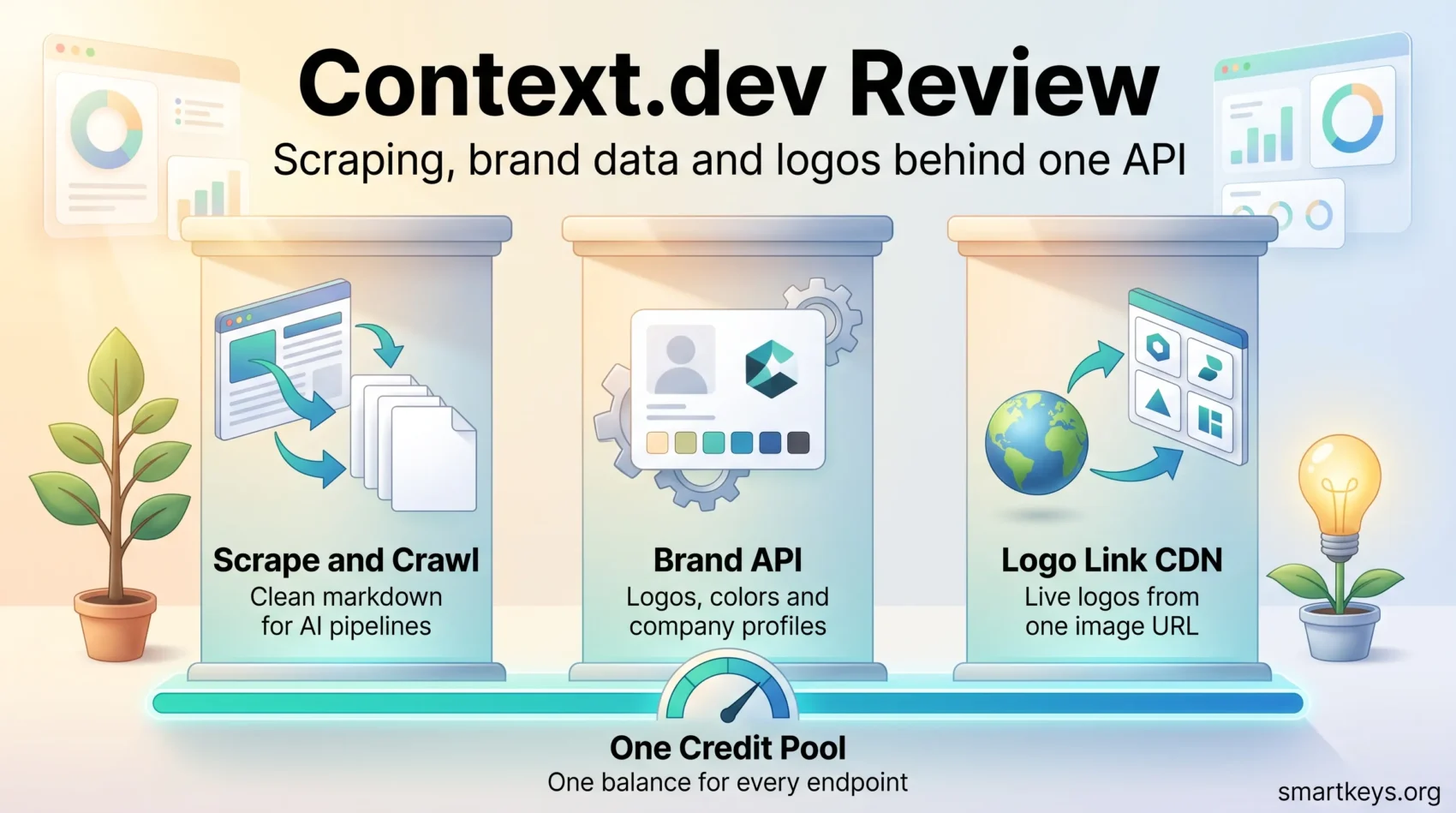
Context.dev bundles web scraping, full-site crawling, structured extraction, brand intelligence and a logo CDN behind one API, one credit pool and one set of SDKs. This Context.dev review covers what the platform actually does as of August 2026, what the four plans really cost, and where it still falls short.
The product started life as Brand.dev, a logo-and-colors provider for developers. It rebranded to Context.dev, went through Y Combinator, and now positions itself as the web-context layer for AI agents. Named customers include Klarna, Similarweb, Mintlify, Chatwoot, daily.dev and SiteGPT.
Short version: if you use two or three of its pillars — scraping, brand data, logos — the bundle is cheaper and simpler than stitching three vendors together. If you only need one slice, a single-purpose tool will usually beat it on price.
Key Takeaways
- One credit pool covers scraping, crawling, extraction, brand data and classification.
- Free tier: 500 API credits with a work email (250 with Gmail/Outlook) plus 10K Logo Link requests, no card.
- Paid plans: Developer $25/mo, Pro $149/mo, Scale $499/mo, Enterprise custom.
- 1 credit = 1 page. JS rendering, anti-bot bypass and premium proxies are included, not surcharged.
- SDKs for TypeScript, Python, Ruby, Go and PHP, plus Zapier, Make and an MCP server.
- Best fit: RAG pipelines, SaaS onboarding personalization, and CRM or fintech products that display company logos at scale.
From Brand.dev to Context.dev: What Actually Changed
Brand.dev solved one narrow problem: give it a domain, get back a logo, a colour palette and some company metadata. Useful, but a feature rather than a platform.
The Context.dev rebrand added the part that mattered — the web itself. You can now scrape any URL to markdown, crawl a whole domain via sitemap discovery, run a JSON schema against a site to get structured data back, take screenshots, and watch pages for changes.
The strategic bet is bundling. Instead of paying Firecrawl for scraping, Clearbit (now discontinued) for logos and a third vendor for firmographics, you meter everything against one balance. For teams already juggling several automation and integration tools, that consolidation is the main selling point.
SiteGPT migrated its entire website-scraping pipeline off Firecrawl and onto Context.dev in under a day — a reasonable proxy for how much switching cost you should budget.
The Scraping and Crawling API
This is the pillar most teams will hit first, and it is the one that has improved most since the rebrand.
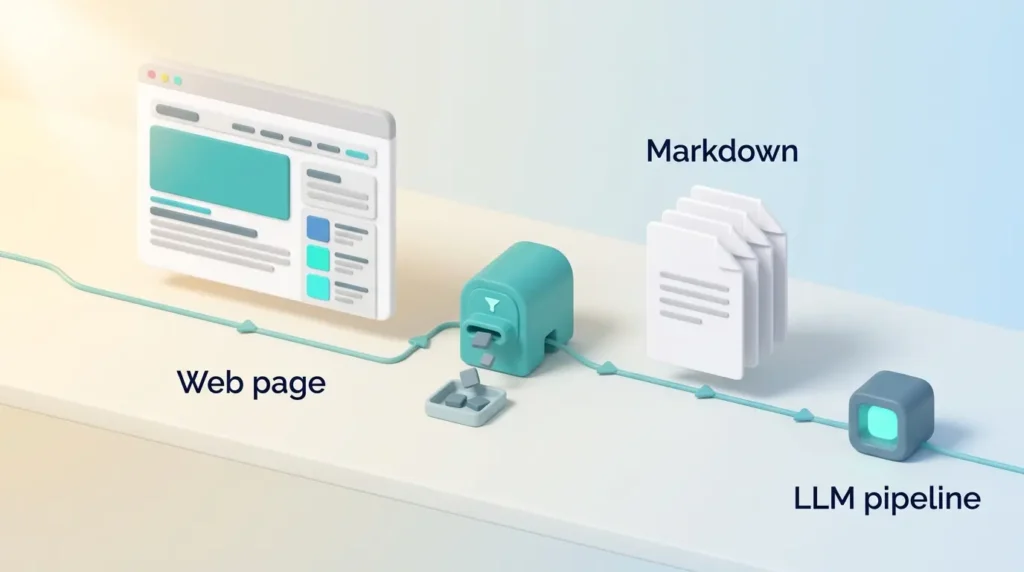
Markdown Output Built for LLMs
Point the scrape endpoint at a URL and you get clean markdown that preserves headings, lists and links — or raw HTML if you prefer to post-process yourself. The markdown path removes most of the boilerplate stripping you would otherwise write by hand before chunking and embedding.
That matters because prompt quality tracks input quality. Feeding models tidy markdown instead of navigation-heavy HTML is one of the cheapest quality wins available in an LLM ops pipeline.
Crawling Entire Domains
The crawl endpoint discovers a site’s sitemap and indexes it page by page, billed at 1 credit per page. You avoid writing queue management, retry logic and politeness controls yourself.
Practical uses: building a knowledge base behind a support bot, keeping documentation embeddings fresh, or crawling academic PDFs at scale. If you are evaluating bot platforms that ingest site content this way, our Chatbase review covers the packaged alternative.
Extract, Screenshots and Monitors
- Extract (10 credits): hand it a JSON schema and it crawls the site and returns data shaped to match — no selectors to maintain.
- Parse Bytes (1 credit): converts an uploaded document to markdown; 5 credits when OCR is needed.
- Web Search (1 credit per result) and Get Screenshot (5 credits).
- Monitors: the newest addition — watch any page for changes and react to diffs instead of re-crawling on a timer.
The pricing detail that stands out: there is no stealth surcharge. Competing scraping APIs commonly bill JS rendering or anti-bot bypass at a 5–25× credit multiplier. Here it stays at 1 credit per page, and failed or blocked requests are not billed at all.
Start Building RAG Pipelines with Context.devLogo Link: The Clearbit Logo API Replacement
Logo Link is a separate product with a separate quota, and it is the single most frictionless thing on the platform.
You build a URL containing a public client ID and a domain, drop it into an img tag, and a square logo comes back from a global CDN at roughly 20ms. No SDK, no backend call, no response to parse, no asset storage.
- Frontend safe: it uses a public client ID rather than a secret key, so it is safe in client-side code.
- No rate limits — delivery is fair-use based and does not touch your API credits.
- Always current: logos are refreshed automatically, so rebrands propagate without a migration.
- 10K requests free on the free tier, scaling to 100K (Developer), 2.5M (Pro) and 10M (Scale).
The catch worth knowing: storage is not permitted on Logo Link. It is designed for ephemeral, real-time embeds. If you need to cache logos indefinitely — for brand kits, exports or offline assets — you must use the Core API’s logo endpoints instead, which cost credits but allow indefinite caching.
Rule of thumb: Logo Link for anything rendered live in a UI or email, Core API for anything you save to disk.
The Brand API for Personalization and Enrichment
The Brand API takes a domain, company name, email address, stock ticker or a single direct page URL, and returns a structured company profile: multiple logo variants, colour palette, fonts, description, social profiles, address and industry classification.
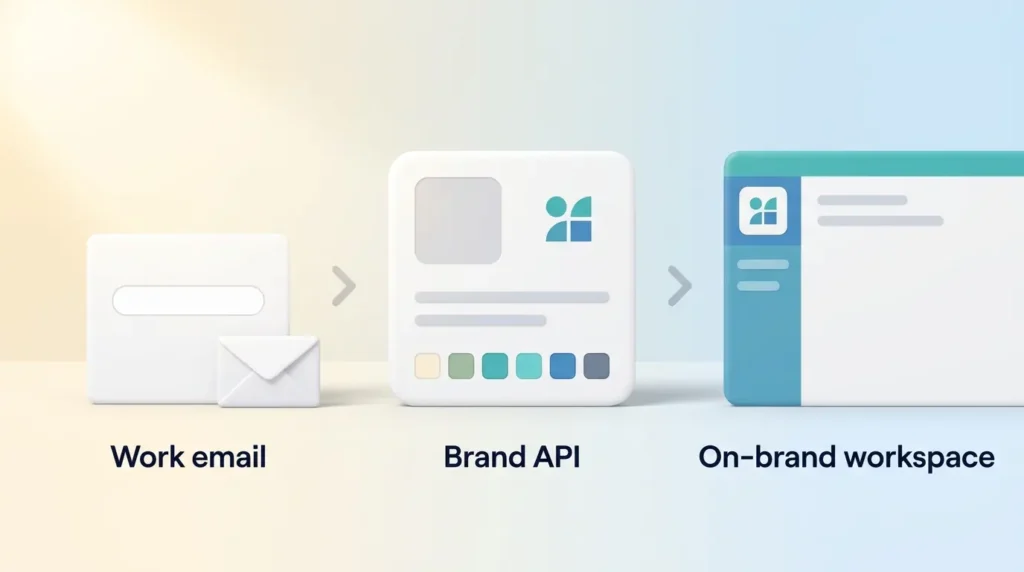
For SaaS signup flows, that turns a bare email field into a pre-filled, on-brand workspace. Combined with real-time data in decision-making, it is the difference between an empty state and a product that looks like it already knows the customer.
- Retrieve Brand — 10 credits. The main enrichment call.
- Search Brand — 1 credit, and free on Pro and Scale plans.
- Get Fonts — 5 credits; Get Styleguide — 10 credits.
- NAICS / SIC lookup and transaction identification — 10 credits each, useful for fintech and compliance workflows.
- Enrich People — 20 credits from an email, social URL, or name plus company.
Freshness and latency, honestly stated: cached brand data is refreshed quarterly, and anything older than three months is re-fetched on request. A first-time domain lookup can take 10–30 seconds while the site is crawled; roughly 70% of requests hit the cache and return quickly. Use the Prefetch endpoint — which is free and rate-limit exempt — to warm records ahead of time.
If your actual need is contact-level B2B data rather than company branding, this is the wrong tool. Compare our FullEnrich review for waterfall email and phone enrichment, or the ZoomInfo review for full sales intelligence.
Context.dev Pricing 2026: Plans and Credit Costs
Pricing is credit-metered and considerably cheaper at the entry point than it was under the old Brand.dev structure.
| Plan | Price | Credits/month | Overage per 10K | Rate limit | Logo Link |
|---|---|---|---|---|---|
| Free | $0 | 500 (one time) | — | 30/min | 10K |
| Developer | $25 | 10,000 | $15 | 60/min | 100K |
| Pro | $149 | 200,000 | $9 | 300/min | 2.5M |
| Scale | $499 | 1,000,000 | $7 | 700/min | 10M |
| Enterprise | Custom | 2M+ | Volume discount | Custom | Custom |
What Each Endpoint Costs
| Endpoint | Credits |
|---|---|
| Scrape Markdown / HTML | 1 (2 with browser actions) |
| Crawl Website | 1 per page |
| Web Search | 1 per result |
| Search Brand | 1 (free on Pro / Scale) |
| Get Screenshot / Get Fonts | 5 |
| Retrieve Brand / Styleguide / Extract | 10 |
| NAICS / SIC / Transaction ID | 10 |
| Enrich People | 20 |
Three details that change the maths: annual billing saves two months on every paid plan; startups and nonprofits can apply for up to 30% off for a year; and failed or blocked requests are never billed.
To size a plan, multiply your daily calls by 30, weight brand and extraction calls by 10×, and compare against the included allowance. At around 250K pages a month, Pro plus overage works out cheaper than jumping to Scale.
Claim Your Free Credits & Test Context.devWhere Context.dev Falls Short
No review is useful without the downsides, so here are the ones that came up repeatedly in user feedback and in the docs.
- Colour extraction is imperfect. Users report the API sometimes struggles to distinguish a primary brand colour from an accent. Budget for a manual override field.
- Quarterly refresh means staleness. A company that rebranded last month may still return old assets until you request a manual update.
- Cold-start latency. First-time domains can take 10–30 seconds. Anything user-facing needs prefetching or an async pattern.
- No one-time lookups. It is a subscription; there is no pay-per-call option for a single project.
- Not self-hostable. The API is proprietary and hosted; only the SDKs are open source.
- Compliance is on you. The platform does not surface per-domain robots.txt or terms-of-service changes, so a pipeline built on a site that later restricts crawling will not warn you.
If you need exactly one capability — raw HTML scraping and nothing else, or a logo CDN and nothing else — a single-purpose vendor will almost certainly be cheaper. The bundle only pays off across two or three pillars.
Who Should Actually Use It
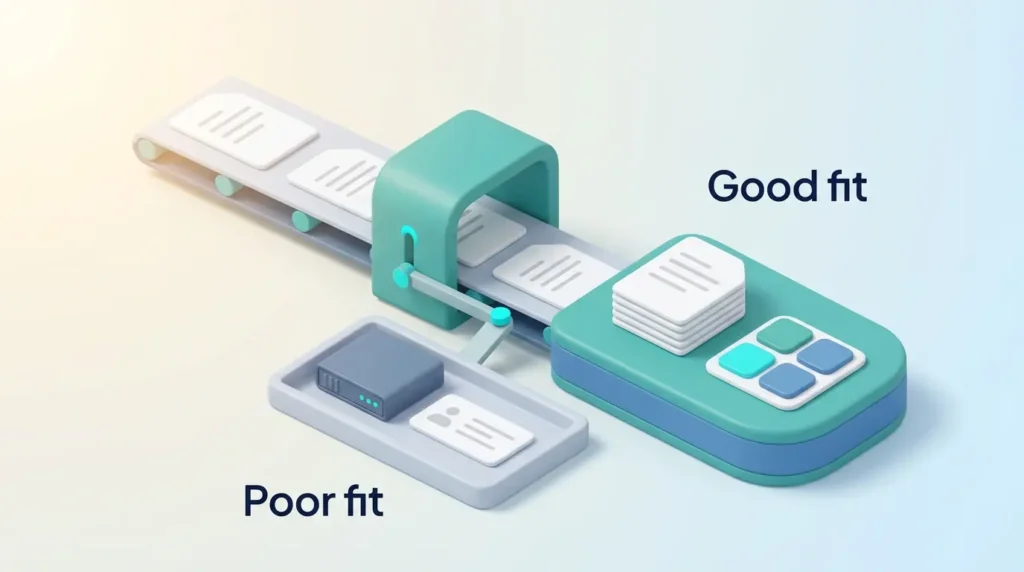
Good fit:
- AI and RAG teams that want clean markdown without owning proxy and anti-bot infrastructure.
- SaaS products personalizing onboarding from a work-email domain.
- CRM, fintech and directory apps that display thousands of company logos and want zero asset management.
- Small teams consolidating three vendor contracts into one, with SOC 2 Type I in place and Type II in progress.
Poor fit:
- Teams needing person-level contact data — use a dedicated enrichment provider.
- Projects requiring on-premise or self-hosted scraping for data-residency reasons.
- One-off scrapes where a subscription cannot be justified.
Verdict
Context.dev earns its place when you use more than one of its three pillars. The scraping API is good enough to replace Firecrawl-class tooling for most RAG work, Logo Link is the most frictionless Clearbit replacement currently available, and the Brand API goes deep enough to power onboarding personalization that most teams otherwise half-build and abandon.
The credit model is unusually honest for the category — no stealth multipliers, no billing on failures, published per-endpoint costs. The weak points are brand-data freshness, colour accuracy and cold-start latency, none of which are dealbreakers if you design around them.
Start on the free tier with a work email. 500 credits is enough to scrape 500 pages or enrich 50 brands, which will tell you within an afternoon whether the output quality clears your bar.
Start Integrating Context.dev TodayFound this useful?
Make SmartKeys a preferred source on Google, and our articles will surface more often in your Top Stories, AI Overviews, and AI Mode.
Add as Preferred Source