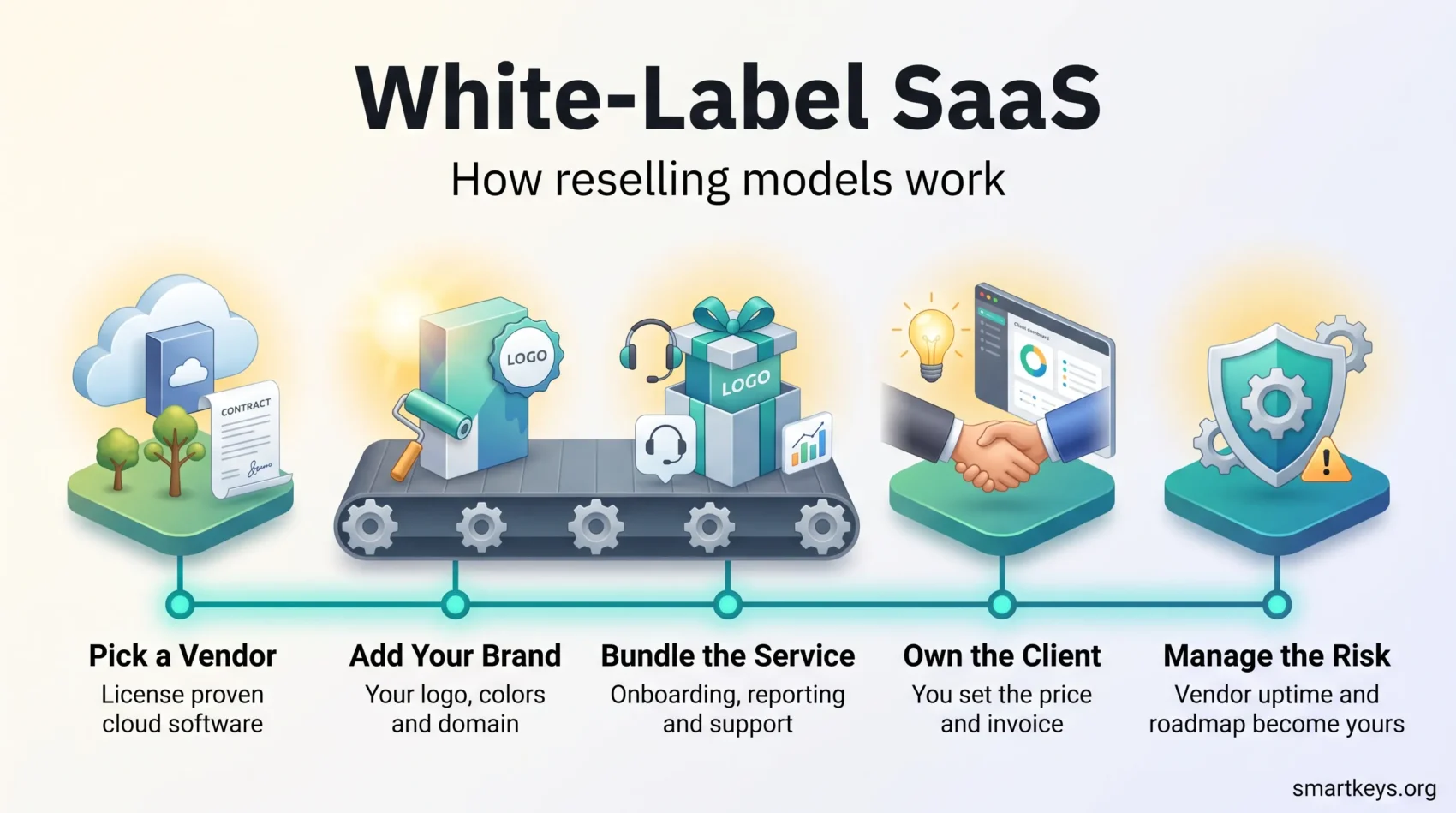
White-label SaaS lets you sell another company’s software under your own brand. The vendor builds and maintains the product; you own the branding, the pricing and the customer relationship. For agencies, consultancies and niche operators, it turns a product roadmap they could never fund into a service they can launch in weeks.
The model has grown with the software market itself. Gartner’s July 2026 forecast puts worldwide software spending at $1.47 trillion for 2026, up 15.5% year on year and among the fastest-growing categories in enterprise IT. More budget flowing through subscriptions means more room for resellers who can package, brand and support software for a specific audience.
Key Takeaways
- You sell a vendor’s software as a service under your own name, without funding development.
- Launch time is measured in weeks rather than the months a custom build needs.
- Your margin comes from the licensing deal, not from engineering effort.
- Owning the brand builds recognition and raises switching costs for clients.
- You inherit the vendor’s uptime, roadmap and security posture – for better or worse.
- Support expectations land on you, even when the fix does not.
Understanding White-Label SaaS
Two ideas sit behind the term. “White label” describes a finished product sold without the maker’s branding so the buyer can put their own name on it. Software as a service means the application runs on the vendor’s infrastructure and is sold by subscription rather than as a licence you install and host yourself. Combine the two and you get cloud software that you rebrand and resell as your own.
The practical enabler is multi-tenant cloud architecture. One codebase serves many customers, each with isolated data and its own theme, domain and logo. That is why a vendor can hand you a fully branded instance without writing a separate product for you.
How It Differs From Ordinary Reselling
A plain reseller sells the vendor’s product under the vendor’s name and earns a commission. A white-label partner sells it under their own name, sets the price, issues the invoice and answers the support ticket. The upside is control and margin; the cost is that you carry the customer relationship end to end. If you are weighing which route fits, the trade-offs mirror those in any partner ecosystem strategy.
Benefits of White-Label SaaS Solutions
- Cost efficiency: you pay licence fees instead of salaries for an engineering team, and the vendor absorbs hosting and maintenance.
- Speed to market: configuration and branding replace a build cycle, so launches are measured in weeks.
- Scalability: adding clients is a licensing question rather than an infrastructure project.
- Focus: your team spends its time on positioning, onboarding and service – the parts clients actually pay you for.
The same logic drives independent operators building narrow products on existing platforms, a pattern covered in the micro SaaS business model.
How White-Label SaaS Works
The mechanics are straightforward, but the details of the agreement decide whether the model earns money or quietly loses it.
Acquiring and Branding the Software
You start by selecting a SaaS vendor and negotiating a licensing deal – typically a per-seat or per-account fee, sometimes with a platform minimum. You then apply your logo, colour palette, custom domain and email templates so the product reads as yours from the first login screen. Consistency matters here: the software becomes a chapter of your brand story rather than a bolt-on tool.
Before you sign, read the contract for the parts that bite later: data ownership and export, uptime commitments, notice periods, price-increase clauses, and whether the vendor may sell directly to your clients.
Integration into Existing Business Models
Once branded, the solution has to fit the services you already sell. That usually means aligning features with your delivery process and connecting the tool to the systems around it. You can strengthen the offer by:
- Bundling the software with onboarding, configuration and reporting
- Adding your own customer support tier and service-level promise
- Connecting it to billing, CRM and analytics through integration platforms
Platforms such as HighLevel and SocialPilot expose admin settings, client sub-accounts and reseller pricing controls precisely so partners can do this without engineering help.
Why White-Label SaaS Keeps Growing
Demand comes from two directions at once: buyers want tools tailored to their sector, and service firms want products to sell without becoming software companies.
Trends Driving the Growth of White-Label SaaS
- Subscription delivery is now the default for business software, which makes reselling a licensing exercise rather than a distribution one.
- AI features have raised the baseline of what a product must do, and few agencies can build that themselves – see how AI is driving SaaS innovation.
- Buyers increasingly prefer software shaped around their industry, the same pull behind industry cloud solutions.
- Clients want fewer suppliers, so a partner who can bundle software with service wins on convenience.
Market Value and Growth Projections
Reliable figures for the white-label segment on its own are scarce, because most vendors report reseller revenue inside their overall subscription numbers. What is documented is the size of the pool it draws from: Gartner’s 2026 forecast places software at $1.47 trillion of a $6.37 trillion global IT spend, growing faster than IT services.
Two structural shifts sit underneath that growth. Vendors are consolidating, which narrows the field of partners you can safely bet on – a dynamic we cover in SaaS consolidation. At the same time, buyers keep moving toward specialised tools, as our review of the vertical SaaS landscape shows. Both favour resellers who own a clearly defined niche.
Key Advantages of White-Label SaaS for Resellers
Reselling existing software changes your cost structure, your launch timeline and the way you compete.
Cost Efficiency and Low Upfront Investment
Building a competitive SaaS product means paying for design, engineering, security review, hosting and support – then paying again every year it stays in market. Licensing shifts that from a capital project to a variable cost tied to how many clients you sign.
The trade is margin for certainty: you will not capture the full subscription price, but you also will not fund a roadmap that never finds product-market fit. Pricing the package well protects the difference, which is worth thinking through alongside a go-to-market plan.
Rapid Market Entry and Brand Customization
Because the product already exists, the work in front of you is configuration, branding and packaging rather than development. Teams routinely go from signed agreement to first paying client inside a quarter.
Branding is the second advantage, and it compounds: when clients log in to a tool carrying your name, renewals feel like renewing with you. Many partners pair a low-friction entry tier with paid upgrades, borrowing from the freemium model.
Top Industries Embracing White-Label SaaS Solutions
Adoption is heaviest wherever an agency already manages something on a client’s behalf and needs a dashboard to prove it.
Email Marketing and Customer Relationship Management (CRM)
Email marketing platforms were among the first to offer white-label tiers, because agencies were already sending on behalf of clients. Rebranding the sending interface and the reports turns a tool cost into a service line. CRM software followed for the same reason: the agency configures pipelines and reporting, the client sees the agency’s brand. The direction of travel there is covered in our overview of CRM trends, and the wider shift in agency deliverables in digital marketing in 2026.
SEO Tools and Chatbots as Examples
SEO tools are a natural fit: rank tracking, site audits and competitor analysis produce recurring reports that clients want under their agency’s letterhead. Chatbots and support assistants are the faster-growing category, since a single deployment can be resold across dozens of client sites with different branding and knowledge bases. Our guide to AI-powered chatbots in customer service looks at where they hold up and where they still need a human.

Challenges in Adopting White-Label SaaS Solutions
The model moves risk rather than removing it. What you gain in speed you give up in control, and the failure modes are predictable enough to plan for.
Quality Control and Dependency on Vendors
Your product is only as good as your vendor’s. If they ship a regression, miss a security patch or quietly deprecate a feature your clients rely on, you carry the consequences without the ability to fix the code. Roadmap control is gone too: a feature your best client needs may sit behind a priority you cannot influence.
Compliance is the sharper version of the same problem. You are the contracting party your clients see, so their data-protection questions land on you even though the data sits on someone else’s infrastructure. Clarify processor roles, sub-processors, hosting regions and breach notification before launch – the ground covered in a proper data governance strategy.
Navigating Customer Expectations and Support
Support is where white-label arrangements most often strain. Your clients expect you to answer, but many fixes require the vendor, which puts a hand-off in the middle of every serious ticket. Set response commitments you can actually meet with that hand-off in place, and negotiate an escalation path with named contacts rather than a shared inbox.
Rising expectations here are not unique to resellers, as our look at customer service trends shows, but the middleman position makes them harder to meet. For broader context, see our overview of cloud computing trends.
What White-Label Reselling Looks Like in Practice
What matters more than headline revenue stories is how vendors structure the offer, because that structure sets your economics.
How Vendors Package the Offer
Social media management is a clear worked example. SocialPilot’s published plans run from Essentials at $20 per month through Standard at $40 and Premium at $100 to Ultimate at $200 per month on monthly billing, with white-label reporting appearing at the Premium tier and fuller white-label customisation at Ultimate. The shape is typical: entry tiers are priced for individual users, and rebranding is gated behind an agency-level plan.
Read it as a template: find where branding control starts, check how many client accounts each tier supports, then confirm your per-client price still leaves a margin after support time.
How Agencies Build Around It
The partners who make this work rarely sell the software alone. They wrap it in setup, strategy, reporting and a named contact, then price the bundle against the outcome rather than the tool. It is also the defence against a client discovering the underlying vendor: what they buy is the service layer, not the login. The economics resemble those of any platform business model, where value accrues to whoever owns the relationship.
The Future of White-Label SaaS
The white-label market is being reshaped by the same forces acting on software generally: AI features, consolidation among vendors and buyers who want fewer, deeper supplier relationships.
Predictions for Market Evolution and Innovation
Expect AI capability to become the main differentiator between white-label platforms, since it is the hardest thing for a reseller to replicate. Expect more granular partner tiers as vendors separate light rebranding from full multi-tenant control. And expect procurement scrutiny to rise, with clients asking who processes their data before they ask what the dashboard looks like.
A build-versus-buy question sits underneath all this: for some capabilities, assembling open components is now a credible alternative, a path examined in our piece on open-source strategy.
Anticipating Changes in Consumer Demand
Buyers have grown used to consumer-grade software and judge branded tools by that standard. Slow interfaces, thin onboarding and generic reporting are noticed immediately. The resellers who hold their accounts are the ones who narrow their focus: a specific industry, a specific workflow, configured properly, with reporting that answers the question the client actually asks.

Conclusion
White-label SaaS is a distribution model, not a shortcut to a software business. It removes the cost and delay of building a product and replaces them with a dependency you have to manage deliberately: your vendor’s roadmap, uptime, security posture and pricing all become yours by association.
Handled well, the trade is a good one. Pick a niche you already understand, negotiate for data portability and a real escalation path, price the bundle rather than the licence, and treat support as the product it effectively is. For the wider pricing and retention context this model sits in, see our overview of subscription business trends.
The partners who struggle are the ones who treat the software as the whole offer. The ones who succeed sell an outcome, and use someone else’s code to deliver it.
Found this useful?
Make SmartKeys a preferred source on Google, and our articles will surface more often in your Top Stories, AI Overviews, and AI Mode.
Add as Preferred Source