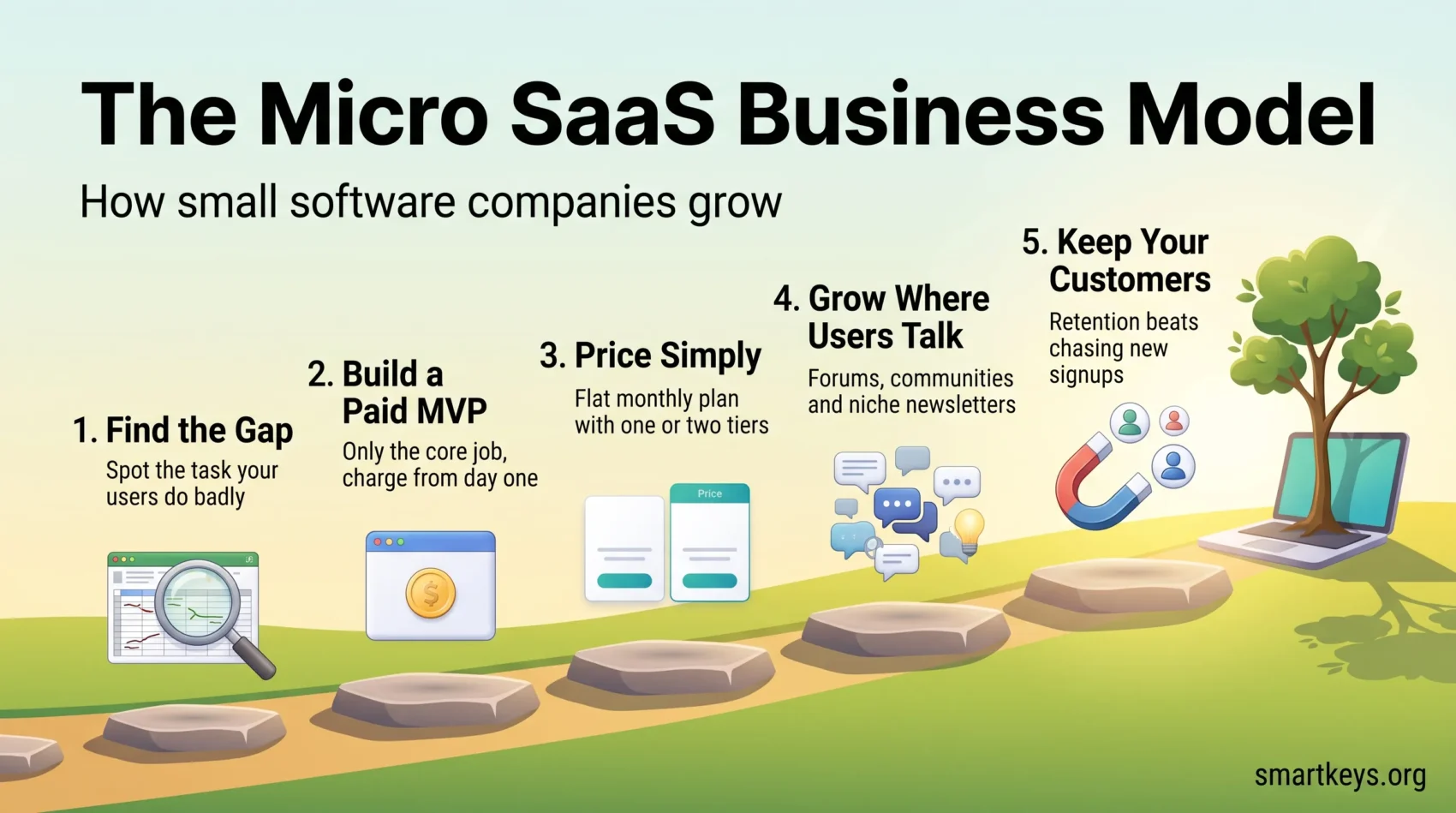
Micro SaaS means a small software subscription business, usually run by one person or a very small team, that solves one narrow problem for a clearly defined group of users. Think of a tool that does nothing but turn podcast episodes into show notes, or one that only checks whether a shop’s product feed matches Google’s rules. It is the deliberate opposite of the all-in-one platform.
The model matters in 2026 because companies keep spending more on software, and a growing share of that money is spent by individual teams rather than by a central IT department. Gartner forecast in February 2026 that worldwide software spending would reach about $1.43 trillion this year, an increase of 14.7% over 2025. A niche tool needs only a tiny slice of that to support its founder.
Key Takeaways
- Micro SaaS means one narrow problem, one clearly defined audience, and usually one or two people running the whole business.
- The model works because the fixed costs of running software collapsed. Hosting, payments and even parts of the build are now rented by the month.
- Most founders self-fund instead of raising money, which changes the goal: cover a salary early rather than grow at any cost.
- The hardest part is not building the product. It is being found by the few thousand people who need it.
- Gartner expects worldwide software spending to reach roughly $1.43 trillion in 2026, growing 14.7% year on year.
What Micro SaaS Actually Means
Software as a service (SaaS) means you rent software over the internet instead of installing and owning it. Micro SaaS is the small end of that market. The product is intentionally narrow, the team is tiny, and the customer base is counted in hundreds or low thousands rather than millions.
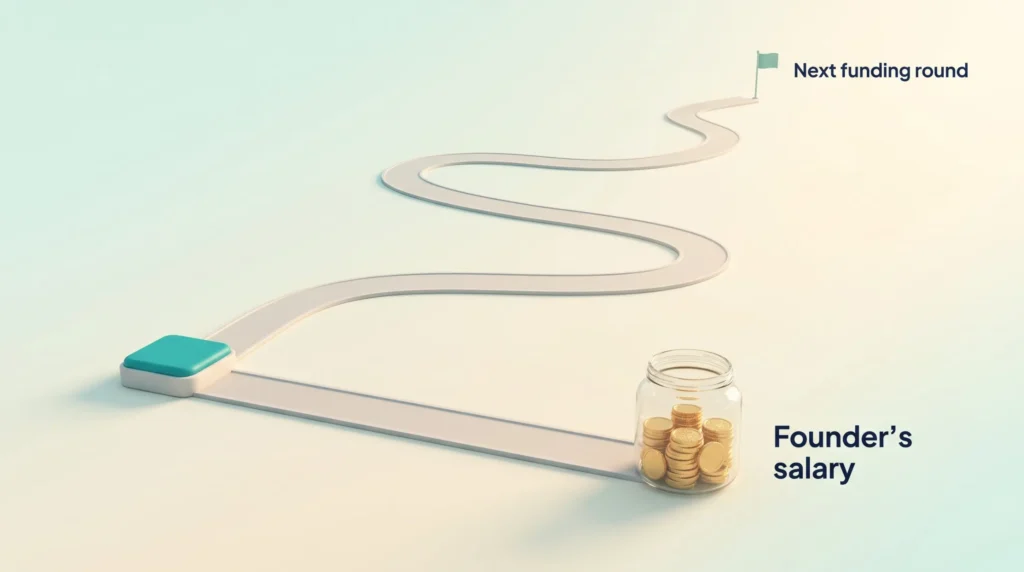
Two things separate it from a conventional startup. The first is scope. A micro SaaS founder turns down most feature requests on purpose, because breadth is what makes software expensive to maintain. The second is funding. Most micro SaaS products are bootstrapped, meaning the founder pays for development out of savings or early revenue rather than raising venture capital. Our overview of startup funding trends covers what the alternative route looks like right now.
That combination changes the definition of success. A venture-backed company has to grow fast enough to justify its next funding round. A micro SaaS only has to cover the founder’s salary and its own bills. The second target is far closer, and reaching it is a real business rather than a milestone on someone else’s timeline. Our article on the shift away from growth at all costs explains why more founders now aim there deliberately.
What Makes Micro SaaS Different in Practice
A single product focus is the clearest difference. Because there is only one thing to improve, feedback turns into shipped changes in days rather than quarters. Users notice this, and it is often the reason they stay.
The cost base is the second difference. There is no sales team, no office and usually no marketing budget beyond a domain name and a few subscriptions. That keeps the break-even point low enough that a few hundred paying customers can be enough.
The third difference is who answers support tickets. In a micro SaaS it is almost always the person who wrote the code. That is slow at scale, but it produces something larger companies pay consultants to recreate: a direct line between what customers struggle with and what gets built next. It also tends to keep churn low, since users who feel heard rarely leave quietly.
Where the Market Sits in 2026
Software spending keeps rising
Gartner’s February 2026 forecast put worldwide software spending at roughly $1.43 trillion for the year, up 14.7% on 2025. It is the fastest growing part of overall IT spending apart from data center hardware. For a small vendor, the useful detail is not the headline number but its shape: a market that large fragments into thousands of specific jobs that no single platform handles well.
Why small tools survive next to large platforms
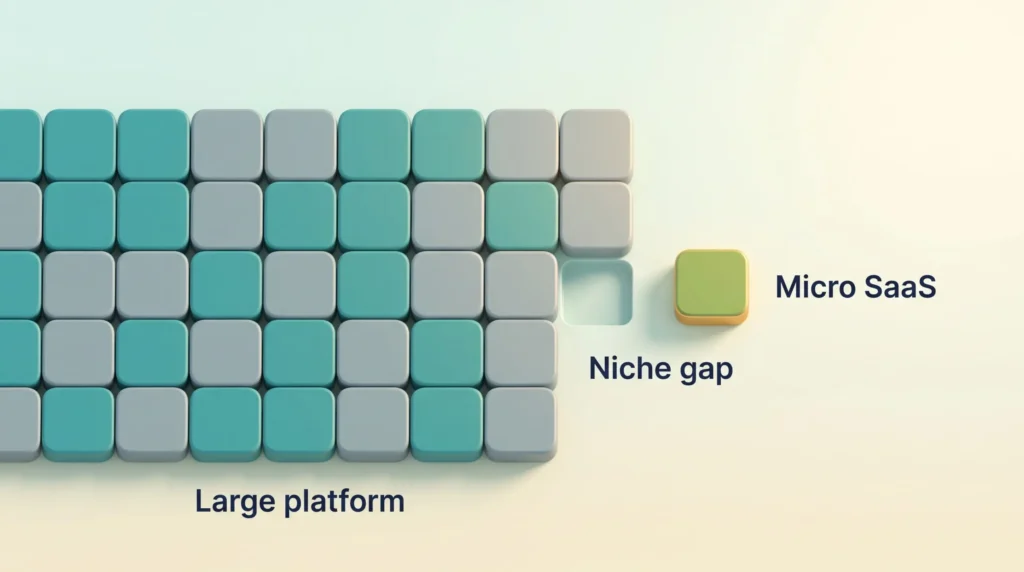
Big platforms are built for the average customer. That is a rational choice for them, and it is exactly what leaves gaps. A payroll suite used by 200 industries cannot afford to build the one report that dental practices need every quarter. A micro SaaS can, because 800 dental practices paying $29 a month is a good outcome for one person and a rounding error for the incumbent.
This is the same logic that drives vertical SaaS, software built for a single industry rather than a single function, and it is why industry-specific tools keep appearing even in categories that look settled. The difference is scale, not strategy.
Consolidation cuts both ways here. As larger vendors buy each other, some customers end up on a platform they did not choose, priced in a bundle they do not need. That reliably creates demand for something smaller. Our piece on SaaS consolidation covers what happens when your vendor gets acquired.
Why Micro SaaS Became Possible
Running software stopped being a capital expense
Twenty years ago, launching a web product meant buying servers. Today hosting, databases, email delivery and payment processing are all rented monthly and priced from near zero. A product with no users costs almost nothing to keep online, which means a founder can be wrong several times without going broke.
No-code and low-code lowered the build barrier
Low-code platforms let people assemble working applications from visual components instead of writing everything from scratch. That does not make everyone a developer, but it does mean a domain expert with no engineering background can ship a first version. Our guide to what non-technical staff can realistically build sets out where the limits sit, and our Bubble.io review covers one of the common starting points in detail.
AI shifted the ratio of building to selling
Code assistants have compressed the part of the job that used to take longest. That is genuinely useful, and it has a side effect worth naming: when building gets cheaper for you, it gets cheaper for everyone else too. The scarce resource moves from engineering hours to distribution and trust. The wider picture of AI in SaaS shows the same pattern: near-universal adoption, uneven returns.
How to Find and Test an Idea
Most micro SaaS products fail at the idea stage rather than the build stage. The founder picks a problem that sounds plausible, builds carefully for six months, and then discovers that nobody was willing to pay to solve it. Two steps prevent most of that.
Look for the gap before you look for the feature
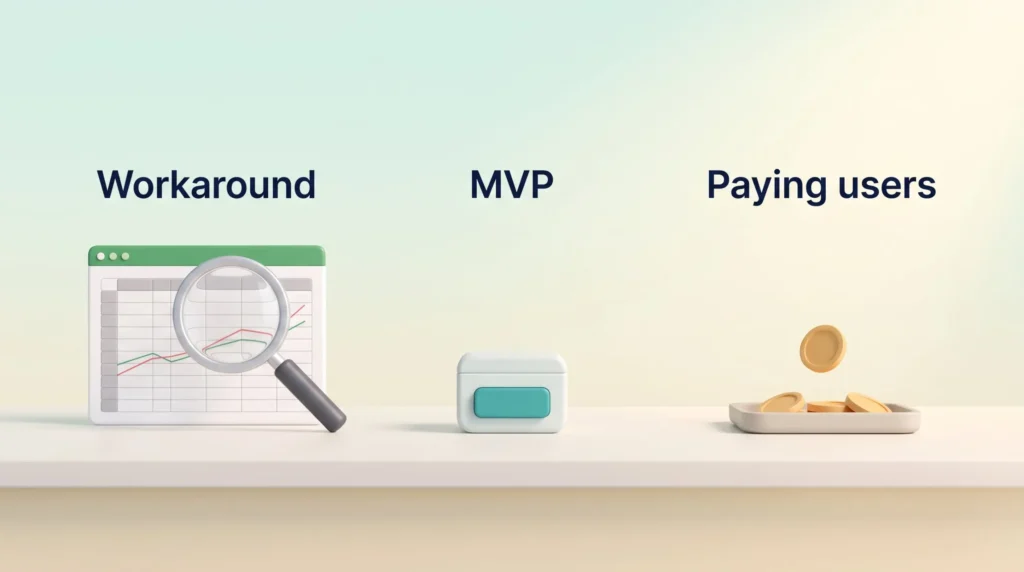
Start with a group of people whose work you already understand, then find the task they do badly. Three sources are reliable. Ask ten of them which part of their week they dread, and listen for the answer that repeats. Read the one-star and three-star reviews of the tools they already pay for, because those describe the exact job the incumbent refuses to do. And watch where they build workarounds: a shared spreadsheet, a manual export, a weekly round of copy and paste. A workaround is a problem someone has already paid for in time.
Write the gap down as one sentence that names who has it and what it costs them today. A bookkeeper who spends two hours every Friday reformatting bank exports is a product idea. “Small firms need better reporting” is not.
Build the smallest version someone can pay for
A minimum viable product (MVP) is the first version that does only the core job and nothing else. Its purpose is not to be a small product. It is to answer one question cheaply: will these people pay? So cut everything that is not the job itself. No settings page, no team accounts, no integrations beyond the one your first users named. Doing part of the work by hand behind the scenes is fine at this stage, and you automate it once the payments are real.
Then put it in front of a handful of real users and charge from the first day, even a small amount. Free users tell you the idea is interesting; paying users tell you it is a business. Ten customers found this way are worth more than a thousand signups from a launch post, because you can ask each of them what made them pay. Our guide to scaling beyond an MVP covers what changes once that answer stays the same across customers.
How Micro SaaS Businesses Charge
Most start with a flat monthly subscription and one or two tiers. It is simple to explain, simple to forecast, and it fits products where every customer uses roughly the same amount.
Two alternatives are worth knowing. Usage-based pricing charges per unit consumed, which suits tools whose costs scale with volume, such as anything that calls a paid AI model on the customer’s behalf. Value-based pricing sets the price against what the customer gains rather than what delivery costs, which works when the saving is easy to quantify. Many products end up combining a base fee with a usage component. If you are setting a first price, start from what the customer saves rather than from what a competitor charges.
A freemium tier is tempting and often a mistake at this size, because free users still generate support work. And because buyers now audit their subscription lists, being one more $19 line item is a real risk. Our article on subscription fatigue covers what that means for retention.
Growth Strategies That Fit a Small Team
The realistic goal is not a marketing campaign. It is to be present where a specific group of people already discusses the problem you solve: a subreddit, a trade forum, a Slack community, a niche newsletter. That takes months and does not scale, which is precisely why larger competitors will not do it.
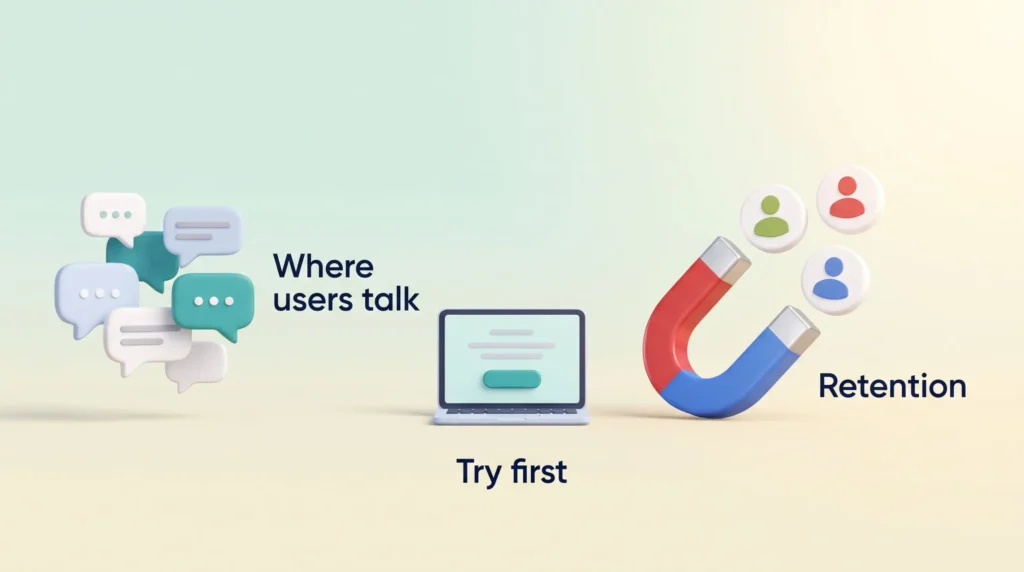
Three practices do most of the work. Write for the exact search a frustrated user types, rather than for a broad keyword. Let people try the product before talking to you, which is the core of a product-led approach. And treat the first fifty customers as a research panel, not just revenue. If you are planning a launch in a sequence rather than improvising, our go-to-market playbook lays out the steps.
Retention matters more here than acquisition. At a small scale, losing five customers a month is the difference between growing and standing still, so the work described in our guide to customer retention pays back faster than chasing new signups does. Outbound has its place once you know exactly who buys, and tools like the one covered in our Clay review handle the research and enrichment side. Our overview of AI in marketing is worth reading before automating any of it, because the disclosure rules changed this year.
The Hard Parts
Being found
This is the constraint that ends most micro SaaS attempts. The product works, the pricing is fair, and roughly nobody knows it exists. Distribution has to be part of the plan from the first week, not a phase that starts after launch.
Crowded niches
Low barriers cut both ways. Any niche visible enough to be obvious probably already has five tools in it. Differentiation usually comes from depth in one workflow or from serving a segment the others treat as an afterthought, not from a longer feature list.
Single person risk
One founder is the developer, support desk, marketer and accountant. Illness, burnout or a good job offer can stop the company. Documented processes, automated backups and a plan for who takes over the domain and the payment account are unglamorous but real parts of the job.
Platform dependency
Many micro SaaS products live inside someone else’s ecosystem: a browser extension store, a Shopify or WordPress marketplace, a social platform’s API. That is a fast route to distribution and a permanent source of risk, since the platform can change its terms, its pricing or its API without warning.
Examples Worth Studying
Two well-documented cases show how the model develops over time.
Kit, the email platform for creators, began as a narrow tool aimed at bloggers who found general-purpose email marketing software a poor fit. It rebranded from ConvertKit in October 2024 as it broadened into a wider creator platform. The arc is typical: start narrow enough to be obviously the right choice for one group, then widen only once that group is served.
Gumroad, which lets independent creators sell digital products, took a different turn and published its codebase as open source in April 2025. That is worth studying for the trade-off rather than the outcome. Opening the code can build trust and attract contributors, and it also removes any technical moat.
Neither company is a template. Both are useful because their decisions and reasoning are public, which is rare at this size. If you are looking at the broader independent business trend, our article on micro-entrepreneurship covers the ground beyond software.
What to Watch Next
Compliance now reaches small vendors. Since 2 August 2026, the transparency rules in Article 50 of the EU AI Act have applied: people have to be told when they are interacting with an AI system, and certain AI-generated content has to be marked as such. A one-person company selling into the EU is not exempt, so if your product includes a chatbot or generates text or images, that disclosure belongs on your roadmap.
Pricing is drifting toward consumption for anything built on AI models, simply because the underlying cost varies per customer. Flat pricing over a variable cost base is how a profitable product quietly turns unprofitable.
Acquisition is a realistic exit. Small profitable products change hands regularly, and the buyer is often another small operator rather than a large company. That makes clean books, documented code and low customer concentration worth more than a growth chart. Our coverage of ESG reporting in SaaS shows what larger buyers increasingly ask vendors to document before they sign.
Conclusion
Micro SaaS is not a shortcut to a large company. It is a different bet: solve one problem properly for a group nobody else finds worth serving, keep costs low enough that a few hundred customers is a living, and stay close enough to those customers that you always know what to build next.
The conditions favour it. Software spending is growing, running a product costs little, and building is faster than it has ever been. The scarce part is attention. If you can reliably reach the people with the problem, the rest of the model is more forgiving than most business plans you could write.
Found this useful?
Make SmartKeys a preferred source on Google, and our articles will surface more often in your Top Stories, AI Overviews, and AI Mode.
Add as Preferred Source