Venture capital is the money professional investors put into young private companies in exchange for a share of the business. In the first half of 2026 there was more of it than ever before, and it was harder than ever for a normal company to reach.
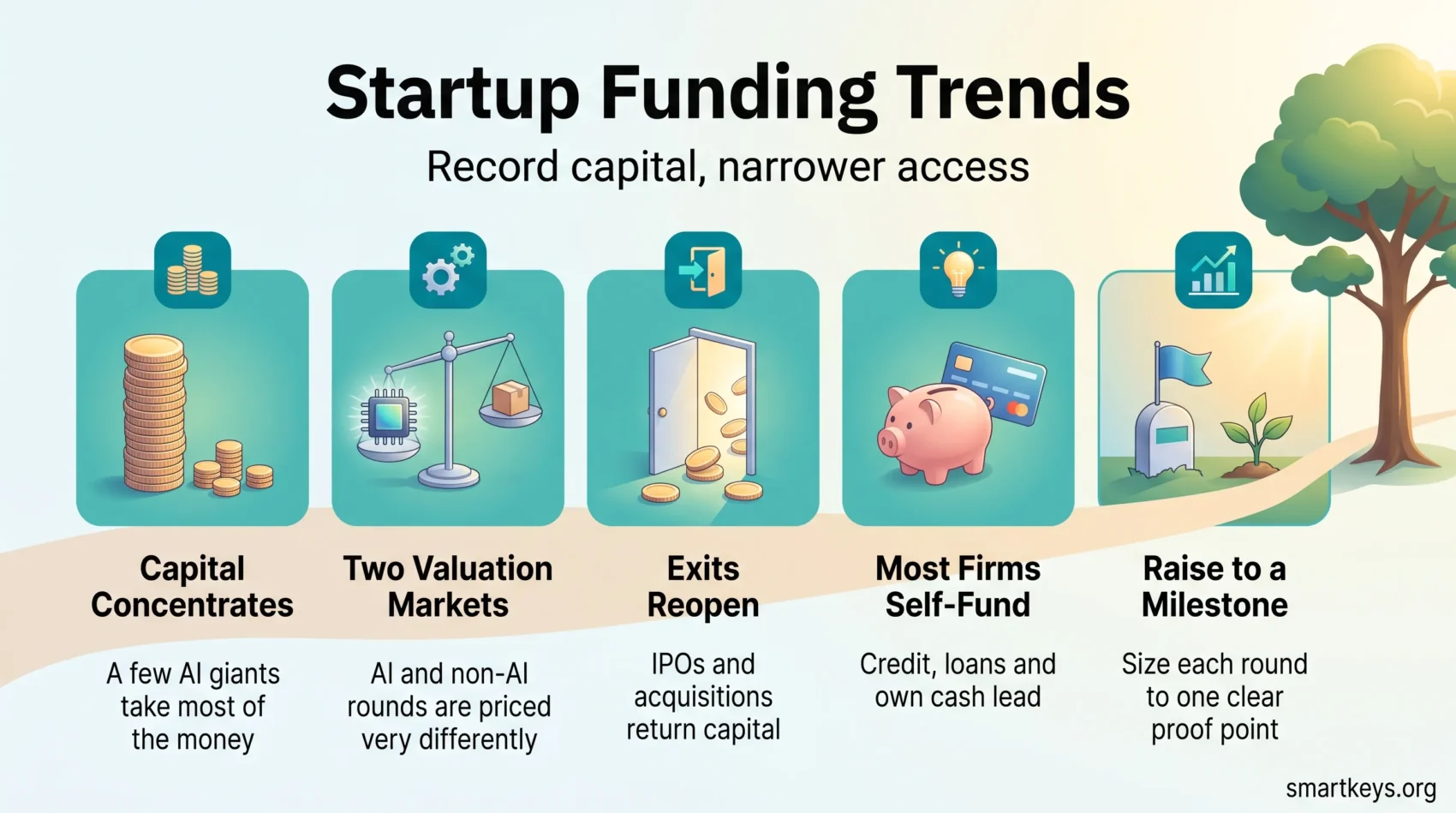
Crunchbase counted a record $510 billion of global startup investment in the first six months of 2026, more than the $440 billion raised across all of 2025. Yet two companies, OpenAI and Anthropic, took $217 billion of that, which is 43% of every venture dollar in the half. More than 70% of the capital invested in the second quarter went to companies working on artificial intelligence.
So the headline and the experience on the ground point in opposite directions. Money is abundant in one narrow lane and normal everywhere else. This guide explains what the 2026 numbers actually say, and what they mean for the round you are planning. If you want to see where funding fits among formation, sector and exit shifts, start with our overview of the broader startup trends beyond funding.
Key takeaways
- Global venture funding hit a record $510 billion in the first half of 2026 (Crunchbase).
- The record is concentrated: OpenAI and Anthropic alone accounted for 43% of it.
- More than 70% of second-quarter capital went to AI companies, which distorts every average you read.
- Outside AI, valuations are disciplined rather than booming, and diligence is slower.
- Most companies never raise venture capital at all, so plan financing around cash you can control.
What actually changed in 2026
Three shifts matter more than the rest, and each one changes how you should read a funding headline.
The record is real, and it is narrow
Crunchbase put global startup investment at $510 billion in the first half of 2026, with roughly $205 billion of that in the second quarter across more than 5,000 companies. The first quarter was even larger at about $305 billion, inflated by a small number of enormous AI rounds.
Strip out those rounds and the picture is ordinary. When two companies take 43% of a half-year total, the “average” round tells you almost nothing about your own market.
AI is not a sector any more, it is the market
More than 70% of the capital invested in the second quarter of 2026 went to AI-focused companies. That has a knock-on effect on everyone else: investor attention, senior engineering talent and even data centre capacity are being bid up by a handful of very well funded buyers.
If you are building something that is not AI, this is the main thing to plan around. You are not competing with other companies in your category for capital so much as competing with a category that is absorbing most of it. Our overview of how AI is changing business operations covers where those budgets are actually landing.
Geography narrowed, then loosened slightly
North America took about 83% of global venture funding in the first quarter of 2026 and roughly two-thirds in the second. That is still heavily concentrated by historical standards, and it shapes who you can realistically pitch from where you sit.
Stage by stage: what a round looks like now
Funding stages are simply the steps a company takes as it raises larger amounts: pre-seed and seed at the start, then Series A, B and C as revenue and headcount grow. Each stage now behaves differently.
Seed is small and crowded
Seed rounds totalled roughly $12 billion globally in the second quarter of 2026, a fraction of the overall market. Within that, about $2.8 billion went into so-called mega seed rounds of $100 million or more, while traditional seed rounds of $10 million and under accounted for about $5 billion.
The practical reading: the seed label now covers two very different things. A first cheque for a two-person team and a $100 million round for an AI lab share a name and nothing else.
Late stage recovered hard
Late-stage investment reached about $134 billion in the second quarter of 2026, up roughly 141% from the same quarter a year earlier. That is where the megadeals sit. For a growth-stage company outside AI, the useful signal is that capital exists at this stage again, but it goes to companies with proven unit economics rather than to a story.
Valuations: two different markets
Carta, which administers cap tables for thousands of startups, reported that the down-round rate fell to 11.4% in the first quarter of 2026, back in line with 2019 and 2020 levels. A down round is a raise at a lower valuation than the previous one, so a falling rate means fewer companies are being repriced downwards.
The same data shows the split clearly. Carta noted that an AI foundational model startup raising a Series A might do so at a median valuation around $300 million, while a non-AI startup at the same stage sits closer to $55 million. Series B and Series C pre-money valuations were up 17.2% and 12.5% respectively against a year earlier.
Two conclusions follow. First, do not benchmark your valuation against AI headlines. Second, if you are not in that lane, the market is workable but unforgiving: it wants retention, margin and payback, not narrative. Our guide to building for profitability rather than growth at any cost goes deeper on the metrics that now carry weight.
How most companies actually get funded
Venture capital dominates the coverage and funds a very small minority of businesses. Most owners finance growth through ordinary credit and their own cash.
The Federal Reserve’s Small Business Credit Survey, published in 2026 and covering a survey run in late 2025, found that 86% of small employer firms use financing on a regular basis, most commonly credit cards and loans. Sixty percent applied for financing in the previous twelve months. Of those applicants, 42% received the full amount they asked for, 36% received some or most of it, and 22% received none.
That last number is the one to plan around. Roughly a fifth of firms that ask for money get nothing, so a plan that assumes approval is a plan with a single point of failure.
What to do with that
- Size the ask to the milestone. Raise for a specific proof point, not for a runway number that sounds comfortable.
- Keep more than one route open. Bank credit, revenue-based finance, grants and angel money all have different speeds and different costs in equity.
- Treat friends and family like investors. Written terms, regular updates and an honest description of the risk protect the relationship as much as the cap table.
- Spend to learn. Cheap experiments that answer a real question beat expensive ones that confirm what you already believed.
Many founders never intend to raise institutional money at all, and that is a legitimate path rather than a fallback. The economics of running lean are covered in our piece on micro-entrepreneurship and in our review of what small businesses are prioritising this year.
Sectors in focus
Capital patterns differ sharply by sector, so the benchmark that matters is the one from your own category.
Artificial intelligence

AI took more than 70% of second-quarter capital, and within that the money is concentrated again at the top. For founders this cuts both ways. Investor interest is easy to get. Differentiation is very hard, because the largest labs can outspend you on compute, data and hiring at the same time.
The teams raising well in 2026 tend to show a specific, measurable result rather than a general capability: a support queue cleared faster, a claims process with fewer errors, an inference bill that came down. Our analysis of AI inside SaaS products looks at why so few of these projects show a measurable return, and the current state of AI regulation covers the compliance work that now sits alongside them.
Fintech
Fintech is the clearest example of money going up while access goes down. Crunchbase reported $28.6 billion of global fintech venture funding in the first half of 2026, up nearly 23% year over year. But it landed in 1,605 deals, down 25.7% from the 2,161 deals in the first half of 2025 and down about 40% from 2024.
Fewer, larger cheques. The United States took about $15 billion of that total, roughly 52%, with the United Kingdom at $2.7 billion and India at $1.9 billion.
Investor attention has moved toward financial infrastructure, wealth management and enterprise automation rather than consumer apps. If you are in this category, our coverage of fintech trends, embedded finance and open banking sets out where the durable revenue sits.
Cybersecurity
Security spending is defensive, which makes it relatively resilient when budgets tighten: a breach costs money whether or not the economy is good. Buyers in 2026 want tools with measurable prevention or detection value and a clean compliance story, not another dashboard. Our guides to cybersecurity trends and cybersecurity mesh architecture cover what buyers are actually specifying.
Everything else
Categories outside the AI lane face longer diligence and tighter terms. That is not the same as being closed. Investors are still funding software with clear payback, and the wave of SaaS consolidation means well-run smaller companies also have a credible acquisition path, not only a funding one.
Exits reopened, which matters more than it sounds
Funding and exits move together. Investors commit to new companies more readily when they can see money coming back out of old ones.
The second quarter of 2026 was a record exit quarter by Crunchbase’s count: 32 companies went public at valuations above $1 billion, and 24 acquisitions closed at $1 billion or more, together worth about $113 billion. The largest single deal was the acquisition of Anysphere for roughly $60 billion.
For a founder, an open exit market shortens the horizon investors are underwriting. It also makes a strategic sale a more realistic plan rather than a consolation prize.
The funding gap for female founders
The headline here improved and the underlying picture did not change much.
PitchBook data reported in early 2026 showed female-founded companies raised a record $73.6 billion in 2025, close to double the $44.7 billion of 2023. But two companies, Anthropic and Scale AI, accounted for more than $30 billion of it. Remove them and the record disappears.
That is the same concentration effect as the overall market, and it means the record should not be read as broad-based improvement. In practice, founders raising against this backdrop do better by targeting investors with a visible track record in their category, by leading with revenue and pilot evidence rather than projections, and by using non-dilutive capital to buy time.
Survival odds: what the official data shows
Widely quoted claims that “90% of startups fail” are hard to source. US Bureau of Labor Statistics data shows that 22.1% of new private-sector businesses close within their first year and 48.6% within five, so roughly half are still trading after five years. That is a hard market, not a lottery, and it should shape how much you raise and how fast you spend it.
What tends to go wrong
The two recurring causes are simple. Companies build something people will not pay for, and companies run out of cash before they find out.
Both are addressable. Charge early, even a small amount, because willingness to pay is the only reliable test of demand. Then watch cash weekly, not monthly, so a problem shows up while you still have options. Our guide to business model innovation covers how to test a revenue model before you commit to it.
A practical playbook for raising in 2026
Turn the numbers above into a plan you can act on this quarter.
Set the milestone before the number
Decide what your next round has to prove, then price the round to fund exactly that plus a margin. A round sized to a milestone is easy to defend in a meeting. A round sized to a number is not.
Benchmark inside your own lane
Compare yourself with companies in your category and stage, not with AI headlines. If you sell software to mid-market buyers, the relevant comps are other mid-market software companies raising this year.
Bring proof, not projections
In a disciplined market, the metrics that move a decision are retention, gross margin, customer acquisition payback and pipeline quality. Have them ready before the first meeting, not after the second.
Get your pricing right first
Pricing is the fastest lever most companies have on the numbers investors care about, and it is usually the least examined. Our guides to building a pricing framework, value-based pricing and usage-based pricing cover the trade-offs.
Keep the process short
A live data room, a weekly metrics update and a tight schedule of meetings shorten diligence. Long processes lose momentum, and lost momentum costs more in terms than any negotiation point.
Plan the growth motion, not just the money
Investors fund a route to market, not a product. Whether you go product-led or sales-led changes your hiring plan, your burn and your comps, so decide it before you raise. Our go-to-market guide and our piece on scaling strategies set out the options. International expansion is usually a later question than founders expect.
What this means if you are raising in the United States
North America still takes the clear majority of global venture capital, so location shapes your investor list more than your product does.
The practical choice is between depth and fit. Bay Area investors see the most deep-tech and AI companies and move fastest on them. New York suits fintech and enterprise software, partly because the buyers are there too. Boston and Washington DC have real depth in health and public-sector technology.
Base yourself where your customers and your hires are, then travel deliberately for capital. A short list of well-matched meetings beats a long tour, and it costs less runway. Keeping a second coast and a second stage of investor warm is what creates competitive tension when you actually open the round. For the wider picture on where companies are being built, see our overview of current startup trends.
Conclusion
The 2026 funding market is genuinely two markets. One is a record-breaking boom in a narrow band of AI companies. The other is a disciplined, workable market for everyone else, where capital is available to companies that can show unit economics and a credible route to profit.
The mistake is reading the first market’s headlines as the conditions for the second. Benchmark inside your own category, size the round to a milestone you can name, keep more than one financing route open, and watch cash weekly. Those four habits matter more in 2026 than any prediction about where the cycle goes next.
Found this useful?
Make SmartKeys a preferred source on Google, and our articles will surface more often in your Top Stories, AI Overviews, and AI Mode.
Add as Preferred Source