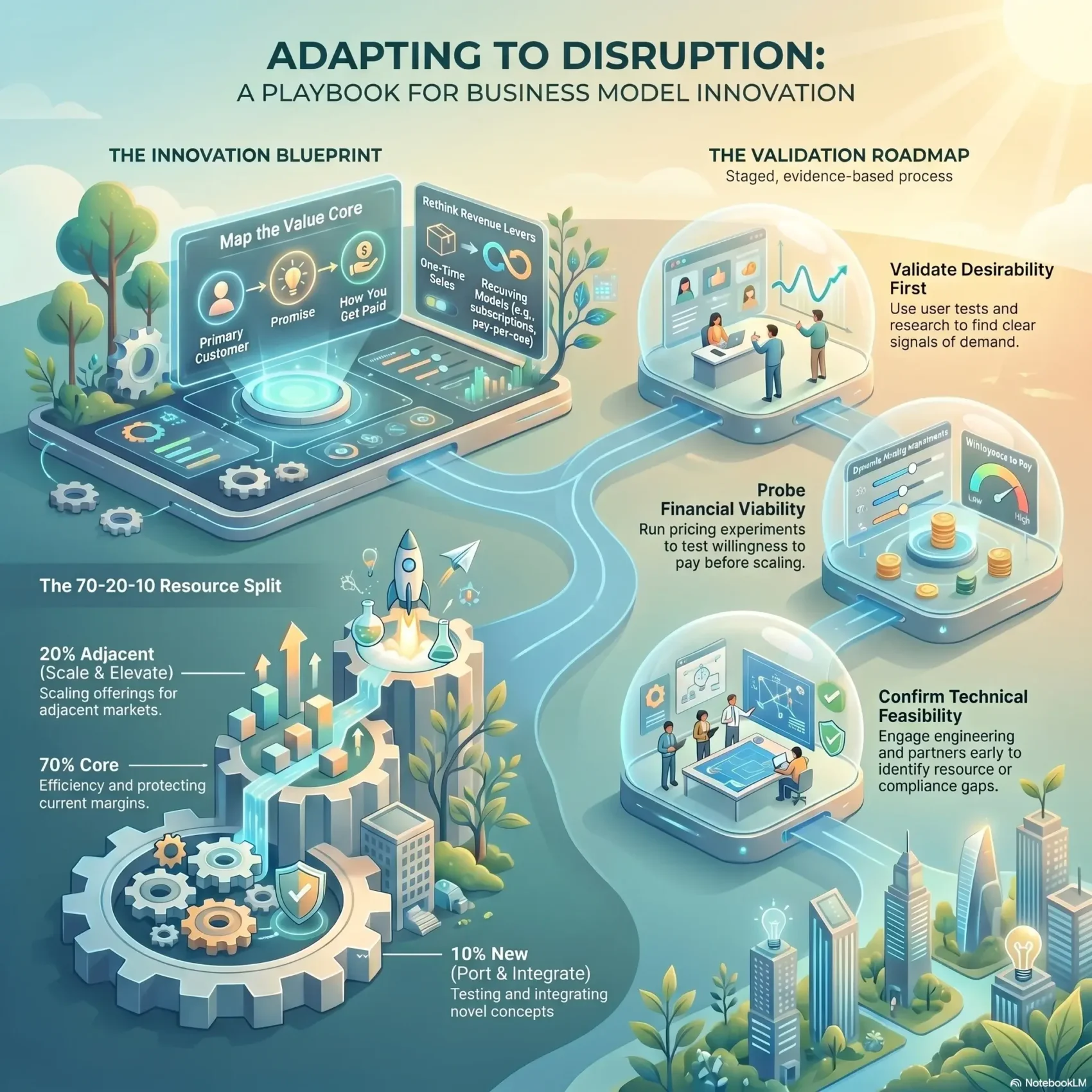
A business model answers three questions: who you serve, what you sell them, and how you get paid. Business model innovation means changing one or more of those answers on purpose, rather than waiting until the market changes them for you.
That is a bigger move than improving a product. A better camera sells more phones. A shift from selling software in a box to charging a monthly fee changes who buys, how sales works and when cash arrives. Netflix, Adobe and Uber all did the second kind of thing, and it reset what customers expected from everyone else in their market.
This guide shows you how to do it deliberately: map what you have today, spot the signals that it needs to change, test options cheaply, and scale only what proves itself.
Key Takeaways
- Map your current model first. You cannot change what you have never written down.
- A business model change beats a product tweak when the problem is how you earn, not what you sell.
- Watch the usual signals: falling margins, price pressure, and customers buying in a new way.
- Test with small, cheap experiments before you commit budget or restructure teams.
- Protect the core business while you experiment, and fund the experiments in stages.
Start here: write down the model you already have
Before you change anything, describe your current model in three plain lines. Most teams have never done this, and they disagree once they try.
- Who: the customer who actually pays. Not the user, not the influencer. The budget holder.
- What: the promise you make, in one sentence, in the words a customer would use.
- How: the way money reaches you. One-off purchase, monthly fee, usage charge, commission, advertising, or a mix.
A small accounting firm might write: “We serve owner-managed companies with under 50 staff. We keep their books correct and their filings on time. They pay a fixed monthly retainer.” That fits on a sticky note, and every argument about strategy gets clearer once it exists.
Turn beliefs into things you can check
Each of those lines rests on assumptions. “Customers want a fixed fee” is a belief until you test it. Write each belief as a sentence that could turn out to be wrong, then rank them by how much damage a wrong answer would do.
Then attach a number to every idea. Not “improve retention”, but “move onboarding into week one and see whether 90-day churn drops”. Ideas without a metric never get judged, so they never get killed.
Why the pressure is real right now
In PwC’s 29th Global CEO Survey, published in January 2026 and based on 4,454 chief executives across 95 countries, 42% said their company had started competing in new sectors over the previous five years. Among those planning a major acquisition, 44% expected to buy outside their own industry. Industry boundaries are moving.
The same survey found that about half of CEOs treat innovation as central to strategy, but only 8% had made significant progress on at least five of the six innovation practices it measured. Intent is common; follow-through is not.
Why it matters: margin, resilience and growth
Differentiation
A competitor can copy a feature in a quarter. Copying how you charge means rebuilding sales compensation, billing and forecasting, which takes far longer. That is why a pricing change can hold an advantage longer than a product change. If you are choosing an approach, start from a structured pricing strategy framework rather than matching the nearest competitor.
Resilience
A business that earns in only one way is fragile. Mixing one-off revenue with recurring revenue softens the hit when one channel stalls. The same logic applies to supply and to distribution: a single source of anything critical is a single point of failure.
Growth into space you already half occupy
The cheapest new market is usually the one next to your current one, where your existing strengths still count. That is the argument for deliberate product diversification rather than a leap into unfamiliar territory.
Frameworks worth using, and what each one is for
You do not need all of these. You need one for mapping, one for testing, and one for finding space.
Business Model Canvas: for mapping
The Business Model Canvas, published by Alexander Osterwalder and Yves Pigneur in 2010, is a single page with nine boxes: customer segments, value proposition, channels, customer relationships, revenue streams, key resources, key activities, key partners and cost structure. Its value is not the boxes but the contradictions they expose. A premium promise sitting next to a low-touch channel becomes obvious once both are on the same page.
Lean Startup: for testing
Lean Startup, from Eric Ries, is a method for learning cheaply. State an assumption, build the smallest thing that can test it, measure what people actually do, then decide whether to continue or change direction. That smallest thing is often not software: a landing page with a price on it answers most early questions for a fraction of the cost.
Blue Ocean and disruption: for finding space
Blue Ocean Strategy, from W. Chan Kim and Renee Mauborgne, asks which factors your industry competes on and whether you could drop some entirely. Budget airlines dropped meals, seat allocation and connecting flights, and competed on price and frequency instead.
Disruption theory, associated with Clayton Christensen, describes a different route: start with a simpler, cheaper product for customers the incumbents ignore, then improve until you reach the mainstream.
Use the canvas to see the model, Lean Startup to test a change, and the other two to decide which change is worth testing. Then set a rule for how an idea moves between stages, so decisions rest on evidence rather than on who argued hardest.
The levers you can actually pull
How you charge
- Subscription: for customers who want continuous access and a predictable cost. Check the current state of subscription business models before you commit.
- Freemium: a free tier builds reach and heavy users convert. The freemium model only works when the free version has a clear ceiling.
- Usage-based: the bill follows consumption. Usage-based pricing suits uneven demand, but makes revenue harder to forecast.
- Value-based: the price reflects the result the customer gets. Value-based pricing needs evidence of that result, so it comes later.
Prices can also move with demand and stock. Dynamic pricing works well in travel and retail, and badly where customers expect a stable, published price.
What you promise
Rewrite your value proposition around the outcome, not the feature list. “Your payroll runs on time without your involvement” beats “automated payroll with 40 integrations”: it names what the buyer is anxious about.
How you reach people
Selling direct gives you margin and a direct relationship, and hands you acquisition, fulfilment and support in return. That trade is the core of any direct-to-consumer strategy. Selling through partners is faster but puts someone between you and the customer, so plan the distribution model first. Comparing the two means comparing acquisition cost and reach side by side, which is what omnichannel strategies are for. Whether the product sells itself or needs a salesperson is a separate decision, weighed up in product-led versus sales-led growth.
Cost, platforms and partners
Automation and self-service lower the cost to serve, which is often what makes a cheaper tier viable at all. A platform business model, where you connect two groups rather than serving one, can grow faster but takes longer to reach critical mass. Partnerships fill gaps in data, distribution or compliance more cheaply than building those capabilities.
Four examples, and what each one actually changed
Netflix: from stock to access
Netflix began as a DVD-by-mail rental service, added streaming in 2007, and closed the DVD business in September 2023, 25 years after launch. The change was not technical. Renting a disc means limited stock and a return date. A flat monthly fee removes the decision a customer makes before every single title.
Adobe: from purchase to subscription
Adobe sold Creative Suite as boxed software with a large upfront price, then moved to Creative Cloud subscriptions and stopped selling new perpetual versions in 2013. The lower entry price widened the customer base and made revenue recurring rather than tied to release cycles. Many existing customers hated it, which is worth remembering: a good business model change is not automatically a popular one.
Uber and Airbnb: from owning to matching
Neither owns the cars or the rooms. They match supply that already exists with demand and take a cut. That removes the capital cost of growth and replaces it with a harder problem: building both sides of a marketplace at once, in every new city.
Apple: from product to ecosystem
Apple sells devices, then services that work best with those devices. Each added service makes leaving more expensive. The lesson is not “build an ecosystem”, but that switching costs, once earned, do more for retention than any campaign.
Three horizons: running today and tomorrow at once
The common failure is not a shortage of ideas. It is that new ideas compete for attention with the business that pays the bills, and lose.
The usual fix is to sort work into three horizons. Horizon one is the core business you run now. Horizon two is adjacent work that could scale within a couple of years. Horizon three is genuinely new, and most of it fails.
In a 2012 Harvard Business Review article, Bansi Nagji and Geoff Tuff described a 70-20-10 split of innovation resources across those levels, which is where the widely quoted ratio comes from. Treat it as a starting point: a company in a fast-moving market needs more in horizons two and three, one defending a stable position needs less.
What matters more than the ratio is the gate between stages. Decide in advance what evidence lets an idea move forward, and what evidence kills it. Without that, horizon three becomes a place where projects live forever without being judged.
A step-by-step process you can run
1. Set the scope
Name the outcome and the deadline. “A second revenue stream worth 10% of revenue within 18 months” is a scope. “Innovate” is not.
2. Generate three to five options
Write down real alternatives: a new customer segment, a different pricing model, a partner-led channel, a platform play. Fewer than three, and you are defending a decision you already made.
3. Test whether anyone wants it
Talk to buyers, show a prototype, run a landing page. You want someone who changes their behaviour, not someone who says it sounds interesting.
4. Test whether anyone will pay
Ask for a price, a deposit or a signed letter of intent. Willingness to pay is the assumption most often skipped, and the most expensive one to get wrong.
5. Test whether you can deliver it
Bring engineering, operations, legal and finance in early. Integration, licensing and compliance problems are cheap to find now and expensive to find after launch.
6. Fund it in stages and operate it
Release budget against milestones rather than in one block, then keep measuring after launch. Whether the new model covers its own cost is a profitability question; growing it afterwards is a different discipline, covered in scaling strategies.
Where these efforts usually fail
- Planning instead of testing. A twelve-month strategy document answers fewer questions than four weeks of customer calls.
- Copying a competitor’s model without their cost base, brand or distribution.
- Ignoring unit economics. If you lose money per customer, growth makes it worse.
- No owner. A new model that reports to nobody gets starved the first time the core business has a bad quarter.
- Bad data. If you cannot see what customers actually do, you cannot judge an experiment. A working customer data platform is a prerequisite, not an extra.
Conclusion
Business model innovation is a habit, not a workshop: write down the model you have, name the assumptions it rests on, test the risky ones cheaply, and fund what survives.
Keep the core business healthy while you do it, keep the number of live experiments small enough that each gets a real decision, and judge them on what customers do rather than on how good the idea sounded in the room.
If your next move is a broader operating change, digital transformation and the current state of AI in business operations are the places to look. If it is a market move, customer retention and customer loyalty will tell you more than another framework will.
Found this useful?
Make SmartKeys a preferred source on Google, and our articles will surface more often in your Top Stories, AI Overviews, and AI Mode.
Add as Preferred Source