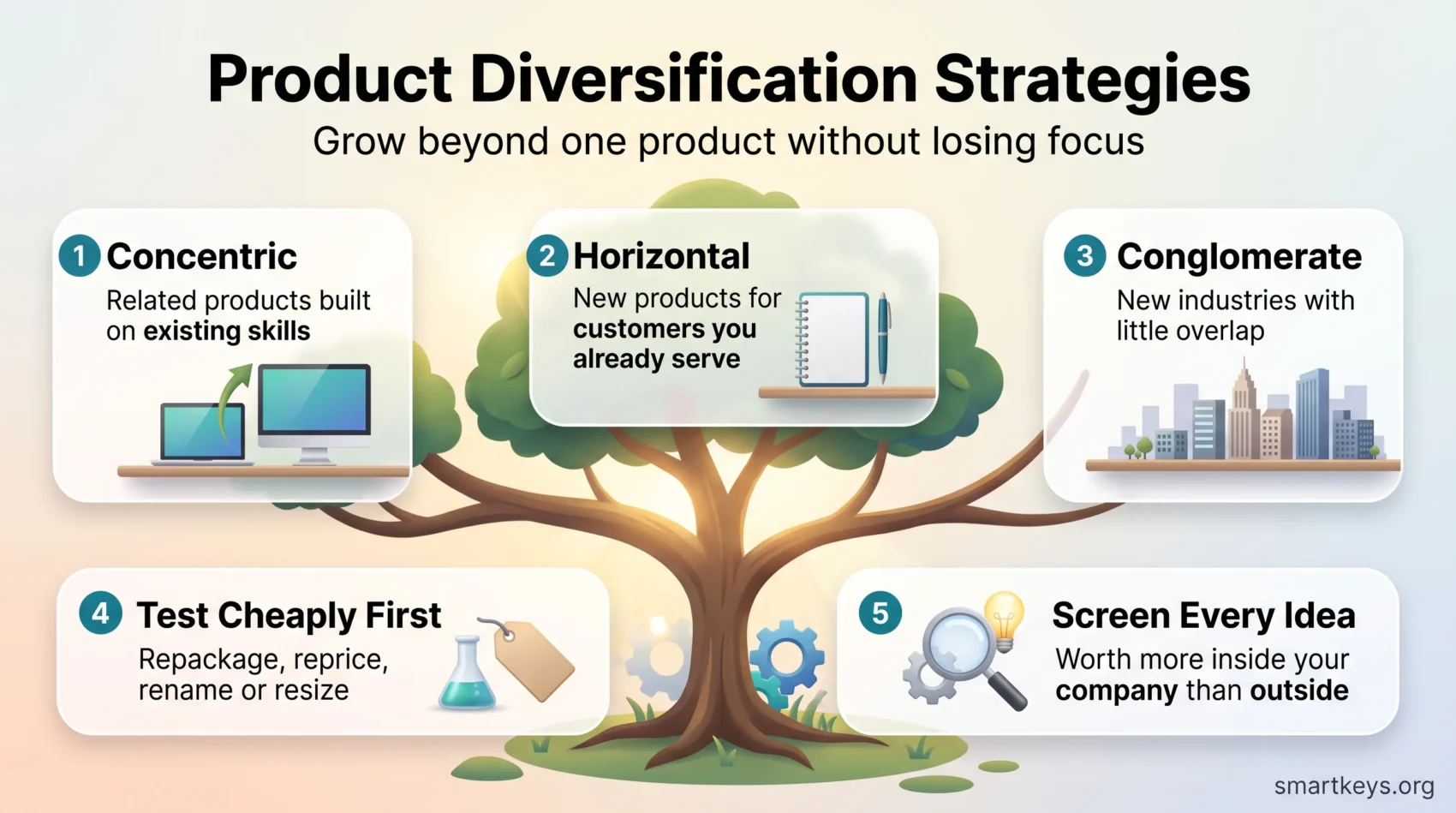
Product diversification means adding new products, services or markets so your revenue no longer depends on one thing selling well.
Done carefully, it steadies income, puts existing skills and channels to fuller use, and gives customers more reasons to stay. Done carelessly, it splits your attention and budget across businesses that never earn their keep.
This guide covers the difference in practice: what counts as diversification, how to choose between related and unrelated moves, which low-cost tests to run first, and the filters that stop a bad idea before it reaches the board.
Key Takeaways
- Diversification means new offerings, new markets, or both, and each combination carries its own level of risk.
- The Ansoff Matrix, a four-box growth chart from 1957, separates it from safer moves such as selling more to existing customers.
- Related moves that reuse your capabilities usually beat unrelated bets.
- 2026 is also a year of corporate breakups, so treat “more businesses” as a hypothesis, not a goal.
- Cheap tests come first: repackaging, repricing, resizing and channel experiments.
Why diversify, and why so many companies are doing the opposite
Spreading revenue across more products and more buyers makes sense once a single niche stops growing. If one line stalls, the others carry the quarter, and you reach customers your current range does not fit.
The practical benefits look like this:
- A wider revenue mix, so one weak product does not decide the year.
- Better use of what you already own: production capacity, distribution deals, customer data, staff expertise.
- More weight with suppliers and retailers as your volume grows.
- More room to absorb seasonality, shifting tastes and new regulation.
Here is the part most guides skip. While mid-sized companies are being told to diversify, several of the largest diversified companies are pulling themselves apart. General Electric, the textbook conglomerate, finished splitting into three separate listed companies when GE Aerospace and GE Vernova began trading on 2 April 2024, after GE HealthCare had already been spun off in January 2023 (CNBC). Investors keep pressing others to follow: law firm Skadden, citing Deal Point Data, counted 27 public activist campaigns aimed at breaking up US-listed companies in 2024 and 23 more through 1 December 2025.
The reason is what analysts call the conglomerate discount. Markets often value a group of unrelated businesses at less than the sum of those businesses would fetch on their own, because outsiders cannot judge each one clearly.
That does not make diversification wrong. It makes the bar specific: a new business has to be worth more inside your company than outside it. If your only argument is “another revenue stream”, the market will disagree.
What product diversification actually means
Adding new lines or variants lets you reach fresh customers without abandoning what already works. It grows sales volume by bringing new offerings to market and by stretching your existing range.
The key word is planned. You expand on purpose, toward segments you have researched, with a budget and a stopping rule, rather than saying yes to whatever a large customer asks for.
How it widens your product line and your market
You add variations, price tiers, or entirely new services that answer needs sitting next to the ones you already serve.
A well-judged extension keeps your core strengths in play and uses channels you have already paid to build, which is why it usually costs far less to launch than a move into unfamiliar territory. That logic is the same one behind a clear go-to-market strategy: reuse what already works before you build something new.
Business-level versus corporate-level moves
Business-level moves extend into adjacent parts of your own industry. A project management tool adding time tracking stays inside its market and serves the same buyers better.
Corporate-level moves mean entering a different industry: a software firm buying a training company, for example. These need capital, governance and patience, and they are where most value gets destroyed. Reviewing your business model innovation options first often shows a cheaper route to the same growth.
Before you scale either kind, check three things: that the capability already exists rather than being hoped for, whether you will bundle the new offering or sell it separately, and whether your channels and support can carry the extra load.
Where diversification sits in the Ansoff Matrix
The Ansoff Matrix is a four-box chart that Igor Ansoff published in Harvard Business Review in 1957. It sorts growth options by two questions: are you selling to existing or new customers, and are you selling existing or new products?
That gives four boxes. Market penetration means selling more of what you have to the people who already buy it. Product development means new products for existing customers. Market development means existing products for new customers. Diversification is the fourth box: new products for new customers, and the only one where both variables change at once.
How it differs from the other three moves
Because both sides are new, diversification usually needs capabilities you do not yet have and coordination across teams that rarely work together.
- Risk: the highest of the four boxes, and often the one requiring new hires or partners.
- Resources: a separate roadmap and separate targets, not a line item on an existing one.
- Sequencing: use payback estimates to balance safe moves against bolder ones.
A worked example: adding a reporting feature for existing customers is product development. Launching a hardware device for an industry you have never sold to is diversification. Both may be right, but they should not share an approval process. A consistent decision-making model keeps that distinction honest.
The three types of diversification
Picking the right path is mostly about how much of your existing capability the new business can reuse. The more it reuses, the cheaper and safer the move.
Concentric: related extensions
Concentric diversification means adding products that draw on skills or technology you already have. A desktop PC maker launching laptops is the classic case. Same engineering, same suppliers, largely the same buyers.
Horizontal: different products, same buyers
Horizontal diversification means selling something quite different to the customers you already reach. A notebook brand launching pens uses the same shelf space and the same buyer relationship, even though making pens is a different business.
Conglomerate: new industries
Conglomerate diversification puts you in a field with little or no overlap with your current business. It can spread risk across unrelated economic cycles, but it demands strong governance and strict capital discipline, and it is the type the market discounts most heavily.
Geographic expansion
Geographic expansion repeats a model that already works in a new country. The product stays broadly the same; tax rules, logistics and buying habits do not. Treat it as its own project with its own budget, and read up on global expansion strategy and cross-border e-commerce before you commit.
Low-cost moves you can test this quarter
Small changes to what you already sell often unlock demand faster than a new product line, at a fraction of the cost. Run these first, then use what you learn to justify anything bigger.
Repackaging or redesigning your landing pages can make the same product read as relevant to a new use case or age group, lifting shelf impact and click-through without touching the product itself.
Repricing and channel-specific positioning
Set different price tiers for specialty retailers and online channels. A higher price with premium placement can open doors to higher-margin stores. A structured pricing strategy framework keeps those tiers from undercutting each other, and value-based pricing gives you a defensible reason for the gap.
Renaming and rebranding
Adapt the name to local languages and norms so people can remember and pronounce it. A clear local name removes friction no advertising budget will fix later.
Resizing SKUs and brand extensions
Offer bulk sizes for wholesale and small counts for convenience retail. SKU here just means a distinct sellable version: a different size, colour or bundle counts as its own. Adding styles, colours or feature tiers meets different budgets without building a new product.
- Tip: align packaging, messaging and channel so all three point at the same customer.
- Use brand extensions to add higher and lower tiers that widen your reach without cheapening the core brand.
New markets or new products: which comes first
The choice starts with one honest question: is your growth limited by who you sell to, or by what you sell?
New markets are not only geographic. Age groups, job roles, company sizes and a move from consumer to business buyers all count. Segment first, then pick the one segment your current capabilities fit best.
Validate it by adapting packaging, messaging and minor features, then measure uptake, churn and feedback before you scale.
Finding and validating a new market
Start light: surveys, customer interviews, a landing page test, one channel experiment. Target one segment at a time so you can read the result. A customer data platform makes those signals easier to compare across segments.
- Age and persona: match tone and channel to how that group actually spends its attention.
- Company size: adjust pricing, service levels and onboarding for small businesses versus enterprises.
- Consumer to business: expect different packaging, contracts and support expectations.
Building new products for your existing customers
Prioritise ideas customers have asked for repeatedly, in their own words, using structured feedback rather than one enthusiastic account. Right-size the build to the question you are answering. Start with a minimum viable product, the smallest version that still tests the core assumption, then iterate. This grows share of wallet while keeping risk low, and it pairs well with the customer retention strategies you already run.
From niche to portfolio: your implementation roadmap
Map where your current offerings win and where they stall, then build the roadmap from that evidence rather than from ambition.
Analyse performance and fit
Assess sales trends, return rates and feedback for each line, at the individual product level rather than the category level.
Keep the dashboard simple: sales velocity, margin and repeat rate per offering. That is usually enough to show where to invest and where to cut. An analytics maturity model helps you judge whether your data is good enough to trust yet.
Set objectives with numbers attached
Define what success means: sales volume, customer count, margin. Attach figures and dates so you can tell later whether to scale, hold or stop.
Scan the market and the competition
Run a competitor review and size the opportunity. TAM and SAM are the usual shorthand here: total addressable market is everyone who could theoretically buy, and serviceable addressable market is the slice you can actually reach with your channels and licences. The gap between the two is where most optimistic business cases fall apart.
Test, validate, iterate
Use surveys, interviews and small pilots before full development. Pilots shrink the downside and sharpen your positioning, because early users describe the product back to you in language you can reuse.
Go to market and execute
Design a launch that aligns messaging, packaging, promotion and partners for each segment. Your distribution channels decide much of this, and strategic alliances can buy reach you would otherwise spend years building.
Assign resources properly: named owners, dates and success criteria. Add stage gates so the decision to continue is made deliberately rather than by default. Expect internal resistance too, which is why change management belongs in the plan and not as an afterthought.
For channel playbooks and cross-channel coordination, review a practical guide on omnichannel strategies to align your launches with customer touchpoints.
Integration paths: horizontal and vertical
Integration means buying or building capabilities next to your own, either sideways into competitors or up and down your supply chain.
Horizontal integration
Horizontal integration means merging with or acquiring a rival. It reduces competition and delivers economies of scale, meaning fixed costs spread across more units so each one costs less. Exxon and Mobil, or BP and Amoco, are the standard examples.
Vertical integration
Vertical integration means owning more of your own supply chain: upstream toward suppliers, or downstream toward the customer. Carnegie Steel owned mines, railways and mills. Apple runs its own retail stores to control how the product is sold, not just how it is made.
The trade-off is flexibility: owning a step in the chain means carrying its costs even when demand falls, which is why supply chain resilience planning belongs before the acquisition, not after.
Key risks and safeguards
- Risks: culture clash, integration complexity, overpaying, and complacency once the deal closes.
- Safeguards: disciplined valuation, cultural due diligence, named synergy targets, and a written integration plan before signing.
- Governance: treat it like any other large capital bet and put it through your risk management framework.
What the big examples actually teach
The famous cases are useful, as long as you read the ones that reversed course as well as the ones that worked.
GE: the case for and against
General Electric spent decades applying engineering scale across aviation, healthcare, energy and finance. It is the standard example of corporate diversification, and it is now the standard example of why breadth eventually became a liability: the group split itself into three focused companies by April 2024. The lesson is not that diversification failed. It is that the case for holding businesses together has to be re-argued as the businesses change.
Disney and Tata Group
Disney expanded from animation into parks, film and television while keeping one creative brand at the centre, so the additions reinforced each other. Tata Group grew from steel into hotels, aviation, vehicles and energy, an unusually broad spread held together by a group structure built for it.
Berkshire Hathaway
Berkshire shows that an unrelated portfolio can work when capital allocation is the actual skill. Its holdings span insurance, utilities, rail, retail and apparel. It also shows the succession risk in that model: Warren Buffett handed the chief executive role to Greg Abel on 1 January 2026 after sixty years, while remaining chairman (CNBC). A portfolio held together by one person’s judgement is exposed the day that person leaves.
Honda and Zippo
Honda built a core skill in small, reliable engines and applied it to motorcycles, cars, all-terrain vehicles, lawn mowers and outboard motors. That is capability leverage in its clearest form.
Zippo stretched a rugged brand into knives, flashlights and writing tools as lighter sales shrank, keeping the brand identity while changing the product. Both are related diversification: one reuses engineering, the other reuses brand meaning.
Decision filters and risk controls
Before you commit capital, put the idea through filters designed to reject it.
Michael Porter proposed three tests in Harvard Business Review in 1987 for judging whether a company should enter a new business at all.
Porter’s three tests
First, the attractiveness test: is the industry structurally profitable, or does everyone in it compete margins away? Second, the cost-of-entry test: will the price of getting in, whether through acquisition or building from scratch, ever be earned back? Porter’s own example was Philip Morris paying roughly four times book value for Seven-Up and struggling to recover it. Third, the better-off test: does the combination make at least one of the two businesses genuinely stronger?
Applying Five Forces
Porter’s Five Forces is a checklist for judging how profitable an industry is likely to be:
- Rivalry: how hard do existing competitors fight on price?
- Supplier and buyer power: who sets the terms, you or them?
- New entrants: how easily can someone else copy this?
- Substitutes: what else solves the same problem well enough?
The M&A reality check
If your diversification plan involves buying a company, price in the base rate. Clayton Christensen and co-authors wrote in Harvard Business Review that study after study puts the failure rate of mergers and acquisitions between 70% and 90%. A later analysis by Baruch Lev and Feng Gu of roughly 40,000 deals over 40 years, reported by Fortune, put the share of acquisitions that fail to meet their stated objectives at 70% to 75%. Overpaying and poor cultural fit come up repeatedly as causes.
- Write an investment case that names the synergies, the integration plan and the value milestones.
- Protect the downside with staged funding, pilot-sized commitments and agreed exit triggers.
- Give the decision independent scrutiny, the same as any other major capital allocation.
“Objective tests and staged investment preserve resources and improve the odds. Enthusiasm does neither.”
How to measure whether it worked
Pick the measures before you launch, not after. Short review cycles let you act while the budget is still flexible.
Revenue mix, acquisition and margin
Track how your revenue mix shifts. If the new line only sells to your existing customers, you have grown share of wallet, which is worth having but is not diversification.
Measure sales volume growth, new-customer acquisition by segment, and margin at both product and portfolio level. A steady profitability focus stops a growing line from quietly losing money.
Resource use, scale and resilience
Monitor throughput and utilisation to confirm the move improves efficiency rather than adding overhead, and document the savings from shared procurement, logistics and support.
- Revenue mix and segment acquisition confirm you actually reached new customers.
- Margin lift validates your pricing and channel choices.
- Utilisation, throughput and shared-service savings show whether the scale argument holds.
- Portfolio resilience shows how much a shock in one market moves the whole result.
Conclusion
Diversification works when a new business is genuinely worth more inside your company than outside it, and when you can say why in one sentence. Everything else in this guide exists to test that sentence.
Use clear goals, small tests and tight timelines. Apply the Ansoff Matrix to classify the move, Porter’s three tests to screen it, and Five Forces to judge the industry you are entering. Renaming, repackaging, repricing and resizing are the cheap experiments that come first, and revenue mix, margin and resource use tell you whether to scale.
Learn from the companies that split up as well as the ones that grew, and give every move a named owner. For channel alignment, review omnichannel strategies to coordinate touchpoints and speed adoption.
Found this useful?
Make SmartKeys a preferred source on Google, and our articles will surface more often in your Top Stories, AI Overviews, and AI Mode.
Add as Preferred SourceFAQ
What is product diversification, in plain terms?
Product diversification means adding new products or services, new customer groups, or both, so your company no longer depends on a single offering selling well. It sits at the riskiest end of the growth options because you are changing what you sell and who you sell it to at the same time. A software company launching a training business is diversifying. The same company adding a reporting feature for existing customers is not. The distinction matters because the two need different budgets, timelines and approval standards. Diversification is deliberate expansion into researched segments, not a series of one-off yes answers to whatever a large customer asks for.
How is diversification different from product development or market development?
The Ansoff Matrix, a four-box growth chart published in Harvard Business Review in 1957, separates them by two questions: existing or new products, existing or new customers. Market penetration means selling more of what you have to the people who already buy it. Product development means new products for your existing customers. Market development means taking your current products to new customers. Diversification is the fourth box, where both change at once. That is why it usually needs capabilities you do not yet have and coordination between teams that rarely work together. The other three boxes are cheaper and faster, so most companies should exhaust them first.
What are concentric, horizontal and conglomerate diversification?
They describe how much of your existing capability the new business can reuse. Concentric diversification adds products built on skills or technology you already have, such as a desktop PC maker launching laptops. Horizontal diversification sells something quite different to the customers you already reach, such as a notebook brand launching pens through the same retail relationships. Conglomerate diversification enters an industry with little or no overlap with your current business, which spreads risk across unrelated cycles but demands strong governance and capital discipline. Geographic expansion is a fourth route: the product stays broadly the same while tax rules, logistics and buying habits change. The more you reuse, the cheaper and safer the move.
Does diversification still make sense when large companies are breaking themselves up?
Yes, but the bar is higher than it used to be. General Electric completed its three-way split in April 2024, and law firm Skadden, citing Deal Point Data, counted 27 activist campaigns aimed at breaking up US-listed companies in 2024 and 23 more through 1 December 2025. Markets often apply a conglomerate discount, valuing a group of unrelated businesses below what those businesses would fetch separately, because outsiders cannot assess each one clearly. The practical consequence is that a new business now has to be worth more inside your company than outside it. If your only argument is that it adds another revenue stream, that is not enough.
How do you test a diversification idea cheaply before committing?
Start with changes to what you already sell. Repackage or reposition an existing product for a different use case, test a new price tier or a channel-specific version, rename it for a new region, or resize it into bulk and single formats. These experiments run in weeks rather than quarters and cost a fraction of a new product line. Then validate the market with surveys, customer interviews, a landing page test and one channel experiment, targeting a single segment so the result is readable. Measure uptake, conversion cost and retention. Only once those numbers hold should you fund development, and even then start with a minimum viable version.
Why do so many acquisitions fail, and what does that mean for diversification?
Clayton Christensen and co-authors wrote in Harvard Business Review that study after study puts the failure rate of mergers and acquisitions between 70% and 90%. A later analysis by Baruch Lev and Feng Gu covering roughly 40,000 deals over 40 years, reported by Fortune in November 2024, put the share failing to meet their stated objectives at 70% to 75%. Overpaying and poor cultural fit come up repeatedly. If your diversification plan involves buying a company rather than building one, price that base rate into the case: name the synergies, write the integration plan before signing, stage the funding, and agree the exit triggers in advance.
Which metrics show whether a diversification move is working?
Pick them before launch. Start with revenue mix: if the new line only sells to your existing customers, you have grown share of wallet rather than diversified. Then track new-customer acquisition by segment, margin at both product and portfolio level, and sales volume growth. On the operations side, monitor utilisation and throughput to confirm the move improves efficiency instead of adding overhead, and document savings from shared procurement and support. Finally, watch portfolio resilience: how much does a shock in one market move the overall result? Review quarterly at most, so you can still act while the budget is flexible.