Value-based pricing means you set your price by what the customer gains, not by what the product costs you to make. If your software saves a finance team ten hours of manual reconciliation a month, the price question is not “what did the servers cost?” but “what are those ten hours worth to them?”
That is the whole idea. The rest is finding out what the gain actually is, in numbers, and keeping your price sensibly below it.
Most companies still price the other way round: add up costs, add a margin, publish. It is quick, and it quietly leaves money on the table whenever customers would happily have paid more.
This guide covers the concepts, the framework, the research, and the rollout. No prior pricing background is assumed, and every term is explained the first time it appears.
Key Takeaways
- Price against the value customers receive, not the cost you incur.
- Measure willingness to pay through research before you change any price.
- The value stick shows how a deal splits between the customer, your company, and your suppliers.
- The approach fits differentiated products far better than interchangeable ones.
- Run a pilot on one segment, watch margin, conversion, churn, and lifetime value, then scale.
- Expect real work: research, cross-team agreement, and clear communication are not optional extras.
What value-based pricing actually means
Here is a definition you can repeat to a colleague: value-based pricing sets the price by what a specific group of customers gains from your product, measured through research rather than guessed.
Two words carry most of the weight, so it is worth being precise about them.
Perceived value sets your ceiling
Perceived value is what the buyer believes they are getting. It is not the objective benefit, and certainly not your opinion of your product. It covers measurable gains (hours saved, errors avoided, revenue added) and softer ones (looking competent to your boss, less anxiety, status).
A concrete case: two project management tools may do the same job, but the one a buyer has seen recommended by three peers feels safer. Safety has a price. That difference is perceived value, and it sets the ceiling on what you can charge.
Willingness to pay and willingness to sell, in plain terms
Willingness to pay (WTP) is the highest price a given customer would still say yes to. Push a cent above it and they walk away.
Willingness to sell (WTS), sometimes called willingness to accept, is the mirror image on the supply side: the lowest amount suppliers or employees would still accept. Below that, they walk away too.
Your price sits between the two. The gap between WTP and your price is what the customer keeps, often called customer delight. The gap between price and cost is your margin.
How this differs from cost-plus pricing
Cost-plus pricing starts inside the building. You total production, delivery, and overhead, add a target margin, and the number that falls out is the price. The customer never enters the calculation.
Value-based pricing starts outside it. You establish what the customer gains, set a price below that ceiling, then check whether your costs leave a workable margin. If they do not, you have a cost or positioning problem, not a pricing problem.
Both have their place. Cost-plus is fine for standardised, low-margin work where nobody pays for differentiation. For anything unique, branded, or genuinely better at solving a problem, it systematically undercharges. For how the methods fit together, see our pricing strategy framework.
The value stick: a simple map of where the money goes
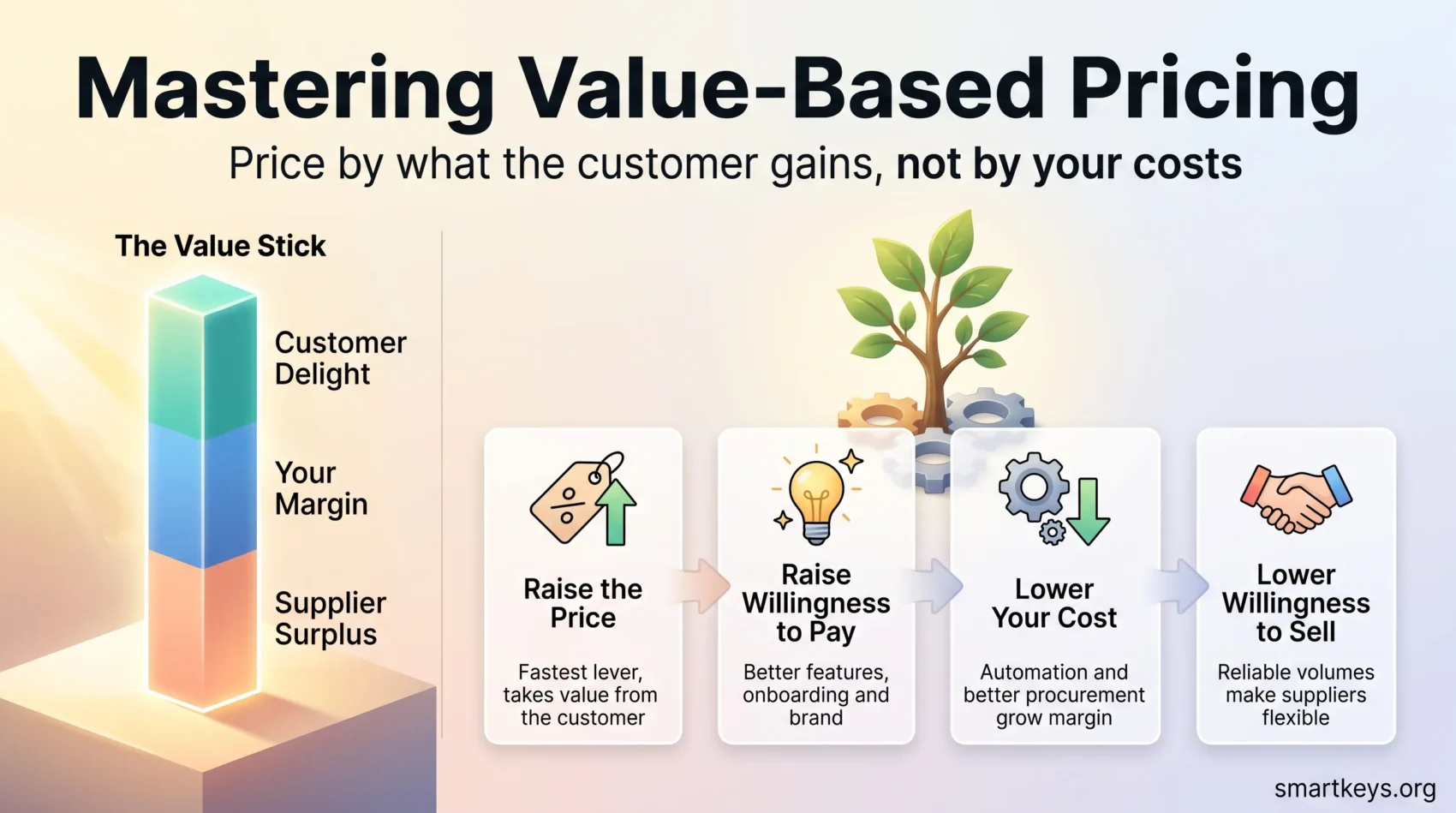
The value stick is a diagram that makes the whole trade-off visible in one picture. It comes from Felix Oberholzer-Gee’s book Better, Simpler Strategy (Harvard Business Review Press), and it is the single most useful tool in this article.
Picture a vertical bar with four marks on it, from top to bottom.
The four points
- Willingness to pay (WTP) sits at the top. The customer’s ceiling.
- Price sits below it. What you actually charge.
- Cost sits below that. What it takes you to deliver.
- Willingness to sell (WTS) sits at the bottom. Your suppliers’ floor.
Those four marks create three bands. WTP down to price is customer delight. Price down to cost is your margin. Cost down to WTS is supplier surplus, the extra your suppliers get above their own minimum.
The full distance from WTP to WTS is the total value the transaction creates, and pricing decides how it gets divided. Strategy, in this framing, means making the bar longer rather than grabbing a bigger slice of it.
Four levers, and what each one costs you
- Raise the price. Fastest to execute, and the only lever that takes value directly from the customer. Use it when demand is strong and your differentiation is obvious.
- Raise willingness to pay. Better features, cleaner onboarding, stronger brand, useful bundles. Slower, but it widens the whole bar instead of shifting the split.
- Lower your cost. Process improvements, automation, better procurement. Grows your margin without touching what the customer pays.
- Lower willingness to sell. Predictable volumes, faster payment, or shared investment make life easier for suppliers, and reliable partners often trade a little money for a lot of certainty.
Track all four numbers somewhere visible. A sheet with WTP, price, cost, and WTS per product line beats most pricing dashboards.
Where value-based pricing works, and where it does not
The method is not universal, and applying it to the wrong category wastes months.
Differentiated products and premium services
The approach works when buyers can tell you apart from the alternatives and care about the difference: specialist software, professional services, designed goods, anything where the brand or the outcome carries real weight.
Here a higher price is itself a signal, read as evidence of better design, support, or lower risk. That only holds if the product delivers, since a premium price on a mediocre product accelerates churn rather than profit. Strong brand storytelling and consistent after-sales care are what keep the premium defensible over time.
Commodities and near-identical products
When buyers genuinely see no difference (bulk flour, standard screws, plain hosting), willingness to pay collapses towards the market price. No amount of research changes that. Compete on cost and efficiency instead.
There is a middle ground. Manufacturers who sell a device cheaply, then sell proprietary refills at a healthy margin, have created differentiation where the product itself has none: the refill fits, the alternative does not. The same logic drives ecosystem pricing in software.
Most companies sell some lines that are differentiated and some that are not. Split the portfolio and apply the right method to each.
Turning features into value people will pay for
A feature list is not a value story. The translation step is where most pricing projects gain or lose credibility.
Convert specs into outcomes
Take each significant feature and finish this sentence: “which means the customer can now …”. A two-second page load means fewer abandoned carts. Automated approvals mean an invoice clears in a day instead of a week. Then attach a number to the outcome, even a rough one.
Numbers survive procurement. “Saves roughly six hours a week per analyst” gets budget approved. “More efficient” does not.
Quality, communication, and experience are value drivers too
Perceived value is built at every touchpoint, not just in the product. Case studies, independent reviews, clear documentation, and responsive support all raise what a buyer will pay, because each reduces the risk they feel they are taking.
Keep the customer channel open
Interviews, surveys, and usage data tell you which attributes actually move the needle. Running voice-of-customer research alongside win and loss interviews gives you both sides: why people buy, and why they do not. Product analytics fills the gap between what customers say and what they do, which is why behavioral analytics belongs in any pricing project.
Then invest in the handful of attributes that move willingness to pay, ignore the long tail nobody mentions, and feed what you learn back into the roadmap rather than only into the price list.
Implementing value-based pricing step by step
Five steps, in order. Skipping the research and going straight to a new price list is the most common way this fails.
1. Pick the segments that gain the most
Different customers get very different value from the same product. Group them by the size of that gain, not by company size or industry out of habit, and aim for three to five value drivers per segment.
2. Measure willingness to pay
Three methods do most of the work. Conjoint analysis shows people realistic product and price combinations and infers what they value from their choices. Gabor-Granger asks directly whether they would buy at a series of prices, to find the drop-off point. Win and loss interviews ask recent buyers and non-buyers what tipped the decision.
Surveys have a known weakness: people overstate what they would pay when no money changes hands. Treat stated numbers as a range and validate them against real purchase behaviour. Tools like SurveyMonkey handle the fieldwork; the analysis is where the value sits.
3. Choose a pricing model that matches the value
Translate your findings into a structure: per seat, per usage, feature tiers, or a hybrid. The test is simple. As a customer gets more value, does their bill move in the same direction? If someone triples their usage and pays the same, your model is not tracking value. Compare the trade-offs in our guides to usage-based pricing, the freemium model, and subscription business models.
4. Pilot before you roll out
Test on one cohort, one region, or new customers only. Build a clear good, better, best ladder so buyers self-select upwards rather than feeling pushed, and watch whether the entry tier starts cannibalising the middle one.
5. Align the teams and govern the change
Pricing touches product, marketing, sales, finance, and support. Agree in advance on the hypothesis, the guardrails (floor price, maximum discount), and the metrics that decide success, then set a quarterly review so prices do not drift. Where sales and marketing work from different assumptions, fixing sales and marketing alignment is a prerequisite, not a nice-to-have.
Practical tip: change one lever at a time. Raise a price, or add a feature, or cut a cost. If you move all three at once you will never know which one produced the result.
What changed in 2026: pricing for AI and consumption
The theory has not moved. The models built on top of it have, and quickly.
For two decades the default in software was per seat: count the users, multiply. That works when each user gets roughly the same value from logging in, and badly when the software does the work instead of the person. If an AI agent handles a thousand support conversations, the seat count tells you nothing about the value delivered.
So vendors moved to consumption and outcome pricing. Intercom prices its Fin AI agent per resolved conversation rather than per seat: its published pricing is $0.99 per outcome on top of a $49 monthly base that includes 50 resolutions. Salesforce meters Agentforce through a credit balance rather than a headcount, as covered in our Salesforce CRM review, and similar credit systems now appear across the major suites. Our Intercom review goes through what that costs in practice.
Outcome pricing is value-based pricing taken to its logical end: the customer pays only when the value arrives. It also transfers risk to the vendor, which is why such plans define very precisely what counts as a resolution.
Two consequences for anyone setting prices in 2026. Buyers expect a cost estimate they can model, so publish worked examples rather than a unit price alone. And finance teams dislike bills that move month to month, so caps, credits, and committed-use discounts are often what closes the deal. The wider shift is covered in our piece on AI in SaaS.
If your prices need to move with demand rather than with value delivered, that is a different discipline: see dynamic pricing.
Communicating a price change without losing customers
A price increase is a communication problem at least as much as a pricing one. Customers rarely object to paying more. They object to being surprised.
Lead with the value story
Open with what changed for them: new capability, faster response times, a broader service level. Then state the new price. Reverse that order and the message reads as a surcharge.
Give sales and support short, concrete talk tracks connecting each capability to a job the customer is trying to do. Vague benefit language collapses under a direct question about money.
Look after price-sensitive customers
Not everyone will follow you upmarket, and that is fine as long as they have somewhere to go. Entry tiers, bundles, and committed-use discounts keep those buyers in your ecosystem. Selective grandfathering for long-standing customers buys goodwill cheaply.
Four things worth doing every time:
- Give notice well ahead of the billing date, in writing.
- Make switching between tiers easy and self-service.
- Compare on total cost of ownership, not just the headline price.
- Watch support volume and sentiment for the first month.
Handled well, a price change can strengthen the relationship. Our guides to customer loyalty and customer retention strategies cover what to do in the weeks that follow.
Measuring whether it worked
Pick a small set of metrics and review them on a fixed rhythm. A large dashboard nobody opens is worse than five numbers somebody checks weekly.
The numbers that matter
- Gross margin by offer. Tells you whether the new price actually improved profitability.
- Conversion rate. Falling conversion after an increase is the early warning that you crossed a WTP ceiling.
- Churn by cohort. Compare customers who joined before and after the change; aggregate churn hides the signal.
- Average revenue per customer. Shows whether buyers moved up or down the tier ladder.
- Customer lifetime value. The long-run test. Higher prices with higher churn can leave you worse off.
- Support contacts about price. A fast proxy for how the change landed.
Read every movement back against the value stick. Did the customer’s share shrink? Did your margin grow, or just move across from your supplier? Feeding pricing data into revenue forecasting keeps the finance conversation honest, and customer success tools will often flag at-risk accounts before churn shows up in the numbers.
Keep the feedback loop running
Repeat the willingness-to-pay research at least annually, and after any major launch or competitor move. Perceived value is not fixed; it moves as alternatives improve and expectations rise. A customer data platform helps by keeping usage, billing, and survey data in one place.
Benefits, limits, and three persistent myths
What you gain: higher achievable prices, a clearer link between roadmap and revenue, and pricing conversations about outcomes rather than discounts. The research is often the biggest prize, because it tells product teams which features are worth building.
What it costs: research time and budget, internal disagreement while assumptions get tested, and ongoing governance. One price will not fit every segment, so expect to maintain tiers.
Three myths worth retiring
- “Every feature should be priced separately.” No. A handful of attributes drive most of the willingness to pay. Charging for the rest just makes your price list unreadable.
- “A strong brand is enough to justify a premium.” Brand buys you a hearing, not a permanent premium. Without a real performance difference, buyers eventually notice.
- “Value-based pricing means charging more.” Sometimes it means charging less, or restructuring so that light users pay less and heavy users pay more. The goal is alignment with value, not a bigger number.
Conclusion
Value-based pricing is less a formula than a habit: keep asking what the customer actually gains, and keep your price honestly related to that answer.
Start small. Pick one segment, find out what the product is worth to them, and test a price with a limited group. Watch margin, conversion, churn, and lifetime value for a full quarter before you generalise.
The companies that get this right rarely have the most sophisticated pricing model. They are the ones who know what their customers value, because they kept asking.
Found this useful?
Make SmartKeys a preferred source on Google, and our articles will surface more often in your Top Stories, AI Overviews, and AI Mode.
Add as Preferred Source