A remote internship is paid or credit-bearing work experience you do from home, for a company that may sit in another city or another country. It gives you what a course cannot: a manager, a deadline, and output that someone else depends on.
There is a catch. Fully remote internships are much rarer than the advertising suggests. The National Association of Colleges and Employers (NACE), the US body that surveys campus recruiting every year, found that employers ran 61.3% of their 2024-25 internships as hybrid and 34.7% entirely in person. Only 0.9% were exclusively remote.
That does not make remote placements a bad idea. It means you need to know where they actually exist, how to judge one before you say yes, and how to work in a way that gets noticed when nobody sees you at a desk.
This guide covers those three things, plus the pay rules that decide whether an unpaid offer is even lawful.
Key Takeaways
- Fully remote internships are rare at traditional US employers, so expect to look beyond the big campus recruiting programs.
- Internships convert well: 63.1% of 2024-25 interns at surveyed employers received a full-time offer, and 88.3% of those accepted.
- Check role scope, mentor time, equipment and time zone overlap before you accept, not after.
- At a US for-profit company, an unpaid internship is only lawful if you are the main person benefiting from it under the Department of Labor test.
- Programs that guarantee a remote placement charge tuition. Treat that as a purchase, not as a job offer.
- For the wider picture on how study connects to hiring, see our guide to education and future jobs.
What a Remote Internship Actually Is
An internship is a short, structured job, usually 8 to 12 weeks, designed so that you learn while you contribute. A remote internship is the same arrangement without the office. You are onboarded, given a scope of work, reviewed, and at the end you have something you can point to.
Three formats get lumped together, and the difference matters when you compare offers.
Fully remote, hybrid, and remote-first
Fully remote means you never travel to a site. Everything runs through chat, video calls and shared documents.
Hybrid means some days on site. If the company is in another country, a hybrid offer is not usable for you, so ask early rather than assuming.
Remote-first describes the company, not the internship. A remote-first employer has already built its processes around written communication and recorded decisions, which usually makes for a better remote internship than a traditional office that improvises one. Our overview of how hybrid work is organised explains the difference in practice.
How common remote internships really are
The NACE figures above are the honest baseline: hybrid dominates, fully remote is a rounding error among the large employers NACE surveys. Those employers are mostly Fortune 1000 companies with campus recruiting teams.
Remote placements cluster somewhere else. They are most common at small software companies, agencies, non-profits, research groups and startups that were distributed from day one and never built an office culture to defend. That is where your search should start, and it is a very different search from applying to a graduate scheme.
Why the Experience Still Counts With Employers
An internship is the cheapest way for a company to test you, and companies use it that way. NACE’s 2026 Internship & Co-op Report, based on 284 organisations surveyed between October 2025 and January 2026, found that 63.1% of 2024-25 interns were offered a full-time role, the highest conversion rate in five years. Of those offered a job, 88.3% took it.
Hiring volume is holding up too. The same report found employers planning a 3.9% increase in intern hires for 2025-26, with 81% saying they would increase or maintain their intern numbers.
Read that as a hiring channel rather than a favour. A finished internship gives a recruiter something a transcript does not: evidence that you can take a task from a brief to a result inside a real team. That evidence travels. It is what makes the first graduate application easier, and it feeds directly into the skills employers are actually hiring for.
Where to Find a Remote Internship
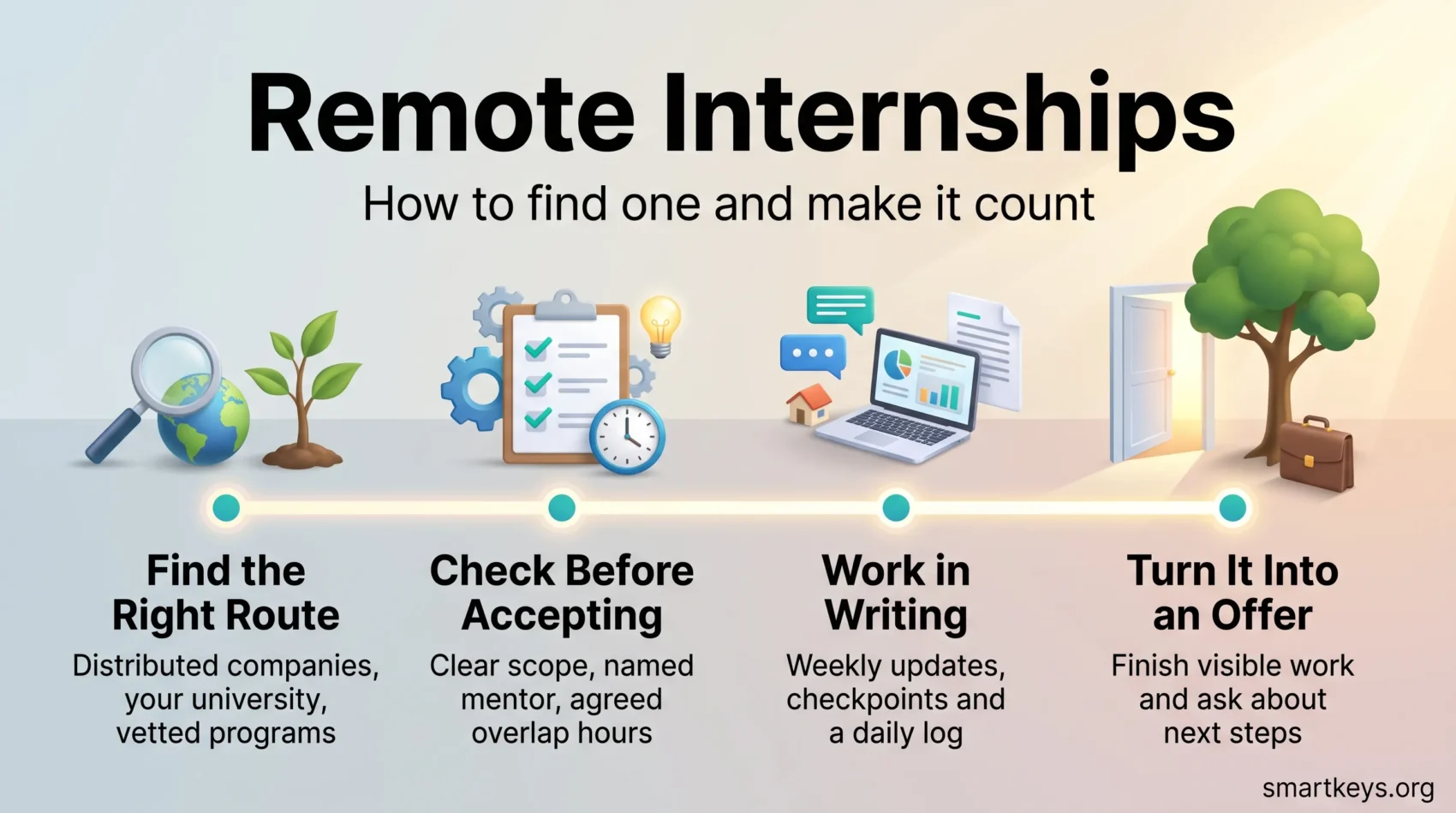
There are three routes, and they suit different people. Most students end up using two of them at once.
Route 1: Apply directly to distributed companies
This is the cheapest route and the one with the best ratio of effort to result, but it needs patience.
Start with companies that already work remotely, then look at their careers page rather than a job board. Filter job boards on “remote” plus “intern” and set an alert instead of checking daily. Small companies often post an internship once and fill it in ten days, so speed matters more than a perfect application.
A short, specific email to a team lead beats a generic form. Name the team, name one thing they shipped, and say what you would work on for the first month.
Route 2: Go through your university
Careers services hold employer relationships you cannot see from outside, and many degree programmes now include a credit-bearing placement. Two advantages are hard to replicate on your own: the placement is usually vetted, and a tutor checks that you are learning rather than doing admin for free.
Ask specifically whether the department has remote-eligible partners. Many careers teams still default to local listings unless you ask.
Route 3: Paid placement programs
A number of companies sell guaranteed remote internships. You pay a fee, they match you with a host company, and you get coaching and online courses alongside the placement. Providers in this category include Virtual Internships and The Intern Group.
These programs solve a genuine problem for people with no local network, particularly students applying across borders. They are also a purchase, so judge them the way you would judge any course:
- Ask what the total cost is, including any deposit, and what the refund terms are if no suitable match appears.
- Ask to see the role description, not the industry category. “Marketing at a startup” is not a scope of work.
- Ask whether the placement is paid by the host. In most of these programs it is not, so the fee is your cost and the experience is your return.
- Ask how many hours of one-to-one coaching are included, and with whom.
- Check independent reviews and, if you can, speak to a past participant from your own country and field.
A guaranteed placement removes uncertainty, which is worth something when you are applying from a country where employers do not recruit. It does not remove the need to check what you are actually buying.
Paid or Unpaid: What the Rules Say
Money is the part most guides skip. In the US, whether an intern must be paid is decided by the Department of Labor’s primary beneficiary test, set out in Fact Sheet #71. The test asks who gains more from the arrangement, you or the company, across seven factors: whether both sides understand there is no pay, whether the training resembles education, whether it is tied to your course or credit, whether it fits the academic calendar, whether it ends when the learning does, whether your work complements paid staff rather than replacing them, and whether both sides understand there is no promise of a job.
If the balance tips towards the employer, you are an employee in law and must receive at least minimum wage and overtime. Different rules apply to public sector and non-profit organisations, where unpaid volunteering is generally allowed.
For paid roles, the going rate is not small. NACE put the average intern wage at $23.35 an hour at bachelor’s degree level for summer 2025. If an offer sits far below that without an academic reason, ask why.
Outside the US, check your own country’s rules before agreeing to anything unpaid, and remember that a host company abroad may be working from a completely different legal starting point.
What to Check Before You Accept
Most bad remote internships fail on setup, not on effort. These are the questions worth asking in the interview, when you still have leverage.
Scope and deliverables
Ask what you will have finished by the last day. A good answer sounds like “a working dashboard for the support team” or “twelve published articles and a performance report”. A vague answer usually means nobody has planned the role, and you will spend the summer waiting for work.
Mentor time
Ask who reviews your work and how often. A named person with a recurring weekly slot is the single strongest predictor of a useful placement. Without it, remote work becomes silence. If the company has no internal mentoring habit, our piece on how mentorship matching platforms work shows what a functioning setup looks like.
Equipment, access and security
Ask what you need to provide and what they provide. Find out on day one which tools you get access to, who approves them, and what the rules are for handling customer data. Companies that take a distributed workforce seriously already have this written down, as our guide to running a virtual office describes.
Time zone overlap
Agree the number of overlapping hours per week in writing before you start. Two to three hours a day of shared working time is usually enough for standups and live feedback. Below that, you need a team that is genuinely good at written handover, which is a real discipline: see follow-the-sun scheduling for how handoffs are structured across zones, and managing cross-border teams for the wider coordination problem.
Onboarding
Ask what your first week looks like. If there is no answer, that is your answer. Structured first weeks are the difference between an intern who contributes by week three and one who is still guessing in week six. Our guide to remote onboarding and training covers what a good version includes.
How to Do Good Work When Nobody Sees You
In an office you get credit for being visible. Remotely, you get credit for being legible. The habits below are what separate the interns who get an offer from the ones who quietly finish and leave.
Write things down. A short written update beats a long call. Post what you finished, what you are doing next, and what is blocking you. Do it on a fixed day, not when you remember. This is the core habit of asynchronous work, and the tools built for it exist to make that visible without meetings.
Break the project into weekly checkpoints. A three-month project with one deadline gives your manager nothing to react to until it is too late to help. Weekly slices give them ten chances.
Protect your working blocks. Set the hours you are actually available, publish them, and hold them. Splitting a short week across too many small tasks is the fastest way to finish with nothing to show. Practical approaches are in our guide to time management techniques, and the same discipline is what makes remote work productive rather than merely flexible.
Ask early, ask specifically. “I am stuck” costs your mentor twenty minutes of diagnosis. “I tried A and B, B failed with this error, is C the right direction?” costs them two.
Keep a work log. One line a day, with numbers where you have them. You will need it for your resume, your references and your final review, and you will not remember week two by week eleven.
Turning the Placement Into an Offer
Conversion is a process, not a reward for good behaviour. Three things move it.
Ask about it in the first two weeks. Not “will you hire me”, but “does this team usually take on interns afterwards, and what does that decision depend on?” You will learn whether a route exists and what it is judged on. If there is no route, you have ten weeks to aim the work at your portfolio instead.
Finish something visible. One completed piece of work that other people use beats five half-finished experiments. Volume is not the metric; something being in production is.
Leave with three assets. A named reference who agrees in advance to take calls, a short written summary of what you delivered with any numbers attached, and a permission-checked sample you can show. Ask for all three in your final week, while people still remember the detail.
If no offer comes, the placement still counts. Contract and project work is now a normal way into a company, as our look at the contract-to-hire trend sets out, and the alumni network of a company you interned at is a legitimate route back in later, which is the same mechanism described in corporate alumni networks.
Keeping the Skills Current After You Finish
An internship dates quickly if you leave it as a line on a resume. Two things extend its value.
The first is deliberate skill maintenance. The tools change, and the fastest way to keep a skill alive is to use it in short, regular bursts rather than in one long course. Our guides to upskilling and reskilling and building a microlearning habit cover how to structure that around a full schedule.
The second is knowing what the market wants next. AI has changed which parts of an entry-level job are worth doing yourself, which is worth understanding before your next application: see how AI augments rather than replaces jobs and what AI hiring tools look for in a candidate.
If you are returning to work rather than starting out, the structured equivalent is a returnship, covered in our guide to returnship programs. And if you want to plan several moves ahead rather than one, the career lattice model is a more realistic map than a ladder.
Conclusion
A remote internship is worth doing, but not on the terms it is usually sold. Fully remote placements are uncommon at large employers, so the search runs through smaller distributed companies, your university, or a paid program you have checked properly.
What decides the outcome is set before you start: a defined scope, a named mentor, agreed overlap hours, and clarity on whether you are being paid. Get those right and the rest is ordinary work, done in writing.
The payoff is real. Most interns at surveyed employers get an offer, and almost all of them accept. Your job is to make sure someone can see what you did.
Found this useful?
Make SmartKeys a preferred source on Google, and our articles will surface more often in your Top Stories, AI Overviews, and AI Mode.
Add as Preferred Source