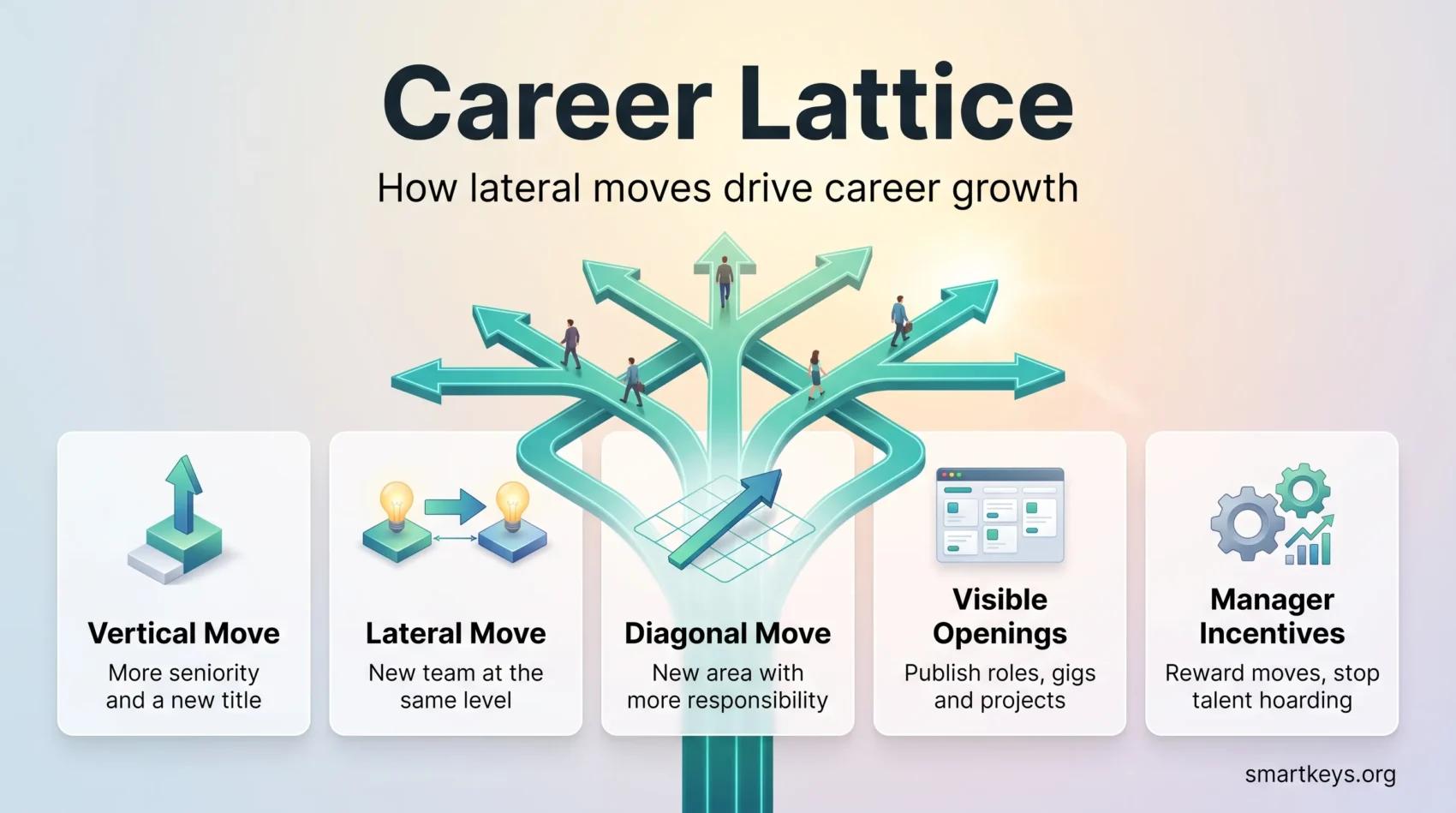
A career lattice describes growth at work as including sideways and diagonal moves, not just promotions. Instead of one ladder with a single rung above you, it treats a move into another team, a broader role at the same level, or a mix of both as real progress.
The idea is not new. Deloitte published it as the corporate lattice in 2010, in a book by Cathleen Benko and Molly Anderson. What has changed is the pressure to use it. This guide covers what the model is, what the data supports, where such programs fail, and how to set one up.
Key Takeaways
- A lattice treats growth as multidirectional: up, sideways and diagonal.
- Hiring and quitting are both slow right now, so internal moves carry more weight.
- It only works when open roles, skills and expectations are visible.
- Managers decide the outcome. Talent hoarding kills it quietly.
- Start small: one pilot team, a skills map, a short list of internal gigs.
Why lateral moves matter more in 2026
The external job market has gone quiet. In July 2026, US quits sat at 3.1 million, a rate of 1.9%, and hires at 5.1 million, or 3.2%, according to the Bureau of Labor Statistics Job Openings and Labor Turnover Survey of 1 September 2026. Fewer people are leaving, and fewer are being hired in.
That is a squeeze from both sides. Employees who want something new have fewer outside options. Employers who need a new capability have a slower, more expensive route to it. Internal mobility, meaning the movement of existing staff into new roles and projects, is the pressure valve for both.
Career movement front-loads. The BLS National Longitudinal Survey of Youth 1979, published on 26 August 2025, found that people born between 1957 and 1964 held an average of 12.9 jobs between ages 18 and 58. Of those, 5.6 came between ages 18 and 24. Between ages 45 and 54, the same group averaged just 2.2. A lattice keeps mid-career movement going inside one employer rather than between several.
What employers are saying
LinkedIn’s 2026 Talent Report puts numbers on the shift. Among the companies it calls talent velocity leaders, 72% say internal mobility matters more than ever, and 90% of chief people officers expect teams to be built around skills rather than job titles. Yet only 30% of organizations globally use skills-based workforce planning, and 22% in North America. Intent is well ahead of practice.
Retention is the driver. LinkedIn found 88% of organizations worried about keeping people even in an uncertain economy, and names learning opportunities as the top retention strategy. That matches what people said when they actually left: in a Pew Research Center survey of 965 US workers who quit a job in 2021, 63% cited no opportunities for advancement, level with low pay.
If advancement is what people leave over, then making it possible without a vacancy above someone is not a perk. It is basic talent retention work.
What a career lattice actually is
Picture your options at work as a grid rather than a line. You can move up, across, or diagonally. All three count.
The three types of move
Vertical: more seniority, more scope, usually a new title. This is the traditional promotion.
Lateral: a new role at roughly the same level, often in another team. A support specialist moving into product operations keeps their pay band but learns a new part of the business.
Diagonal: a mix of the two, such as a senior engineer becoming a team lead in a different product area.
A lattice does not abolish promotions. It stops treating them as the only evidence that someone is growing.
How it differs from a job ladder
A traditional ladder is organized around titles inside one function. You go up or you stay put. A lattice is organized around skills and outcomes, so the question shifts from “what is the next title” to “what can this person do next, and where is that needed”.
That changes the paperwork. Ladders need a hierarchy of levels. Lattices need a job architecture, meaning a documented map of roles, levels and pay bands, plus a skills taxonomy, meaning a shared vocabulary for what people can do. Without both, a lateral move looks like a demotion and nobody volunteers.
Ladder or lattice: which fits your organization
Neither model is automatically better. They suit different structures and different people.
Depth versus breadth
Ladders reward deep specialization. If you want to be the person who knows the pricing engine better than anyone, a ladder rewards that patience. Lattices reward breadth: someone who has worked in support, then implementation, then product understands how a decision in one place lands in another.
Breadth is also more portable. When a role changes shape, as many are under automation, transferable skills are easier to redirect. That is the logic behind mid-career retraining and behind redeploying workers whose tasks get automated.
Where each model fits
Firms with strict reporting lines, regulated roles and long apprenticeships run ladders well. Flatter companies get more out of a lattice, because work already crosses team boundaries. Most organizations end up with both: a ladder inside each function, a lattice across them.
One decision rule helps. If there is no realistic opening above you for two or three years, a lateral or diagonal move usually beats waiting.
What a lattice delivers
Cheaper, faster hiring
Filling a role internally removes the search, most of the screening and much of the ramp-up. The person already knows your systems, your customers and how decisions get made, and the move can stop a resignation before it happens.
The saving is real but not automatic. You still have to backfill the role they left, and you need a way to measure whether the development spend paid off.
Skills that spread instead of pooling
When people move between teams they carry context with them. A marketer who spent six months in support writes better onboarding emails afterwards, because they have read the tickets. This is the everyday version of a cross-training strategy: fewer single points of failure, fewer teams solving a problem another team solved last quarter.
Paths that fit real lives
Not everyone wants more scope this year. Someone caring for a parent or finishing a degree may want a sideways move into steadier work and a return to growth later. A lattice gives that a name and a route instead of treating it as opting out, and options like job sharing follow the same logic.
Teams that can be reshaped
If you know what your people can do, you can staff a new priority in weeks rather than months. That is the business payoff, and it is why the model runs through most current HR trends.
Where lattice programs break down
Most failures are predictable. Four causes account for nearly all of them.
Talent hoarding
A manager who loses a strong performer pays the cost immediately and shares the benefit with everyone else. So they block the move, or never mention the opening. Nothing else you do matters if this is left alone.
The fix is to change what managers are measured on. Count internal moves out of a team as a positive in their review, guarantee a backfill budget, and make development a stated part of the management job. This belongs in continuous performance management, not in an annual value statement.
Opportunities nobody can see
Many internal job boards list only formal vacancies. The most useful entry points are smaller: a three-month project, a secondment, a few hours a week on another team’s problem. If those never get published, only the well-connected hear about them.
Vague roles and missing skills data
If nobody can say what a level 3 analyst is expected to do, nobody can say whether a support lead qualifies. Ambiguity always resolves in favour of the safe candidate. Document roles, levels and pay bands, then run a skills gap analysis so you know what you already have.
Distance and visibility
In hybrid teams, the people in the room get noticed more often. That is proximity bias, and it distorts who is considered for a move. Written criteria and published openings blunt it, as does treating career advancement for remote staff as a design problem rather than an individual’s networking failure.
Five steps to adopt a lattice model
1. Tie it to a business number
Pick one or two outcomes leadership already cares about: time to fill a critical role, regretted attrition in one function, or the cost of a planned capability build. Run a pilot in one division and report against those numbers. Culture arguments do not survive a budget review.
2. Map skills to work
Write down the roles you have, the levels within them and the skills each requires. Pull evidence from performance records and project history rather than inventing a taxonomy in a workshop. Keep the first version small: a map of three functions that people trust beats a company-wide one nobody reads.
3. Make openings visible
Publish full roles, short-term gigs and project work in one place. An internal talent marketplace does this at scale by matching people to work on skills; Gloat and Cornerstone, which acquired skills-intelligence provider SkyHive in May 2024, both sell one. For a few hundred people, a well-maintained internal careers page is enough.
4. Lower the risk of moving
Most people will not apply for an unfamiliar role cold. Offer smaller commitments first: a shadowing week, a short gig, a swap with an end date, a return path. Pair that with mentorship matching and give managers a script for career conversations, because most have never been taught how to run one.
5. Set rules and measure
Decide the basics in advance and publish them: how long someone must hold a role before moving, who approves it, how fast hiring managers must respond, and what happens to pay in a lateral move. Pay questions get easier when your pay transparency position is settled, and the rules belong in a written employee mobility policy.
A worked example: Buffer’s two tracks
The social media company Buffer publishes its career framework openly, which makes it easier to copy than most.
Buffer runs two tracks: Makers, meaning individual contributors, and Managers. Each track has levels, which mark a real jump in scope and need formal approval, plus four steps inside each level, granted by an area director, that mark smaller gains in ownership. Buffer’s reasoning is blunt: not everyone can be a manager, especially when the team is not growing.
Two things are worth borrowing. The framework lets specialists advance without managing anyone, which stops good engineers becoming reluctant managers. And the steps mean progress is recognised several times a year rather than once, if at all. You do not need Buffer’s transparency to copy the structure.
Tools and metrics that keep it honest
What to put in place
Start with one place where internal opportunities live and one where skills are recorded. Add a view showing an employee the roles adjacent to theirs and the two or three skills that separate them. When the gap is visible, learning has a target, which is what makes micro-credentials worth the effort.
What to measure
Four numbers are enough to start:
- Internal fill rate: the share of open roles filled by existing employees.
- Time to fill: compared between internal and external hires.
- Regretted attrition: in the teams running the pilot, against a comparable group.
- Movement spread: how many different teams people moved into, which shows whether mobility is real or stuck in one department.
Most workforce analytics tools report the first three out of the box. The fourth usually needs a query, and it is the one that tells you whether the lattice exists outside the slide deck.
Publish what happened
Short, specific stories move more people than policy documents. Name the role someone moved from and into, what they had to learn and what was hard. Honest accounts, including the ones that went badly, do more for employee engagement than a case study nobody believes.
Conclusion
A career lattice is not a slogan about flexibility. It is a set of specific decisions: what roles exist, what skills they need, who can see the openings, what a manager is rewarded for, and what happens to pay when someone moves sideways.
Get those right and growth stops depending on somebody above you leaving. Get them wrong and the lattice is a ladder with better branding. Start narrow: one pilot function, a published skills map, a handful of internal gigs, four numbers checked quarterly.
For the skills side, our guides to upskilling and reskilling and which job skills are most in demand are the natural next reads.
Found this useful?
Make SmartKeys a preferred source on Google, and our articles will surface more often in your Top Stories, AI Overviews, and AI Mode.
Add as Preferred Source