A job sharing model splits one full-time position between two people who jointly own the results, not just the hours. Done well, the role stays covered five days a week even though neither partner works five days.
Interest keeps growing. The flexible-work platform Flexa reported in December 2025 that demand for job shares was up 66% across its user base, and it is no longer limited to parents or people easing toward retirement. Employers have their own reason to look: the CIPD surveyed 5,017 UK working adults in early 2025 and found that 3% had left a job in the previous year because it offered no flexibility, roughly 1.1 million people.
This guide shows what to split, how to run handovers, and how to pilot the arrangement in one quarter without disrupting service.
Key Takeaways
- Two people share one full-time role and are jointly accountable for its outcomes.
- Four formats (splitting, pairing, top sharing, and twin versus islands) cover almost every use case.
- A written daily handover plus one weekly overlap is the minimum viable routine.
- Employers gain continuity, two skill sets in one seat, and a wider hiring pool.
- The real costs are coordination time, payroll admin, and finding a compatible pair.
- Start with a 90-day pilot, a written contingency plan, and clear decision rights.
Why job sharing matters in 2026
Flexibility has stopped being a perk and become a hiring condition. The easy version of it, though, is getting harder to find. Robert Half’s analysis of US job postings in the first half of 2026 found only 10% advertised as hybrid and 3% as fully remote, and 87% fully on site. Senior roles did slightly better at 12% hybrid.
Demand has not followed. In the same research, 46% of professionals said they were already looking or planning to look for a new role in the second half of 2026, with remote flexibility among the leading reasons.
That gap is where job sharing becomes interesting. If you cannot offer location flexibility, time flexibility is the lever you have left. It is the most demanding version of that lever, and also the most valuable, because it does something part-time alone cannot: it keeps the seat covered. A four-day-a-week employee leaves a gap on Friday. A well-run tandem does not.
Three situations where the model pays for itself quickly:
- Retaining senior people who want fewer hours. Instead of losing a decade of institutional knowledge, you keep half of it and hire the other half. That makes it a practical talent retention tool.
- Roles that must never go dark, such as key accounts, scheduling, operations, and first-line management.
- Widening the candidate pool. When Zurich began advertising every UK vacancy as open to part-time, flexible, or job share working, applications from women rose 16%, and nearly 20% more women applied for management roles. Part-time hires across the company doubled from 6% to 11% between the March 2019 launch and early 2022.
If you are still deciding which flexibility levers to pull first, compare the options in our overview of flexible work schedules, our analysis of the four-day workweek, and the wider picture in our HR trends report for 2026.
What the job sharing model actually is
Definition: two employees share one full-time position and hold joint responsibility for its outcomes. The hours can split evenly (2.5 days each) or unevenly (3 plus 2), but the accountability does not split. Both partners answer for the role.
That is the line between a job share and two part-time jobs that happen to sit next to each other. In a genuine tandem:
- Both partners can speak for the role to stakeholders.
- Decision rights are written down, including which calls either partner may make alone.
- Performance is measured on shared outcomes plus individual contribution.
- Hours, vacation, and sick-day rules are codified in the contract and in your time-tracking tool.
Four job sharing formats you can adopt
The formats differ mainly in how much coordination they demand. Pick the lightest one your role can live with.
1. Job splitting: divide by scope
One partner owns operations, the other owns stakeholder work. Each plays to a strength and handoff volume stays low. Best for roles with two separable halves, such as a customer success job where one partner runs renewals and the other runs onboarding.
2. Job pairing: co-own everything
Both partners can do any task and alternate or overlap days. This carries the highest coordination cost and the highest resilience, because either person can cover a crisis. Best for client-facing and service roles.
3. Top sharing: split a leadership role
Two managers co-lead. It widens perspective and spreads the people-management load, but it only works if the pair agrees publicly on strategy and the team knows who to approach for what. Align reviews and reporting lines before you start.
4. Twin versus islands
Twin: both partners do the same tasks on different days, with one overlap day for updates. Islands: each owns distinct specialties and works largely independently. Twin maximizes coverage; islands minimizes coordination.
Choosing between them
| Format | Coordination effort | Best for |
|---|---|---|
| Job splitting | Low | Roles with two separable workstreams |
| Job pairing | High | Client service, operations, on-call cover |
| Top sharing | High | Team leads and senior managers |
| Twin | Medium | Roles needing daily continuity |
| Islands | Low | Specialist or project-based work |
Whichever format you pick, the mechanics are the same as any prioritization system: someone has to decide what gets done, deferred, or dropped. The 4 D’s of time management give a tandem a shared vocabulary for exactly that.
How to implement job sharing step by step
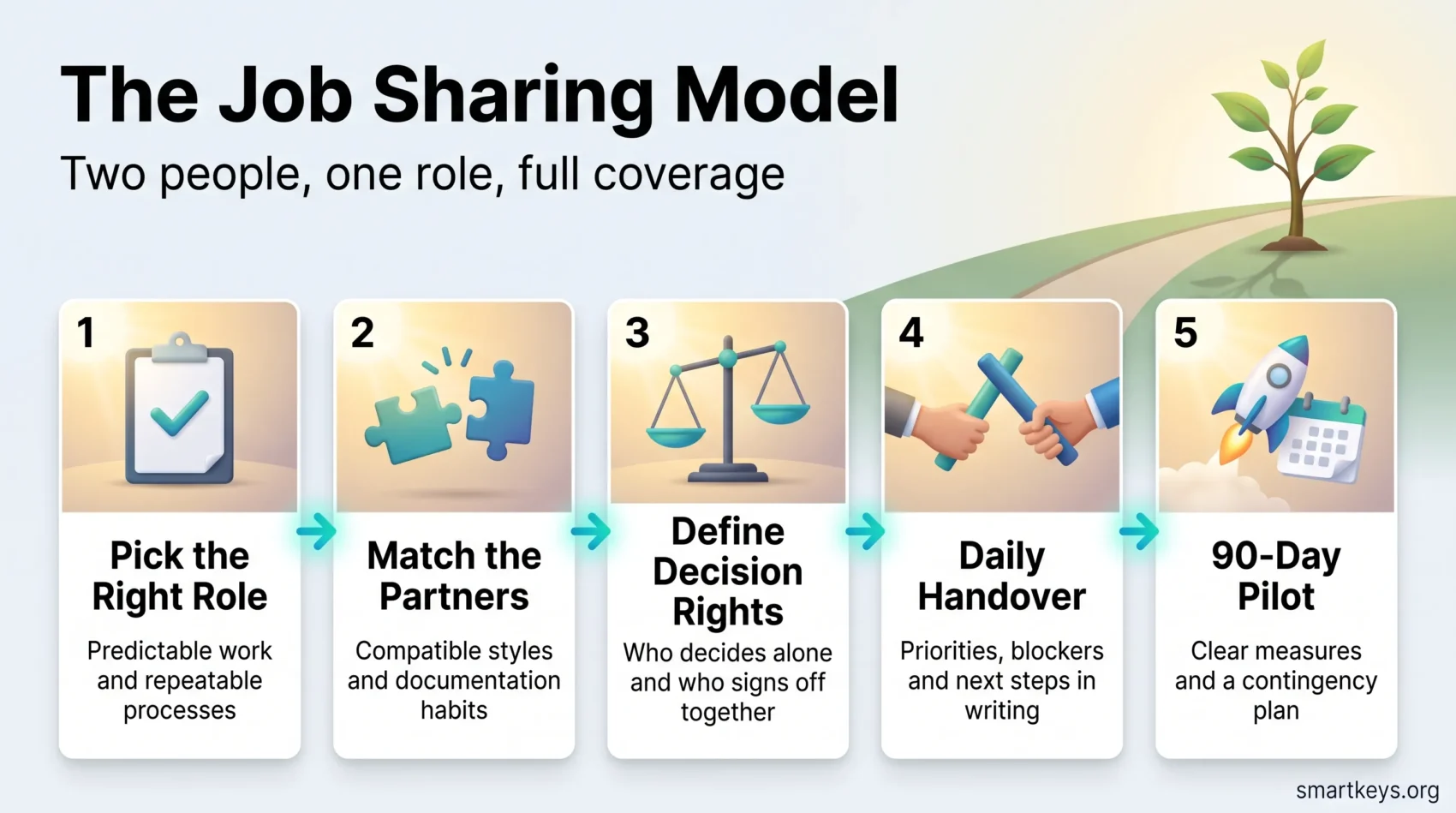
Step 1: Pick the right role
Good candidates have predictable workloads, repeatable processes, and a clear definition of “done.” Poor ones need deep immersion in a single long-running project, or rare expertise only one person holds.
Step 2: Match compatible partners
Screen for communication style, documentation habits, reliability, and career goals, not just skills. A brilliant pair with mismatched note-taking will leak work at every handover.
Step 3: Write down responsibilities and decision rights
Map each task and decision to a partner. Mark which decisions either person may take solo, which need joint sign-off, and what the escalation path is when timing is tight.
Step 4: Set hours, overlap, and absence rules
Agree the schedule around customer demand, not convenience, and book at least one weekly overlap window. Document how salary, vacation, bonuses, and sick days are pro-rated, and involve HR and payroll before the pilot. If pay is tied to outcomes, revisit your performance-based pay model so a shared role is not penalised by individual targets. For teams spread across countries, check how your global payroll setup handles two contracts against one position.
Step 5: Build the handover routine
A written daily handover listing priorities, blockers, due dates, and next steps. One shared inbox with availability in the signature. One task board as the single source of truth. This is written-first working, so the habits from asynchronous work transfer directly, and a standard meeting notes template stops decisions from living only in one partner’s head.
Step 6: Run a 90-day pilot
Define success measures for the tandem and for each partner, set a check-in cadence, and write a contingency plan for the day one partner leaves or changes hours. Capture the templates as you go, using the same discipline you would apply to any standard operating procedure, so the second rollout takes a fraction of the effort.
If you are formalising several arrangements at once, fold the rules into your existing policy document. Our hybrid work policy template covers the eligibility and communication clauses you will need.
Tools, schedules, and handover practices that make it work
Communication essentials
Standardize on a shared inbox and put each partner’s working days in the email signature, so external contacts can serve themselves. Keep the daily handover short: three headings beat three paragraphs. The rest of the stack is what hybrid teams already use, covered in our roundup of hybrid workforce tools.
Time and attendance
Configure your attendance tool so reported hours match reality: shift plan, shift start, required time windows, paid time. That removes most of the payroll friction people expect from shared roles. In shift-based operations, rostering software can hold both partners against one position without double-counting the headcount.
Space and coordination
Desk and room booking software keeps overlap days predictable and shows whether the seat is actually being used. A workable split: 8 AM to 12 PM for one partner, 12 PM to 4 PM for the other, with a two-hour Wednesday overlap for live alignment. Protecting that overlap is easier if the team already runs a focus time policy that keeps some hours free of meetings.
What to track
- Throughput and response times, so you can see coverage gaps before customers do.
- Exceptions such as swaps, sick leave, and vacation, logged in one system managers can read.
- Handover completion. A missed handover is the leading indicator of a failing tandem.
What the rules are starting to require
Job sharing is normally voluntary, but in the UK it is moving closer to something employers have to consider properly. The Employment Rights Act 2025 adds a reasonableness test to flexible working requests: an employer refusing one will have to name which of the eight statutory business grounds applies and explain why the refusal is reasonable. Draft regulations also set out consultation steps, including a meeting with the employee and consideration of alternatives such as a trial period. Law firm Clyde & Co reported in February 2026 that these provisions are expected to take effect in 2027.
The practical shift matters more than the legal detail. A refusal will need to survive scrutiny, and a job share is exactly the alternative an employer will be expected to have weighed. Rules differ by country, so check your local position.
Benefits and challenges to weigh
What you gain
Two skill sets in one seat. Problems get a second perspective by default rather than by escalation.
Continuity. Vacation, illness, and training stop being service risks, which removes a real single point of failure.
Reduced hours where they help. Cutting hours is one of the few interventions that addresses employee burnout at its source rather than its symptoms. It is no substitute for good management, though. Gallup found that employees who have clear expectations from their manager are 47% less likely to report frequent burnout, so a job share without clear decision rights just moves the confusion around.
A wider talent pool. Carers, students, phased retirees, and people who cannot work full weeks all become reachable candidates. It also creates a sideways route for people who want scope without more hours, as described in our guide to the career lattice, and it belongs alongside the other options in our review of employee engagement trends.
What it costs
- Manager time. Two people to coach, review, and align. Budget for it honestly.
- Pairing risk. A mismatched tandem is worse than one part-timer, so screen for it up front.
- Admin. Pro-rated benefits, desk allocation on overlap days, and payroll setup all need one-time work.
- Partner departure. Losing one half leaves an awkward remainder. This is what the contingency plan is for.
Mitigation: document everything, cross-train from day one, and keep the pilot small enough to reverse.
Conclusion
Job sharing works when you treat it as an operating design, not a favour. Pick a predictable role, match two compatible people, write down decision rights, and protect one weekly overlap.
Get the basics in place: hours configured in your attendance tool, a daily written handover, one shared inbox, one task board. Then run it for 90 days against measures you defined in advance, and publish what you learn so the next rollout is faster.
The outcome is a role that stays covered and two people who stay. For roles at the other end of the career arc, the same mechanics power phased retirement programs.
Found this useful?
Make SmartKeys a preferred source on Google, and our articles will surface more often in your Top Stories, AI Overviews, and AI Mode.
Add as Preferred Source