Managing cross-border teams is no longer an experiment. Remote work settled into a stable pattern rather than disappearing: Stanford’s Survey of Working Arrangements and Attitudes (SWAA) put roughly a quarter of paid full days in the US as worked from home in May 2026, against under 6% before the pandemic. Once location stops determining who you can hire, international collaboration becomes a normal operating model instead of a special case.
That shift rewards companies that build for it deliberately. Hiring across borders widens the talent pool, but it also multiplies the number of payroll rules, data regimes, holiday calendars and communication norms a manager has to hold in their head. The teams that thrive treat those differences as design constraints, not friction to be tolerated.
This guide covers what actually changes when your team spans countries and time zones: the benefits worth chasing, the failure modes to plan around, the communication habits that keep people aligned, and the tooling and compliance groundwork that makes global team management sustainable.
Key Takeaways
- Remote work has stabilised rather than reversed, making international collaboration a durable hiring strategy.
- Time zones, not distance, are the real constraint. Design for overlap and asynchronous handoffs.
- Compliance is the underrated risk: payroll, worker classification, data transfers and pay transparency rules differ by country.
- Written-first communication and clear documentation beat more meetings for remote team coordination.
- Cultural fluency is a skill you train, not a trait you hire for.
- Tool sprawl undermines distributed team efficiency. Fewer, well-adopted tools outperform a long list.
- Trust and clarity of expectations predict performance better than hours logged.
The Rise of Cross-Border Remote Teams
The move towards cross-border teams reflects a permanent change in how work is distributed. Gallup’s 2025 research on US remote-capable employees found hybrid arrangements to be the dominant pattern, with fully remote roles making up a substantial minority and fully on-site work the smallest group. Hybrid workers averaged roughly 2.3 days a week in the office. In other words, most knowledge work is now partly location-independent by default.
For employers, that opens a wider hiring map. Companies recruit for a skill rather than a commute, which is especially valuable in specialisms where local supply is thin. The work-from-anywhere economy also reshapes retention: people weigh flexibility alongside pay, and a rigid location policy quietly narrows your candidate pool.
The trade-off is complexity. A distributed team means multiple employment jurisdictions, currencies, public holiday calendars and notice periods. Cybersecurity exposure grows with every new network and device, and legal obligations follow the employee’s location, not your headquarters. These pressures sit alongside the broader future of work trends reshaping how organisations operate.
None of this is a reason to stay local. It is a reason to be explicit. Teams that write down expectations, working hours and escalation paths before they scale internationally spend far less time untangling misunderstandings later.
Benefits of Managing International Collaboration
The clearest benefit is access. A wider hiring map means more candidates for hard-to-fill roles and less pressure to overpay in a single expensive metro. It also lets you match seniority to need rather than to whoever happens to live nearby.
Diversity of perspective is the second benefit, and it is more practical than it sounds. Teams built from different markets catch assumptions that a single-country team would never question: pricing that does not translate, onboarding copy that reads oddly, a feature that assumes one regulatory environment. That is useful product intelligence, not just good optics.
Coverage is the third. A team spread across time zones can support customers over a longer window without asking anyone to work nights. Handled well through a follow-the-sun handoff model, work moves between regions instead of piling up overnight. Each region owns the work during its daytime and passes it on with a clear written note.
Finally, international hiring changes how you compete for people. Candidates increasingly expect flexibility as a baseline, and being able to hire someone where they already live removes relocation from the equation entirely. Multigenerational teams and caregivers in particular benefit from arrangements that do not assume a daily commute.
These advantages are real but not automatic. They show up when the operating model is built for distribution, and they evaporate when a global team is run like a co-located one with extra video calls.
Challenges of Managing Cross-Border Teams
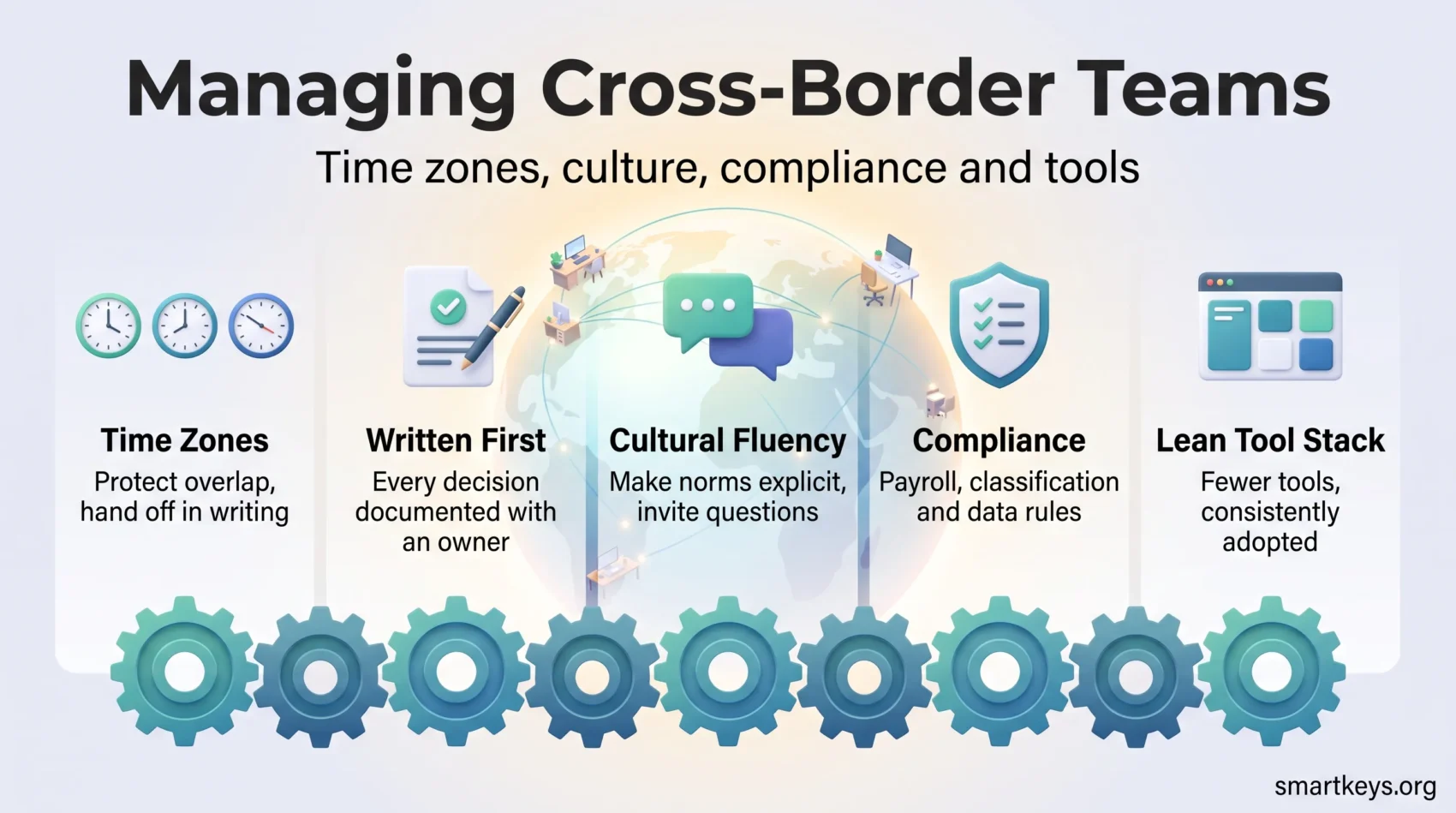
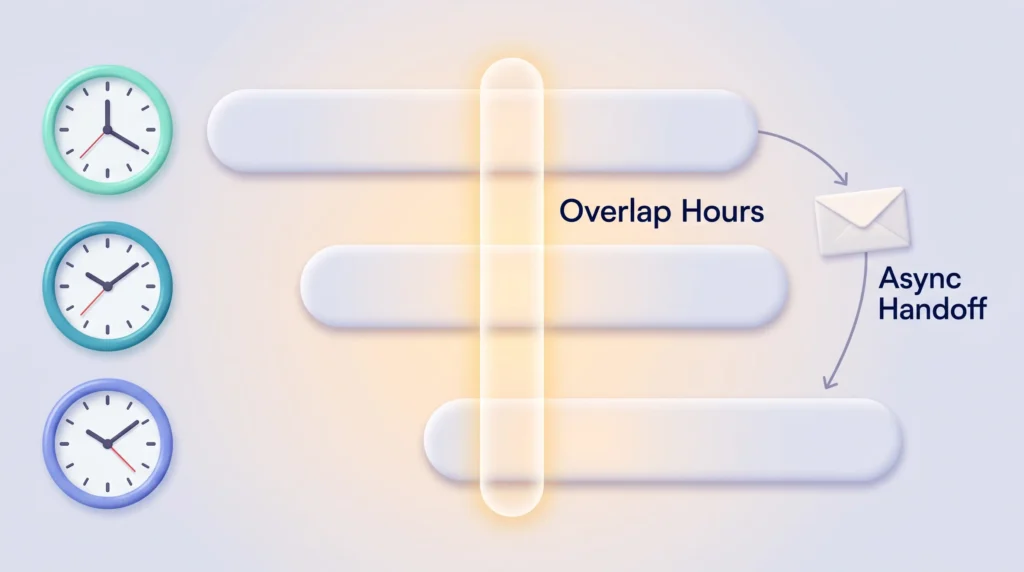
Managing cross-border teams introduces failure modes that rarely appear in a single office. Time zones are the most persistent. When overlap shrinks to an hour or two, every unanswered question costs a full day. The fix is structural: define which decisions can be made without consensus, and move status updates out of meetings entirely.
Communication style is the second challenge. Directness, hierarchy, how disagreement is voiced and how a deadline is interpreted all vary by culture. Misreadings here are usually invisible until something slips. Naming these differences openly, rather than assuming a shared default, is the cheapest intervention available.
Isolation is the third. Remote employees who lack informal contact drift from the team’s context, and Gallup’s data shows trust runs thin in both directions: only a minority of employees strongly feel their manager trusts them to be productive remotely, and managers report similar hesitancy about their remote teams. Protecting remote work and mental health is a management responsibility, not a perk.
Then there is compliance, which is where cross-border teams get genuinely expensive if ignored. Worker classification, payroll and tax registration, statutory benefits and notice periods differ everywhere. Data localization laws restrict where employee and customer data may be stored or processed. In the EU, the Pay Transparency Directive’s transposition deadline of 7 June 2026 has passed, and law firms tracking implementation report that many member states missed it, which leaves multinational employers dealing with a patchwork of national rules rather than one harmonised standard.
Security is the final layer. Cybersecurity concerns multiply when confidential material crosses borders on personal networks and unmanaged devices. Access control, device policy and clear rules on data privacy at work matter more than any single tool.
Effective Virtual Team Communication Strategies
Good virtual team communication in a distributed team is written-first. If a decision only exists in a call, half the team will learn about it late and second-hand. Writing things down is what makes low overlap survivable.
Start by separating synchronous from asynchronous work. Reserve live time for discussion that genuinely needs it (disagreement, ambiguity, relationship-building) and push everything else into asynchronous communication tools. A recorded walkthrough with a written summary usually serves a global team better than a meeting two-thirds of them attend at an awkward hour.
Make the defaults explicit. Agree response-time expectations by channel, so nobody feels obliged to be permanently online. Publish core overlap hours and treat them as protected.
Make availability visible, too. Ask everyone to block their working hours in the shared calendar and show their local time in their chat profile. A colleague in Singapore can then see at a glance that a Berlin teammate is offline, and write a complete message instead of a quick “are you there?” that waits eight hours for a reply. A shared international holiday calendar for the whole team prevents the familiar mistake of scheduling a launch through someone’s national holiday.
Where meetings are necessary, structure them. A written agenda circulated in advance, decisions recorded in the doc, and an owner for every action item make the difference between a call that saves time and one that consumes it. A structured meeting approach boosts productivity and strengthens remote team coordination. Some teams go further with silent meetings, where participants read and comment on a document before any discussion starts.
Language deserves specific attention. When most of the team works in a second language, slang, idioms and rapid-fire humour exclude people quietly. Plain phrasing, written follow-ups and real-time translation tools lower that barrier without slowing anyone down.
- Define response-time expectations for each channel
- Default to written decisions with a named owner
- Protect a small block of shared overlap hours
- Record and summarise anything one time zone will miss
- Keep language plain and free of local idiom
Tools for Remote Team Coordination
The right tools for remote team coordination reduce the number of conversations needed to get work done. The wrong ones multiply them. Before adding anything, be clear about which job it is doing: talking, tracking, storing or deciding.
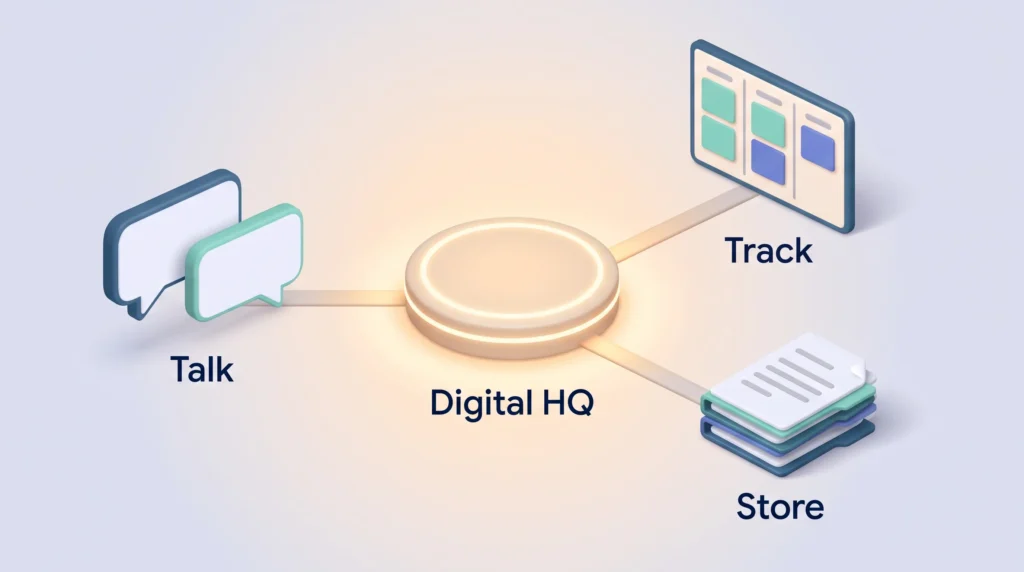
For real-time and threaded conversation, Slack and Microsoft Teams remain the default choices, with Zoom and Google Meet covering video. For work tracking, Asana, Trello, Jira, ClickUp and Monday.com all handle the basics; the differentiator is whether your team actually keeps them current. For documents and knowledge, Google Workspace, Microsoft 365, Notion and Confluence give distributed teams a single place to find the current version of anything. That shared home is the foundation of a working digital headquarters.
Beyond the core stack, a few categories earn their place in cross-border setups specifically. Automation platforms such as Zapier or Make remove the manual handoffs that stall overnight. AI collaboration tools increasingly handle meeting notes, summaries and first-draft documentation, which disproportionately helps people who missed the live conversation. And global payroll solutions or an employer-of-record arrangement let you hire compliantly in a country where you have no legal entity.
Resist the urge to add more. Tool sprawl fragments where information lives, and a distributed team pays for that fragmentation every day. A short, well-adopted stack with clear conventions (where decisions live, where files live, where tasks live) beats a longer list nobody applies consistently.
Whatever you choose, document it during onboarding. New joiners in a different time zone cannot learn conventions by watching the room, so the conventions have to be written down.
Fostering Multicultural Team Synergy
Building multicultural team synergy takes more than good intentions. It requires making the implicit explicit, repeatedly, until shared norms actually exist.
- Cultural fluency training: Practical sessions on how feedback, hierarchy and disagreement are handled in your team’s main markets.
- Open dialogue: Space for people to explain how they prefer to work and where they have felt misread.
- Active listening: Confirming understanding rather than assuming it, especially across a language gap.
- Deliberate connection: Informal time that is scheduled rather than left to chance, since corridors do not exist remotely. A virtual watercooler channel for casual chat, rotating coffee pairings or an occasional online game session all work if they stay optional.
- Occasional in-person time: Where budget allows, bring people together once or twice a year. A few days of shared work and meals build the goodwill that carries a team through months of written collaboration.
A culture of transparency does much of the heavy lifting here. When decisions, reasoning and priorities are visible to everyone, people stop filling gaps with assumptions. Cross-cultural misreadings usually start in those gaps.
To keep communication clear across cultures:
- Invite questions explicitly, since not every culture volunteers disagreement.
- Standardise where and how work is discussed, so nobody has to guess the channel.
- Avoid idiom, sports metaphors and regional shorthand.
- Confirm decisions in writing, in the same place, every time.
Done consistently, this turns diversity from a coordination cost into an advantage. Focusing on multicultural team synergy is what makes the rest of cross-border management workable.
Building Offshore Teams for Global Success
Offshore team building works when it is treated as a long-term capability rather than a cost exercise. The distinction shows up quickly: teams hired purely on price tend to churn, while teams hired for capability and supported properly compound in value.
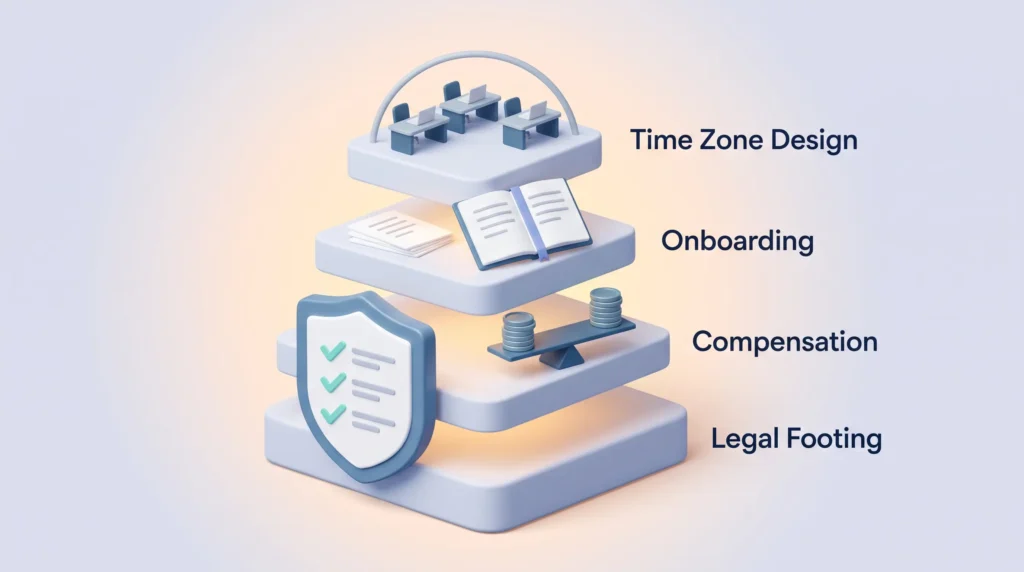
Four elements matter most when you expand into a new country.
- Legal footing: Decide early between establishing an entity, using an employer of record, or engaging contractors, and get classification right, because misclassification is the most common and most expensive mistake.
- Compensation logic: Choose a defensible approach to pay across markets and be able to explain it. Global pay parity questions surface faster in transparent, distributed teams, and EU pay transparency rules make that reasoning increasingly visible by law.
- Onboarding depth: Remote joiners need context, not just credentials. Written documentation, a named buddy and explicit early goals shorten the ramp considerably.
- Time zone design: Cluster hires so each region has enough overlap with the people they depend on. A single isolated hire twelve hours away rarely succeeds.
Leadership has to adapt too. Managing people you never see requires different habits: clearer written direction, more frequent check-ins on context rather than task status, and outcomes defined in advance. Investing in remote leadership skills tends to pay back faster than any tool purchase, and it is one of the clearest shifts shaping the future of remote work.
If you are engaging independent professionals rather than employees, the mechanics differ again: managing freelancers means being precise about scope, deliverables and payment terms across currencies. Either way, offshore expansion should follow a deliberate global expansion strategy, not opportunistic hiring.
Enhancing Distributed Team Efficiency
Improving distributed team efficiency starts with clarity about outcomes. When a manager cannot observe effort, measuring effort becomes meaningless, and attempts to do so anyway erode trust fast. Define what done looks like, agree the deadline, then get out of the way.
Set expectations in writing. Each person should know their priorities for the period, who depends on their output, and what to do when they are blocked. Blockers are the real cost of low overlap: an unresolved question at the end of one region’s day can idle another for a full working day.
Give people room to decide. Distributed teams work best when the people closest to the work can make routine calls without waiting for a manager who is asleep. This is sometimes called a decentralized setup: teams organise their own work within clear goals and are accountable for results, while leadership sets direction and handles the few decisions that truly need a central view.
Use rhythm rather than surveillance. A short written daily update, a weekly review of priorities, and a monthly look at how the team is working together give managers visibility without monitoring keystrokes. Productivity paranoia is self-defeating: it produces performative activity, not results.
Invest in connection deliberately. Informal interaction has to be scheduled when it cannot happen naturally, and sustained engagement in remote teams comes from people understanding why their work matters, not from more meetings.
Finally, review the operating model periodically. The habits that worked for eight people in two time zones will not survive thirty people in six. Distributed teams need their processes revisited as they grow, not inherited unchanged.
Protecting Work-Life Boundaries Across Time Zones
Global teams create a quiet pressure to be available around the clock. A message arrives at 10 p.m. because it is mid-morning for the sender, and replying feels polite. Repeat that every evening and it turns into burnout.

The fix is a written rule, not individual willpower. State clearly that nobody is expected to answer outside their own working hours, and that urgent issues go through a named escalation path instead of general chat. Use scheduled send so messages land at the start of the recipient’s day. Several countries now give employees a legal right to disconnect after hours, so a clear policy also keeps you on the right side of local law.
Share the pain of awkward meeting times. If one region always joins at 7 a.m. or 9 p.m., rotate the slot so the same people do not carry the cost every week. Small signals like this show that everyone’s personal time counts equally, which does more for retention than any perk.
Conclusion
Managing cross-border teams well comes down to three things: explicit expectations, communication designed for low overlap, and a compliance foundation that does not collapse when you hire in a new country. Tools help, but they cannot compensate for an operating model built for a single office.
The upside is substantial. A team assembled without geographic limits brings skills, market knowledge and coverage that a local team cannot match. That advantage is available to any organisation willing to write things down, train for cultural fluency, and take employment and data rules seriously from the start.
Start with the constraint that hurts most (usually time zones or compliance) and fix that properly before optimising anything else. Sustainable international collaboration is built one deliberate decision at a time, and the teams that do it well treat distribution as a design problem rather than a compromise.
Found this useful?
Make SmartKeys a preferred source on Google, and our articles will surface more often in your Top Stories, AI Overviews, and AI Mode.
Add as Preferred SourceFAQ
What are the main benefits of managing cross-border remote teams?
The biggest benefit is access to talent you could never reach with a local-only hiring policy, which matters most for specialised roles where domestic supply is limited. Beyond hiring, cross-border teams bring genuine market knowledge into the business: colleagues in different countries spot assumptions about pricing, language and regulation that a single-country team would miss. Teams spread across time zones can also cover a longer support window without asking anyone to work unsociable hours. Finally, offering location flexibility strengthens retention, since candidates increasingly weigh it alongside salary. These benefits appear reliably only when the operating model is designed for distribution rather than adapted from a co-located one.
What challenges come with international collaboration?
Four recur consistently. Time zone gaps turn every unanswered question into a lost day, so decision rights and asynchronous handoffs need to be defined explicitly. Cultural differences in directness, hierarchy and how disagreement is expressed cause misreadings that stay invisible until a deadline slips. Isolation affects people who lack informal contact with colleagues, and Gallup’s research shows trust is often thin in both directions between remote employees and their managers. Compliance is the fourth and most expensive if neglected, covering worker classification, payroll, statutory benefits and cross-border data rules. None of these are unsolvable, but all of them need addressing before a team scales internationally rather than after.
How do I manage time zones across a cross-border team?
Treat overlap as a scarce resource and spend it deliberately. Identify a small block of shared hours, protect it, and reserve it for conversations that genuinely need to be live: disagreement, ambiguity and relationship-building. Everything else should move to writing, with recorded walkthroughs and written summaries so nobody depends on having attended. Cluster hires regionally so each person has meaningful overlap with the colleagues they depend on daily; a single isolated hire twelve hours away rarely works out. Define clearly which decisions people can make without waiting for consensus, since that single change removes most overnight blockers. A shared holiday calendar prevents scheduling work through someone’s national holiday.
How can I improve virtual communication in a global team?
Make writing the default. If a decision exists only in a call, part of the team learns it late and without context. Agree response-time expectations per channel so nobody feels obliged to be permanently available, and record decisions in a consistent place with a named owner for each action. Structure the meetings you do keep: circulate an agenda in advance, capture outcomes in the document, and summarise for anyone who could not attend. Keep language plain, since idioms and regional shorthand quietly exclude colleagues working in a second language. Translation and transcription tools help, but clear writing habits matter more than any single piece of software.
What tools do cross-border teams actually need?
Fewer than most teams end up with. You need one place for conversation, such as Slack or Microsoft Teams, plus video via Zoom or Google Meet. You need one work tracker; Asana, Trello, Jira, ClickUp or Monday.com all work if the team keeps it current. You need one documentation home, whether that is Google Workspace, Microsoft 365, Notion or Confluence. Cross-border setups add two more categories: automation to remove manual handoffs that stall overnight, and a global payroll or employer-of-record provider for hiring where you have no legal entity. Tool sprawl is the real risk, because fragmenting where information lives costs a distributed team something every day.
What legal and compliance issues apply to cross-border teams?
Employment obligations generally follow where the person works, not where your company is registered. That means local rules on worker classification, payroll and tax registration, statutory benefits, working time and notice periods. Misclassifying an employee as a contractor is the most common and costly error. Data protection adds another layer, since rules on cross-border transfers and data localization restrict where employee and customer information may be stored or processed. Pay transparency is now a live issue in Europe: the EU Pay Transparency Directive’s transposition deadline of 7 June 2026 has passed, and legal trackers report that many member states missed it, leaving employers facing national variations. Take local advice before hiring in a new country.
How do I build multicultural team synergy?
Make norms explicit instead of assuming they are shared. Run practical cultural fluency sessions covering how feedback, hierarchy and disagreement work in your team’s main markets, and give people space to describe how they prefer to work. Invite questions directly, because not every culture volunteers disagreement without being asked. Standardise where work is discussed so nobody has to guess the right channel, and confirm decisions in writing every time. Schedule informal connection deliberately, since the incidental conversations of an office do not happen remotely, and meet in person occasionally if you can. Transparency does much of the work here: when reasoning and priorities are visible, people stop filling gaps with assumptions, and that is where most cross-cultural misreadings begin.
How do you protect work-life boundaries in a team spread across time zones?
Write down that nobody has to reply outside their own working hours, and back it up with a named escalation path for genuine emergencies. Without that rule, people in later time zones feel pushed to answer evening messages simply because the sender is in the middle of their day. Scheduled send helps, since messages then arrive at the start of the recipient’s morning. Ask everyone to show their working hours in the shared calendar and their local time in chat, so colleagues can see who is offline. Finally, rotate inconvenient meeting slots so the same region does not always join early in the morning or late at night. Some countries also give employees a legal right to disconnect, so check local rules.